Nurse Practitioner Salary in Maryland: A 2026 Guide
Explore nurse practitioner salary in Maryland for 2026, from $131k medians to metro, specialty, and telehealth breakdowns plus FIRE planning tips.

Maryland nurse practitioners earn a median annual salary of $131,110, with reported pay ranging from $99,920 at the 10th percentile to $169,330 at the 90th percentile. That median sits within 1% of the national NP median, so the key question for Baltimore and Washington-area clinicians is what remains after Maryland taxes, housing, commuting, and schedule constraints.
A headline salary can obscure the economics of a job. A Maryland offer may look stronger than a lower-cost state's offer, yet deliver less discretionary income once housing and transportation enter the calculation. The useful comparison isn't just base pay. It's after-tax purchasing power, total compensation, clinical workload, and control over your schedule.
The available wage snapshots also differ in scope. One Maryland profile reports a mean wage of $121,044, a median of $131,282, and a broad distribution from $89,725 at the 10th percentile to $156,535 at the 75th percentile; its published table describes the 90th percentile as a higher band within the same dataset (Maryland NP wage profile). A separate May 2025 federal snapshot reports a $131,110 median, or $63.03 per hour, compared with a $132,300 national median, and places Maryland pay between $99,920 and $169,330 across the 10th and 90th percentiles (May 2025 Maryland NP salary snapshot).
The 2026 Maryland NP Pay Snapshot
The cleanest starting point for evaluating nurse practitioner salary in Maryland is the median, not the mean. The federal snapshot places the Maryland median at $131,110 annually, or $63.03 per hour, while the national NP median is $132,300. Maryland therefore sits just below the national center rather than offering an obvious statewide premium (Maryland and national NP wage comparison).
The distribution matters more than the single headline. Maryland pay runs from $99,920 at the 10th percentile to $169,330 at the 90th percentile, a difference of $69,410. That spread captures differences in specialty, employer, seniority, call obligations, shift structure, and local labor markets. It also explains why two clinicians searching for “Maryland NP salary” can encounter offers that seem unrelated.
The numbers employers may frame differently
A separate Maryland labor-market profile lists an estimated employment base of 130, a mean wage of $121,044, a median wage of $131,282, and a 75th-percentile wage of $156,535 (Maryland NP labor-market profile). These figures shouldn't be blended mechanically with the federal snapshot. Different releases and methodologies can produce different employment and wage estimates.
| Metric | Maryland | United States | Maryland vs. National |
|---|---|---|---|
| Median annual wage | $131,110 | $132,300 | Slightly lower |
| Median hourly wage | $63.03 | Not provided | Not directly comparable |
| 10th percentile | $99,920 | Not provided | Not directly comparable |
| 90th percentile | $169,330 | Not provided | Not directly comparable |
The practical conclusion is narrow but important. Maryland's median pay is competitive nationally, but cost exposure near Baltimore and D.C. can determine whether that competitiveness survives outside the offer letter. Use the state-by-state NP salary benchmarks to establish a market baseline, then evaluate the specific metro, specialty, and schedule rather than treating the statewide median as a guaranteed rate.
Practical rule: A Maryland offer at the median is a reference point, not proof that the role is financially superior.
How Experience Moves the Maryland NP Pay Curve
The Maryland pay curve is wide, but it isn't infinitely elastic. The lower end begins near $99,920, while the upper end reaches $169,330 in the federal snapshot (Maryland NP percentile data). Those endpoints are better understood as compensation environments than as automatic rewards for years worked.
A new graduate in primary care, community health, or a tightly budgeted outpatient practice may encounter an offer near the lower percentile. That doesn't mean the role is defective. It may reflect structured supervision, a smaller panel, loan-repayment eligibility, or limited specialty complexity. The problem arises when an employer offers lower-percentile pay while assigning independent throughput, inbox management, teaching, and uncompensated administrative work.
Reading percentiles as career transitions
The middle of the curve is where many clinicians spend the most time. The Maryland profile reports a 25th-percentile wage of $119,660, while the federal snapshot places the median at $131,110 (Maryland NP wage profile). An early-career NP who has developed specialty competence, completed credentialing, and can manage a panel independently should compare an offer with that middle band, not with a new-graduate floor.
The upper quartile is a different job design. The Maryland profile reports $156,535 at the 75th percentile, and the federal snapshot reports $169,330 at the 90th percentile (Maryland NP percentile data). At those levels, employers generally need to compensate for scarce expertise, lead responsibilities, hospital coverage, procedural work, or a schedule that others won't accept.
| Experience tier | Typical years | Salary range | Common settings |
|---|---|---|---|
| Entry market | Not specified | Near $99,920 | Primary care and community settings |
| Developing clinician | Not specified | Around the lower-to-middle percentiles | Outpatient groups and specialty clinics |
| Established clinician | Not specified | Around the median to upper quartile | Specialty practices and hospital services |
| Senior or lead role | Not specified | Toward $156,535 to $169,330 | Leadership, advanced specialty, and system roles |
The data supports a negotiation principle: experience alone doesn't set pay. Scope, scarcity, and schedule burden determine whether an employer has a reason to move you toward the upper curve.
Specialty Pay Differentials Across Maryland
Specialty-level Maryland figures aren't established in the verified wage data, so a precise statewide pay band for family practice, psychiatric mental health, adult-gerontology acute care, or surgical subspecialties would overstate what can be proven. The defensible conclusion is that specialty changes negotiating power, but the statewide median can't tell you how much a particular specialty should command.
Family practice is the most useful benchmark because it often resembles the broad outpatient NP market. Compare the actual offer with the Maryland median of $131,110, then adjust for panel size, visit expectations, inbox coverage, same-day access, and whether the employer pays for administrative time (Maryland NP salary snapshot). A lower base can be rational if the schedule is protected. It isn't rational if the role combines a lower-percentile salary with physician-level availability expectations.
Scarcity is leverage, not a guaranteed premium
Psychiatric mental health, acute care, and surgical NPs may encounter stronger demand in some Maryland markets, but demand pressure doesn't create a universal salary number. Ask employers to identify the operational problem behind the role. Is the position difficult to staff because of call? Is it tied to inpatient coverage? Does it require first-assist expertise, weekend work, or rapid credentialing?
| Specialty | Maryland base range | Premium vs. median | Demand driver |
|---|---|---|---|
| Family practice | Establish against the statewide median | Must be verified by offer | Broad outpatient demand |
| Psychiatric mental health | Employer-specific | Must be verified by offer | Behavioral-health access needs |
| Adult-gerontology acute care | Employer-specific | Must be verified by offer | Inpatient coverage and shift structure |
| Surgical subspecialty | Employer-specific | Must be verified by offer | Procedural expertise and coverage burden |
The Maryland NP salary market map can help frame local comparisons, but clinicians should still request the compensation formula in writing. Base salary, productivity incentives, shift differentials, call pay, and quality bonuses may sit in separate documents.
A specialty label doesn't justify a premium by itself. The premium belongs to the scarce responsibility attached to the role.
Metro Versus Rural Pay Across Maryland
Maryland's statewide median compresses distinct labor markets into one number. A clinician near Bethesda or Silver Spring may face a different housing decision, commute, and employer mix than someone evaluating Hagerstown, Western Maryland, or the Eastern Shore. Without verified metro-specific wage and housing figures, the responsible analysis is qualitative rather than fabricated precision.
The central trade-off is straightforward. Urban employers may offer stronger nominal compensation and denser specialty opportunities, while rural employers may reduce housing pressure and offer incentives tied to access needs. A lower rural salary can therefore produce more usable cash flow if the clinician avoids a costly commute or high-rent market.
Housing can reverse the apparent ranking
An offer near Washington, D.C. should be evaluated as a household decision, not just a labor-market decision. Ask whether the role requires living close to the facility, whether parking is included, how many commuting days are mandatory, and whether telehealth can remove part of the travel burden. The same base salary can support very different savings rates depending on those constraints.
Baltimore introduces a similar split. A role in a major health system may provide specialty exposure, academic resources, and a clearer path to leadership. A smaller-market role may offer less institutional prestige but more control over patient volume, call, and clinic design. For FIRE planning, those operating conditions matter because a predictable schedule can make secondary clinical work, family care, and consistent investing easier.
| Area | Median annual wage | 75th percentile | 90th percentile | Housing cost index vs. U.S. average |
|---|---|---|---|---|
| Baltimore area | Not verified | Not verified | Not verified | Not verified |
| Washington metro, Maryland portion | Not verified | Not verified | Not verified | Not verified |
| Southern Maryland | Not verified | Not verified | Not verified | Not verified |
| Western Maryland | Not verified | Not verified | Not verified | Not verified |
| Eastern Shore rural areas | Not verified | Not verified | Not verified | Not verified |
Use regional comparisons only when the source defines the geography and methodology clearly. Job-board salaries can include overtime, bonuses, or self-reported totals, which makes them poor substitutes for a wage survey. For an offer decision, calculate annual base, guaranteed differentials, expected variable pay, commuting cost, and housing requirement separately.
Total Compensation Beyond Base Salary
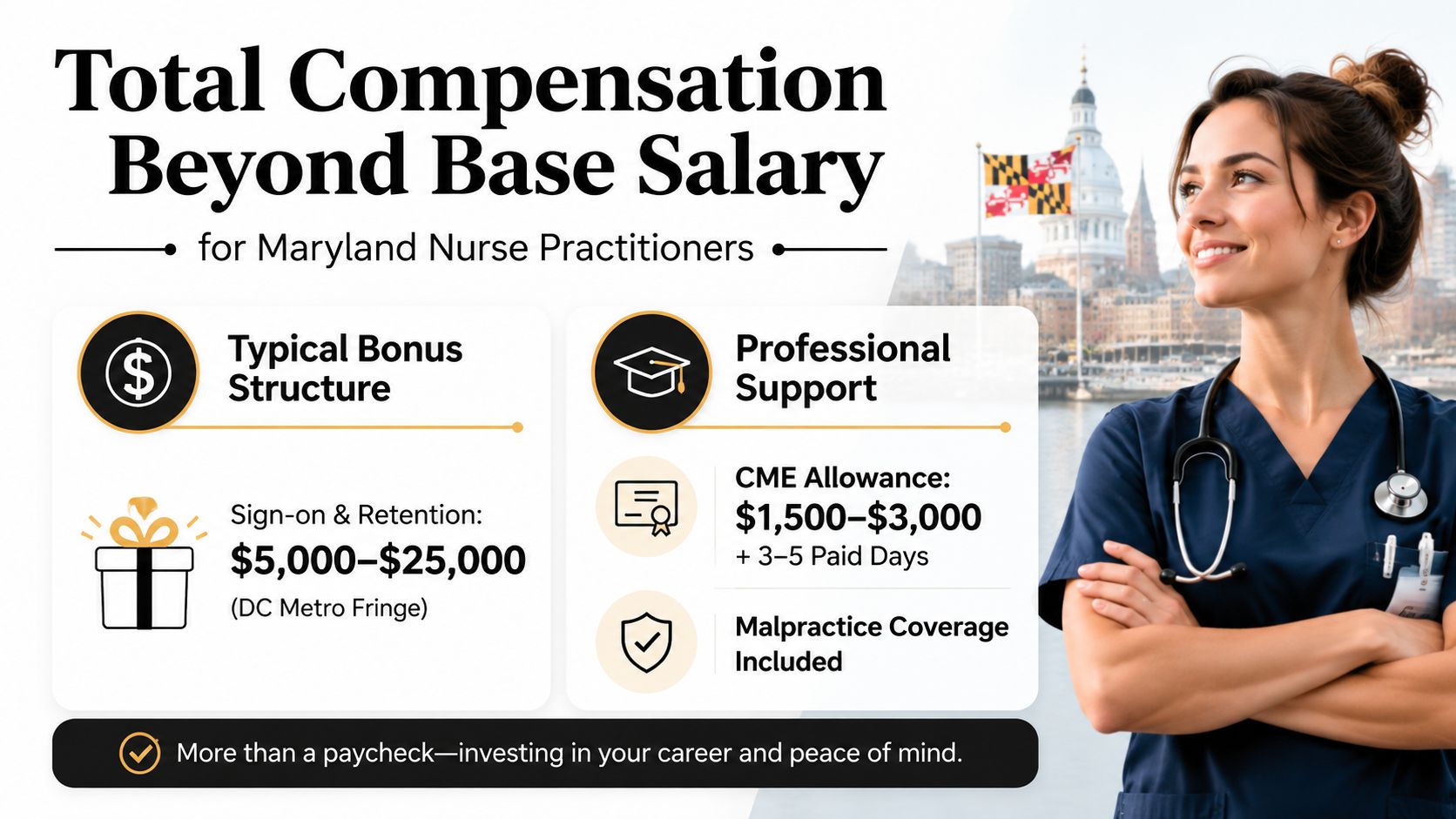
Base salary is only one component of a Maryland NP offer. The verified data doesn't establish a statewide norm for bonuses, CME, retirement matching, malpractice coverage, loan repayment, or paid leave, so candidates should treat each benefit as a contract term to verify rather than assume.
The most valuable benefits often reduce personal financial risk. Employer-paid malpractice coverage, tail coverage, licensing and credentialing expenses, retirement contributions, health insurance, paid leave, and CME support can make a lower base more competitive. The value also depends on whether the benefit is guaranteed, discretionary, vested immediately, or subject to a repayment clause.
Build the package line by line
A sign-on payment isn't equivalent to recurring salary if the employer can claw it back after a short departure period. A retirement match isn't equivalent to cash if vesting rules restrict access. CME money has little practical value if the schedule makes attendance impossible.
Review these terms in a fixed order:
- Guaranteed cash: Separate base salary from sign-on, retention, productivity, and shift payments.
- Professional protection: Confirm malpractice limits, tail responsibility, license fees, DEA fees, and credentialing costs.
- Time value: Count paid CME days, administrative time, vacation, holidays, and protected inbox hours.
- Long-term benefits: Examine retirement contributions, vesting, health premiums, and student-loan support.
- Exit terms: Check repayment obligations, notice periods, restrictive covenants, and termination language.
The strongest offer isn't necessarily the one with the highest advertised salary. It's the one that pays fairly for clinical responsibility while preventing the clinician from personally absorbing predictable employment costs.
Cost of Living and the Real Maryland Pay Picture
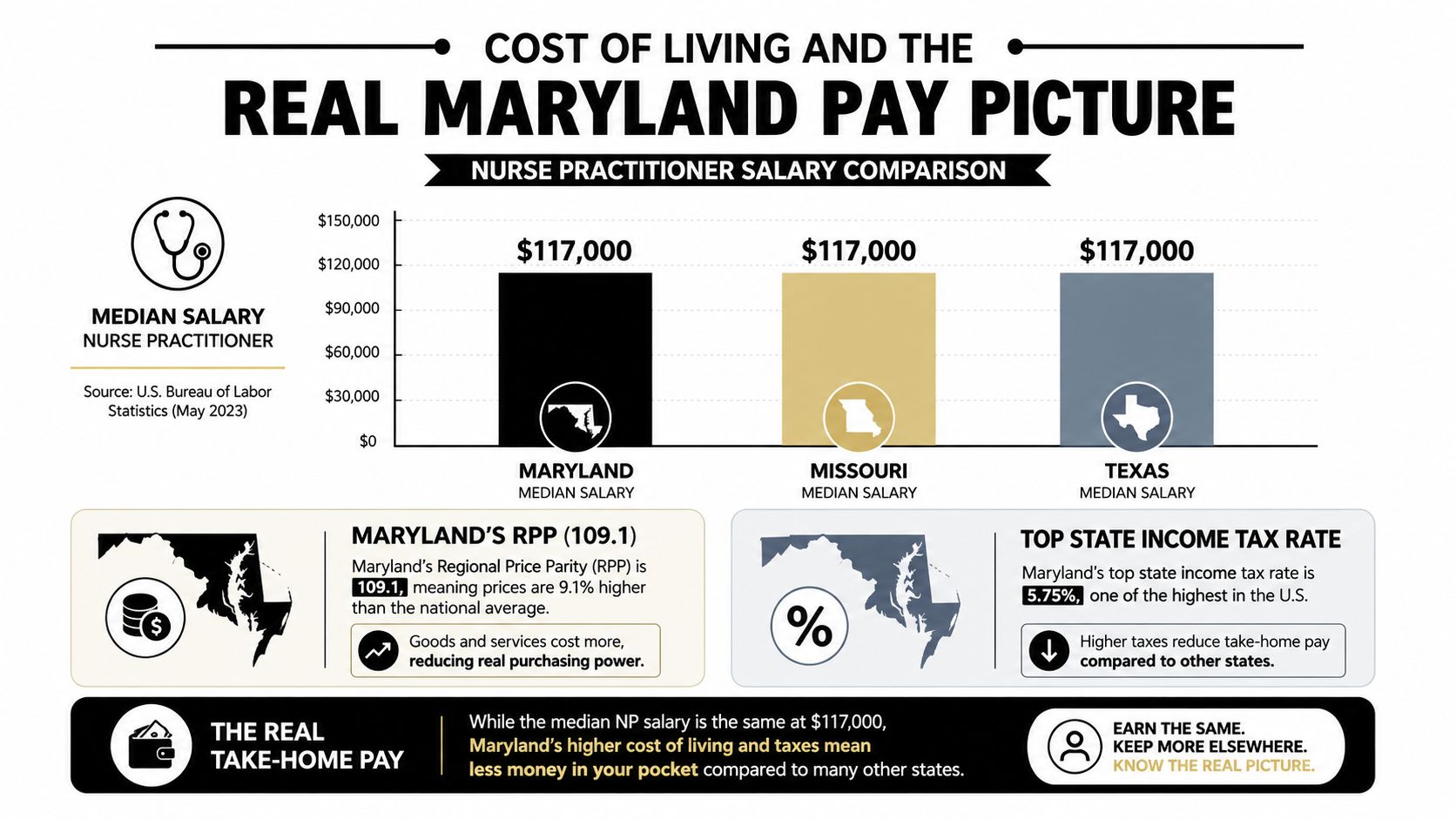
Maryland's $131,110 median NP salary sits close to the national median, so a clinician shouldn't assume the state compensates for its expensive metro areas (Maryland NP salary snapshot). The verified data specifically identifies a gap in existing coverage: salary pages often stop at gross pay and don't connect the number to household budgets near Baltimore or Washington, D.C.
That omission changes the decision. A Tennessee or Texas offer with a lower nominal salary may leave more money available for housing, transportation, and savings. Conversely, a Maryland role may still win if it eliminates a long commute, offers remote work, provides superior benefits, or places the clinician near family support.
Don't confuse gross pay with financial advantage
Maryland has state and local income-tax exposure, and the exact burden depends on filing status, taxable income, deductions, county, and household structure. Without a complete tax profile, precise take-home calculations would be false precision. The same caution applies to regional purchasing-power adjustments. Housing, utilities, childcare, transportation, and insurance can vary sharply within the state.
Run three budgets before accepting an offer:
- Resident budget: Include rent or mortgage, parking, commuting, utilities, insurance, and local taxes.
- Workload budget: Price unpaid charting, call recovery, weekend coverage, and time spent commuting.
- Savings budget: Calculate what remains after recurring expenses, then apply that amount consistently rather than using a gross-salary percentage.
Remote telehealth can change the comparison if the employer permits the clinician to live outside Maryland while being paid under a Maryland-linked contract. Licensing, tax nexus, malpractice, and employer policy still require review. The qualitative takeaway is clear: location flexibility can be worth more than a modest base-salary increase when it reduces fixed household costs without increasing clinical burden.
FIRE Projections from a Maryland NP Salary
FIRE planning requires two inputs that salary articles usually separate: annual spending and investable income. The Maryland wage curve supplies a useful income range, from $99,920 to $169,330, with a median of $131,110 (Maryland NP wage snapshot). It doesn't, by itself, determine a retirement date.
The common FIRE shortcut is an expense multiple. A target based on 25 times annual spending is more aggressive than one based on 33 times annual spending, because the latter assumes a larger portfolio relative to planned withdrawals. Those are planning assumptions, not promises, and they should be tested against taxes, dependents, healthcare, and geographic moves.
Work from spending outward
At a spending level of $60,000, the target is $1.5 million at 25 times expenses or $1.98 million at 33 times expenses. At $85,000, those targets become $2.125 million and $2.805 million. At $120,000, they become $3 million and $3.96 million.
| Spending tier | Take-home pay | Savings rate | Annual savings | FIRE target at 25x | Years to FIRE |
|---|---|---|---|---|---|
| $60,000 | Must be calculated from personal tax profile | 15% | Must be calculated | $1.5 million | Must be modeled |
| $85,000 | Must be calculated from personal tax profile | 25% | Must be calculated | $2.125 million | Must be modeled |
| $120,000 | Must be calculated from personal tax profile | 35% | Must be calculated | $3 million | Must be modeled |
A clinician earning near the median may reach financial independence faster by controlling expenses than by chasing a nominally higher role that adds call, commuting, or unpaid work. A senior offer near the upper percentile can accelerate investing, but only if the added income survives taxes and lifestyle inflation.
The relevant salary is the amount you can invest repeatedly without damaging your health or your household.
Use a personal model that distinguishes base salary from bonuses and benefits. Count only recurring, reliable compensation toward fixed savings commitments. Treat sign-on payments as one-time capital, not as evidence that the job's annual economics are stronger.
Negotiation and Job Search Strategy for Maryland NPs
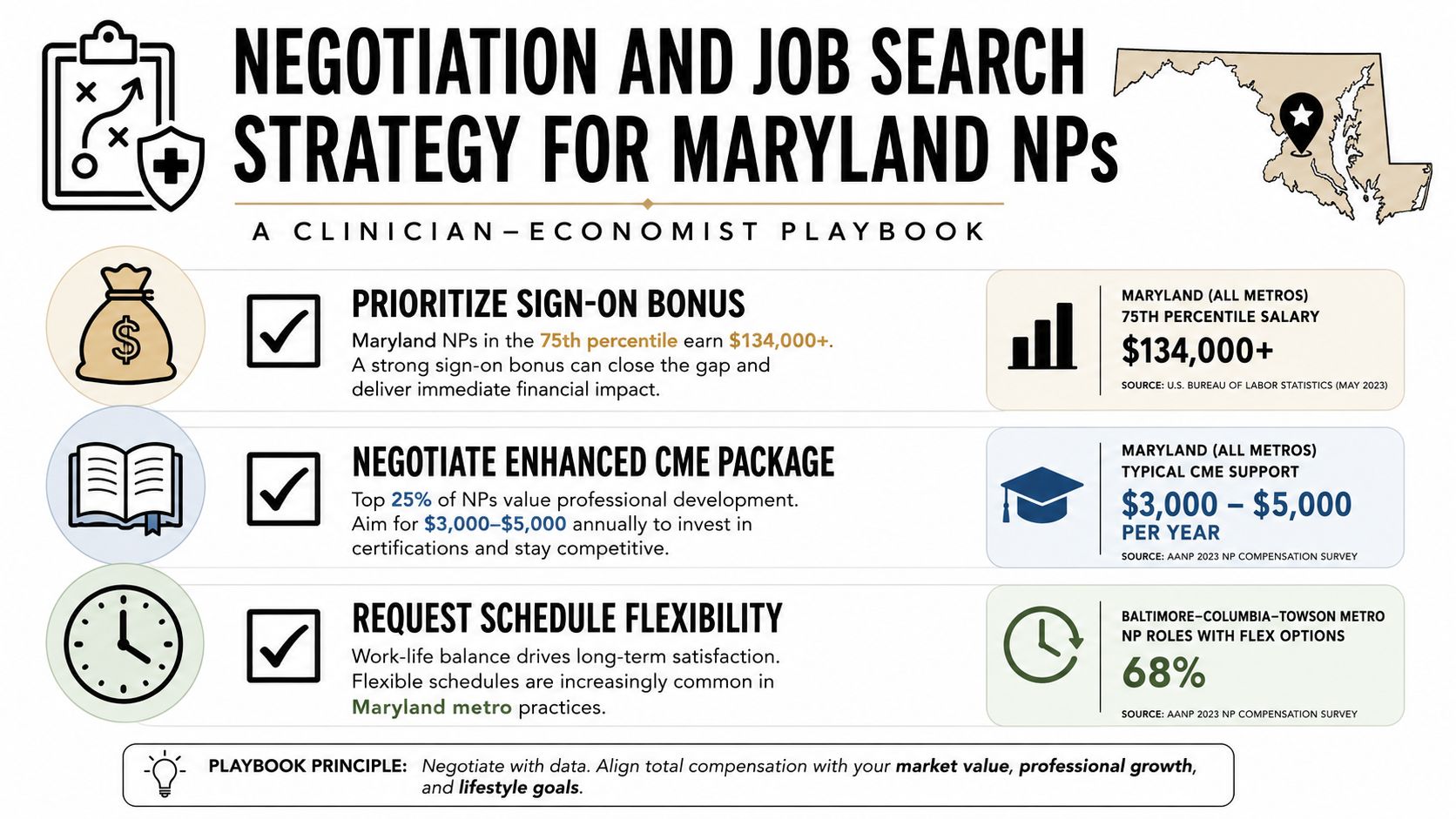
A Maryland NP offer should be negotiated against the wage curve and the job's actual burden. If the base sits near the median, ask what responsibility, autonomy, productivity expectations, and schedule justify that position. If the role demands specialty scarcity, inpatient coverage, procedures, or leadership, the employer should explain how those demands appear in base pay or guaranteed additional compensation.
Prioritize terms that improve both cash flow and sustainability:
- Base position: Identify whether the salary is near the lower, middle, or upper Maryland percentile.
- Schedule control: Request fixed weekdays, protected administrative time, and clearly defined telehealth blocks.
- Bonus mechanics: Require written formulas, payment dates, eligibility conditions, and clawback terms.
- Professional costs: Ask the employer to cover licensing, credentialing, malpractice, tail, and CME expenses.
- Workload limits: Negotiate panel size, visit length, inbox expectations, call frequency, and coverage rules.
- Exit rights: Review restrictive covenants, notice periods, termination provisions, and repayment obligations.
Use a precise counteroffer
A direct script is more effective than a general request for “better compensation”:
“The proposed base places this role near the Maryland market midpoint. Given the specialty scope and the required schedule, I'd like to revise the offer through a higher base, a guaranteed sign-on payment without an extended clawback, or protected administrative time with a defined telehealth schedule.”
The contract matters as much as the number. Pay particular attention to restrictive-covenant language around large systems, including Johns Hopkins, the University of Maryland Medical System, and MedStar. The geographic radius, duration, covered services, and post-employment restrictions can affect your next move more than a modest starting bonus.
For a deeper contract-focused framework, use these salary negotiation tactics for clinicians. The Maryland job-search funnel should be simple:
- Filter roles by specialty, geography, remote access, call, and weekend requirements.
- Remove postings that omit compensation structure or workload expectations.
- Compare remaining offers by guaranteed annual value and schedule control.
- Have an attorney review restrictive covenants and repayment clauses.
- Negotiate the two terms most likely to affect your long-term health and savings rate.
A Maryland NP must also satisfy the state's credentialing requirements. The regulation requires a current Maryland RN license or multistate RN privilege, graduation from a Board-approved accredited graduate NP program at the master's level or higher, current national certification in each specialty area sought, and compliance with Board application and fee requirements (Maryland NP certification regulation).
WeekdayDoc offers curated remote, hybrid, and in-person clinician roles with salary information, burnout-oriented work-style markers, and state-level FIRE projections. Visit WeekdayDoc to compare Maryland NP opportunities by specialty, schedule, and work setting, then use the contract and salary tools to evaluate the full offer before you sign.