How to Calculate Take Home Salary for Clinicians
Learn how to calculate take home salary step by step, from gross pay to federal taxes, FICA, and state deductions, with real clinician examples.

You can earn $300,000 on paper and still feel short on cash every month if the offer leans on pretax benefits, a big retirement deferral, or state withholding you didn't model. That gap matters most for clinicians, because the job you're choosing isn't just a salary, it's a schedule, a burnout risk, and a lifestyle decision that has to survive real deposits, not recruiter math.
Gross pay is the headline number in the offer letter. Net pay, or take-home salary, is what lands in your account after taxes and deductions. For clinicians comparing roles, that difference can decide whether a “great” job funds savings, student debt, family expenses, and FIRE goals, or just sounds good in a compensation meeting.
Why Take Home Salary Matters More Than Gross for Clinicians
A recruiter can quote $250,000, but that number still leaves out the part that determines your real life, the deposit. A heavier pretax benefit load, a different state withholding setup, or a pay cycle that spreads cash more thinly can make two offers feel very different once payroll runs. For clinicians weighing burnout-friendly roles, how to calculate take home salary is not a side skill, it is part of deciding whether the job supports your savings rate, family expenses, and FIRE plan.
Clinician offers also tend to be bundled in ways that hide the true cash picture. Base salary may sit next to RVU bonuses, shift differentials, call pay, retention bonuses, and benefit elections, all of which affect the paycheck differently. A role that looks stronger on paper can end up weaker after payroll applies the deductions that matter most to your monthly budget.
Gross salary is the amount before taxes and deductions. Net salary is the amount deposited after those items come out. In the standard U.S. payroll framework, FICA is 7.65% of wages, made up of 6.2% Social Security and 1.45% Medicare (Fool). That gap appears before federal income tax and benefit elections even enter the picture, which is why gross and net separate so quickly.
Practical rule: If two jobs have similar gross pay, compare the deposit amount, not the offer letter, before you decide which one fits your life.
That shift in thinking matters when the schedule is part of the compensation. A no-call role can be worth a slightly lower gross salary if the take-home still covers housing, debt payments, and the savings rate you need to stay on track. WeekdayDoc's model is built around that question, because the right job has to work in your account and in your calendar.
The Deductions That Sit Between Gross and Net
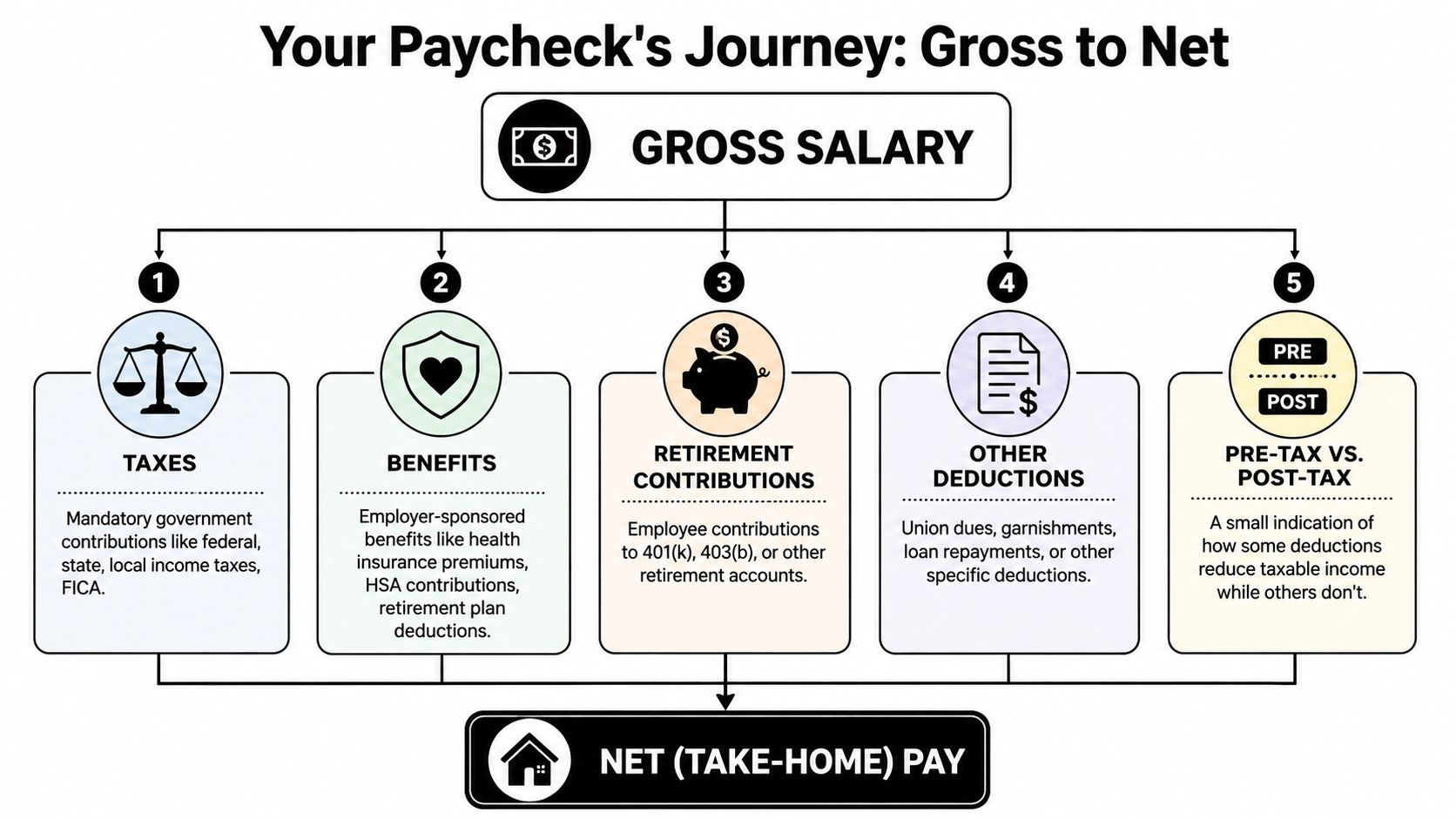
A clinician can read an offer letter and still miss what matters most, the amount that reaches the bank account. Gross pay looks clean on paper, but payroll turns that number into net pay by pulling out taxes, benefit elections, and other deductions before the deposit lands. For anyone comparing burnout-friendly jobs, or testing whether a role fits a FIRE target, that difference changes the answer fast.
The cleanest way to sort a pay stub is to separate items that reduce taxable wages from items that only reduce the final deposit. Pre-tax deductions shrink the base used for some taxes. Post-tax deductions do not. Once those lines blur together, a seemingly strong salary can look much weaker after payroll has done its work.
The usual deduction stack starts with federal income tax withholding, then state and local income tax where applicable, then FICA payroll taxes. In the standard U.S. payroll setup, the baseline FICA rate is still 7.65% of wages, and that payroll-tax starting point shows up in calculators and paycheck explanations (DigitalCalculator). Many clinicians also see pretax benefit lines, such as health insurance premiums, HSA or FSA elections, and retirement plan deferrals, before the paycheck is finalized.
What lowers taxable income and what doesn't
Pre-tax deductions usually come out before taxes are calculated. A traditional 401(k), 403(b), or eligible health premium can reduce the taxable wage base even when gross salary stays the same. Post-tax deductions come out after withholding and do not lower tax liability. Common examples include Roth contributions, union dues, wage garnishments, and certain after-tax benefit payments.
For a plain-language explanation of one of those post-tax items, WeekdayDoc's resource on how wage garnishment reduces take-home pay is a useful reference because garnishments sit on the wrong side of the paycheck for many clinicians. If the offer is built around locums work, moonlighting, or another mixed arrangement, independent contractor status guide helps explain why payroll treatment changes and why the deposit can differ from a W-2 role.
A pay stub is easier to read when you stop asking, “Why is this so low?” and start asking, “Which lines reduced taxable income, and which lines only reduced the deposit?”
That distinction matters when a contract says “benefits included.” Those costs usually show up before the money hits your account, and they can shape whether the job supports housing, debt paydown, and the savings rate you need for your next move. Gross salary is the headline. Net pay is the number that decides whether the role fits your life.
Federal Tax and FICA Math Step by Step
A clinician looking at a $250,000 offer can still be surprised by the deposit, because gross pay and take-home pay are separated by more than one layer of withholding. FICA is one layer. Federal withholding is another. Pretax deductions can shrink the wage base before either of those gets calculated, so the order changes the result.
Start with gross pay, then work through the payroll sequence. If there are no pretax deductions, FICA is commonly estimated at 7.65% of wages. On a $250,000 salary, that works out to $19,125 before federal income tax, retirement deferrals, health premiums, or state taxes. Real payroll systems do not apply that shortcut evenly across all wages, because Social Security is capped while Medicare continues to apply to wages.
The simple payroll order
- Start with gross wages.
- Subtract pretax deductions such as eligible retirement contributions or health premiums.
- Apply FICA to the appropriate wage base.
- Apply federal withholding using W-4 details and payroll tables.
- Subtract state, local, and post-tax deductions to reach net pay.
That sequence explains why two clinicians can hear the same salary quote and still see different deposits. Filing status, a spouse's income, children, and W-4 choices can all change withholding even when the final tax bill lands in a similar range. Payroll systems are built to withhold through the year, not to make an offer sound cleaner in an interview. That is also why salary planning for burnout-sensitive roles has to include the paycheck, not just the contract headline, especially if you are comparing savings rate and FIRE targets against the hours you are willing to work.
| FICA Breakdown on a $250,000 Clinician Salary | |||
|---|---|---|---|
| Component | Rate | Applied To | Annual Amount |
| Social Security | 6.2% | Gross wages in the standard benchmark | $15,500 |
| Medicare | 1.45% | Gross wages in the standard benchmark | $3,625 |
| Total FICA | 7.65% | Gross wages in the standard benchmark | $19,125 |
Higher earners should also think about supplemental pay, because bonuses and other extra compensation can change the size of each paycheck even when the annual offer looks stable. If you want a broader lens on how compensation structure affects what an employer can and cannot shift onto payroll, HireAccountants' reduce business tax liability tips gives useful context on the employer side of those choices. Clinicians rarely control those levers, but they still feel the result in net pay.
How Pay Frequency Changes the Same Salary
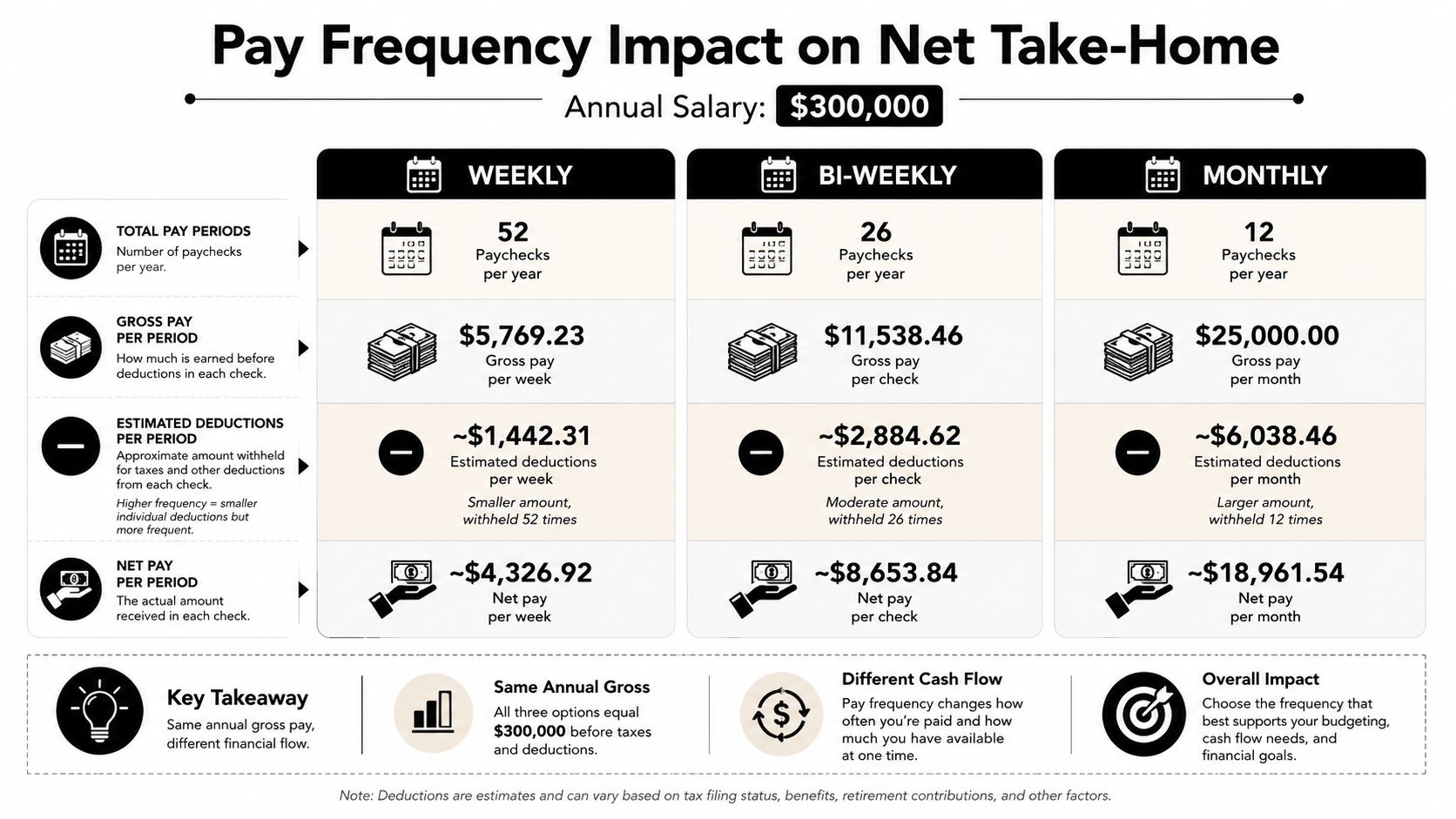
Two offers can carry the same annual salary and still feel very different in real life because the deposit schedule changes the rhythm of your cash flow. A monthly paycheck forces more planning. A biweekly or weekly paycheck gives you more frequent deposits, which can make it easier to cover loan payments, childcare, and savings transfers without waiting for the end of the month. That difference matters when you are comparing burnout-friendly roles and trying to see how quickly a salary can support your spending plan and FIRE target.
The usual pay-frequency split matters because salary calculators often estimate take-home by dividing annual pay by 12 for monthly or by 26 for biweekly. That is a useful planning shortcut, but payroll withholding is still calculated per period. The same annual salary can therefore produce checks that look and feel different depending on how often you are paid.
Why the deposit feels different
A clinician paid weekly sees smaller individual checks, but more of them. A monthly-paid clinician sees larger checks, but fewer chances to absorb a surprise expense before the next payroll run. Semi-monthly payroll often lands in the middle, yet it can still be awkward for budgeting because due dates do not always line up with deposit dates. That is why the practical affordability of a role can shift even when the annual number does not.
For clinician contracts, the question is not only “What is the salary?” It is also “How often do I get paid, and what comes out of each paycheck?” If you are comparing jobs with bonuses or delayed start dates, the timing of those deposits can change how a role supports rent, tuition, or debt service in the first few months.
Budgeting rule: Match your fixed bills to the smallest likely deposit cadence, not the best-case paycheck.
That is the safest way to avoid overcommitting before the first real payroll runs. It is also the cleanest way to compare two otherwise similar offers when one pays more often and one pays less often.
Worked Examples for Common Clinician Scenarios
A real-world offer becomes easier to judge once you push it through a full paycheck stack. A hospitalist MD with a $290,000 base, a 10% 403(b) contribution, and family health coverage will see a meaningfully different deposit than a remote psychiatric NP with a smaller gross salary but stronger pretax planning. The headline number doesn't tell you which one is more useful for FIRE.
The hospitalist example is usually the better stress test because the gross looks large enough to hide expensive deductions. A 10% 403(b) contribution on $290,000 is $29,000 going out before tax math even starts, and family health coverage cuts further into take-home. If the role is in a no-income-tax state, that helps, but it doesn't erase federal withholding, FICA, or benefit costs. The paycheck can still look a lot smaller than the recruiter's quote.
Two clinician offer types, two very different deposits
A remote psychiatric NP earning $165,000 on a W-2 has a different structure. The salary is lower, but a partial 401(k) match, family HSA contributions, and a state income tax all shape the final deposit. Job evaluation becomes practical, because a role with better flexibility can still support long-term goals if the net number clears your spending floor.
WeekdayDoc's NP average salary page is useful here because compensation benchmarking only helps when it's paired with take-home math. Gross salary by itself doesn't tell a clinician whether a job can fund a lower-stress life, build emergency savings, or keep FIRE on track.
| Scenario | Gross Salary | Major Deductions to Model | What It Means |
|---|---|---|---|
| Hospitalist MD | $290,000 | 403(b), family health coverage, federal withholding, FICA | Higher gross, but benefits and pretax elections can cut the deposit sharply |
| Remote psychiatric NP | $165,000 | 401(k) match, HSA, state tax, federal withholding, FICA | Lower gross, but flexibility can still make the role attractive if the net fits the budget |
The right question isn't which offer has the bigger number. It's which role leaves enough cash flow after withholding to support the life you want, including loan payoff, savings, and protected time off.
Variable Pay and Cross-State Offers
Many paycheck tools still assume a fixed salary in one state, which is exactly where clinician compensation gets messy. Bonuses, shift differentials, call pay, and mixed hourly-salaried arrangements change take-home pay in ways a clean annual salary quote can't capture. Add a cross-state job search, and the gap between offer language and actual deposits gets wider.
Variable compensation is the first trap. A bonus paid in one period can make withholding look higher than the rest of the year, even when the annual total is fine. That doesn't mean you're losing money, it means payroll is withholding against a different payment type. Clinicians who get sign-on bonuses or irregular premium shifts should model the year, not just the first check.
What to ask before you assume the offer is accurate
- Is this role fixed or variable? A base salary with bonus potential behaves differently from a pure salary.
- Which state's rules apply? A job in one state and a residence in another can change withholding and filing needs.
- Are deductions per paycheck or annualized? Health premiums and retirement deferrals can be spread differently by employer.
- Does the W-4 reflect your actual household? Filing status and withholding settings can change the deposit materially.
Cross-state offers deserve special caution because state and provincial tax treatment varies, and even same-salary roles can land very differently in the account depending on jurisdiction. That issue shows up for mobile clinicians, telehealth providers, and anyone comparing relocation options. For broader cross-border comparison, a calculator like mytakehome.co.uk reflects the same core problem across jurisdictions, namely that gross pay means different things once local payroll rules enter the picture.
The main point is simple. A number on an offer letter is not a paycheck. If the role includes bonuses, call, or a different work state from home state, model the deposit before you sign.
Plugging Your Numbers Into WeekdayDoc's Salary and FIRE Tools
Once you know your take-home number, the next step is to test whether the job matches your life plan. That means checking it against savings goals, debt payoff, and the work schedule you can sustain. WeekdayDoc's salary calculator pro is built for that kind of comparison, especially when you want to pair pay with burnout-friendly filters and FIRE projections.
The practical move is to use your net pay, not gross salary, as the input for decision-making. A role with lower gross pay can still be the better choice if it protects your time, lowers burnout, and leaves enough after-tax cash to keep investing. That's the point where compensation stops being theoretical and starts affecting the life you can maintain.

WeekdayDoc ties salary data to FIRE projections by state, so clinicians can compare a high-gross, high-stress role against a more sustainable alternative. That's the right way to think about compensation when you care about both money and longevity in practice.
If you're comparing clinician jobs right now, run the gross, deductions, and net numbers before you judge the offer. Then use WeekdayDoc to compare burnout-friendly roles, salary data, and FIRE projections side by side so you can choose the job that fits your budget and your life.