Telehealth Nurse Practitioner Salary The Ultimate 2026 Guide
Explore our 2026 guide to telehealth nurse practitioner salary trends. Discover key pay factors, state data, and how to negotiate a top remote NP salary.

A competitive telehealth nurse practitioner salary is definitely within reach, with the national average hitting a strong $165,094 annually in 2026. That works out to about $79.37 per hour, making a pretty compelling case for clinicians looking for roles that actually respect their work-life balance.
Your 2026 Telehealth NP Salary Guide
Trying to figure out telehealth compensation can feel like navigating a maze. But getting a handle on the numbers is the first step toward building a career that’s not just rewarding, but sustainable.
A telehealth NP salary isn't one static number. It's a range, and that range is shaped by your experience, where you practice, and the current demand. For a lot of clinicians, these remote positions are the perfect antidote to burnout—offering real financial stability without the constant grind of on-call duties or mandatory weekend shifts.
This guide is here to cut through the noise. At WeekdayDoc, our mission is simple: we connect great clinicians like you with burnout-friendly jobs. We zero in on roles that protect your time—no call, no weekends, no nights—so you can finally have a career and a life.
A Snapshot of National Salary Benchmarks
Let's ground this conversation in some hard data. As of February 2026, the pay landscape for telehealth nurse practitioners is looking pretty bright.
Top earners are pulling in as much as $180,000 annually, while even the 25th percentile starts at a solid $108,000. This shows that even if you're earlier in your career, you can still secure a substantial income in a remote role.
The chart below gives you a quick visual of how these salaries break down, from entry-level to the top of the pay scale.
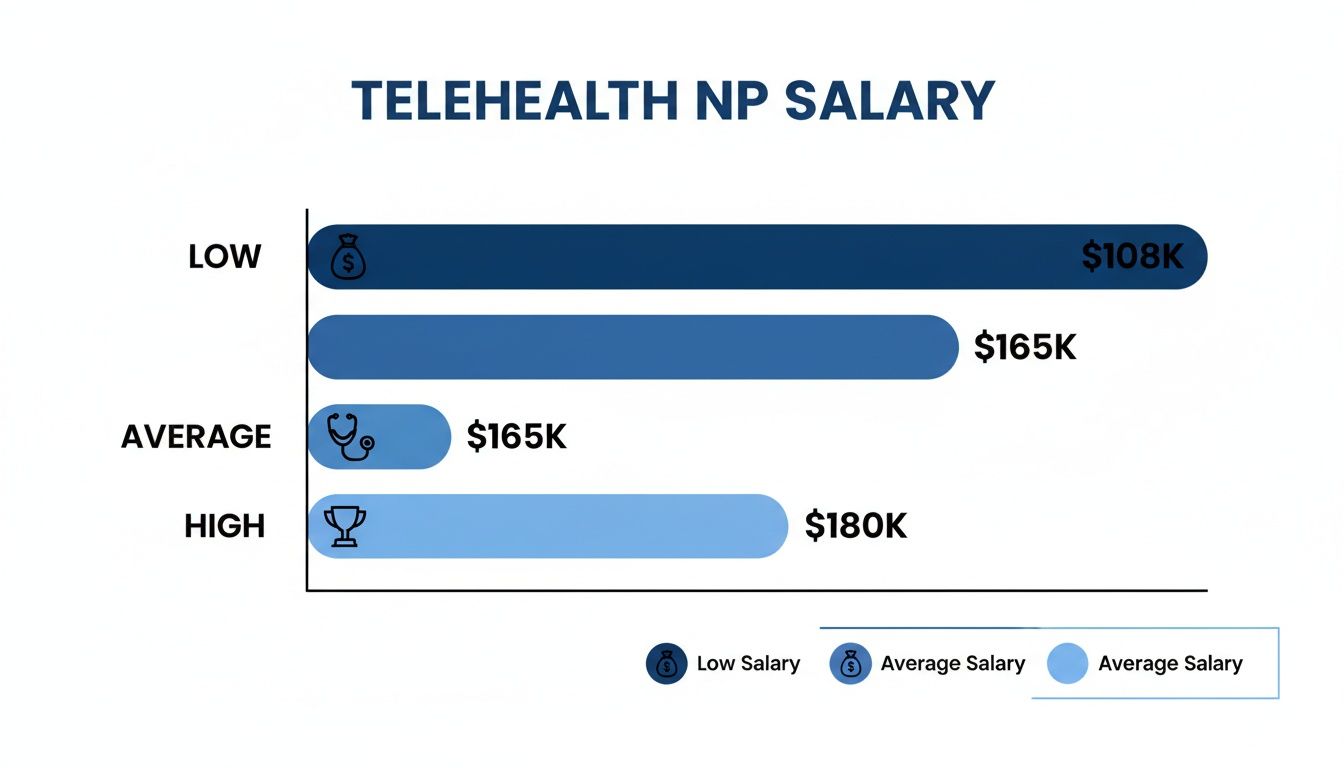
As you can see, the average salary sits comfortably above $160,000, making this an incredibly attractive path for NPs who want both financial security and personal freedom.
To give you a clearer picture, here’s a table breaking down the national salary benchmarks for 2026.
Telehealth Nurse Practitioner Salary Benchmarks 2026
This table provides a quick overview of the national salary data, showing how compensation varies across different earning percentiles.
| Percentile | Annual Salary | Hourly Rate |
|---|---|---|
| Top 10% | $180,000 | $86.54 |
| 75th Percentile | $169,500 | $81.49 |
| Average | $165,094 | $79.37 |
| 25th Percentile | $108,000 | $51.92 |
Source: Data compiled from national salary aggregators as of February 2026.
These figures reinforce the financial viability of telehealth roles, demonstrating strong earning potential across the board.
Understanding Your Market Value
Your earning power as a telehealth NP is significant. It's especially impressive when you compare it to other nursing roles. For instance, the average telehealth NP salary is more than double what an average registered nurse earns (around $80,321).
While some very specific in-person roles like an emergency medicine NP might earn more, telehealth offers a unique combination of high pay and scheduling freedom that's hard to beat.
This unique positioning makes telehealth a powerful option for clinicians interested in Financial Independence, Retire Early (FIRE) or who simply want a long-term, sustainable career that doesn't demand they sacrifice their personal time.
It’s also useful to see how this career stacks up in the broader remote work economy. To see where your salary fits in, you can explore the best jobs you could do from home, complete with salary data. This context really helps you appreciate just how competitive your compensation is and gives you a wider lens on your career options.
Understanding the Key Drivers of Your Telehealth NP Salary
Your telehealth NP salary isn’t a single, fixed number. Think of it more like a recipe, where several key ingredients combine to create the final result. Grasping what these ingredients are—and why they matter—is the first step to maximizing your earning potential.
You can find two telehealth NP jobs that look identical on paper, yet have wildly different pay packages. The reason? Factors like where you’re licensed, who you work for, and your specialty all create unique pressures that dictate what companies are willing to pay. This section breaks down those core drivers so you have a clear framework for evaluating any opportunity.

Let’s get into the "why" behind the numbers, so you can strategically position yourself for the best possible offer.
The Power of Location and Regional Demand
Even when you work from home, where you live—and where your employer is based—still matters a lot. State licensing requirements, regional cost of living, and local demand for care create different salary landscapes all over the country.
A telehealth company based in a high-cost city like San Francisco might offer higher base pay to compete for talent, even if you’re working from a lower-cost state. On the flip side, a job serving patients in a medically underserved rural area could come with a premium because of high demand and a short supply of clinicians.
The numbers tell the story. The telehealth NP salary landscape is gaining serious momentum, with average starting NP salaries projected to hit $180,000 in 2025—that's a 9.7% jump from 2023. Regionally, the West leads with average APRN compensation around $164,000, while the Midwest isn't far behind at $146,000. Pay can even vary inside a single state. For example, as of January 2026, telehealth NPs in Chicago earn an average of $134,328, with top earners pulling in $185,426. You can find more details on regional pay differences over at ZipRecruiter.com.
Key Takeaway: Your physical location is more than an address; it’s a critical salary lever. Holding licenses in multiple states, especially in high-demand regions, opens up more doors and gives you a much stronger negotiating hand.
How Your Employer Type Shapes Your Paycheck
Who you work for is another huge piece of the puzzle. A venture-backed telehealth startup and a massive, established hospital system have completely different financial realities and priorities, which directly impacts how they compensate their people.
Here’s a quick breakdown of what you can generally expect:
- Large Health Systems: These institutions usually offer stable, salaried (W2) jobs with solid benefits—think health insurance, retirement plans, and PTO. Their pay scales are often more structured and predictable.
- Telehealth Startups: Startups might dangle a competitive salary plus equity or stock options, which can be incredibly valuable if the company takes off. The trade-off? Benefits might not be as comprehensive, and job security can sometimes be lower.
- Private Practices and Smaller Groups: You’ll often find more flexibility here, maybe with a higher hourly rate. But these roles are frequently on a 1099 independent contractor basis, meaning you’re on the hook for your own taxes, insurance, and retirement.
The clinical setting matters, too. Data shows NPs in hospital inpatient care have the highest average earnings at $189,000, while those in community and public health settings average around $124,000. It just goes to show that the environment where you practice—even remotely—directly influences your paycheck. You can explore a wide variety of these roles by checking out these telehealth nurse practitioner jobs.
The Impact of Hours and Employment Status
Finally, how you’re employed—full-time, part-time, or as a contractor—has a profound effect on your total earnings and take-home pay.
A full-time, salaried W2 position gives you a predictable income and employer-paid benefits, which have real monetary value. In contrast, a 1099 contractor role might come with a higher hourly rate, giving you the chance to earn more if you keep your schedule full. The catch is that you have to budget for self-employment taxes (around 15.3%) and pay for your own health insurance and retirement savings.
Think of it like getting a car. The salaried role is like an all-inclusive lease—predictable and secure. The contractor role is like buying the car outright—you have more freedom, but you're responsible for all the maintenance and repairs. Neither is better than the other; it all comes down to your financial goals, comfort with risk, and how much flexibility you need.
How Specialty and Experience Boost Your Earning Potential
Let's be blunt: not all telehealth NP jobs pay the same. Once you move past the national averages, you’ll find that two things really move the needle on your paycheck: your specialty and your experience.
Think of your general NP certification as your ticket to the telehealth game. It gets you in the door. But a specialty certification? That’s your VIP pass. It proves you have the kind of focused, in-demand skills that companies will compete—and pay a premium—for.
The Specialization Premium in Telehealth
In telehealth, simple supply and demand dictates a lot. Certain specialties are exploding in popularity, and there just aren't enough qualified NPs to go around. That scarcity drives salaries way up.
The clearest example is psychiatric-mental health. The national demand for mental healthcare is immense, and it’s a field that works exceptionally well in a virtual setting. This has created a fierce hiring market for Psychiatric and Mental Health Nurse Practitioners (PMHNPs). It's not uncommon to see telehealth PMHNP salaries ranging from $140,000 to $200,000 a year, sometimes even higher.
In the world of remote care, your specialty is a direct return on investment. The more specialized and in-demand your skills, the more bargaining power you have. That power translates directly into a higher salary.
Other fields are seeing a similar bump. Cardiology NPs, for instance, average around $136,846, while bilingual NPs—who are crucial for closing communication gaps—can command $134,329. The trend is obvious: specialized skills get rewarded. If you want to dig into more of the numbers, this comprehensive 2025 NP salary guide is a great resource.
Here’s a quick look at how some of the top telehealth NP specialties compare.
Telehealth NP Salary by Top Specialties (2026 Averages)
This table breaks down the average salary ranges for a few of the most sought-after NP specializations, highlighting exactly why they're so valuable in the remote care market.
| Specialty | Average Annual Salary Range | Key Demand Driver |
|---|---|---|
| Psychiatric-Mental Health (PMHNP) | $140,000 - $200,000+ | Sky-high patient demand, a severe provider shortage, and telehealth being a perfect fit for therapy and med management. |
| Cardiology | $130,000 - $145,000 | Managing chronic diseases for an aging population and using remote monitoring to keep patients out of the hospital. |
| Dermatology | $125,000 - $140,000 | The visual nature of dermatology makes it ideal for "store-and-forward" telehealth and live video consults. |
| Family Practice (FNP) with Niche Skills | $120,000 - $135,000 | FNPs are incredibly versatile, especially if they have multi-state licenses or are bilingual. |
Note: These ranges are based on aggregated national data and will shift based on your specific employer, location, and experience.
How Experience Shapes Your Salary Curve
Years on the job always count, but the experience-to-income curve in telehealth can be a little different from a traditional hospital role. In many health systems, pay bumps are tied to seniority in a slow, predictable climb over many years.
Telehealth flips that script a bit. The focus is less on your total years as an NP and more on your relevant virtual care expertise. An NP with five years of dedicated telehealth experience could easily earn more than a 20-year veteran who's just starting to learn the ropes of remote care.
The numbers back this up. The salary jump from 2-4 years of experience ($117,010) to over 8 years ($120,537) isn't massive. What this tells us is that after you've got a few years under your belt, your value is driven more by your specialty and how efficient you are in a remote setting—not just by your tenure. Being a pro with virtual care tech and managing a remote patient panel is a highly marketable skill in and of itself.
Negotiating Your Remote Contract and Benefits
Getting a great telehealth nurse practitioner salary isn’t just about the number on the page. A solid compensation package is a structure, and your base pay is only the foundation. The real, lasting value is often built in the other pieces you negotiate—the benefits, stipends, and work-life boundaries that will define your remote career.
Think of it like building a house. Your salary is the concrete slab it sits on. It's essential, but the walls, roof, and amenities are what make it a comfortable, sustainable place to live. A remote contract has its own unique set of amenities, and learning how to ask for them is the key to maximizing your total compensation.

This is the point where you shift from being just a candidate to becoming a strategic partner in designing your own role. Let’s break down the key areas to focus on when you get to the negotiating table.
Beyond the Base Salary: Remote-Specific Perks
In a clinic, the employer pays for the lights, the internet, and the desk you use. When you work from home, those operational costs suddenly shift to you. A savvy negotiator sees this and frames the conversation around reimbursement for what are, essentially, business expenses.
Your goal here is to build a benefits package that reflects the reality of a home-based practice. These aren't just nice-to-haves; they are the tools you need to do your job well.
Here are the critical items you should be discussing:
- Home Office Stipend: This should be a recurring payment (monthly or annually) to cover costs like high-speed internet, electricity, and other utilities. I recommend framing this as a "business continuity" expense for the company.
- Technology and Equipment: The company should provide or pay for your work laptop, monitors, and headset. Don't forget to ask about software licenses and secure network access (VPN) costs.
- Licensing and Credentialing Fees: This is huge. If the job requires you to hold licenses in multiple states, the employer must cover all application and renewal fees. This can easily save you thousands of dollars over the life of the contract.
- Continuing Medical Education (CME) Allowance: This is standard, but make sure it’s adapted for telehealth. The policy should explicitly cover virtual conferences and online certification courses, not just travel to in-person events.
Protecting Yourself: Malpractice and Contract Language
The fine print in your contract is where the real risks hide, especially when it comes to liability. Telehealth malpractice insurance has its own quirks, and you need to be certain your coverage is specifically designed for virtual care across all states where you’ll be seeing patients.
Never assume a standard malpractice policy is good enough. You need to ask pointed questions: "Does this policy cover asynchronous (store-and-forward) communication in addition to live video consults?" and "What are the coverage limits for practicing across multiple state lines?"
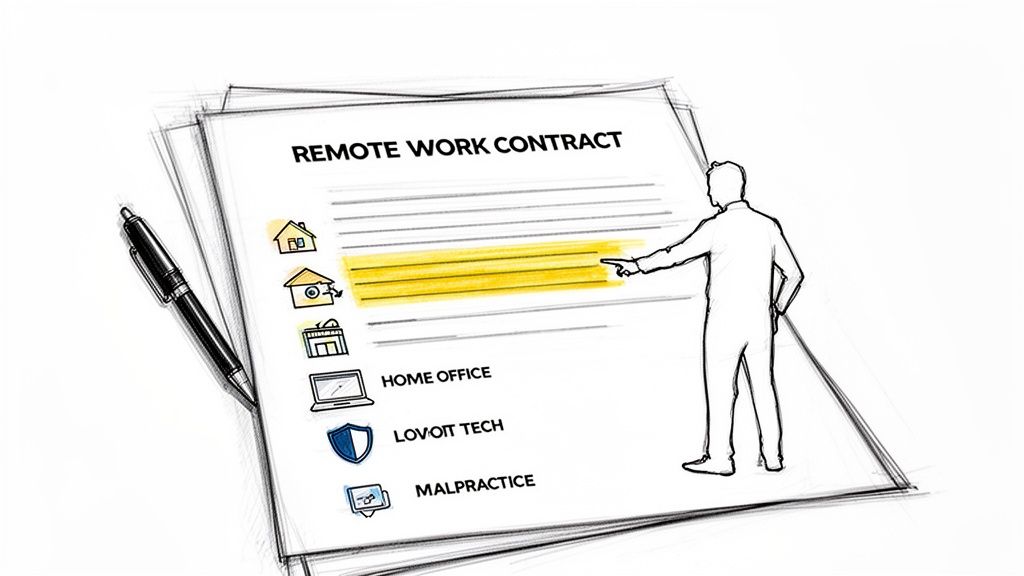
This is also the time to zero in on the non-compete and termination clauses. An overly restrictive non-compete can hamstring your future career options in the telehealth world. If you need help deciphering the legal jargon, an online tool can be a great first pass. You can learn more about analyzing your employment agreement with WeekdayDoc's Contract Scanner to spot potential red flags before you sign.
Quantifying the Unseen Value of Work-Life Balance
Finally, don’t ever underestimate the massive financial and personal value of the non-monetary benefits. A job that guarantees no nights, no weekends, and no on-call duties—the kind of role WeekdayDoc was built to find—has a real, quantifiable impact on your life.
So how do you use this in a negotiation? You frame it as a trade-off.
Try a script like this: "I'm very excited about this opportunity, particularly because the work-life balance aligns perfectly with my goal for a sustainable, long-term career. A predictable Monday-to-Friday schedule without on-call responsibilities allows me to be fully focused during work hours, which directly benefits patient care and reduces my personal risk of burnout. This stability is a significant factor in how I'm evaluating the overall compensation package."
That one statement connects the schedule directly to your performance and professional longevity. You’re not just asking for time off; you’re showing how a burnout-friendly job makes you a better, more reliable clinician. It turns an abstract idea into a tangible asset that justifies your salary request and reinforces your value.
Using Data to Make Your Next Career Move
Theory is great, but it’s time to put it into action. This is where you stop guessing about your financial future and start making clear, data-driven decisions that actually get you to your long-term goals. A top-tier telehealth NP salary isn't just a number; it’s a tool to build the life you want.
Making a smart career move means looking past the base salary. You have to understand how that income translates into real-world wealth, factoring in everything from state taxes to the local cost of living. It also means weighing the financial perks against the priceless benefit of a sustainable, burnout-free career.
The best approach combines powerful tools with your own personal insight, letting you model different career paths and pick the one that truly fits.
Modeling Your Financial Future
Let's say you're juggling two job offers. Offer A is $170,000 in California. Offer B is $155,000 in Texas. On the surface, the choice seems like a no-brainer. But this is where running the numbers changes everything.
When you plug those figures into a solid calculator, the picture gets a lot clearer. The tool automatically accounts for California's high state income tax and much steeper cost of living. Suddenly, that $170,000 feels more like $150,000 in actual spending power. Meanwhile, the $155,000 offer in no-income-tax Texas might leave you with way more cash in your pocket each month.
This is exactly what WeekdayDoc’s tools were designed to handle. You can discover how different salary and location scenarios impact your financial independence goals with our Salary & FIRE Calculator. It’s built to turn abstract numbers into a concrete timeline, showing you exactly which opportunities will speed up your path to financial freedom.
Integrating the Burnout-Friendly Score
A huge salary is worthless if the job burns you out in a year. Long-term career sustainability is just as critical as your immediate paycheck. That’s why every single job listing on WeekdayDoc includes a Burnout-Friendly Score.
This score isn't some random number. It’s a calculated metric based on the factors that directly impact your well-being:
- No Call, No Weekends: The job must have a predictable, weekday schedule. Period.
- Reasonable Patient Load: We look at the expected number of patient encounters per hour.
- Administrative Burden: The score factors in the amount of non-clinical "pajama time" work required.
- Company Culture: We assess real-world reviews and feedback on how clinicians are supported.
When you’re evaluating an opportunity, use this score as a key data point. A job with a slightly lower salary but a high Burnout-Friendly Score might be a much smarter long-term play. It represents a role where you can actually thrive, protect your health, and keep earning steadily for years.
A sustainable career is an appreciating asset. A role that burns you out is a liability, no matter how high the initial pay. The Burnout-Friendly Score helps you tell the difference.
A Real-World Example in Action
Let’s look at a real story. Dr. Anya, a PMHNP, was completely fed up with the relentless on-call schedule at her hospital. She had two telehealth offers on the table.
The first was from a flashy startup offering $190,000 but with vague language about "flexible scheduling" and high patient quotas. The second was from a smaller, established practice offering $175,000 with a guaranteed 9-to-5, Monday-to-Friday schedule and a high Burnout-Friendly Score on WeekdayDoc.
Using the Salary & FIRE Calculator, Anya saw the $15,000 pay cut would only delay her retirement goal by about 18 months. When she factored in the burnout risk of the higher-paying job, the choice was crystal clear. She took the $175,000 role, knowing its sustainability would protect both her mental health and her earning power for the long haul.
Anya’s story shows how to combine financial modeling with well-being metrics to make a truly informed decision. To find these kinds of opportunities, exploring available remote jobs is a great first step. By using data, you can move past the temptation of a single big number and choose the career path that delivers both wealth and well-being.
Answering Your Top Questions About Telehealth NP Salaries
When you're exploring telehealth jobs, the big-picture salary numbers are just the start. It’s the nitty-gritty details that really determine whether a role is the right financial and lifestyle fit for you.
Let's cut through the noise. This section gives you direct answers to the most common questions we get from Nurse Practitioners making the switch to remote work. Think of it as your practical cheat sheet for navigating telehealth compensation with confidence.
Is the Salary for a Fully Remote NP Different from a Hybrid Role?
On paper, the base salary for a fully remote NP and a hybrid role can look nearly identical. But when you dig into the total financial picture, they're often worlds apart.
A 100% remote position usually means a higher take-home pay, even with the same salary. Why? You completely erase commuting costs—no more spending on gas, car maintenance, or train passes. Many remote-first companies also offer stipends for your home office or tech, putting more money directly back in your pocket.
A hybrid role, on the other hand, comes with hidden costs like driving to the office a few days a week. It might offer in-person perks like a subsidized cafeteria, but you have to weigh if those benefits outweigh the expenses and time lost commuting.
To get a real apples-to-apples comparison, you have to calculate the total value. Start with the base salary, subtract commuting and other out-of-pocket costs, and then add the value of any stipends. That's how you see which job truly pays more.
Are Telehealth NPs Usually Salaried or Paid Hourly?
You'll find both models out there, and the best one for you really boils down to what you value most: stability or flexibility.
- Salaried (W2) Positions: These are the standard for large, established health systems. You get a predictable paycheck every two weeks, which makes budgeting a breeze. More importantly, these roles come with a full benefits package—health insurance, 401(k) matching, and paid time off. It’s the security option.
- Hourly (1099) Positions: This model is popular with telehealth startups and newer digital health companies. You’re an independent contractor, which almost always means a higher hourly rate. The catch? You're on the hook for your own self-employment taxes (around 15.3%) and have to buy your own health insurance and fund your own retirement.
It's a classic trade-off. W2 offers peace of mind, while 1099 offers higher earning potential and more control, but with more personal responsibility.
How Does Multi-State Licensure Affect My Salary Potential?
This is one of the biggest levers you can pull to boost your telehealth salary. Holding multiple state licenses turns you from a local candidate into a national one, instantly making you more valuable.
Think about it from the employer's perspective. A company with a national patient base needs clinicians who can legally practice across state lines. By being licensed in multiple states, especially through the Nurse Licensure Compact (NLC), you solve a massive logistical headache for them.
This immediately gives you significant leverage in salary negotiations. It also unlocks a much larger pool of potential jobs, lets you grab extra shifts if you're paid hourly, and allows you to work for companies based in high-paying states, regardless of where you live. Investing in more licenses is a direct investment in your earning power.
What Are the Key Tax Considerations for a Remote NP?
Working from home brings a whole new set of tax rules that are completely different from a traditional clinic job. Getting a handle on them is key to managing your money well.
The biggest factor is your employment status. As a W2 employee, your employer handles withholding taxes from your paycheck, so tax season is pretty straightforward.
If you're a 1099 independent contractor, it's a different ballgame. You get paid your full pre-tax rate and are responsible for making quarterly estimated tax payments to the IRS. This covers your federal and state income tax, plus self-employment taxes. It takes discipline, but it also opens up business deductions, like a home office deduction for the space you use exclusively for work.
You also need to be aware of state tax laws, particularly if you live in one state but your employer is based in another. We always recommend talking to a tax professional who knows the ins and outs of remote work to make sure you're compliant and saving every dollar you can.
Ready to find a role that values both your expertise and your well-being? At WeekdayDoc, we curate the best burnout-friendly telehealth NP jobs with transparent salary data and work-life balance scores. Start your search for a better career today at WeekdayDoc.com.