Physician Part Time Employment - physician part time employment
Discover physician part time employment options, negotiate fair contracts, and balance work and life while advancing your career.

For decades, the path for physicians felt set in stone: grueling hours, endless on-call nights, and a professional pace that was simply unsustainable. But that old model is breaking down. A quiet but powerful shift is happening across medicine as doctors realize professional fulfillment doesn't have to come at the cost of personal well-being.
This isn't just about cutting back. It's about fundamentally redesigning a career to fit a life, and physician part time employment is the blueprint many are using to do it.
The New Blueprint for a Physician's Career
Think of the mid-career surgeon who, after a decade of loving the OR, finds herself buried under administrative tasks and bone-deep exhaustion. Or the primary care doc who feels like he’s on a hamster wheel, unable to connect with patients the way he once did.
These aren't isolated stories. They're playing out in hospitals and clinics everywhere, pushing incredible clinicians to the brink. They’re the reason so many are looking for a different way to practice medicine.
Why Part Time Is Becoming the New Full Time
This move toward part-time work isn't just a feeling; the numbers back it up. Over the last two decades, the number of physicians working part-time has climbed dramatically. Today, they make up 21% of the entire physician workforce—a huge jump from just 13% back in 2005. This data, highlighted in resources like the NEJM CareerCenter, shows a clear and decisive trend toward prioritizing a more balanced life.
This evolution is a direct response to the burnout epidemic. Physicians are consciously choosing to step off the old, worn-out path and forge a new, more sustainable one.
The infographic below perfectly captures this transition.
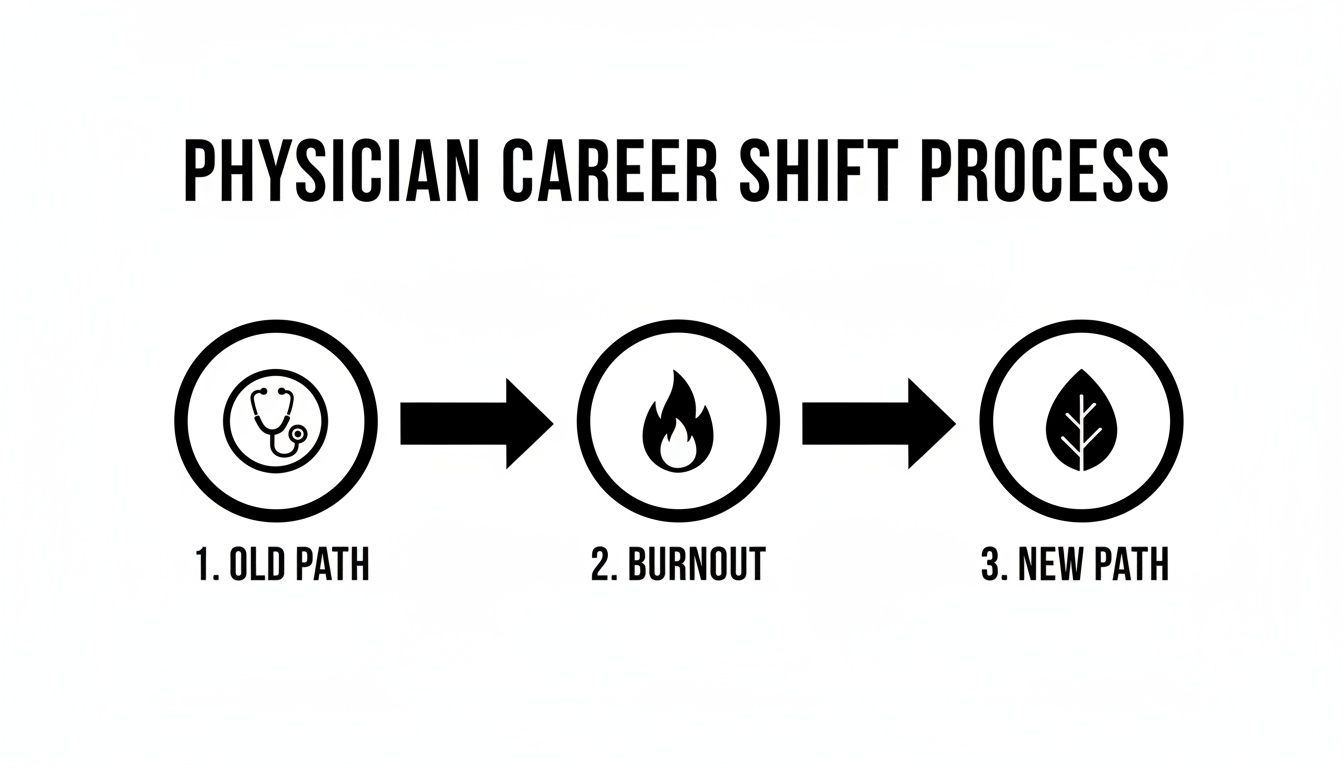
It shows that critical moment where a physician decides to pivot—not away from medicine, but toward a way of practicing that can actually last a lifetime.
For many, physician part time employment isn't about working less—it's about working smarter. It’s a deliberate choice to reclaim autonomy over your schedule, your mental health, and your personal life.
The motivations behind this shift are varied, but they all point toward a more intentional and sustainable career. The table below summarizes the key drivers we see every day.
Why More Physicians Are Choosing Part Time Roles
| Motivation | Primary Benefit |
|---|---|
| Combating Burnout | Reduces emotional exhaustion and restores passion for medicine. |
| Improving Family Life | Creates more time and presence for partners, children, and aging parents. |
| Pursuing Other Interests | Opens up schedules for entrepreneurship, teaching, or non-medical hobbies. |
| Phasing into Retirement | Allows a gradual transition out of full-time practice instead of an abrupt stop. |
Ultimately, these reasons are deeply personal yet universally understood within the medical community. It's a strategic move to build a career that is not only successful but also deeply fulfilling for the long haul.
Defining Your Ideal Part-Time Practice

Before you even glance at a job board, the single most important thing you can do is figure out what “ideal” actually looks like for you. It’s easy to say you want “less work,” but that’s too vague.
Getting crystal clear on your goals is the key to a successful search. Think of it as creating a blueprint for the next chapter of your career. Without it, you're just scrolling aimlessly.
First, let's talk time. How many hours a week, or shifts a month, feels right? Not just doable, but sustainable. Are you thinking a strict three-day workweek? Or maybe a more fluid schedule with a set number of monthly hours?
And what about the setting? Are you picturing a fully remote telehealth job from your home office, a hybrid role, or a few days a week in a local clinic? Each path has completely different lifestyle implications.
Outlining Your Non-Negotiables
Once you've got the big picture, it's time to drill down into the details that make or break your day-to-day. Your non-negotiables are the hard boundaries you set to protect your time, energy, and sanity.
Seriously consider these areas:
- Call Schedules: Is "no call" a dealbreaker? For many of us seeking a better balance, this is the number one requirement.
- Admin Burden: How much of your soul are you willing to sell to the EMR? Be honest about how much time you'll tolerate for charting, in-basket management, and other non-clinical tasks.
- Clinical Focus: Do you need to keep up certain procedural skills, or are you ready for a purely consultative role?
- Patient Volume: What’s a comfortable, safe patient load for you? Think in terms of patients per hour or per day. There's a huge difference between seeing 4 patients an hour versus 2.
Defining these parameters before you start your search is a game-changer. It shifts you from reactively looking at whatever comes your way to proactively seeking out roles that truly fit your life. You're in the driver's seat.
If you're worried about the admin side of things, remember that leveraging services from specialized medical virtual assistant companies can be a huge help. They can take a lot of the clerical work off your plate, letting you focus on seeing patients.
Calculating Your Financial Needs
Okay, let's talk about the elephant in the room: money. The thought of a pay cut is what stops many physicians from making the leap to part-time.
This is where a little prep work pays off. Before you look at a single salary number, calculate your actual financial needs. Tally up your baseline monthly expenses, contributions to savings goals (retirement, 529s, etc.), and any debt payments.
Knowing your "magic number" makes you a much smarter negotiator. It empowers you to confidently evaluate an hourly rate or a prorated salary and know if it actually works for your family. A solid financial plan gives you the freedom to choose a job based on the best fit, not just the biggest paycheck.
For more on this, our deep dive into flexible schedule physician jobs has some great practical tips.
Finding the Right Part Time Physician Jobs
Alright, you've done the hard work of figuring out exactly what you want. Now comes the fun part: finding that perfect role.
First, let's talk structure. Most physician part time employment falls into a few buckets: direct employment (W-2), independent contracting (1099), and locum tenens. A W-2 job is your classic employee setup, often with benefits and more stability. A 1099 role gives you more freedom and potential tax write-offs but puts things like health insurance and retirement on you.
Locum tenens is a different beast altogether—it’s about temporary assignments. This can be an incredible way to test-drive a new practice, explore a different city, or just earn good money without a long-term chain attached. It's a popular route for doctors craving flexibility without the full commitment.
Mastering Your Job Search Strategy
Forget what you know about scrolling through massive, generic job boards for hours. That's a recipe for frustration. The key is to be surgical with your search, using platforms and filters that understand what clinicians actually need.
Here are a few targeted strategies that will save you time and headaches:
- Go Niche: Use job boards built for clinicians who care about work-life balance. Platforms like WeekdayDoc curate jobs specifically for burnout-conscious physicians. You can browse our pre-vetted physician part time employment opportunities that already meet criteria like "no call."
- Create Smart Alerts: Get specific with your keywords. Instead of a generic alert for "pediatrician," try something like "outpatient pediatrician no weekends" or "part time telehealth psychiatrist." Let the right jobs come to you.
- Look Past the Job Title: Don't immediately dismiss a role like "Urgent Care Physician." The description might reveal a predictable 9-to-5 schedule with zero on-call duties, which could be exactly what you're looking for. Always read the fine print.
And of course, a focused job search requires a focused resume. Taking the time for creating a powerful Curriculum Vitae (CV) that highlights your specific skills for a flexible, autonomous role is non-negotiable.
A Real-World Example
Dr. Anya Sharma, a pediatrician, was on the brink of burnout from her hospitalist gig. Her goal was simple: find a three-day-a-week outpatient role with no call. By using specific filters like "part time pediatrics" and "no call schedule," she cut through hundreds of irrelevant jobs and found a handful of perfect matches. One of those is now the job she loves.
The Rise of Flexible and Locums Work
This shift toward flexible work isn't just in our heads. With a physician shortage looming, locum tenens and part-time gigs have become a mainstream career path.
A recent survey found that a staggering 44% of physicians have switched to locums work, either full- or part-time. That's a massive jump from just 28% two years ago. And among docs who picked up a side gig, 60% chose locums, citing the blend of flexibility and solid income without the usual practice headaches. You can dig into the full report from the 2024 CHG Healthcare survey.
What does this mean for you? You have more leverage than ever. Employers are finally realizing they need to offer flexible schedules to attract and keep good doctors. Your ideal part-time job is definitely out there—you just need a smart, focused approach to find it.
How to Evaluate Part Time Contracts and Pay
Getting that part-time offer is a huge win, but don't pop the champagne just yet. The real work is about to begin. The contract you're holding is the blueprint for your professional life for the next few years, so treating it like a casual read-through is a massive mistake.
This is where you have to put on your business hat. It's easy to get fixated on the hourly rate or the prorated salary, but that's just one piece of the puzzle. You need to dig deeper to see the whole financial picture. Is this a W-2 job with some benefits baked in, or are you a 1099 contractor on the hook for your own taxes and insurance? The difference is enormous.
Deconstructing the Compensation Package
First things first: you need to calculate your true take-home pay. That killer hourly rate on a 1099 contract can look amazing on paper, but it shrinks fast once you subtract self-employment taxes (around 15.3%), your own health insurance premiums, and the money you have to sock away for retirement.
To compare apples to apples, get a handle on the Full-Time Equivalent (FTE). An offer for a 0.6 FTE position means you're committing to 60% of a full-time workload. Your pay and any prorated benefits must line up with that. If the full-time docs are making $300,000, your base salary should be a clean $180,000. If it’s not, you need to ask why.
"Never assume verbal promises will make it into the final contract. If it’s not in writing—from your CME stipend to your exact clinical hours—it doesn’t exist. Get every detail documented." - Quote from a Healthcare Contract Attorney
Breaking down these offers can feel like a complex math problem. To make it easier, we built a tool that does the heavy lifting for you. Our physician offer analyzer helps you compare different pay structures side-by-side so you can see which one actually comes out on top.
Pay structures for part-time roles can vary wildly. Understanding the pros and cons of each model is key to finding a role that offers the financial predictability you need.
Comparing Pay Models for Part Time Physician Roles
| Model | Pros | Cons | Best For |
|---|---|---|---|
| Prorated Salary (W-2) | Predictable income, often eligible for prorated benefits (health, 401k), simpler taxes. | Lower hourly rate compared to 1099, less flexibility to refuse work. | Physicians seeking stability, predictable cash flow, and access to employer-sponsored benefits. |
| Hourly Rate (1099) | Potentially higher gross pay per hour, more control over schedule, tax-deductible business expenses. | Income can be variable, responsible for all taxes and benefits, administrative burden. | Doctors who want maximum flexibility, have other sources of benefits, and are comfortable managing their own business finances. |
| Per Diem / Locums | Highest hourly rates, extreme flexibility to pick up shifts as desired, great for filling income gaps. | No guaranteed hours, no benefits, constant need to find new assignments, credentialing hassles. | Physicians bridging a career gap, supplementing other part-time work, or prioritizing schedule freedom above all else. |
| Productivity-Based (RVU) | High earning potential if you're efficient and patient volume is high. | Income is highly unpredictable, risk of low pay during slow periods, can incentivize volume over quality. | Highly motivated physicians in busy, well-run practices who are confident in their ability to generate high volume. |
Each model has its place, but the right one for you depends entirely on your personal financial goals and tolerance for risk. A stable, prorated salary might be perfect for someone building a FIRE plan, while a high 1099 rate could be ideal for a physician who already has benefits through a spouse.
Key Contract Clauses to Scrutinize
Beyond the money, the fine print in your contract can either give you freedom or lock you into a professional cage. You absolutely have to sweat the details on these clauses.
- Non-Compete Agreements: This is a big one. A tough non-compete can bar you from working within a certain mileage radius for a year or more after you leave. For a part-time doctor looking to build a portfolio of local gigs, this is a potential career-killer.
- Malpractice Insurance: Who's footing the bill? And is it a claims-made or an occurrence policy? If it’s claims-made, the contract must spell out who buys the "tail coverage" when you leave. Tail insurance covers you for claims filed after you’ve left for incidents that happened during your employment, and it can cost a fortune.
- Termination Clause: Hunt for the "without cause" termination section. This is what dictates how much notice you or your employer has to give to end the agreement. You want to see a standard notice period, typically 60-90 days, which gives you enough time to find something new.
Negotiating Your Benefits
Working part-time shouldn't mean you get zero benefits. More and more organizations are willing to prorate key benefits based on your FTE, but you often have to ask.
Here’s what’s frequently on the table for negotiation:
- Health Insurance: Many employers will cover a prorated share of your premium. It's always worth asking.
- Retirement Contributions: Check your eligibility for a 401(k) or 403(b) and, more importantly, any employer match. Ask how that match is calculated for part-timers.
- CME Stipend: Continuing Medical Education funds are a classic negotiating point. Make a case for a prorated amount that reflects your clinical hours.
- Paid Time Off (PTO): This should be a straightforward calculation. If a full-time position comes with four weeks of vacation, a 0.5 FTE role should get two weeks. Don't leave it to chance.
At the end of the day, a solid contract is about creating a clear, fair agreement that protects everyone. When you take the time to review, question, and negotiate, you're not being difficult—you're being a smart professional. This diligence ensures your new part-time role is a true step toward the sustainable, balanced career you set out to build.
Managing the Transition to Part Time Work
Getting the offer is a huge win, but the real work starts after you sign. Shifting to part-time isn't just about showing up for fewer hours; it’s about meticulously planning the transition to protect the very work-life balance you fought for. This is where you lay the foundation for a sustainable, long-term career shift.
First up, the administrative grind. Credentialing with a new hospital or health system is notoriously slow. You need to get on this immediately. Start gathering digital copies of everything—your medical license, board certifications, DEA certificate, the works. Having it all organized and ready to go will save you from a last-minute panic that could delay your start date.
This is even more critical today, as the majority of U.S. physicians are now employed by larger organizations. In fact, over half now work directly for health systems. This trend actually makes physician part time employment more accessible, since these larger, stable employers are offering flexible schedules to attract talent. You can dig into the full research on these physician employment dynamics to see how the landscape is shifting.
Navigating Insurance and Certifications
Malpractice insurance is a major piece of the puzzle, especially if you’re working a 1099 or locum tenens role where you’re on the hook for your own coverage. Don't just accept the first quote you get. It pays to shop around, compare policies, and make absolutely sure your coverage fits your specific scope of practice. And don't forget to ask the million-dollar question: who pays for tail coverage?
Your board certification is another area that needs attention. A part-time schedule can make it tricky to meet maintenance requirements if you're not careful.
- Check Your Board's Rules: Dive into the specifics. What are the minimum clinical hours or case volumes required for recertification in your specialty?
- Track Your CME Diligently: Don’t wait until the last minute. Log your Continuing Medical Education credits as you earn them to avoid a scramble.
- Block Out MOC Time: Put it on your calendar. Whether it’s studying for an exam or completing modules, treat your Maintenance of Certification activities like a clinical shift.
The single biggest threat to a successful part-time arrangement is "scope creep"—the slow, insidious expansion of your duties back into full-time hours. Protecting your boundaries isn't optional; it's the core of making this transition work.
Setting and Protecting Your Boundaries
This brings us to the most important part: setting iron-clad boundaries from day one. Your new schedule is a professional agreement, not a gentle suggestion. Make sure your colleagues, the administration, and even your patients understand your working hours.
Set up an automated out-of-office reply for your non-working days. It should clearly state when you'll be back and who to contact for urgent issues. Resist the urge to check your work email or peek at the EMR during your personal time. That discipline is what reinforces the structure of your part-time role and keeps burnout from creeping back into your life.
Get these logistics handled proactively, and you'll ensure your transition isn't just a change in hours, but a genuine upgrade to your quality of life.
Answering Your Top Questions About Part-Time Physician Work
Making the leap to part-time work is a huge decision, and it’s totally normal to have a ton of questions swirling around. Will my skills get rusty? How will this impact my loans? Is this whole “work-life balance” thing even real?
Let's cut through the noise. Here are the most common concerns I hear from physicians considering a change, along with some straight-up answers based on real-world experience.
Will This Hurt My Clinical Skills or Career Growth?
This is probably the number one fear, and it's a valid one. But the short answer is no—as long as you’re intentional about it. Going part-time isn't about hitting the brakes on your career; it’s about redirecting it.
Many physicians actually find their professional profile gets stronger. A more balanced schedule frees you up to build a more resilient, multi-faceted career.
- Stay Sharp with CME: You’ll finally have time to pursue Continuing Medical Education that genuinely excites you, not just the stuff you need to check a box.
- Diversify Your Practice: Maybe you can explore a sub-specialty you've been curious about or try a different care model, like moving from a chaotic inpatient setting to a focused outpatient clinic.
- Build Your "Portfolio Career": Use those extra days to do something totally different. I've seen colleagues get into medical writing, consult for health-tech startups, or take on leadership roles in professional societies.
A part-time schedule isn’t a step back. Think of it as a strategic pivot. You're trading exhaustive hours for focused, high-impact work that actually aligns with where you want to go, both personally and professionally.
How Does This Affect Student Loans and Financial Goals?
Okay, let's talk money. Dropping hours obviously means a change in income, so you'll need a new financial game plan. It’s not impossible, but it does require re-evaluating your budget, how much you're saving, and your debt strategy.
The big one here is Public Service Loan Forgiveness (PSLF). If you're on the PSLF track, you have to be careful. To qualify, you must work for a non-profit or government employer and meet the full-time requirement, which is defined as an average of at least 30 hours per week.
Some part-time gigs will hit this 30-hour mark, but many won't. Make sure you get this clarified in writing during your contract negotiations.
Can I Really Find a Job Without Nights or Weekends?
Yes. 100% yes.
A few years ago, a job like this felt like a unicorn. But the market has shifted in our favor. So many physicians have demanded better work-life balance that employers have been forced to listen and adapt.
Outpatient clinics, specialized telehealth companies, and even some forward-thinking urgent care centers now regularly offer roles with zero on-call duties or weekend shifts. The key is knowing where to look—using targeted job board filters is your best friend here.
What Are the Biggest Challenges When Going Part-Time?
It's not always a perfect transition. One of the most common hurdles is managing the expectations of your full-time colleagues. They might not fully grasp your new schedule, leading to "scope creep"—where you're constantly asked to pick up extra tasks or stay late.
The best defense is a good offense. Set crystal-clear boundaries and expectations during your contract negotiation. Then, from day one, you have to gently but firmly reinforce them. It’s about protecting the very balance you worked so hard to create.
Ready to find a job that fits your life, not the other way around? At WeekdayDoc, we curate burnout-friendly physician roles with no nights, no weekends, and no call. Start your search for a sustainable medical career today at https://www.weekdaydoc.com.