Write a Physician Job Description That Attracts Top Clinicians
Tired of generic job postings? Learn to write a physician job description that attracts top, burnout-conscious talent by highlighting what truly matters.

A physician job description is more than a list of duties; it’s your first handshake with a potential colleague. In today’s market, where clinicians are stretched thinner than ever, that handshake needs to be firm, clear, and reassuring. It must speak directly to the real priorities of modern physicians: work-life balance, a supportive culture, and a sustainable career path.
Why Your Current Physician Job Description Fails
Let's be honest. Most physician job descriptions are failing to connect with top talent. They often read like sterile, templated documents filled with corporate jargon that completely misses what doctors, PAs, and NPs are actually looking for.
Simply listing duties and qualifications is an outdated strategy. It just doesn't work in a market where clinicians are hyper-aware of burnout and actively seeking roles that won't break them.
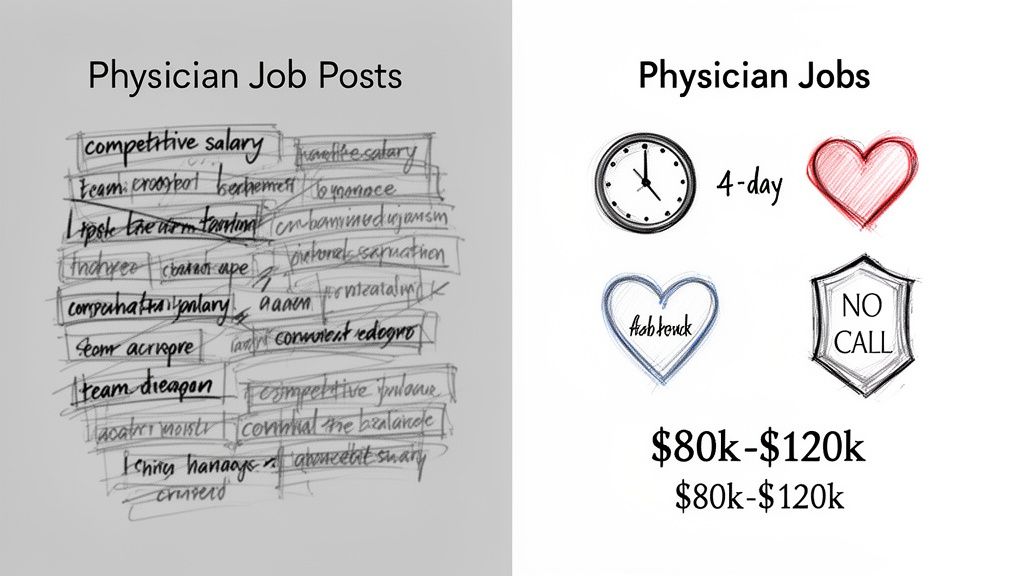
The priorities for clinicians have shifted dramatically. Things that used to be considered perks—like a predictable schedule or reasonable patient loads—are now non-negotiable requirements for many.
The Disconnect Between Employers and Clinicians
The core problem is a massive disconnect. Employers are often focused on institutional needs and legal compliance, cranking out posts that feel impersonal and uninspiring. Clinicians, on the other hand, are scanning those same posts for signals that an organization actually respects their time and well-being.
This gap is only getting wider in our challenging healthcare landscape. The U.S. is facing a projected shortage of up to 86,000 physicians by 2036. While this is an improvement from previous estimates, it still highlights the intense competition for qualified professionals, especially in primary care.
A generic job description just gets lost in the noise. It fails to answer the questions that are top-of-mind for today’s burnout-conscious candidates:
- What is the actual daily patient load?
- Is there an on-call requirement? If so, what’s the real frequency?
- Is the compensation transparent and fair?
- Does the culture genuinely support a life outside of medicine?
When a job description is vague about scheduling, compensation, or patient volume, savvy clinicians see it as a giant red flag. They assume the worst—long hours, low pay, and high stress—and simply move on.
The shift from vague language to specific, compelling details is crucial. Here's a quick look at how to make that change:
| Element | Traditional Approach (Vague & Uninspiring) | Modern Approach (Specific & Appealing) |
|---|---|---|
| Schedule | "Full-time position with occasional on-call duties." | "Monday-Friday, 8 AM - 5 PM schedule. No nights, weekends, or on-call." |
| Patient Load | "Manage a diverse patient panel." | "See an average of 16-18 patients per day with dedicated administrative time." |
| Compensation | "Competitive salary and benefits package." | "Starting salary of $240,000 plus performance bonuses and 4 weeks PTO." |
| Culture | "Join our dynamic team." | "A collaborative environment with a 1:1 MA-to-physician ratio to minimize your admin burden." |
Moving to this modern approach shows you understand what clinicians truly value today.
Moving Beyond Traditional Incentives
Traditional incentives are losing their punch. While a competitive salary is still important, it's no longer the only thing that matters. Clinicians are now weighing compensation against the cost to their personal lives. A higher salary isn't appealing if it comes with mandatory weekend shifts and a soul-crushing administrative burden.
Your job post has to stop being a simple listing and start being a compelling career opportunity. By focusing on the signals that matter most—schedule, autonomy, and support—you can attract candidates who aren't just qualified, but who are a genuine fit for your practice's values. For employers looking to attract these highly sought-after clinicians, learning how to showcase these benefits is key. This means moving from vague promises to concrete details.
Building the Core of Your Job Description
Alright, you’ve got the right mindset. Now it’s time to move from theory to action. A solid physician job description really comes down to three core pillars: the summary, the responsibilities, and the qualifications. If you nail these, you’re not just listing a job—you’re telling a story that resonates with modern clinicians.
This isn’t about filling in a template. It's about being strategic. Every sentence needs to be written with your ideal candidate in mind, answering their unspoken questions before they even ask them. To get the big picture, it’s worth understanding what makes an effective job role description in any field, as those core principles are the foundation we'll build on.
Crafting a Compelling Job Summary
Think of your job summary as the headline. It's your one shot to grab a busy clinician's attention and stop their scroll. This is where you sell the "why"—why this job, why this practice, and why it’s a better move than the dozen other listings they’ve seen today.
You have to lead with the good stuff. Go straight for the benefits that directly counter burnout.
- Weak Summary: "Seeking a qualified Family Medicine Physician for a full-time position in a busy outpatient clinic. The ideal candidate will be responsible for providing comprehensive patient care."
- Strong Summary: "Join a supportive, physician-led outpatient practice where your work-life balance is our priority. This Family Medicine role offers a 4-day work week, no on-call duties, and a capped patient panel of 18 per day, allowing you to focus on quality care, not just quantity."
See the difference? The second one immediately signals respect for the physician’s time and well-being. It cuts through the generic HR-speak and gives them concrete details they actually care about.
Your job summary should be an elevator pitch for a sustainable career. If it reads like a generic template, you've already lost the best candidates.
Defining Responsibilities with Purpose
The responsibilities section often turns into a generic laundry list of duties. Let’s be honest, any family medicine doctor knows they’ll be diagnosing and treating patients. Instead of just stating the obvious, frame these duties in a way that shows off your practice's culture and support systems.
Describe the impact of the work and the environment where it happens. It’s a subtle shift, but it helps candidates actually picture themselves thriving in the role.
Standard Approach vs. Impact-Focused Approach
| Standard Responsibility | Impact-Focused Responsibility |
|---|---|
| "Diagnose and treat patients." | "Provide compassionate, evidence-based care to a diverse patient community with the support of a dedicated 1:1 MA scribe." |
| "Maintain patient records." | "Efficiently manage patient care using our streamlined EMR system with dedicated weekly administrative time built into your schedule." |
| "Collaborate with other providers." | "Engage in collaborative case discussions during protected weekly team meetings to ensure the best patient outcomes." |
This approach does two crucial things at once: it clearly states the job functions while showcasing the support you provide—like scribes or protected admin time—that make the job sustainable.
Setting Realistic and Inclusive Qualifications
This is where so many job posts go wrong. By listing a dozen "must-have" qualifications that are really "nice-to-haves," you can scare off perfectly capable people. The goal is to define what’s absolutely essential without putting up unnecessary walls.
Be crystal clear about what is required versus what is simply preferred.
Essential Qualifications might include:
- MD or DO degree from an accredited institution.
- Board certification or board eligibility in a specific specialty (e.g., Family Medicine, Internal Medicine).
- Active, unrestricted medical license in the state of practice (or the ability to get one).
- Current DEA registration.
Preferred Qualifications could include:
- Experience with a specific EMR system (e.g., Epic, Cerner).
- Fluency in a second language relevant to the local patient population.
- Previous experience in a particular setting, such as community health or telehealth.
Making this distinction is key. It tells applicants what the non-negotiables are while showing flexibility on other things. This kind of inclusive language invites a wider range of candidates who might not tick every single "preferred" box but are still great fits.
The same rules apply for advanced practice providers. A Physician Assistant job description, for instance, should clearly outline certification needs. While not always mandatory, having the Physician Assistant-Certified (PA-C) designation is a strong signal of expertise. Median PA salaries can hit $130,020, with top earners passing $170,790, so being upfront about credentialing helps attract the top talent you’re looking for.
Highlighting What Modern Clinicians Actually Want
Once you've nailed down the core sections of your job description, it's time to zero in on the details that separate a decent opportunity from an irresistible one. This is where you speak directly to the biggest concerns of burnout-conscious clinicians. Vague promises just won't cut it anymore. Today's candidates need concrete, specific information to feel confident about a new role.
This means you stop simply describing the job and start illustrating the life a clinician can build while doing it. It’s your chance to prove you understand their priorities extend far beyond a paycheck.
The fundamentals we've covered—a sharp summary, clear responsibilities, and realistic qualifications—are the essential foundation for these next crucial details.
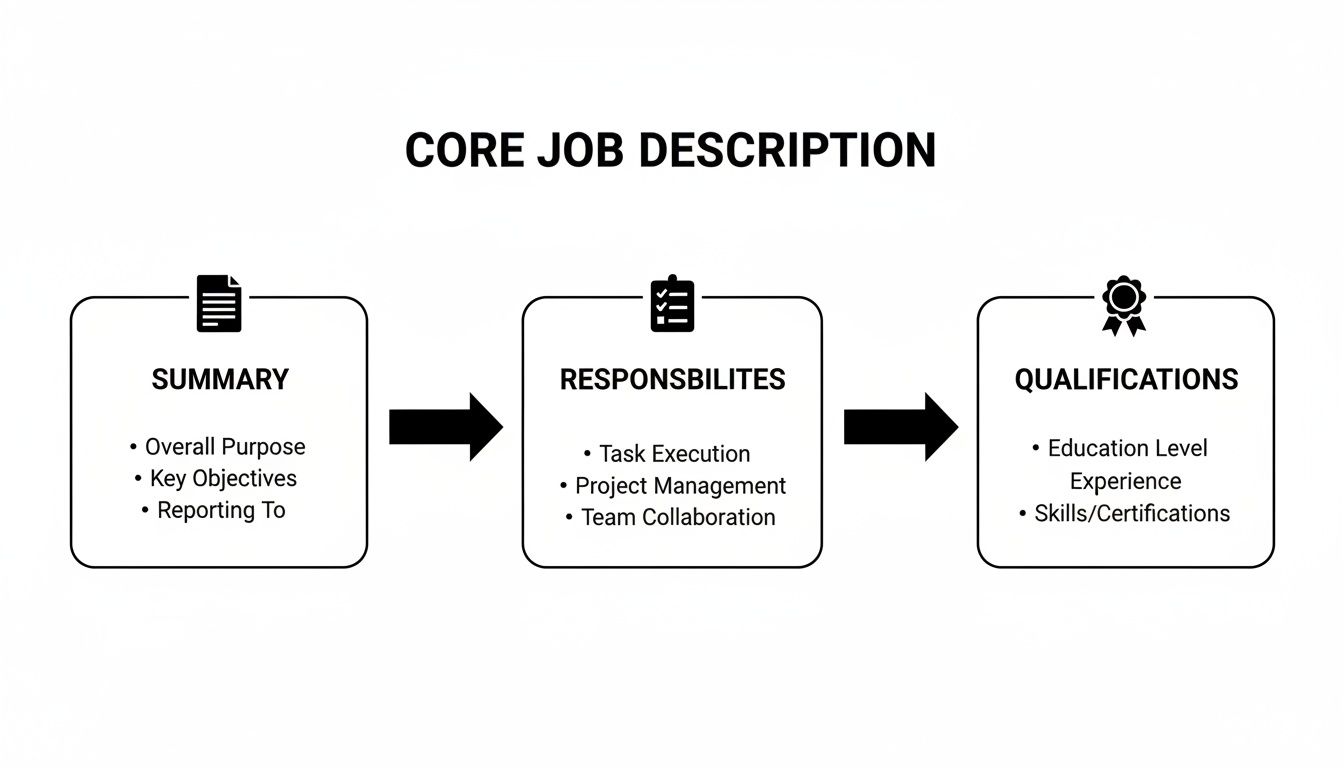
With that structure in place, let's add the high-impact elements that really get attention.
Be Explicit About Scheduling and On-Call Duties
For so many clinicians, the real source of stress isn't the work itself, but the chaotic schedule that bleeds into their personal lives. Any ambiguity here is a massive red flag.
You have to be direct and transparent. If the role has a predictable schedule, that's your headline.
- Weak Phrasing: "Flexible full-time schedule."
- Strong Phrasing: "This is a stable Monday-Friday role from 8 AM to 4 PM. There are no evening, weekend, or on-call responsibilities."
That last sentence is pure gold. Phrases like "No Call, No Weekends" act as a beacon for clinicians who are actively trying to build a sustainable career. Don't bury this detail—feature it right up in the summary and again in the scheduling section.
Define the Daily Workload and Patient Volume
The fear of being thrown into an impossibly busy clinic is a primary driver of burnout. A great job description calms this anxiety before the candidate even applies by setting clear expectations.
Forget generic statements. Get specific with the numbers.
A clinician reading "see 16-18 patients per day with 1 hour of protected administrative time" feels an immediate sense of relief. It shows your organization has actually designed the role to be manageable and respects their need to catch up on documentation.
This kind of transparency builds trust instantly. It shows you value quality of care over sheer volume.
Frame Compensation as Financial Wellness
Salary is obviously critical, but how you talk about it makes a huge difference. The most forward-thinking employers frame compensation not just as a number, but as a tool for achieving long-term financial health and personal freedom.
Start by listing a clear salary range. This is quickly becoming a non-negotiable for candidates and is already a legal requirement in many states. But then, go further by connecting the dots to financial wellness.
- Retirement Benefits: Don't just say "401(k) available." Give the details that matter. "We offer a 401(k) plan with a 5% employer match, fully vested after one year, to help you achieve your long-term financial goals."
- Student Loan Repayment: If you offer it, quantify it. "Receive up to $25,000 annually in student loan repayment support."
- Long-Term Goals: Explicitly connect the compensation to goals like financial independence. A strong salary in a lower cost-of-living state can dramatically accelerate a clinician's path to FIRE (Financial Independence, Retire Early).
These details prove you're invested in your clinicians as people, not just as providers.
To make sure you're hitting all these points, use this checklist as a final review before you post your job description.
Burnout-Friendly Signals Checklist
This checklist will help you verify that your job description includes the key signals that resonate with modern clinicians prioritizing work-life balance.
| Signal | Why It Matters | Example Phrasing |
|---|---|---|
| No Call/No Weekends | This is the most powerful signal for burnout prevention. It immediately communicates a respect for personal time. | "This position includes no on-call, weekend, or evening responsibilities." |
| Specific Patient Volume | It replaces anxiety about workload with a clear, manageable expectation. | "Expect to see an average of 16-18 patients per day." |
| Protected Admin Time | Shows you understand and have planned for the "pajama time" burden of EHRs. | "Includes 1 hour of protected administrative time built into your daily schedule." |
| Clear Salary Range | Transparency builds trust and saves everyone time. | "The anticipated salary range for this position is $220,000 - $250,000 annually." |
| Specific Retirement Match | Details show you're serious about long-term financial health. | "401(k) with a 5% employer match, fully vested after one year." |
By including these specific, tangible details, your job description moves from a simple announcement to a compelling argument for why a top clinician should join your team.
The Growing Demand for Flexibility
The entire healthcare workforce is changing. A major demographic shift is happening right now, with the Association of American Medical Colleges (AAMC) reporting that more than two of every five active physicians will be 65 or older within the next decade.
This aging workforce, combined with a younger generation that demands better balance, is fueling a need for more flexible work. This is why the locum tenens market, for instance, is projected to grow by 5% in 2026.
This data isn't just a statistic; it's a call to action. Highlighting flexibility—whether it's a four-day work week, hybrid remote options, or well-structured part-time physician jobs—is no longer a niche perk. These are essential features of an attractive, modern clinical role. By communicating these benefits clearly, you'll speak directly to the needs of today's best candidates.
Effective Job Description Templates for Clinical Roles
All the theory in the world doesn't matter if you can't put it into practice. To help you get a running start, we’ve put together a few ready-to-use templates for common clinical roles.
These aren't just generic, fill-in-the-blank documents. We’ve strategically built them around the burnout-conscious principles we've been discussing. Think clear headings, scannable bullet points, and example language that highlights a supportive work environment from the get-go.
Feel free to use these as a solid foundation. Just remember to tweak them to fit your unique practice culture and the specific needs of the role.
Family Medicine Physician (MD/DO) Template
This one is geared toward an outpatient primary care clinic, with a heavy emphasis on work-life balance and a workload that won’t crush your soul.
Job Title: Family Medicine Physician (4-Day Work Week)
Job Summary:
Join our physician-led primary care clinic in sunny Austin, TX, where we believe that taking care of our doctors is the first step to providing exceptional patient care. We're looking for a dedicated Family Medicine Physician for a role that offers a 4-day work week, no on-call duties, and a capped patient panel of 18 per day. If you’re searching for a sustainable career path that offers both professional challenge and personal time, this is it.
Key Responsibilities:
- Provide comprehensive, evidence-based primary care to a diverse patient community, supported by a dedicated 1:1 MA scribe to keep your focus on patients, not paperwork.
- Manage a capped patient panel, giving you the time you actually need for thoughtful diagnosis, treatment, and follow-up.
- Jump into collaborative case discussions during our weekly protected team meetings, fostering a culture of shared learning and better outcomes.
- Work within our streamlined EMR system with 1 hour of protected administrative time built right into your daily schedule.
Schedule and Compensation:
- Schedule: Full-time, 4-day work week (32 clinical hours). You can count on no nights, no weekends, and no on-call responsibilities.
- Salary: The anticipated salary range is $225,000 - $250,000 annually, depending on your experience.
- Benefits: Comprehensive health, dental, and vision insurance; 401(k) with a 5% employer match; 4 weeks of paid time off; $3,000 annual CME stipend.
Nurse Practitioner (NP) Telehealth Template
This example is built for a remote role, zeroing in on the autonomy, flexibility, and tech that makes a virtual practice thrive.
Job Title: Remote Psychiatric Nurse Practitioner (PMHNP)
Job Summary:
Make a real difference from the comfort of your own home. Our growing telehealth practice is looking for a board-certified Psychiatric-Mental Health Nurse Practitioner (PMHNP) to provide compassionate, virtual care to adult patients. You'll get the autonomy to manage your own schedule within core hours and the full backing of a dedicated clinical operations team.
Key Responsibilities:
- Conduct initial psychiatric evaluations and ongoing medication management through our secure, user-friendly telehealth platform.
- Develop and implement personalized treatment plans in collaboration with your patients.
- Maintain accurate and timely clinical notes with the help of our AI-powered charting assistant.
This role is perfect for a self-motivated NP who craves flexibility and is passionate about improving access to mental healthcare. We provide the platform and the support; you bring the clinical expertise.
Schedule and Compensation:
- Schedule: Fully remote, flexible 30-40 hours per week. You set your own patient hours between 9 AM - 6 PM in your time zone. No on-call or weekend work required.
- Compensation: Highly competitive per-visit rates with an expected annual income of $140,000 - $160,000.
- Benefits: Technology stipend, full malpractice insurance coverage, and access to peer consultation groups.
Physician Assistant (PA) Urgent Care Template
This template is for a fast-paced but highly structured urgent care environment. The goal here is to highlight team collaboration and predictable shift work, which are huge draws for many PAs. A well-crafted PA job description is more critical than ever, especially as roles become more specialized.
Job Title: Physician Assistant - Urgent Care
Job Summary:
Join a tight-knit team at our modern urgent care center, where you can focus on acute patient needs without the long-term grind of longitudinal care. We’re looking for an experienced Physician Assistant (PA-C) who thrives in a collaborative, team-based setting. This role offers predictable 12-hour shifts and zero on-call duties, making for a fantastic work-life balance.
Key Responsibilities:
- Evaluate, diagnose, and treat patients presenting with acute illnesses and injuries.
- Perform common urgent care procedures like suturing, splinting, and I&Ds.
- Work hand-in-hand with supervising physicians and other APPs in a genuinely supportive environment.
Schedule and Compensation:
- Schedule: Three 12-hour shifts per week with a consistent, rotating schedule published well in advance.
- Salary: Base salary of $135,000 plus quarterly performance bonuses.
- Benefits: Full medical benefits, PTO, CME allowance, and a 401(k) plan.
These templates should give you a powerful starting point. For more examples and to see how leading healthcare organizations are attracting top talent, check out the curated listings on our physician job board.
Boosting Visibility and Ensuring Inclusivity
A perfectly crafted job description is only half the battle. If the right candidates never see it, all that work goes to waste. Once you’ve nailed the role’s details, your next job is to make sure your posting gets in front of the clinicians you actually want to hire. This comes down to two key things: smart search optimization (SEO) and a genuine commitment to inclusivity.
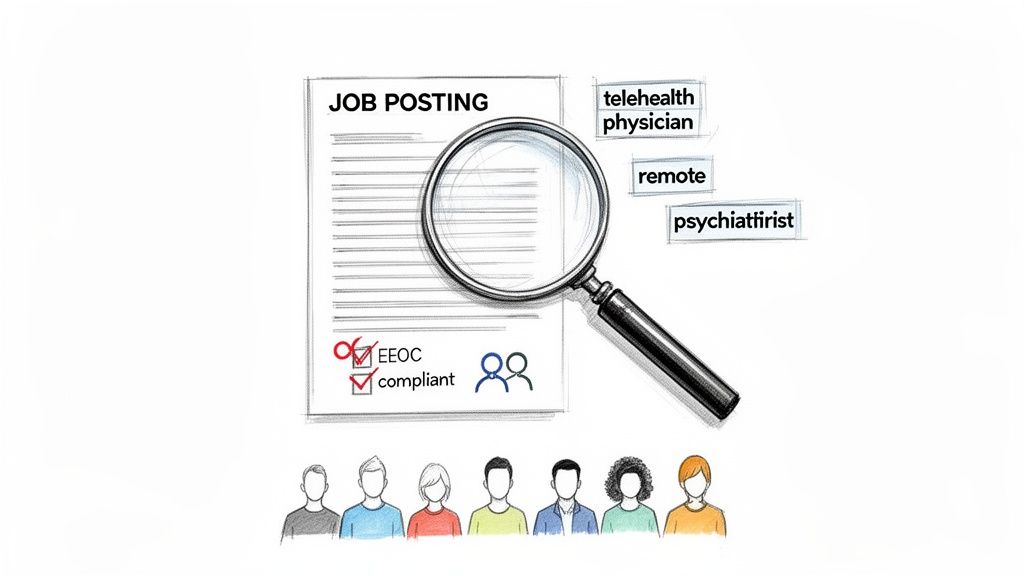
This isn’t just a "nice-to-have." With the World Health Organization projecting a global shortage of at least ten million healthcare workers by 2030, every single qualified applicant is gold. You can't afford to be invisible or unintentionally turn people away.
Making Your Post Search-Friendly
Clinicians aren’t just scrolling aimlessly; they’re searching with purpose. Put yourself in their shoes. What terms would a burned-out family medicine doctor type into a job board search bar?
They’re probably looking for their specialty, a specific work style, and maybe a location. Your goal is to sprinkle these exact phrases throughout your posting.
- Job Title: Don't just say "Physician." Be specific. "Remote Family Medicine Physician (No Call)" is much better.
- Job Summary: Weave in keywords naturally. Start with sentences like, "This full-time telehealth psychiatrist role..." or "Our growing outpatient clinic in Houston is seeking..."
- Responsibilities: Think about the day-to-day. Include terms like "virtual consultations," "outpatient procedures," or "flexible patient scheduling."
It’s a simple change, but aligning your language with what candidates are actively searching for makes a massive difference in whether your job shows up on page one or page ten.
The key is to write a searchable job description, not just a descriptive one. The best candidates are hunting for signals of a better work-life balance, so make those keywords easy for them to find.
If you need more hands-on help, you can always find specialized recruitment agencies that live and breathe the nuances of clinical hiring.
Writing for Everyone: Inclusivity and Compliance
Beyond getting found, your language needs to feel welcoming to every single qualified person who reads it. An inclusive job description not only attracts a broader, more diverse pool of talent but also keeps you compliant with Equal Employment Opportunity Commission (EEOC) guidelines.
It’s surprisingly easy for unconscious bias to creep into your writing and discourage great people from even applying. You have to be deliberate with your words.
How to Write an Inclusive Job Description:
- Use Gender-Neutral Language: This is non-negotiable. Swap "he/she" for "they" or "the candidate." Use neutral titles like "chairperson" or "department head" instead of gendered ones.
- Ditch the Coded Language: Words like "rockstar," "ninja," or "hacker" often come across as exclusionary and tend to be associated with a young, male-dominated tech culture. Stick to clear, professional descriptions of the skills you actually need.
- Separate Must-Haves from Nice-to-Haves: Be honest about what is truly essential for the job. Piling on overly specific qualifications can unintentionally screen out fantastic candidates from non-traditional backgrounds who are more than capable of doing the work.
Making these adjustments sends a clear signal: your organization values diversity and is serious about building an equitable workplace. That doesn't just improve your applicant pool—it builds your reputation as an employer people genuinely want to work for.
Of course. Here is the rewritten section, crafted to sound like an experienced human expert and match the provided style guide.
Answering Your Top Questions About Physician Job Descriptions
Even with the best templates, certain questions always come up when you're writing a physician job description. Whether you're an employer trying to attract top talent or a clinician trying to decode a listing, the details matter. Let's get straight to the most common queries.
How Long Should a Physician Job Description Be?
Aim for the sweet spot: between 500 and 800 words. That’s enough space to cover the essentials—duties, schedule, patient load, compensation—without becoming a novel that a busy doctor will just skim.
But honestly, the word count is less important than the structure. Use clean headings, bullet points, and short paragraphs. This lets a candidate jump right to what they care about most, like the on-call schedule or salary range. A well-formatted post feels concise and respectful of their time, no matter the length.
What Are the Biggest Mistakes to Avoid?
The single most damaging mistake is being vague. Using phrases like “competitive salary” or “flexible schedule” is a massive red flag for today's clinicians. They’ve learned from experience that ambiguity usually means the reality is disappointing.
Other common blunders include:
- Forgetting the Vibe: A job is more than a list of tasks. You need to sell the environment. What’s it really like to work there?
- Creating Impossible "Requirements": Listing a dozen “must-haves” that are actually “nice-to-haves” will scare off great candidates who might have a non-traditional background but are perfect for the role.
- Ignoring How Doctors Actually Search: If you don't use the keywords clinicians are typing into search bars, your perfect job will stay buried on page ten of the results.
Getting this right means shifting your mindset. You're not just filling a slot; you're marketing a career-defining opportunity to a highly sought-after professional.
What Red Flags Should Clinicians Look For?
For clinicians, the red flags are basically the reverse of the mistakes above. Be deeply skeptical of any physician job description that avoids concrete numbers and details.
Vague language is your biggest warning sign. If they can’t clearly state the compensation, patient volume, or on-call duties, it means one of two things: the organization is a mess, or they’re hiding something you won’t like.
Also, watch out for catch-all phrases like “duties as assigned.” That can be code for all the undesirable work no one else wants to do. A great employer respects you enough to be upfront about call schedules, admin time, and weekend expectations. If that information is missing, it speaks volumes.
How Important Is SEO for a Job Description?
It’s not just important; it’s absolutely critical. Clinicians don't casually browse job boards. They search with purpose. A psychiatrist will type in "remote telepsychiatry job," and a family doctor might search for "no call family medicine jobs in Texas."
If those exact keywords aren't in your job title, summary, and body, you're invisible to the most relevant candidates. Good SEO is what connects your thoughtfully crafted opportunity directly to the professional who is actively looking for it. It's the bridge between your opening and their career goals.
Ready to find a role that respects your time and expertise? At WeekdayDoc, we curate burnout-friendly physician jobs that prioritize work-life balance. Browse listings with transparent salary data, "No Call" and "No Weekends" guarantees, and our proprietary Burnout-Friendly Score. Start your search for a sustainable career today at https://www.weekdaydoc.com.