Remote Pediatric Nurse Practitioner Jobs
Explore remote pediatric nurse practitioner jobs and compare credentials, state licensure, pay, schedules, and clinical support before applying.

A remote title tells you where you work, but it doesn't guarantee a sustainable schedule or a strictly pediatric caseload. Healthcare organizations apply the remote label to everything from autonomous asynchronous work to monitored telehealth shifts requiring weekend availability.
When searching for remote pediatric nurse practitioner jobs, you need a reliable way to evaluate the daily reality of the position. A listing might highlight the convenience of a home office while burying the details about state licensure costs, unpaid documentation time, and strict visit quotas. WeekdayDoc helps you look past the basic job title by providing structured data on work-life balance, call requirements, and salary percentiles, making it easier to judge whether a role is financially fair and operationally livable.
What Remote Pediatric NP Jobs Involve
The remote label describes where you work, leaving the patient population and schedule flexibility undefined. Employers organize these positions into several distinct lanes, and your daily workflow depends on which lane a specific job occupies.
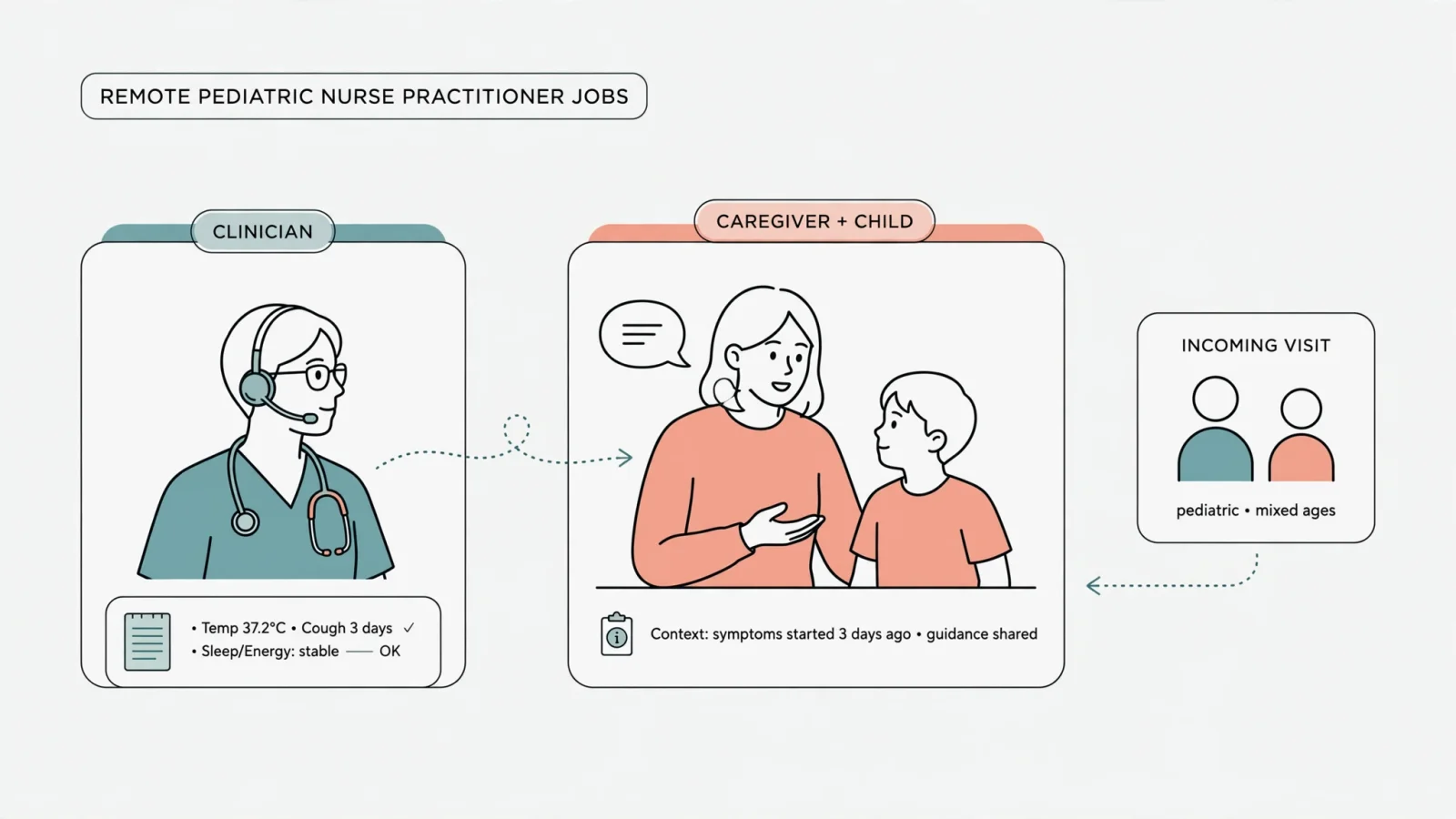
Direct virtual care forms the most visible category, involving live video or audio visits with patients and their caregivers. You might handle scheduled primary care follow-ups, behavioral health check-ins, or on-demand virtual urgent care. Because urgent care platforms often operate around the clock, the work can resemble a traditional clinical shift delivered through a webcam. You sign on at a specific time, clear a queue of waiting patients, document the encounters, and sign off.
Some platforms mix patient populations to maintain high visit volumes. A virtual urgent care posting might advertise for a nurse practitioner, but the daily queue could include both adults and children. Ask whether the employer expects you to treat all ages or if they route pediatric cases exclusively to clinicians with pediatric certifications. Assuming a role limits your panel to children because the word pediatric appeared in the search results risks an immediate mismatch during onboarding.
Adjacent remote clinical work offers a different daily experience. Healthcare systems, insurance companies, and digital health startups hire clinicians for care management, triage, utilization review, and clinical quality assessments. These positions often involve chart reviews, phone consultations with caregivers, and coordination with local primary care offices. Because they do not always involve diagnosing or prescribing, some adjacent roles accept a broader range of nursing credentials. Confirm whether a specific non-clinical opening requires advanced practice status or if a registered nurse license suffices, as that distinction influences the salary band.
Which Credentials Fit Remote Pediatric NP Roles?
Advanced practice registered nurses generally need at least a master's degree in an APRN specialty, an RN license in their state, national certification, and a state APRN license. The Bureau of Labor Statistics summary outlines these baseline occupational standards, and it notes that requirements vary by state.
The Pediatric Nursing Certification Board maintains separate certification pathways for primary care and acute care. A primary care certification requires at least 500 supervised direct-care clinical hours in primary-care pediatrics, whereas acute care follows a different clinical hour requirement focused on complex, critical, or chronic illness. Telehealth platforms focusing on routine childhood illnesses, sleep consultations, or behavioral health typically require the primary care credential. Virtual hospital-at-home programs or specialty remote monitoring roles may demand an acute care background.
Pediatric clinical experience alone does not override a missing credential. If a digital health company requires a family nurse practitioner to treat a mixed-age patient panel, your years working in a brick-and-mortar pediatric clinic will not satisfy their credentialing department. Conversely, a platform building a specialized pediatric service line might reject an FNP application in favor of a candidate holding a specific pediatric nurse practitioner certification. Matching your formal training and active certifications to the exact posting prevents delays. Finding the right fit becomes easier when you understand nurse practitioner work-life balance by setting, as different credential paths often lead to distinct daily workflows.
Review Patient-State Licensure Rules
Because nursing practice, including telehealth, takes place where the patient is located, licensure follows that state's rules. The National Council of State Boards of Nursing explains that qualified nurses can apply for a multistate license to practice in other compact states without additional licenses, but they need a single-state license to practice in noncompact states.
Operating a national or regional telehealth panel requires holding an active APRN license in every state where your patients reside. Some states also enforce specific prescribing regulations, especially for controlled substances, and may require a pre-existing in-person relationship before a provider can issue certain medications remotely. Ask the hiring team exactly which states fall within your expected coverage area.
Maintaining a roster of ten or fifteen state licenses involves significant administrative burden and high renewal fees. Ask the employer if they cover the upfront application costs, fingerprinting fees, and ongoing renewal expenses for every required state, and confirm who handles the paperwork. Some mature telehealth companies employ dedicated credentialing teams that manage the entire multi-state application process on your behalf, while startups might expect you to complete the applications on state board websites and wait for reimbursement.
Your own work location may also be restricted. A company might require you to maintain your primary residence in a specific state for tax purposes, even if you hold licenses elsewhere. Others require you to work from a private, locked room with a hardwired internet connection, prohibiting you from taking shifts while traveling. Verify these geographic and technical constraints before signing an offer.
Evaluate the Pediatric Care Model
A sleek scheduling application often masks the underlying clinical environment. Look past the software to evaluate the actual care you will deliver, as treating children remotely introduces unique clinical challenges that adult-focused telehealth platforms sometimes overlook.
The American Academy of Pediatrics recommends that virtual visits include appropriate caregiver involvement, secure connections, and clear protocols for in-person referrals. In interviews, use these standards to ask the medical director which ages and conditions the platform covers. A service treating mild allergic rhinitis in teenagers operates differently than one attempting to diagnose acute otitis media in a non-verbal toddler.
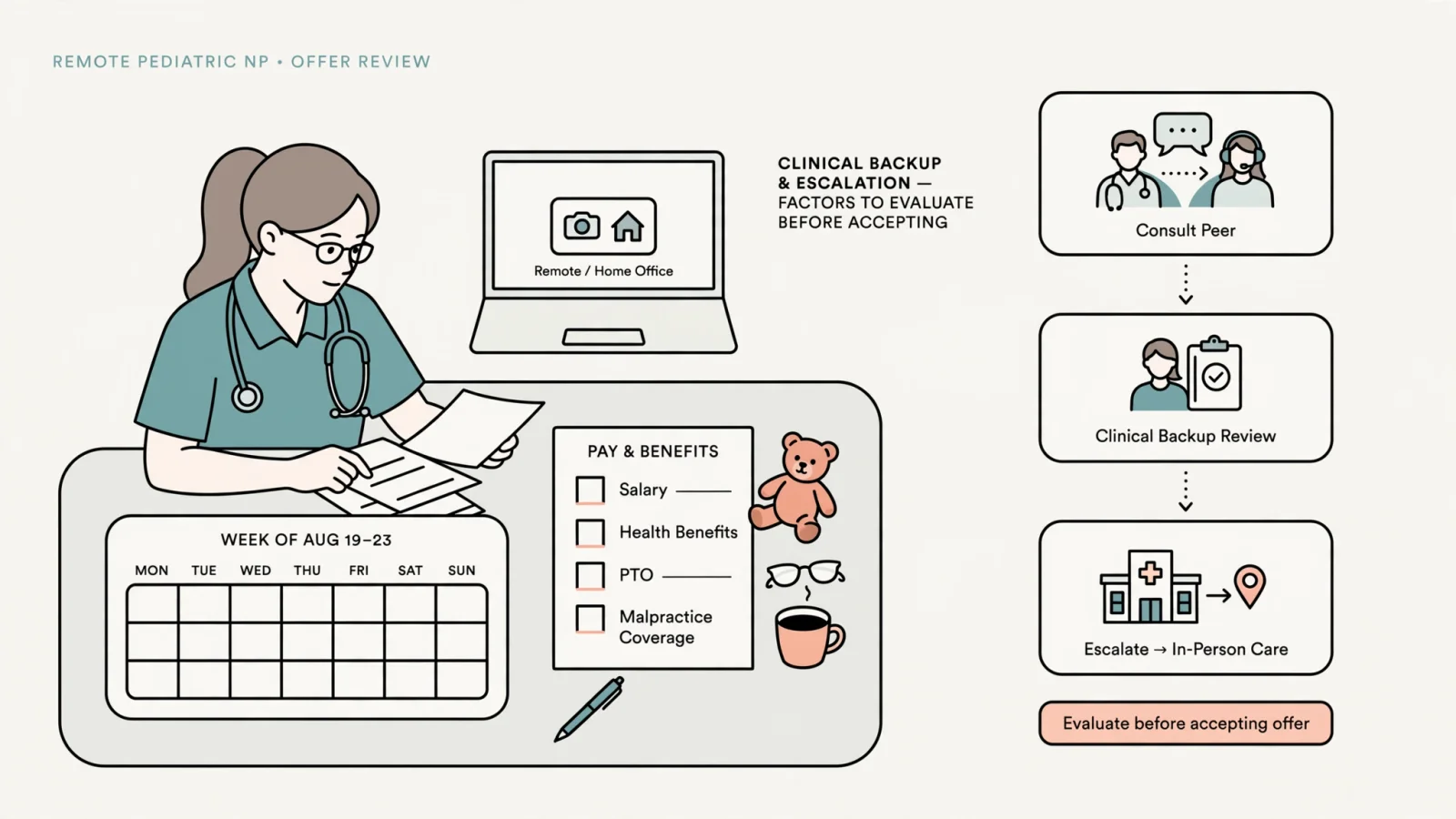
Understanding the platform's limits helps determine how well it supports your clinical judgment. Ask what symptoms trigger a mandatory escalation to an in-person emergency department or local urgent care. If a caregiver logs on with a visibly lethargic infant, you need a clear process for directing them to immediate physical care without spending twenty minutes arguing with customer service.
Review the available clinical backup, since remote work can feel isolating when a complex case appears on your screen. Determine whether a supervising physician or a seasoned peer is available for immediate consultation. Ask how the platform handles caregiver consent and adolescent privacy, particularly when teenagers need confidential discussions regarding reproductive health or mental health.
Coordination with the child's established medical home maintains long-term patient safety. Check whether the platform automatically faxes or securely transmits visit summaries to the family's local pediatrician. Confirm who handles patient technology support, ensuring that troubleshooting a broken microphone falls to a dedicated IT desk rather than your limited clinical time.
Compare Compensation Beyond the Headline
Remote nursing roles present complex pay structures that look different from traditional hospital salaries. The Bureau of Labor Statistics reported a national median annual wage for nurse practitioners of $126,260 in May 2023. This number provides a broad occupational benchmark, but it does not represent a guaranteed salary for a pediatric telehealth role. You have to compare the full compensation model to understand your true earning potential.
Employers hire remote practitioners either as W-2 employees or 1099 independent contractors. A W-2 role usually offers a predictable salary, paid time off, health insurance, and employer-sponsored retirement plans. A 1099 arrangement often pays a higher hourly or per-visit rate, but you must cover your own health insurance, self-employment taxes, and unpaid time off. Comparing the financial value of these offers requires understanding nurse practitioner 1099 versus W-2 pay structures in detail.
Review how the platform calculates your time. Guaranteed hourly pay ensures you earn money regardless of patient volume. Visit-based pay shifts the financial risk of low census directly onto your shoulders, meaning you sit at your desk unpaid if a patient misses an appointment or the marketing team fails to drive traffic. Ask about the cancellation and no-show policies to find out if the employer pays a partial fee for a missed appointment.
Documentation time often becomes a hidden tax on your earnings. Some platforms expect you to complete all charting, answer patient messages, and attend staff meetings outside of your billable hours. If an employer pays for time spent face-to-face on video, your effective hourly rate drops significantly once you factor in the administrative workload. WeekdayDoc makes these variables visible by showing market percentiles and tracking dollar-per-RVU benchmarks where relevant, helping you identify lowball offers wrapped in the promise of remote convenience.
Always review the liability coverage. The employer should provide comprehensive malpractice insurance, including tail coverage that protects you if a claim arises after you leave the company. If the contract forces you to purchase your own tail policy, you could face a substantial bill upon resignation. Check for repayment clauses tied to licensing fees or credentialing costs, as some companies require you to refund these expenses if you depart within the first year.
Review the Expected Schedule
Working from home rarely guarantees complete scheduling freedom. Remote platforms require predictable coverage to meet patient demand, often translating to rigid scheduling expectations for clinicians.
Telehealth platforms offering 24/7 care need clinicians to work nights, weekends, and holidays. Ask how the company distributes these unpopular shifts. Some employers require a strict weekend rotation, while others rely on a differential pay structure to attract voluntary night coverage.
Time zones complicate remote schedules. If you live in New York but work for a platform serving a heavy concentration of patients in California, your late afternoon shift might stretch well into the late evening. Verify the exact time zone used for scheduling and clarify how daylight saving time transitions affect your logged hours.
Assess the expected volume and shift control. Some platforms dictate how many patients you must see per hour, utilizing strict queue-management software that flags your account if you fall behind. Others allow you to set your own pace, giving you the autonomy to spend extra time with an anxious parent. High visit quotas combined with complex pediatric presentations can quickly become exhausting.
WeekdayDoc evaluates these operational details to generate a 0-to-10 work-life and burnout score for each listing. By quantifying call coverage, weekend requirements, schedule flexibility, and administrative burden, the platform helps you compare the true demands of different jobs. You can use a nurse practitioner contract negotiation guide to translate these insights into a stronger counteroffer, ensuring your written agreement matches the verbal promises made during your interviews. Wait to resign from your current job until every scheduling expectation is spelled out in your signed contract.
Questions to Ask Before Accepting
Turning your evaluation into a structured interview checklist prevents key details from slipping through the cracks. Bring these questions to your final meetings with the hiring manager or medical director:
- Is the patient panel strictly pediatric, or will I treat mixed-age populations?
- Which specific nursing credentials and population certifications do you require?
- Which patient states must I hold licenses in, and do you cover the application and renewal costs?
- What are the exact scheduled hours, time zone rules, and weekend expectations?
- Am I paid a guaranteed hourly rate, or is compensation strictly visit-based?
- Does my paid time include documentation, chart review, and staff meetings?
- Who handles technical support when a family cannot connect to the video platform?
- What pediatric clinical protocols dictate mandatory in-person escalation?
- Does the company provide malpractice insurance with full tail coverage?
- Are there any financial repayment clauses if I leave the role within the first year?
Search and Compare Remote Pediatric NP Listings
Finding the right role requires testing different search phrases. Employers use varying terminology, so search for remote pediatric NP jobs, pediatric telehealth nurse practitioner jobs, virtual pediatric urgent care NP, and pediatric telemedicine jobs. If you want a reduced schedule, look specifically for part-time remote pediatric NP jobs to filter out the high-volume corporate postings.
Filter your results by the accepted credential, the eligible patient states, and the specific setting. A care management role at an insurance company will demand a completely different skill set than a direct-care position at a startup urgent care platform. Read the written job description rather than relying on the title, since postings change rapidly. A company that offered flexible hours last quarter might have shifted to strict shift requirements today.
WeekdayDoc organizes these search results around the data that impacts your daily life. You can compare listings by their disclosed schedules, call burdens, and compensation models. Paid clinician features include AI-matched job alerts that notify you when a role fits your exact parameters, alongside negotiation scripts to help you secure a better rate.
Before signing any paperwork, run the document through the WeekdayDoc AI contract scanner. You can upload a PDF or paste the text directly into the tool. It acts as a targeted review aid, flagging aggressive non-compete clauses, missing tail coverage, and hidden payback conditions. While it does not replace formal legal advice, the scanner highlights the specific sections you need an attorney to review.
Employers also benefit from transparency. Hiring teams that clearly disclose their patient age range, required credentials, eligible states, and paid administrative time attract better candidates. Using these tools to compare operational workloads can help you find a remote pediatric nurse practitioner job that supports a sustainable career.
Find a role that respects your time and your license. Search opportunities, compare burnout scores, and review market salary percentiles at WeekdayDoc.