Physician Assistant Contract Review: 8 Clauses
Review a PA contract for scope, supervision, productivity pay, call, schedule changes, malpractice tail, termination, and restrictive covenants.

The gap between a job posting and a signed agreement is often wide, as a listing might advertise a flexible schedule while the formal contract permits unilateral changes to clinic hours. Similarly, an employer may state that malpractice is covered without mentioning that you remain responsible for an expensive tail policy upon departure. A role that appears to have low call requirements can carry a different workload once you read a clause requiring other duties as assigned.
A thorough physician assistant contract review covers clinical safety, finances, and work-life fit rather than focusing only on salary. Preparing your documents for review takes organization, which is why WeekdayDoc provides an AI contract scanner that surfaces terms to question before you decide whether to sign. Running your document through the tool highlights restrictive covenants, tail obligations, and payback clauses so you can prepare specific questions for qualified legal counsel.
Read the Complete Contract Package
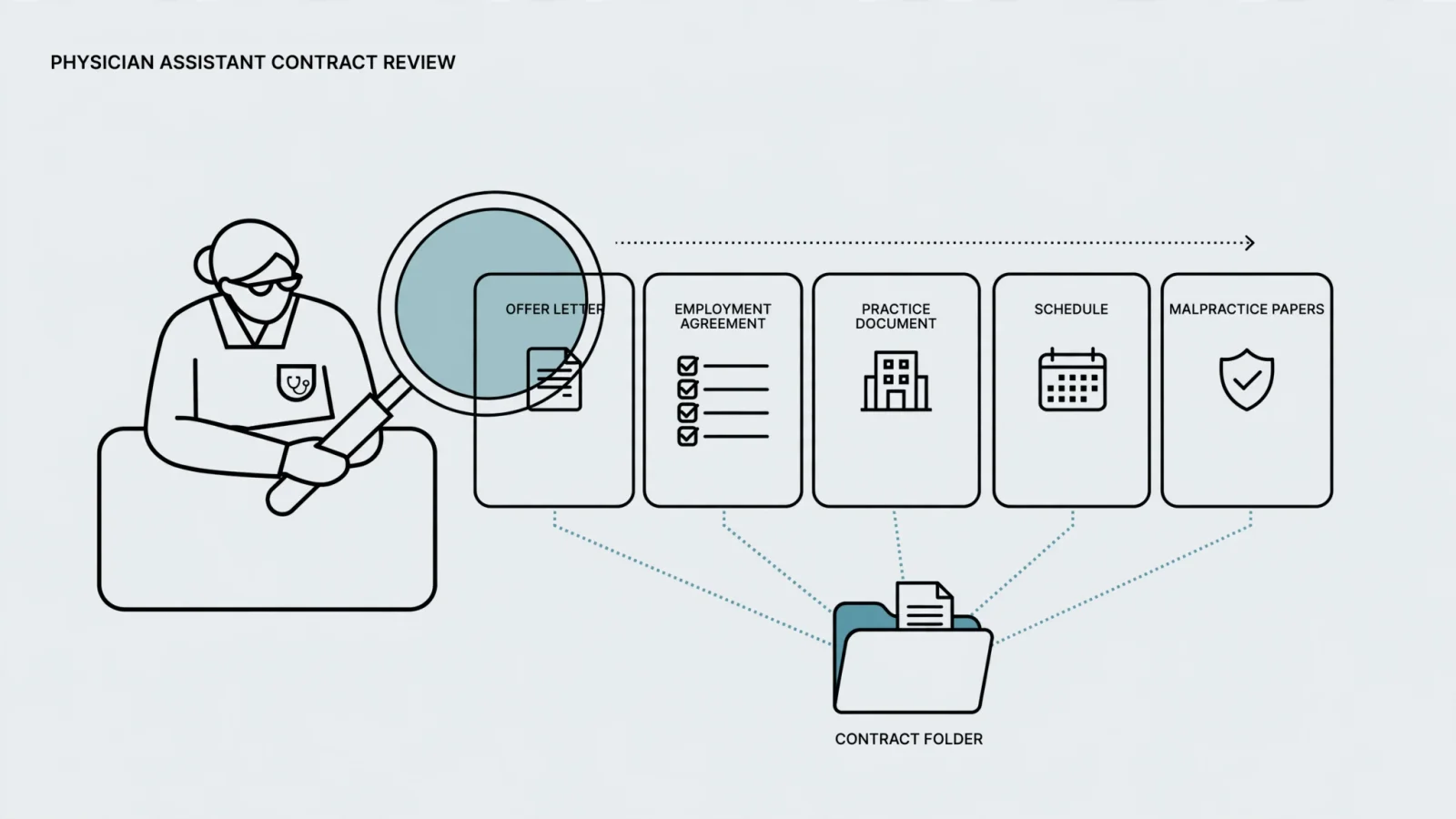
Evaluating an offer requires reading every document that governs your employment, because an isolated base salary figure means little if a separate, unseen policy dictates how you earn it.
Match the Offer to the Agreement
Gather your employment agreement or independent-contractor agreement, offer letter, and compensation exhibits to ensure the final contract matches the initial offer letter. Employers sometimes leave negotiated terms out of the final draft by assuming a verbal promise covers the difference. Ask for the employee handbook, and make sure all negotiated promises appear in the formal contract rather than remaining in a separate policy. If an employer promises remote charting time or a specific location, those terms require written confirmation.
Gather Policies, Practice Documents, and Insurance Details
Beyond the core agreement, collect the written job description, supervision protocols, and the call schedule policy alongside the malpractice declarations page or certificate of insurance. Having all documents regarding restrictive covenants, confidentiality, nonsolicitation, sign-on bonuses, relocation funds, and training-repayment agreements allows you to review the credentialing and privileging requirements for your specific site. Policies incorporated by reference but not provided with the contract are binding, meaning you agree to terms you have not read unless you request them. Check whether the employer can revise those external policies without notice, which could alter your working conditions later.
Evaluate W-2 Versus 1099 Economics
When an arrangement classifies you as a 1099 independent contractor instead of a W-2 employee, the economics of the deal change. Independent contracting shifts self-employment taxes, health insurance costs, retirement funding, and professional liability premiums entirely to you, while also adding expenses for equipment, technology, billing, and credentialing. You will need to determine how much unpaid administrative time the role requires and whether the higher hourly rate compensates for the lost benefits and paid time off. State and federal rules also limit when a clinician can legally operate as an independent contractor, making regulatory review a necessary step.
Define Scope, Supervision, and Clinical Autonomy
Your employment contract does not exist in a vacuum. Depending on the state and setting, practice agreements, collaboration documents, facility bylaws, clinical privileges, and payer rules also govern your scope.
Map Duties, Sites, and Privileges
Identify your exact specialty and patient population in the document so the language clarifies your inpatient, outpatient, emergency, surgical, procedural, or telehealth duties. Pinpoint the locations and sites where the practice may assign you to work, and verify that the contract lists the procedures you will perform alongside your prescribing authority limitations. Comparing these contractual expectations against your clinical training and the facility's credentialing requirements prevents situations where a practice expects you to perform procedures outside your clinical privileges, putting your license at risk.
Confirm Backup and Practice Relationships
Identify the named supervising or collaborating physicians where applicable. For Medicare-related services, the Centers for Medicare & Medicaid Services states that Medicare covers PA services only when the PA performs them according to state law and scope-of-practice rules and under physician supervision. Find out who handles clinical backup during nights, weekends, and emergencies, and clarify response expectations when the primary physician is unavailable. To clarify those arrangements, confirm in the agreement how consultations and backup are handled, including whether communication is by phone, video, or in person. Then check applicable state law alongside the agreement to understand how the physician relationship is structured.
Flag Open-Ended Assignment Language
Watch for language that describes your supervision as assigned or outlines other clinical duties as determined by the employer. A contract lacking a backup physician or a response-time standard leaves you vulnerable during complicated patient presentations, so a contract allowing an employer to expand your duties or reassign you to another department without training or compensation requires revision. If the contract references a practice agreement, verify that the employer attached it.
Model Compensation and Productivity Pay
The goal of reviewing the compensation section is to determine how much you can realistically earn under normal working conditions, since an advertised base salary is only one variable.
Separate Guaranteed Pay From Incentives
Inventory your base salary, the length of your guaranteed salary period, and any draw or advance against future productivity, along with all sign-on bonuses, retention incentives, relocation funds, and loan-repayment benefits. Separating these guaranteed figures from the productivity threshold, work-unit methodology, conversion factor, and quality incentives provides a clearer picture of your floor income. From there, you can understand your call pay, extra-shift pay, and compensation for administrative or leadership duties, as well as the payment timing, the reconciliation process, and your rights to post-termination payments.
Rebuild the Formula With Real Work
An illustrative productivity formula might add the product of eligible work units above a threshold and a conversion factor to your base salary, alongside defined quality payments. This structure serves as an example rather than a universal PA standard. Ask which relative value unit schedule applies and whether the employer can change the conversion factor unilaterally, and determine whether procedures, follow-ups, telehealth visits, e-consults, and patient messages count toward your total. The AAPA Salary Report notes median PA compensation of $140,000 for data year 2025, and reports that more than 58 percent of PAs received a bonus from their primary employer. Use this data as market context rather than a salary floor, and ask if the practice compensates time spent on inbox work, refills, prior authorizations, charting, care coordination, teaching, and meetings. Modeling your ramp-up time, credentialing delays, vacation, holidays, and payer mix helps before treating any bonus as expected income.
Test Adjustments, Clawbacks, and Compliance
Discretionary bonuses and undefined quality metrics offer little financial security, especially if a negative productivity balance carries forward and allows a slow month to impact your future earnings. Penalty provisions, clawbacks, and prorated repayment requirements for early departure are severe warning signs. Compliance also matters because the Office of Inspector General explains that satisfying an exception to the physician self-referral law does not by itself protect an arrangement from liability under the federal anti-kickback statute. Formulas that reward referrals or the ordering of goods, facilities, services, or items reimbursable by a federal health care program warrant review by the employer's compliance team. Organize flags around payback clauses and missing formula terms so you can present them as direct negotiation questions.

Quantify Call, Schedule, and Change Rights
Schedule quality is a direct component of your compensation, and a high salary loses value if the position requires uncompensated overnight call and weekend coverage.
Turn Call Language Into Annual Workload
Identify your exact clinic hours, the number of clinical days per week, and your expected full-time equivalent status to translate vague rotation language into annual estimates. A one-in-six weekend rotation equals about 8.7 weekends per year, while a one-in-four overnight call requirement equals approximately 91 nights annually. Your actual burden depends on whether call involves a single shift, a full weekend, home call, in-house coverage, or frequent callbacks. Confirming your required response time, expected call volume, post-call relief policies, and any extra compensation for additional shifts clarifies the true time commitment.
Read Flexibility and Location Clauses Closely
Examine whether the employer has the right to move you from remote to on-site work, change clinic hours without your consent, or assign you to another location entirely. Clauses allowing an employer to add nights, holidays, or call shifts without a contract amendment invite burnout. Negotiating a formal notice period for any schedule changes and a maximum travel distance for reassignment protects your lifestyle. A material change to your duties gives you grounds to ask for additional compensation or a right to terminate the agreement without repayment obligations. For advanced practice clinicians seeking sustainable careers, researching nurse practitioner work-life balance by setting or similar PA benchmarks helps set realistic expectations before accepting vague terms.
Compare Promised Work-Life With the Contract
WeekdayDoc's listing-level work-life score evaluates call burden, schedule flexibility, clinical autonomy, and administrative workload before you apply, and the contract review verifies that the signed language supports the schedule that produced the score. Verbal promises regarding a four-day work week or protected charting time carry zero legal weight if the contract designates your schedule as subject to employer discretion. The physician assistant work-life balance guide on WeekdayDoc provides context on comparing advertised flexibility against binding contractual duties.
Verify Malpractice Coverage and Tail Responsibility
Never accept a verbal assurance that malpractice is included as a complete answer, because liability coverage depends on the specific policy type and the entity paying the premiums.
Identify the Policy Type and Limits
| Coverage type | What the PA should understand |
|---|---|
| Occurrence | Generally covers incidents that occur during the policy period, regardless of when the claim is filed. |
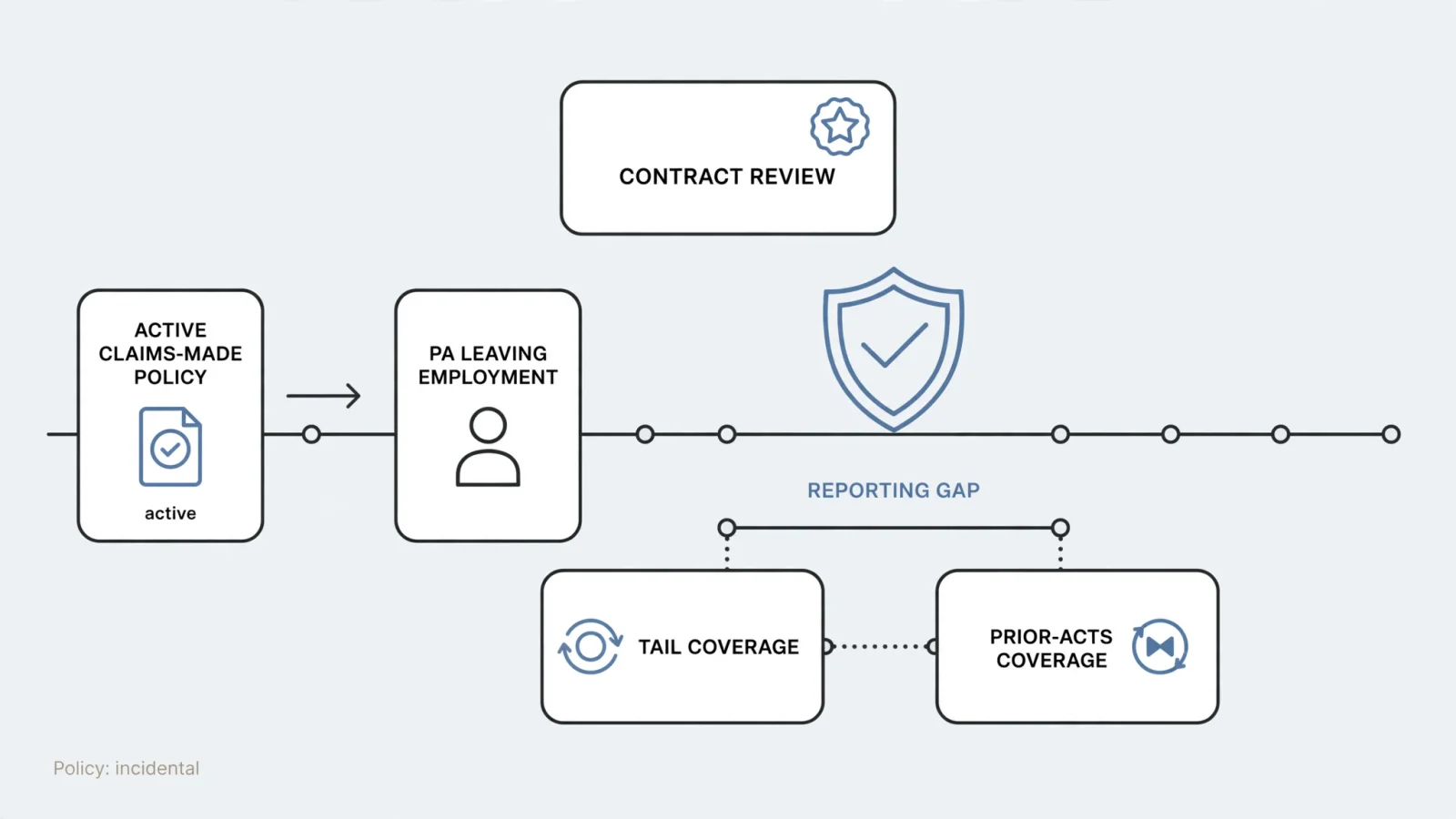
| Claims-made | Generally depends on the policy being active when the claim is made; leaving or changing insurers creates a coverage gap. |
| Tail coverage | Extends reporting protection after a claims-made policy ends. |
| Prior-acts or nose coverage | New coverage that protects against qualifying incidents from a prior policy period. |
Ask for the per-claim and aggregate limits, and check if defense costs fall inside or outside the policy limits, as costs inside the limits erode the money available for a settlement. Determining who controls settlement decisions and confirming the retroactive date ensures your past and future work remain protected. The policy should identify you as a named insured rather than merely covering you under a broad facility policy.
Assign Tail, Prior-Acts, and Defense Duties
The agreement should explicitly state who buys and pays for tail or prior-acts coverage when the relationship ends. Determine if this responsibility shifts based on how the employment terminates, as an employer firing you without cause should bear the cost of the tail policy. Ask what happens if the practice changes carriers, if you take unpaid leave, or if you retire. Establishing a strict timeline for when tail coverage is purchased prevents a dangerous reporting gap.
Request Proof of Coverage
Request a certificate of insurance or the declarations page every year, since a claims-made policy lacking tail language or a retroactive date represents a severe liability risk. An obligation for the PA to pay tail coverage regardless of why employment ends represents a substantial financial penalty for leaving a toxic work environment. Understanding these mechanics mirrors evaluating risk in alternative pharmacist careers or allied health roles, where precise liability boundaries define your long-term financial safety.
Evaluate Termination and Post-Employment Limits Together
The benefits section matters little if the termination clauses allow the employer to end your employment arbitrarily while enforcing restrictive covenants.
Clarify Termination, Cure, and Final Pay
Review the initial term length, renewal conditions, and any automatic evergreen language so you can distinguish termination without cause from termination for cause. Look for immediate termination triggers, formal notice periods, and defined cure periods that allow you time to fix non-urgent breaches. Clarifying your pay during the notice period and the handling of accrued paid time off, CME funds, and benefits helps you plan your transition. Review how the practice reconciles final bonuses and earned but uncollected compensation after your departure, along with rules for managing patient transition, record access for malpractice defense, and credentialing consequences.
Evaluate Repayment and Restrictive Covenants
Sign-on bonuses, relocation funds, and training-repayment clauses often tie directly to termination rights. Ensure repayment obligations are waived if the employer eliminates your position, initiates a termination without cause, changes your schedule materially, or fails to provide promised backup supervision. Review every post-employment restriction carefully to identify the geographic area, duration, and specific services covered beyond the standard noncompete paragraph. Checking whether the limits restrict telehealth practice, patient solicitation, employee solicitation, and the use of patient lists highlights potential career roadblocks. Identifying liquidated damages or buyout options allows you to exit the restriction cleanly.
Check State-Specific Enforceability
Do not assume a PA noncompete is automatically void or automatically enforceable. Currently, the FTC's Noncompete Rule is not in effect or enforceable. Because the federal rule is not in effect, review state law and the specific wording of your contract before assessing enforceability. For a jurisdiction-specific conclusion, review the reason your employment ends and the type of restriction, along with state statutes, licensing authorities, and local court decisions.
Translate the Review Into a Signing Decision
Negotiating every sentence in a contract frustrates both parties and rarely succeeds. Ranking your requested changes helps you focus on the clauses dictating your clinical safety, daily workload, liability, and exit risk.
Triage the Highest-Impact Red Flags
Use this checklist of severe contract warnings:
- Undefined scope or a missing supervision document.
- No named backup physician or clear response-time protocol.
- Unilateral employer rights to change schedule, location, or duties.
- Call assignments without frequency limits or specific compensation.
- Discretionary bonus formulas or missing productivity thresholds.
- No relative value unit credit for required administrative work.
- Bonus repayment or negative balances triggered upon departure.
- Unspecified malpractice types or PA-paid tail coverage regardless of termination reason.
- Noncompetes enforced after an employer terminates you without cause.
- Unavailable employee handbooks incorporated by reference.
- No written process for final bonus reconciliation.
- A 1099 arrangement that shifts taxes and insurance without an equivalent hourly rate increase.
- Remote or flexible work promised verbally but absent from the text.
Negotiate Open Terms Effectively
Key Elements in an Employment Contract Start your review with scope, backup supervision, schedule guarantees, call burden, compensation methodology, malpractice insurance, termination protocols, repayment obligations, and post-employment restrictions.
The Value of Legal Counsel An attorney familiar with PA contracts and the law in your specific practice location can provide valuable protection. Legal review is especially useful when facing noncompetes, claims-made malpractice coverage, complex productivity pay, 1099 classification, relocation repayment, or multistate practice.
Responsibility for Tail Coverage The contract should explicitly state who is responsible for tail coverage. If the policy is claims-made, tail or prior-acts coverage is necessary when you leave or change insurers, so never assume the employer covers this expense unless the text confirms it clearly.
Protections Against Schedule Changes Schedule adjustments depend on the exact agreement language and applicable state law. Look for clauses allowing changes to hours, location, call, specialty, or work setting, and negotiate notice periods, limits, additional compensation, or an exit right for material changes.
Enforceability of PA Noncompetes There is no reliable nationwide answer regarding noncompete enforcement. With the FTC's nationwide Noncompete Rule currently unenforceable, state law controls the outcome, meaning the wording of the restriction, the reason employment ended, and the type of restriction carry significant weight.
Evaluating Productivity Pay Translate the formula into realistic annual income using expected patient volume, work units, call requirements, administrative time, ramp-up delays, coding rules, and the employer's historical data, while evaluating base salary and expected incentive pay separately.
Beyond the Work-Life Score A score makes call, nights, weekends, flexibility, and administrative burden easier to compare before applying, but the signed contract must confirm those exact expectations.
Use WeekdayDoc Before You Sign
Review the full job offer before finalizing the agreement. Uploading your PA agreement to WeekdayDoc's AI contract scanner flags terms related to noncompetes, tail coverage, payback clauses, and other potential negotiation points. Using the results to prepare targeted questions and negotiation requests allows you to consult qualified counsel for formal legal interpretation. Evaluating the real lifestyle and financial trade-offs of a role before committing protects your career and prevents burnout.
Ready to compare sustainable clinical careers with transparent schedules and clear compensation data? Visit WeekdayDoc to search roles, check work-life scores, and scan your next contract.