Physician Tail Coverage: Who Pays, How It Works
Understand physician tail coverage, compare claims-made and occurrence policies, estimate tail costs, and negotiate who pays before signing an offer.

Physician tail coverage is an extended reporting endorsement that preserves malpractice protection for eligible medical services performed while a claims-made policy was active. By allowing claims to be reported after the primary policy ends, this endorsement protects past care. It does not provide liability protection for new patient visits conducted after you leave a practice, and any claim reported under a tail endorsement remains subject to the original policy’s retroactive date, limits, exclusions, and reporting requirements.
Salary and bonus figures look different once an unpaid post-employment obligation enters the equation. A high base salary loses its appeal if the contract shifts the entire cost of a reporting endorsement to the departing clinician. When evaluating job offers on WeekdayDoc, you can look past the compensation numbers to see the malpractice coverage type, tail payer, departure triggers, prior-acts coverage, limits, and telehealth status. Comparing these details upfront prevents unexpected financial liabilities from disrupting your career transition.
How Policy Type Dictates Your Liability
Understanding post-employment financial risk requires separating the two main types of medical liability insurance, because the policy structure dictates whether you will need a separate reporting endorsement.
Understanding the Coverage Trigger
Claims-made coverage responds when a claim is made or reported during the active policy period, provided the alleged medical incident falls after the policy’s applicable retroactive date. A later-reported claim falls outside coverage once the policy ends, which leaves a gap unless a tail endorsement or prior-acts protection applies.
Occurrence coverage behaves differently by responding based on when the underlying medical incident occurred. The policy in effect on the day of the treatment covers the event, even if the patient files the claim years later, making separate tail coverage unnecessary for those incidents.
Tracing a Delayed Claim
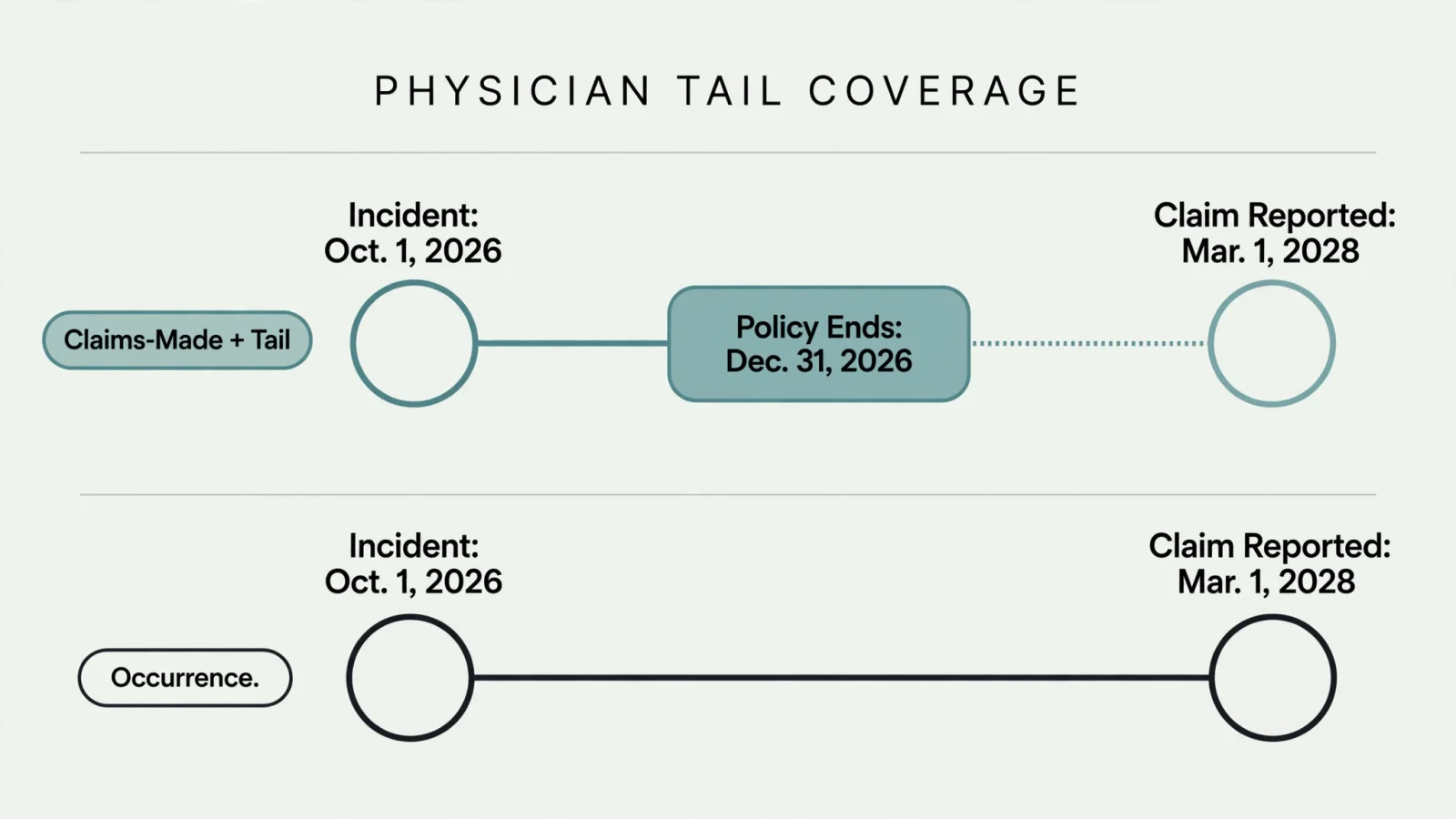
Consider a scenario for a physician named Dr. Lee to see how coverage triggers behave in practice. Dr. Lee treats a patient on October 1, 2026. The employment contract and the associated claims-made policy end on December 31, 2026. The patient files a malpractice claim on March 1, 2028. A Texas Medical Liability Trust comparison shows how the policy type changes the outcome for a delayed claim.
Without a reporting endorsement or prior-acts coverage, the claim falls outside the old claims-made policy because the patient filed it after the December 31 expiration date. If Dr. Lee purchased a tail endorsement, the claim falls under coverage since the endorsement extends the reporting window for incidents that happened before the policy ended. If Dr. Lee originally held an occurrence policy, that insurer responds to the March 2028 claim because the treatment occurred during the active coverage period in October 2026.
Retroactive Dates and Reporting Windows
A retroactive date marks the earliest date covered acts receive protection under a claims-made policy. Services performed before this date fall outside the coverage parameters.
The reporting period defines the window during which a claim must be made or reported for the insurer to defend it. Some policies include a short automatic reporting window of thirty to ninety days after cancellation. That brief grace period does not substitute for a full, unlimited reporting endorsement because you need long-term protection for claims that surface months or years after a patient encounter.
Bridging the Gap Between Employers
When you change jobs under a claims-made policy, you need a strategy to bridge the coverage gap. You typically have two ways to maintain protection for past services.
Buying an Extension From Your Old Carrier
You usually purchase an extended reporting endorsement from the prior claims-made insurer. That purchase extends the allowable time for reporting eligible claims arising from the old policy period. The original carrier’s limits, retroactive date, and specific conditions continue to govern how claims are handled.
Securing Prior-Acts Protection
You arrange nose coverage, known formally as prior-acts coverage, with your new insurer. This setup uses a retroactive date to include eligible services performed under the earlier claims-made policy. Setting up protection with the new carrier can eliminate the need to purchase an endorsement from the old carrier.
Verifying Your New Protection
A new employer does not automatically cover your past clinical acts. The new policy must specifically reach back to the first day of your relevant prior coverage. Review the document to confirm that the new insurer covers your exact specialty, procedures, practice locations, and telehealth work, provides adequate limits, and does not add problematic exclusions. Never cancel your old policy until the replacement arrangement is documented in writing, because an insurer nonrenewal or a practice change creates the same transition gap as a routine job change.

Allocating the Cost and Vesting Obligations
There is no universal U.S. rule assigning reporting endorsement costs to either the physician or the employer. The employment agreement, the policy form, applicable state law, and the specific circumstances of the departure dictate the financial responsibility. The American Medical Association advises in its physician contracting guidelines that these obligations should be written directly into the employment contract.
Common Payment Arrangements
Negotiated structures follow several predictable patterns. The strongest clinician protection happens when the employer pays the tail cost for every departure scenario. A common compromise requires the employer to pay after termination without cause, while the physician pays after voluntary resignation or termination for cause. Some contracts use tenure-based or prorated responsibility to shift the cost to the employer gradually over a period of years, whereas other agreements place the entire burden on the physician. Alternatively, the new employer might offer prior-acts coverage as part of a recruitment package.
Departure Events and Vesting
Vesting is a contract concept rather than a strict rule of malpractice insurance, meaning the employment agreement defines when the payment obligation arises. Read the document to see if responsibility shifts on the date you give notice, your last clinical day, the effective termination date, or the moment the policy expires.
The contract needs to define what constitutes "cause" for termination and specify whether a cure period exists before the employer can enforce that clause. A detailed agreement states the exact dollar or percentage responsibility required at each stage of your tenure. It should cover voluntary resignation, employer-initiated termination, disability, retirement, death, license-related departure, practice closure, sale, merger, and insurer nonrenewal. Separating the insurer’s duty to cover claims from the employment contract’s formula for paying the premium clarifies your personal exposure.
Managing Deductions and Reimbursements
Employers sometimes offer to pay the premium to the carrier but reserve the right to deduct the amount from your final compensation or unpaid bonus. The contract outlines the authorization requirements, caps, processing timeline, and your dispute rights for these deductions. Enforceability of wage deductions varies by jurisdiction, so state-law review is needed. WeekdayDoc surfaces these specific departure triggers in the platform, allowing you to compare open roles based on true post-employment risk instead of baseline salary alone.
Estimating Costs and Evaluating Policy Terms
Estimating the potential cost of an extended reporting endorsement helps you budget for a career change. A broad rule of thumb offers a starting point, but you still need actual numbers before making a final decision.
Using Planning Benchmarks
A recent American Medical Association guide for final-year residents cites an estimate of roughly 200 percent of the final-year premium for a reporting endorsement. Another benchmark suggests two to three times the policy premium at the time of cancellation.
These figures act as planning benchmarks rather than guaranteed quotes. The final cost depends on your medical specialty, geographic state, policy limits, claims history, the maturity of the claims-made policy, the specific carrier, and the total length of the reporting extension. Request a carrier-specific quote before signing an employment offer if the contract places any payment responsibility on you. High-acuity roles involving procedural work, emergency medicine, or obstetrics often carry higher premiums that multiply rapidly upon departure.
Limits, Defense Costs, and Settlement
The cost of the endorsement matters alongside the mechanics of the policy itself. Review the per-claim and aggregate limits to confirm they meet facility and payer credentialing requirements. Check if the limits apply solely to you as an individual or if they are shared across a group of clinicians, which dilutes the available funds. Determine if the policy includes deductibles or self-insured retentions requiring out-of-pocket payment before the insurer takes over.
According to contract review materials from the Texas Medical Liability Trust, defense costs sit either inside or outside the policy limits. When defense costs sit inside the limits, every dollar spent on legal fees reduces the total money available to pay a settlement or judgment. When they sit outside, the stated liability limits remain fully intact for the claim itself. Clarify who holds the consent-to-settle authority, understand your duties for reporting claims, and request immediate access to the declarations page.
The Effective-Compensation View
Compare offers by calculating your effective compensation. Start with the stated base salary, subtract your expected unreimbursed tail cost, and then subtract any unreimbursed annual malpractice premiums. This estimate provides a clearer picture of the role’s financial value and future liabilities than the headline salary alone.

Negotiating Your Malpractice Protection
With that understanding, move to practical negotiation steps. A verbal promise from a recruiter offers no protection if an insurance carrier sends a collection notice three years later.
Getting the Details in Writing
Ask the hiring team to clearly identify whether the proposed policy is occurrence or claims-made. Request the retroactive date, the per-claim limits, the aggregate limits, and confirmation of individual coverage. Clarify who controls settlement decisions and how incidents are reported. Have the employer define who pays the reporting endorsement in each specific termination scenario.
Setting Target Outcomes and Fallbacks
Approach the negotiation with a defined hierarchy of preferred positions. Occurrence coverage ranks first because it eliminates the need for an extended reporting endorsement. If the employer uses claims-made coverage, ask them to pay the tail cost for every departure scenario.
If the employer rejects universal coverage, suggest a compromise where they pay after termination without cause, practice closure, sale, disability, retirement, or death. This leaves you with a narrowly defined obligation only in cases of voluntary resignation or termination for cause. Another strong alternative involves securing confirmed prior-acts coverage from a new employer. If you must pay the premium, negotiate a written cap, a prorating formula based on tenure, a clear reimbursement deadline, and specific contract language that blocks unilateral deductions from your final paycheck.
Identifying Contract Red Flags
Certain contract provisions signal elevated financial risk. Clauses assigning all endorsement costs to the clinician regardless of the termination reason warrant pushback. Undefined deduction permissions give the employer excessive leverage over your final compensation. An omitted retroactive date or a reliance on verbal nose coverage leaves you vulnerable to a denied claim, while vague language stating only that coverage will be provided "as required" fails to define the payment mechanics.
Watch for policies that hide shared limits, place defense costs inside those limits, or omit protection for telehealth and multi-state practice. Expand your review to catch one-sided indemnification clauses that attempt to hold you personally liable for exposures the malpractice policy refuses to cover. WeekdayDoc provides an AI contract scanner that accepts PDF, DOCX, TXT, or pasted text to flag these specific issues. Use the scanner results to prepare targeted questions for a qualified healthcare attorney or insurance professional before finalizing the agreement.
Managing Transitions and Policy Exits
The framework for evaluating malpractice obligations applies to every stage of a clinical career. Different transition types introduce specific coverage challenges that require proactive management.
New Attendings, Locums, Contractors, and Telehealth
New attendings and fellows moving from an employer-sponsored residency policy to a private practice need to confirm what coverage applies in the new role, rather than assuming residency protection automatically continues. Ask whether the new employer provides occurrence coverage, employer-paid reporting endorsements, or a different arrangement. Mid-career clinicians might ask whether a new employer supplies prior-acts protection, reimburses the old premium, or leaves a transition gap on the clinician's shoulders.
Locum tenens clinicians and independent contractors must verify who is insured under the agreement. Clarify which facilities and assignments fall under the active policy, who holds the responsibility for reporting claims, and who pays after the engagement concludes. A 1099 tax status does not dictate the insurance arrangement. Telehealth clinicians need to confirm the policy covers telemedicine services involving patients located in other states, because treating state licensure requirements as separate from insurance coverage prevents dangerous assumptions.
The underlying concepts of claims-made triggers and retroactive dates apply broadly across the healthcare workforce. Nurse practitioners, physician assistants, CRNAs, registered nurses, psychologists, therapists, pharmacists, and other allied clinicians encounter the same transition risks, though exact requirements vary by role, facility, payer, and jurisdiction.
Practice Sale, Merger, or Closure
A practice transaction or unexpected closure creates immediate confusion over liability protection. Identify the specific entity that owns the active policy, then determine who holds responsibility for renewal or endorsement purchases, which corporate entity assumes ongoing liabilities, and whether your continuing retroactive coverage remains intact. Request written proof of this continuing protection before the transition finalizes.
Following an Exit Checklist
Manage your departure systematically to prevent a denied claim. Follow this exit checklist before your final day:
- Give the formal notice of departure required by your contract.
- Confirm the exact calendar date the old policy ends.
- Report all known incidents and outstanding claims to the carrier using the prescribed method.
- Obtain written proof of your tail or prior-acts protection.
- Request a carrier-specific premium quote if the contract holds you responsible for any portion of the cost.
- Preserve all policy documents, declarations pages, and email correspondence in your permanent records.
Reviewing the fundamentals answers the most common transition questions. Occurrence policies do not require a separate endorsement for incidents that happened during the active period. An employment agreement can allocate endorsement costs to the clinician, subject to applicable state law. Nose coverage does not apply automatically; you secure and document the retroactive date. Practice closures create the exact same reporting-gap risk as a voluntary resignation, requiring immediate attention to your policy terms.
WeekdayDoc helps healthcare professionals evaluate the real lifestyle and financial trade-offs of a role before applying or signing. Search for permanent, locum, remote, and telehealth positions with visible work-life scores, transparent schedule expectations, and clear malpractice terms. Use the AI contract scanner to spot problematic clauses, and find sustainable clinical opportunities at WeekdayDoc.