Physician Pay Per Hour: Calculate Your Real Rate
Calculate physician pay per hour by including salary, bonuses, call, charting, inbox work, PTO, benefits, commute, and every required work hour.

Converting a physician's annual salary into a precise hourly figure takes more than basic division. The U.S. Bureau of Labor Statistics reported a median annual wage of $275,930 for physicians and surgeons and lists median pay of $132.66 per hour.
That baseline number tells an incomplete story because medical professionals work long, irregular, overnight, and on-call schedules. Dividing gross income by 40 hours a week ignores specialty differences, geographic cost of living, practice models, benefits, and unpaid administrative work. A high annual salary looks appealing on an offer letter, but the exact same salary becomes less competitive when the role requires heavy home call, long commutes, and hours of charting every night.
WeekdayDoc helps you compare a job’s compensation with its schedule and work-life burden rather than relying on salary alone. Finding your true physician pay per hour requires defining which hours you work, which hours restrict your personal life, and how much compensation you reliably receive.

Calculate Different Versions of Your Hourly Rate
No single calculation captures the full reality of a clinical contract. Because you might want to measure immediate cash flow or total lifestyle impact, you need to build distinct rates to evaluate an offer.
Nominal hourly rate Divide your annual base salary by 2,080 to get a fast, conventional salary-to-hourly conversion. This calculation assumes exactly 52 weeks of 40 hours each and ignores any work beyond the stated schedule.
Effective cash hourly rate Add your guaranteed annual cash compensation to a conservative expected bonus, then divide that sum by your actual annual work hours. The numerator includes guaranteed base salary, guaranteed call or shift stipends, and production compensation you are reasonably likely to earn. Leave benefits out of this calculation to focus on cash.
All-in effective hourly rate Combine your guaranteed cash, expected bonus, and employer-paid benefits, dividing the total by your actual annual work hours. For this numerator, assign a dollar value to the employer health-insurance contribution, attainable retirement matching, malpractice coverage, CME allowances, licensing and DEA reimbursements, and paid professional dues. Annualize any guaranteed relocation or loan-repayment benefits over your required service period, keeping gross compensation separate from after-tax spending power.
Lifestyle-adjusted hourly rate Take your all-in compensation from the previous step and divide it by your actual work hours plus your commute, required travel, and a separately labeled availability burden. Use this figure as a comparison tool to capture the opportunity cost of a long drive, mandatory home call, or required availability that prevents you from making personal plans.
Label every numerator and denominator to compare multiple offers evenly.

Count Every Hour the Role Requires
Dividing your salary solely by face-to-face patient hours artificially inflates your rate. The denominator must include every block of time the role demands.
An American Medical Association summary of 2023 data documented a 59-hour workweek, with respondents averaging 27.3 hours of direct patient care, 14.1 hours of indirect patient care, and 7.9 hours of administrative work. This sample of more than 12,400 physicians across 31 states and 81 organizations shows how much time disappears outside the exam room.
Your work hours include scheduled care, chart completion, inbox messages, refill requests, result reviews, prior authorizations, forms, meetings, mandatory training, and travel between work sites. The AMA's explanation of outpatient coding guidelines confirms that preparation, documentation, communication, result interpretation, and care coordination count as encounter-related work time. Commuting falls outside coding time, but it carries a heavy lifestyle cost that belongs in your personal calculation.
Separate active call work from mandatory availability by counting the full shift for in-house call. For home call, count the time spent managing interruptions while keeping the restriction on your movement visible through a distinct availability-adjusted scenario.
Measure this hidden work with a practical time audit spanning two to four weeks. Track the start and end of your scheduled clinical work, logging any charting you do after the last appointment. You can group the minutes spent on inbox messages, phone calls, refills, and prior authorizations alongside recurring meetings and call interruptions. Finish the audit by recording commutes, post-call obligations, and any time spent working while on paid time off.
Annualize those results using your actual call calendar and expected seasonal workload rather than relying on an idealized light week. Model your paid time off using the worked-hour method, dividing your annual salary only by the weeks you spend working. This approach inherently reflects your paid time off because you receive annual compensation while working fewer hours, which prevents you from adding PTO twice to your rate calculation.
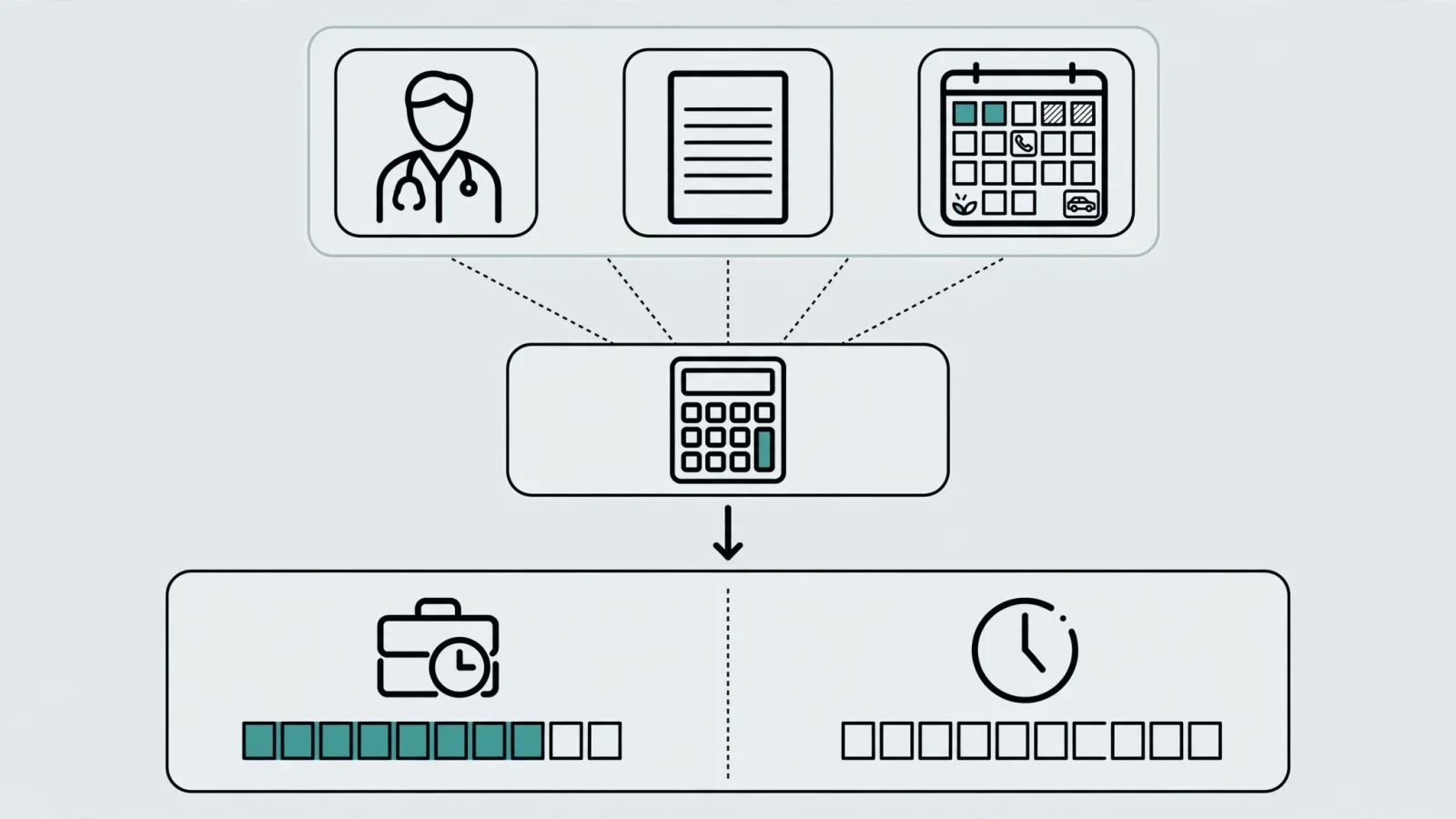
Calculate Bonuses, Benefits, and RVUs
Building compensation scenarios for any job offer starts with a guaranteed baseline that includes only your base salary and fixed stipends. From there, create a conservative scenario that adds a cautious estimate of your likely production pay, and finish with an upside scenario that models the full target bonus.
Calculate an expected at-risk bonus by multiplying the target amount by the estimated probability of receiving it, avoiding the trap of treating a bonus as guaranteed because the offer letter names a target figure. Inspect the contract for thresholds, ramp-up periods, payment lags, quality requirements, productivity caps, and clawbacks. You also need to check whether the employer relies on collections rather than work performed and whether they hold the power to change the formula unilaterally.
Value your benefits using the exact annual health-insurance premium, deductible, and retirement match detailed in your specific offer. Pull the precise values of your malpractice policy, tail coverage, CME allowance, and licensing support directly from the contract terms.
Production compensation requires careful conversion. Medicare physician fee schedule payment rates are based on work, practice expense, and malpractice expense relative value units, with geographic adjusters applied to those RVUs and a fixed-dollar conversion factor used to convert them into payment rates. For compensation analysis, compare the work RVUs and applicable conversion factor with the time required to generate that productivity.
Employee classification rules also impact your earning potential. The U.S. Department of Labor places licensed physicians within the professional-exemption category under federal overtime rules, meaning a salaried medical professional does not automatically receive overtime pay. State laws, classification, and specific contract terms dictate whether you receive extra compensation for extra hours.
Evaluate a Hypothetical $300,000 Outpatient Offer
To make the framework concrete, assume a $300,000 base salary and a $20,000 target bonus with an 80% conservative probability of achievement. In this scenario, the employer provides $30,000 in paid benefits and professional expenses.
The schedule demands four clinical days per week, totaling 40 scheduled hours for 46 working weeks. Beyond face-to-face care, the role requires seven hours of documentation, inbox management, and administrative work each week, while active call duties consume 140 hours per year. The clinic sits one hour away, creating a two-hour round-trip commute on each of the four clinical days.
Building the annual-hours denominator starts with 1,840 scheduled hours (40 hours multiplied by 46 weeks). Documentation and administrative work add 322 hours, and active call contributes 140 hours, bringing the total actual work requirement to 2,302 hours.
You can compare five valid rates using this data.
| Calculation Type | Formula | Result |
|---|---|---|
| Nominal salary rate | $300,000 ÷ 2,080 | $144.23/hour |
| Base salary per actual work hour | $300,000 ÷ 2,302 | $130.32/hour |
| Conservative cash rate | ($300,000 + $16,000) ÷ 2,302 | $137.27/hour |
| All-in work-hour rate | ($300,000 + $16,000 + $30,000) ÷ 2,302 | $150.30/hour |
| Lifestyle-adjusted rate | $346,000 ÷ 2,670 hours (including 368 commute hours) | $129.59/hour |
All five figures answer different financial questions. The conventional 2,080-hour denominator produces $144.23, but stripping away benefits and bonuses to look at guaranteed cash for actual time worked drops the value to $130.32. Including likely bonuses and total benefits raises the compensation to $150.30, while adding the heavy commute to the lifestyle denominator lowers the value back to $129.59.
The six non-working weeks are already reflected in the worked-hour denominator. You receive annual compensation while working fewer total hours across the year, making it unnecessary to add a separate dollar value for paid time off.
Analyze the Time Required by Different Specialties
Evaluating job types requires understanding where the hidden hours live, as no single practice model universally pays more for the time invested.
Outpatient roles frequently hide charting, inbox management, refill requests, prior authorizations, result interpretation, meetings, and patient overflow. This means a primary care schedule that looks manageable on paper can easily spill into the evening.
Hospitalist positions demand a different analysis centered on shift length, handoff protocols, admission loads, and discharge paperwork. Cross-cover duties, post-shift charting, night rotations, and commuting all dilute the shift rate. Emergency medicine roles face similar challenges with sign-out delays, chart completion, boarding-related workload, weekend requirements, and holiday scheduling.
Procedural and surgical roles compound time demands with pre-op and post-op work, rounding, operating room turnover delays, facility travel, call schedules, and long-term follow-up.
Remote roles eliminate the commute but introduce burdens like visit preparation, technology troubleshooting, stringent documentation, async patient messages, and platform meetings. A remote schedule can also blur work boundaries, creating an expectation of constant after-hours availability.
Evaluating locum tenens work requires comparing a high hourly pay rate against unpaid credentialing, gaps between assignments, self-funded malpractice, travel time, and housing logistics. Similarly, independent contractor or 1099 offers require you to deduct self-funded health insurance, retirement contributions, licensing, CME, unpaid leave, business costs, and higher tax obligations before finding your effective rate.
Alternative paths carry their own time demands, where exploring physician consulting jobs or medical leadership roles replaces clinical call with travel, reporting, deliverables, performance metrics, and bonus risk. Advanced practice professionals face comparable trade-offs, making it necessary to evaluate physician assistant work-life balance with the same rigorous look at administrative load versus clinical time.
You can use WeekdayDoc to compare physician jobs using visible schedule expectations, work-life scores, salary benchmarks, and RVU data. Building a comparison table for every offer helps you visualize guaranteed cash, benefits, actual hours, call expectations, nights and weekends, administrative burden, commutes, and your effective hourly compensation.
Review the Contract Terms Before Signing
Evaluating a contract requires you to bring a specific checklist to the negotiation table, because a high salary offer loses its value if unwritten expectations consume your entire week.
Start by asking what portion of the compensation is guaranteed and what amount sits at risk. You should review the exact calculation method for any bonus, noting what happens if productivity falls below the threshold and whether the compensation relies on total collections, total RVUs, or work RVUs. Identify the exact conversion factor and check if the employer imposes caps, clawbacks, redistribution pools, ramp-up periods, or payment delays.
Administrative expectations dictate your daily schedule. Ask how many hours are officially scheduled and whether charting or inbox time is protected. Finding out who handles routine messages, refills, results, and prior authorizations provides insight into the daily workflow. You can also ask how much work the current clinicians complete after their shifts and what meetings or training sessions are mandatory.
Securing the call burden in writing protects your time off. Clarify the weekday, weekend, holiday, in-house, and home-call expectations before signing. Asking the hiring manager to outline the typical number of interruptions per shift and whether post-call relief is guaranteed helps prevent burnout, and you must confirm whether call duties are paid separately or baked into the base salary.
Securing exact figures for the employer’s health contribution and attainable retirement match anchors the benefits package. Review the terms for malpractice coverage, tail obligations, CME funding, and licensing support, then clarify the PTO rules to see if taking time off creates an unmanageable inbox or call backlog upon return.
Finally, restrictive clauses require careful review. Check the noncompete radius, relocation payback terms, and loan-repayment conditions alongside credentialing timelines, required travel between sites, commute expectations, remote-work protections, and availability expectations during staffing shortages.
Compare the compensation, call requirements, administrative burden, and work-life score of your next role on WeekdayDoc. Use our salary benchmarks and RVU tools to evaluate the financial details, then access our negotiation resources and contract-review tools before you sign.