Asynchronous Telehealth Jobs Vs. Synchronous Roles
Compare asynchronous and synchronous telehealth jobs by flexibility, continuity, documentation, autonomy, workload, pay, and burnout risk.

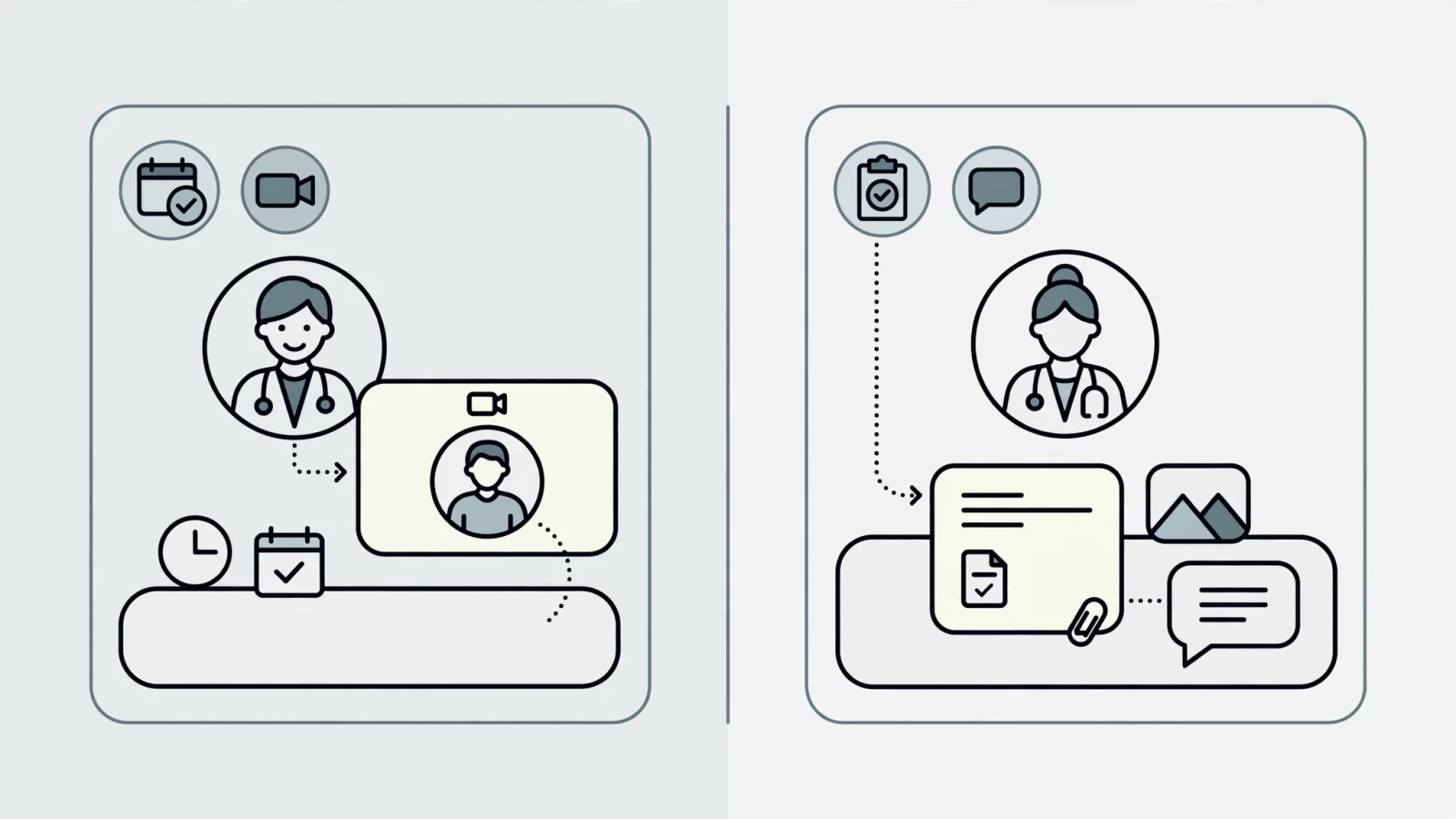
Asynchronous telehealth replaces the live appointment block with a review queue. Rather than meeting face-to-face, a patient or referring clinician submits messages, images, and remote-device data for you to evaluate later. This store-and-forward model directly contrasts with synchronous care, which requires connecting simultaneously over live video or a telephone call.
Federal guidance from the Department of Health and Human Services says this store-and-forward approach is often used for patient intake and follow-up care, including review of images, medical reports, lab results, digital medical imaging, and health histories. Because you and the patient interact at different times, the interaction doesn't require a shared appointment slot, so you can review information when it fits your schedule and respond to text messages within a defined period.
Employers often advertise asynchronous telehealth jobs as online e-visit clinicians, secure-message reviewers, or remote patient-monitoring specialists, so review the clinical scope before applying. A true patient-care role involves direct assessment and treatment, whereas remote utilization review nurse jobs focus on medical necessity rather than patient-facing telehealth, and provider-to-provider e-consults limit your interaction to advising another clinician.
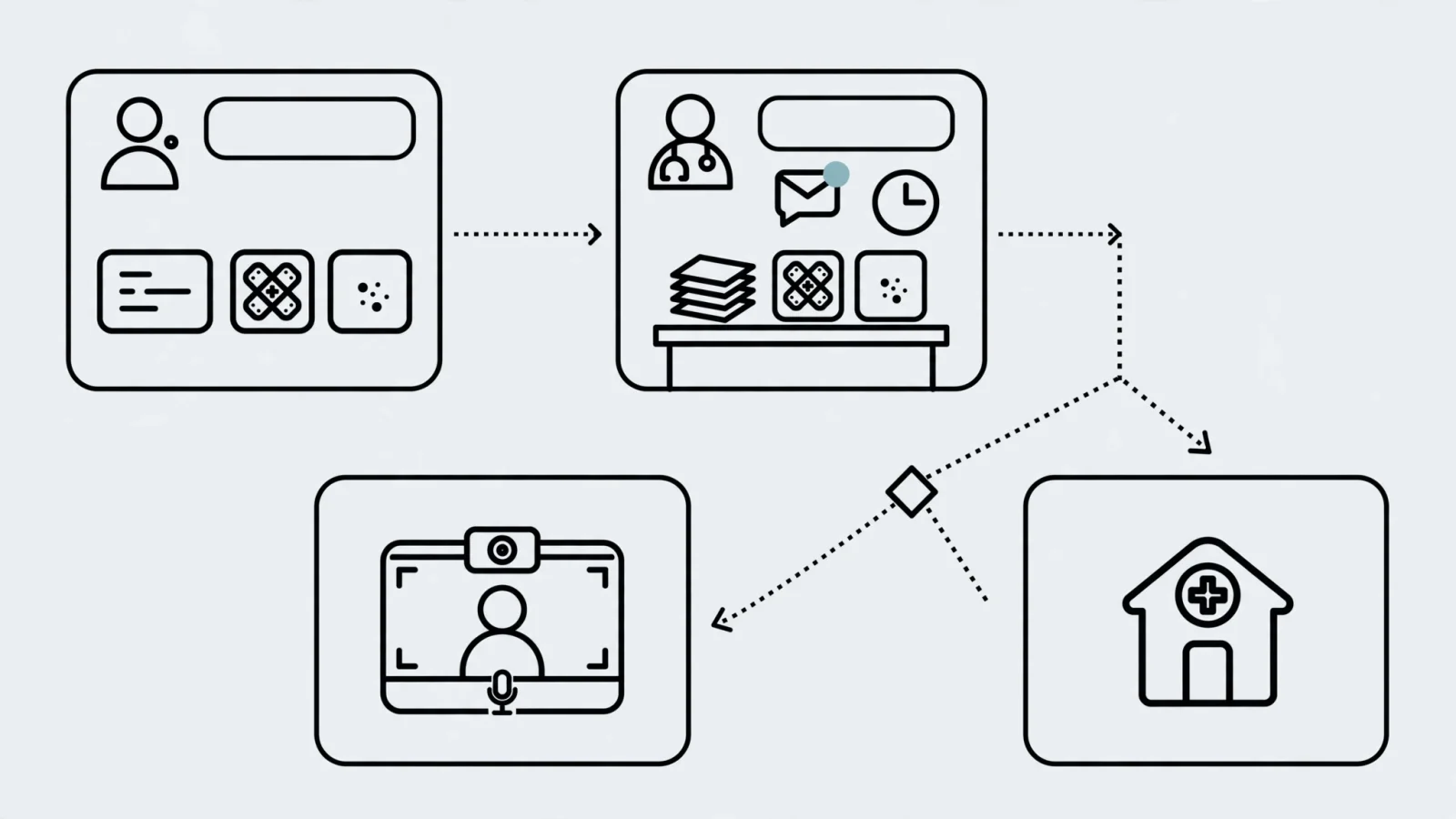
Many remote positions blend these models. A hybrid role might begin with an intake questionnaire and escalate to a video visit if the patient reports an acute symptom. To find a sustainable schedule, evaluate those operational rules rather than relying on a job title. WeekdayDoc makes these hidden variables visible by scoring every clinical job on a 0-to-10 scale for work-life balance, measuring call expectations, weekend coverage, and administrative burden alongside transparent salary benchmarks.
Synchronous Telehealth Jobs: The Live-Care Baseline
Scheduled video and telephone visits mimic the traditional in-person clinic. In these roles, you work fixed blocks, follow visit-per-session targets, manage live call shifts, and document the encounter between or after appointments.
Live interaction provides immediate clinical tools, allowing you to ask clarifying questions, observe nonverbal cues, and build real-time rapport. If a patient appears acutely unwell on camera, immediate escalation to an emergency department is possible. Synchronous care also supports continuity provided you own a dedicated patient panel, which lets you treat the same individuals for recurring management.
Calendar-based telehealth brings specific physical and mental trade-offs, starting with schedule compression caused by rapid visit pacing. When one complex video visit runs late, the delay cascades through the rest of the shift. Alongside managing no-shows and technical failures, you face the physical strain of video fatigue. Charting frequently spills beyond the appointment block because back-to-back scheduling leaves minimal room for documentation.
Synchronous work does not guarantee a closer clinician-patient relationship, as a live video job can remain episodic if the employer relies on a rotating queue rather than assigned panels. Ultimately, the quality of a scheduled telehealth role depends on panel design, realistic visit lengths, protected charting time, and clear coverage rules.
Asynchronous Telehealth Jobs: Flexibility With Boundaries
Store-and-forward care changes the encounter workflow entirely. The process begins with automated intake or triage, after which you review the submitted history alongside attached clinical media. Once you formulate an assessment and document the reasoning, you write a follow-up plan. If the submitted information is incomplete or contradictory, you send a secure message requesting clarification or escalate the case to a live visit.
This workflow can provide uninterrupted review time, allowing you to examine complex histories and formulate clear written plans without managing a live video connection.
This operational structure does not mean you work on your own terms, since flexibility remains bounded by employer rules. A position with no scheduled visits can still require active queue coverage, strict response-time targets, evening monitoring, and weekend shifts. Some platforms enforce a median turnaround time of two hours, which keeps you tethered to the inbox throughout the day.
A virtual e-visit includes the full exchange of online inquiries and other communications associated with a single patient encounter, and providers should document all pertinent communication related to that encounter in the patient’s medical record. The American Academy of Family Physicians’ guidelines also call for forwarding a summary to the patient’s primary care physician or medical home.
Clinical autonomy also shifts. While you gain control over the pace of your review, you lose the ability to physically examine the patient or ask immediate questions. Strict clinical protocols often limit your permitted diagnoses and prescribing authority, meaning every asynchronous workflow needs a defined escalation route for cases that exceed those safety boundaries.
Compare the Six Job Factors Side by Side
A modality label alone tells you very little about a role's actual demands. To understand what the workday entails, compare the structural rules governing time, volume, and clinical authority.
| Factor | Synchronous Video/Telephone Care | Asynchronous Store-and-Forward Care |
|---|---|---|
| Flexibility | Fixed appointment blocks, set clinic hours, and scheduled live call shifts. | Bound by response windows, turnaround-time targets, and mandatory queue coverage. |
| Continuity | Supports recurring live visits, though high-volume platforms often use transactional routing. | Supports longitudinal messaging, provided the employer assigns a dedicated patient panel. |
| Documentation | Charting occurs during or immediately after the live time-bound visit. | Requires written clinical reasoning for the full communication exchange and record review. |
| Autonomy | Allows immediate follow-up questions and live observation of patient behavior. | Provides uninterrupted review time but restricts physical examination and relies heavily on protocols. |
| Volume | Measured strictly in visits per hour, visits per session, or scheduled appointment slots. | Measured in cases, message threads, episodes, escalations, and average handling time. |
| Pay | Usually based on hourly clinical blocks, annual salary, or encounter productivity targets. | Often uses per-case, per-episode, per-message, RVU-based, or blended compensation models. |
Flexibility and Continuity
While synchronous roles tie you to a calendar, asynchronous roles tie you to a clock. Your actual schedule freedom depends entirely on the employer's response-time rules. A required 24-hour turnaround allows you to batch your work, but a one-hour turnaround functions identically to an on-call shift. Continuity operates similarly. Recurring video appointments build rapport, whereas messaging builds a durable written relationship, though neither modality delivers continuity if you work a randomized, shared queue.
Documentation and Clinical Autonomy
Live visits generate standard encounter notes, but store-and-forward care transforms your core task into written communication. You review charts, draft detailed explanations, manage inbox threads, and document the complete episode. A 2024 observational study of primary care clinicians found that each additional 10 incoming portal messages added an average of 12 minutes per quarter to electronic health record time outside scheduled hours. Managing this volume depends on protocol strictness, as you need the authority to request more information, decline unsafe cases, and escalate appropriately without facing productivity penalties.
Patient Volume and Burnout
Evaluating store-and-forward volume using standard visits per hour is ineffective because you track completed cases, message threads, image reviews, and rework. Complex submissions take longer to unravel than straightforward prescription refills. A remote clinical informatics job measures project hours rather than patient counts, while asynchronous work measures average handling time. Burnout risk in video care stems from schedule compression, whereas exhaustion in asynchronous environments stems from unbounded inbox volume, hidden after-hours monitoring, and unpaid documentation time.
WeekdayDoc translates these hidden variables into actionable decision data by evaluating call coverage, nights, weekends, flexibility, autonomy, and administrative burden at the job level. This allows you to see the true operational demands before submitting an application.

Pay, Licensure, and Contract Reality
Neither modality guarantees higher compensation, as the job's pay structure and unpaid obligations determine your actual earnings. To understand your take-home pay, calculate your effective hourly compensation by dividing your total guaranteed and variable pay by all required work time.
That denominator includes every required task, from clinical review and patient messages to coding, staff meetings, and licensing. If your employer pays per case but requires you to monitor an inbox for four unpaid hours awaiting submissions, your effective hourly rate falls. During interviews, clarify whether incomplete, reopened, duplicate, and escalated cases count toward your paid productivity.
Billing structures provide context for these compensation models. For example, the Centers for Medicare & Medicaid Services lists online digital evaluation and management codes (CPT 99421–99423) for established-patient services provided over up to seven days. The agency bases the code level on cumulative time during that period, rather than a single discrete encounter, and also lists HCPCS code G2010 for the remote evaluation of recorded video or images.
These billing rules dictate how employers collect revenue, not how they pay clinicians. Since the Medicare Physician Fee Schedule varies widely by locality and geographic practice cost index, a national fee-schedule amount does not translate directly into an expected salary. Furthermore, because Medicare generally structures standard telehealth rules around interactive two-way technology, live-visit reimbursement rates rarely apply to store-and-forward services.
State licensing boundaries still apply regardless of the technology used. The Federation of State Medical Boards reported in late 2024 that all state medical boards required physicians practicing telemedicine to hold a license in the state where the patient is located, barring specific interstate compact pathways. Nurses, physician assistants, therapists, psychologists, and pharmacists face similar location-based board requirements.
An employment contract should spell out who pays for additional state registrations, renewals, and credentialing time. It should also clarify whether malpractice coverage is occurrence-based or claims-made and, if it is claims-made, who pays for tail coverage when you leave. It should identify any non-compete clauses that restrict future telehealth work, payback clauses tied to training, and requirements to monitor the inbox during scheduled time off.
Choose a Sustainable Asynchronous Telehealth Job
Securing a livable remote role requires analyzing the daily operational mechanics. Evaluating any asynchronous or hybrid offer comes down to understanding the exact workload expectations.
An offer is easier to assess when you know the exact percentage of asynchronous versus live work, the required response window, and whether the employer enforces a daily queue cap. Data on average case complexity can help you estimate the number of completed cases or messages per paid hour. The offer should also spell out the escalation rate, the process for handling rework, and whether you own a dedicated patient panel. It should state whether documentation time is paid, how the compensation unit functions, and what guaranteed minimum applies.
When speaking with recruiters, ask specific operational questions to clarify those daily mechanics:
- Is this role entirely asynchronous, or will I cover hybrid live shifts?
- Who manages urgent messages that arrive outside my scheduled review window?
- How does the system assign follow-up messages from completed cases?
- What happens to my productivity metrics when a patient submits incomplete information?
- Can I pause intake routing when my queue reaches capacity?
- Is my compensation based on submitted cases, completed cases, or only approved cases?
Evaluating a non-clinical path like a remote healthcare data analyst job or a remote nurse educator role requires a similar focus on workload boundaries over job titles, because the setting matters less than the specific expectations placed on your time.
Verdict: Which Model Fits Your Priorities?
A synchronous telehealth role fits well if you value real-time clinical rapport, immediate diagnostic clarification, and predictable appointment blocks. Live video work suits clinicians who want to finish a scheduled shift, complete the charting, and disconnect entirely from patient care until the next assigned block.
An asynchronous telehealth role is often better if you value control over your exact review timing, prefer written clinical reasoning to video communication, and want to evaluate cases without calendar fragmentation. Store-and-forward work suits clinicians who can efficiently manage a queue, set firm boundaries around inbox monitoring, and follow clinical protocols.
Neither option automatically prevents burnout, since a poorly managed asynchronous queue generates as much exhaustion as a compressed video calendar. Often, a well-designed hybrid role provides the strongest balance by allowing you to manage routine follow-ups via secure messaging while reserving live video blocks for complex evaluations.
WeekdayDoc helps you secure the exact model you need by categorizing permanent, locum, remote, and hybrid clinical jobs with critical context attached to every listing. You can compare salary percentiles, evaluate dollar-per-RVU benchmarks, and view a validated work-life score for every role. Clinicians use AI-matched alerts to find appropriate specialties, one-click applications to move quickly, and targeted negotiation scripts to clarify pay and schedule boundaries. Once you receive an offer, the AI contract scanner immediately flags non-competes, tail coverage liabilities, and payback clauses. Visit WeekdayDoc to compare accurate burnout data and find a clinical schedule that supports a sustainable career.