Crafting a Sustainable Internal Medicine Physician Career
Build a sustainable internal medicine physician career. Our guide covers subspecialties, work-life balance, burnout prevention, and finding your ideal job.

An internal medicine career is a commitment to untangling the most complex medical puzzles in adults. It's a field built on diagnostic rigor and deep, long-term patient relationships. But let’s be honest—the ground is shifting beneath our feet, with new practice models and a physician shortage forcing us to rethink what a sustainable career looks like.
The New Blueprint for an Internal Medicine Career
The classic image of an internist—juggling inpatient rounds, a full outpatient clinic, and a relentless call schedule—is fading fast. For a growing number of physicians, that model simply isn't sustainable anymore. The old blueprint is being torn up, not out of choice, but out of necessity as job pressures collide with a system stretched to its breaking point.

This isn't just about feeling overworked; it's a direct response to huge systemic challenges. The U.S. is staring down a projected shortage of up to 86,000 physicians by 2036, and internists are on the front lines of that gap.
This scarcity is happening alongside a massive internal shift in how we practice. Over the last decade, the percentage of internists working as hospitalists jumped from 25% to 40%. At the same time, outpatient-only roles grew from 23% to 38%. These aren't minor tweaks; they represent a fundamental change in the job description of a general internist. You can dig deeper into these physician employment trends and their outlook.
The table below breaks down these modern pressures and the new, sustainable solutions this guide will help you find.
The Modern Internal Medicine Career at a Glance
| Career Aspect | Current Trend or Challenge | The Sustainable Solution |
|---|---|---|
| Workload & Pace | Rising patient volumes and administrative burden are leading directly to burnout. | Seeking roles with protected admin time, manageable patient panels, and efficient workflows. |
| Schedule Control | Traditional roles often demand unpredictable call, nights, and weekends, disrupting personal life. | Prioritizing jobs with weekday-only schedules, no mandatory call, and predictable hours. |
| Practice Setting | The "do-it-all" generalist role is splitting into specialized hospitalist or outpatient tracks. | Intentionally choosing a practice model (e.g., outpatient, telemedicine) that aligns with your desired lifestyle. |
| Career Longevity | High burnout rates are shortening careers and contributing to the physician shortage. | Proactively designing a career that integrates financial goals and personal well-being from the start. |
This new blueprint is about taking control of your professional life instead of letting it control you.
Designing a Career for Longevity
The modern approach to an internal medicine career is proactive, not reactive. It’s about being the architect of a professional life that aligns with your well-being, financial freedom, and genuine satisfaction. This means looking past the default options and actively hunting for roles that are built for sustainability from the ground up.
An Olympian mindset isn't just for athletes; it's about cultivating faith that you're doing meaningful work. For physicians, this means tending to your perseverance through wellness, knowing that burnout would shorten the fulfilling, lifelong career you hope to build.
This new mindset prioritizes a few non-negotiables that tackle the root causes of burnout head-on. The focus is shifting toward:
- Schedule Control: Seeking out positions that offer predictable hours without the constant drain of nights, weekends, or on-call duties.
- Practice Autonomy: Finding environments where you are trusted to make clinical decisions without being buried in administrative red tape.
- Work-Life Integration: Choosing roles that fiercely protect your personal time, creating a healthy balance between your professional calling and your life outside of it.
Think of this guide as your playbook for navigating this new reality. It's designed to empower you to find a fulfilling, durable, and rewarding internal medicine physician career that works for you, not against you.
Choosing Your Path: Training and Subspecialties
Think of your internal medicine residency as building a solid foundation. For three years, you learn the essential framework for diagnosing and managing the whole spectrum of adult diseases. Once that foundation is set, you hit a fork in the road.
Do you become a generalist, mastering the entire house? Or do you build a specialized wing, becoming an expert in one specific area? This is the core choice between practicing general internal medicine and pursuing a subspecialty fellowship.
This isn't just an academic exercise—it's a decision that will shape your daily work, your lifestyle, and your career satisfaction for decades. Each fellowship adds a unique set of skills to your toolkit, changing how you practice medicine and what your day-to-day life looks like. It’s less about just clinical interest and more about intentionally designing a career that fits your personal and professional goals.
The Fellowship Fork in the Road
After you complete a three-year internal medicine residency, you're officially board-eligible. You can walk right into a job as a hospitalist or an outpatient primary care physician. But for many, this is just the beginning.
In fact, a huge number of internists—close to half in recent years—opt for more training. This means going through a competitive application process for a fellowship that adds another one to three (or more) years of focused work.
This extra training is what makes you a true expert in a niche area, whether it's the heart (Cardiology), the digestive system (Gastroenterology), or the kidneys (Nephrology). The path you pick has a massive impact on the kinds of problems you solve and the environment you work in every day.
Popular Subspecialties and Their Career Blueprints
Every subspecialty comes with its own blueprint—a unique mix of schedule demands, call burden, and procedural focus. No single choice is universally "better," but knowing the trade-offs is key to mapping out your internal medicine physician career.
Let's break down some of the most common pathways:
- Cardiology: This is a high-demand, procedure-heavy field focused on the heart and blood vessels. Cardiologists are constantly moving between the clinic, hospital rounds, and the cath lab. The call burden can be intense, especially for interventionalists, but it's also one of the highest-paid specialties.
- Gastroenterology (GI): A great mix of deep thinking and hands-on procedures like endoscopies and colonoscopies. GI docs manage everything from reflux to Crohn's disease. While it can be demanding, many GI jobs, especially those in outpatient settings, can be structured for a surprisingly balanced lifestyle.
- Pulmonary and Critical Care: This dual fellowship prepares you to manage both lung diseases (like asthma and COPD) and the sickest patients in the ICU. It's an intense path with a heavy inpatient focus and a demanding call schedule, but it's incredibly rewarding if you thrive in high-stakes medicine.
- Endocrinology: A largely outpatient specialty centered on hormonal disorders like diabetes and thyroid disease. It's known for offering a predictable schedule with minimal call, making it a top choice for physicians who put a premium on work-life balance.
"I use the word cultivated intentionally. Traits like perseverance, compassion, and humility are not fixed. They can grow, wither, or be tended to... I also tend to my perseverance through wellness, knowing that burnout would shorten the fulfilling, lifelong career I hope to build."
This gets to the heart of it. Building a sustainable career isn't just about the one big choice you make at the beginning. It's about continuously nurturing the things that keep you going, no matter which specialty you pick.
Even in demanding fields like Cardiology or Critical Care, you can find roles that protect your well-being. Choosing your fellowship is just the first step in cultivating a career that lasts.
Finding the Right Practice Setting for Your Lifestyle
Deciding where you practice medicine is just as important as the specialty you choose. In fact, it might be more important for your long-term happiness. The right environment can play to your strengths and protect your sanity, while the wrong one can feel like you’re fighting an uphill battle every single day.
Fortunately, an internal medicine physician career offers a huge variety of settings, each with its own unique pace, demands, and rewards. It’s no longer just about the classic hospitalist vs. outpatient debate. Today’s options include models that give you more control over your schedule, your autonomy, and the way you connect with patients. Getting familiar with these paths is the first step in building a career that actually fits your life.
This decision tree gives a great visual of those first big career forks after residency—whether to subspecialize or stick with general internal medicine, and how your practice setting fits in.
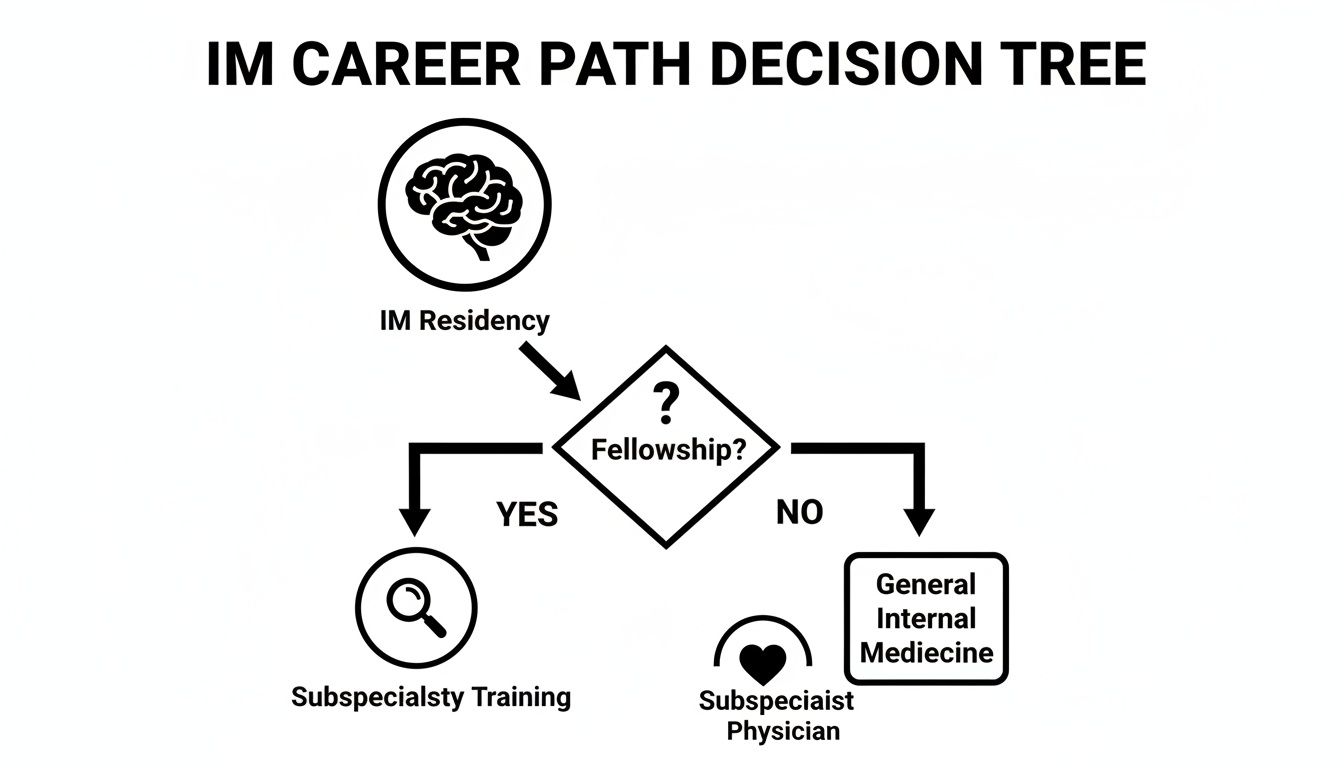
As you can see, your practice setting is a critical choice that directly shapes your day-to-day reality, regardless of whether you’re a generalist or a subspecialist.
A Comparison of Internal Medicine Practice Settings
Choosing the right setting is one of the most powerful moves you can make to prevent burnout and build a sustainable career. Let’s break down the most common options to see how they stack up in terms of schedule, call burden, and the type of physician they suit best.
| Practice Setting | Typical Schedule | Call Burden | Best For |
|---|---|---|---|
| Hospitalist | Block schedule (e.g., 7 on / 7 off) | No call on off weeks | Physicians who want consolidated work weeks and love high-acuity cases. |
| Outpatient | Monday-Friday, 9-5 | Light phone call, often shared | Doctors who value long-term patient relationships and predictable hours. |
| Concierge | Flexible, longer appointments | Very low due to small panel size | Physicians seeking autonomy and deep patient engagement without insurance hassles. |
| Telemedicine | Highly flexible, often self-scheduled | None | Those who want maximum schedule control and location independence. |
| Urgent Care | Shift-based, including evenings/weekends | None | Internists who enjoy variety and acute care without the inpatient intensity. |
Each path offers a distinct trade-off. The key is knowing what you value most—is it total schedule freedom, predictable hours, or the adrenaline of acute care? Being honest about your priorities will guide you to the right fit.
The Hospitalist: High-Acuity, High-Stakes Medicine
If you thrive on solving complex, acute medical puzzles in a fast-paced team setting, the hospitalist role is hard to beat. You're the quarterback of inpatient care, managing everything from admission to discharge for the sickest patients.
The schedule is the main draw for many. Hospitalists often work in blocks like "7 on, 7 off," giving you an intense, focused week of work followed by a full week completely off. It’s perfect if you want to consolidate your work and have huge chunks of free time for travel, family, or other passions. The flip side? Those "on" weeks are grueling and almost always include nights and weekends.
The Outpatient Clinic: A Focus on Continuity and Connection
The outpatient world is built on long-term relationships and preventative medicine. Here, you’re the trusted advisor, helping patients manage chronic conditions like diabetes or hypertension over the course of years, not days.
This setting offers a more traditional and predictable workweek, typically Monday through Friday during business hours. While the call burden is much lighter than inpatient work, it’s not zero—you’ll still field after-hours patient calls and tackle a mountain of inbox messages and refill requests. It’s a great fit for physicians who find deep satisfaction in continuity of care.
Your practice setting is more than a workplace; it's the ecosystem where your professional life will either thrive or struggle. Choosing an environment that aligns with your personal rhythm and priorities is one of the most effective forms of burnout prevention.
Exploring Newer Practice Models
Beyond the two traditional pillars of internal medicine, other models are gaining serious traction by offering physicians more control.
- Concierge Medicine: This model flips the script with a much smaller patient panel. This allows for longer, unhurried appointments and a deeply personalized level of care. You get to ditch the insurance headaches and practice with real autonomy, but it does require a bit of a business owner’s mindset.
- Telemedicine: Digital health has opened a new frontier for internists, offering unparalleled flexibility. You can truly work from anywhere and completely eliminate a commute. If this sounds appealing, you can check out curated lists of remote internal medicine physician jobs that are built around work-life balance.
- Urgent Care: This is the dynamic middle ground between a primary care clinic and the ER. You’ll see a wide variety of acute but non-life-threatening issues, giving you a fast-paced day without the long-term management responsibilities of a primary care physician.
Each of these settings caters to a different lifestyle and professional goal. The most important thing is to be brutally honest with yourself about what you need to feel energized by your work. By choosing your environment wisely, you can design a rewarding and sustainable internal medicine physician career on your own terms.
Maximizing Your Value with Salary and FIRE Strategies
Your medical degree isn't just a license to practice—it's one of the most powerful financial assets you'll ever own. Knowing how to maximize its value is fundamental to building a long, satisfying career in internal medicine. This isn't about chasing the highest possible salary at all costs. It's about strategically aligning your income with your life goals to build real, sustainable wealth and freedom.
This all starts with getting a clear picture of your earning potential. Compensation for internists is all over the map, swinging wildly based on your subspecialty, where you practice, and the type of setting you work in. A hospitalist in a big city has a completely different financial picture than an outpatient endocrinologist in a rural town.
Financial independence isn't about quitting medicine to sit on a beach. It’s about gaining the freedom to practice on your terms. Maybe that means cutting back to three days a week, taking a year off to travel, or launching that side project you've always dreamed of—all without the stress of needing a paycheck.
When you pair smart financial planning with strategic career moves, your salary becomes more than just income. It becomes the tool that buys back your time and protects you from burnout.
Decoding Your Earning Potential
Let's be clear: demand for internists is high and only getting stronger. An aging population and the rise of chronic diseases mean your skills are more valuable than ever. The U.S. Bureau of Labor Statistics projects a 3% employment increase for physicians through 2034, signaling steady demand for your expertise for years to come. You can dig into the full projections for the physician workforce to see the data for yourself.
This demand is what drives compensation. But to really understand your earning power, you have to look past the national averages and focus on the variables that actually move the needle.
- Subspecialty: It's no secret that procedural subspecialties like cardiology and gastroenterology are at the top of the pay scale, often clearing $500,000. On the other hand, cognitive specialties like endocrinology and rheumatology offer a fantastic work-life balance with competitive, though generally lower, paychecks.
- Geography: State lines can mean a salary difference of over $100,000. And don't assume that high cost-of-living areas automatically come with the highest pay—it's critical to weigh both income and expenses.
- Practice Model: A private practice setup can offer higher earning potential, but it comes with the headaches of running a business. A salaried job in a large health system gives you stability and great benefits, while a telemedicine role offers a level of flexibility that can be priceless.
To get a truly personalized estimate based on your specific situation, a tool like our Salary Calculator Pro is invaluable. It breaks down potential income by specialty and location, giving you the data you need.
Integrating FIRE for Career Sustainability
The concept of Financial Independence, Retire Early (FIRE) is catching on fast among physicians, but probably not for the reason you think. For most of us, it isn’t about retiring in our 40s to do nothing. It’s about reaching "work-optional" status—the point where your job becomes a choice, not a necessity.
Achieving FIRE simply means your investments generate enough income to cover your living expenses forever. To get there, you need to understand how to build and manage a portfolio designed for the long haul. Building solid FIRE investment portfolio strategies is the key to turning your high income into lasting financial freedom.
This financial security is the ultimate shield against burnout. When you're not chained to your job to pay the bills, you regain all the power. You can negotiate for a better schedule, switch to a less demanding role, or take that much-needed sabbatical to recharge without financial worry.
Here’s a quick look at what a FIRE projection can show you. Notice how even small changes in your savings rate can dramatically shorten your timeline to financial independence.
As you can see, bumping up your savings rate can shave years off your journey, making a sustainable career feel much more achievable, much faster. The trick is to connect your high earning potential with a deliberate financial plan right from the start.
Building a Burnout-Proof Career by Design
Physician burnout isn't a character flaw or a sign you can't "hack it." It’s a systemic problem, and the only real defense is a systemic one. Telling a doctor drowning in paperwork to be more "resilient" is like telling a soldier to dodge bullets better. It completely misses the point.
To build a truly sustainable internal medicine physician career, you have to stop patching the holes and start designing a better boat—a professional life that is structurally resistant to exhaustion.

We all know the primary culprits: soul-crushing administrative tasks, zero control over your schedule, and the constant emotional drain. The real solution lies in proactive career architecture—learning to spot and prioritize roles that are built from the ground up to protect your time, energy, and sanity.
Know Your Enemy: The Real Drivers of Burnout
Your first move is to understand what you're up against. Burnout almost always boils down to a massive gap between a job's demands and your ability to control them. This isn't about working hard; it's about being forced into inefficient systems with impossible workloads and a culture that treats asking for help as a weakness.
The data paints a grim picture. A Yale study tracked physician attrition rates from 2013 to 2019 and saw them climb from 3.5% to 4.9%. That jump is actively fueling the physician shortage we’re all feeling.
The study also found that hospital-based internists, who are often managing the most complex patients, face a staggering 57% higher risk of leaving their jobs. This highlights just how intense the pressure has become in certain settings.
To fight back, you have to get comfortable negotiating for what you need and drawing hard lines. A crucial part of this is understanding and healing from workforce burnout, because you can't build a better future without addressing the damage from the past.
The Power of Structural Protections
The single best way to beat burnout is to choose a job that's designed to prevent it in the first place. Think of it like building a house in a hurricane zone. You wouldn't just cross your fingers and hope for the best; you'd use storm-proof windows and a reinforced foundation.
In your career, this means hunting for roles with specific, built-in features that shield your time.
These protections aren't luxuries; they're necessities:
- Protected Administrative Time: Jobs that carve out dedicated, paid time in your schedule just for charting. This is a game-changer that stops admin work from spilling into your nights and weekends.
- Reasonable Patient Panels: Outpatient or concierge roles that put a hard cap on your patient load. This allows for better medicine, deeper patient relationships, and far less cognitive overload.
- Efficient Workflows: Practices that actually invest in their physicians by providing scribes, smart EMRs, and other support systems to slash clerical work and let you focus on being a doctor.
A burnout-proof career isn't something you stumble into. It's something you build, piece by piece. It starts with a simple shift: stop accepting the default path and start demanding roles that treat your well-being as a non-negotiable.
Your Best Defense: No-Call and Weekday-Only Roles
Of all the structural protections available, none are more powerful than a schedule that walls off your nights and weekends. Jobs without on-call duties are the ultimate defense against the chronic sleep deprivation and personal-life chaos that are the primary fuel for burnout.
By deliberately seeking out jobs with predictable, Monday-to-Friday hours, you're directly neutralizing one of the biggest threats to your career longevity.
Curious about your own risk level? The first step is to get a baseline. You can use our physician burnout calculator to get a clear, quantitative look at where you stand.
When you make the conscious choice to find a role that gives you your evenings and weekends back, you’re not just finding a new job. You’re taking back control and building a professional life that isn't just successful, but actually sustainable for the long haul.
Finding Your Ideal Internal Medicine Job
Okay, you've done the hard part—you know what you want and, just as importantly, what you don't want in your next job. Now it's time to actually find it.
Let's be honest: the old way of job searching feels like a lottery. You scroll through endless listings, send out résumés into the void, and hope for the best. It's a passive, reactive process that leaves you feeling powerless.
It's time to flip the script. Instead of just taking what's offered, you can actively hunt for roles that fit your life. We're talking about a focused search for specific, non-negotiable criteria—whether that’s a pure weekday schedule, zero call, or a job that puts you within a 20-minute drive of your kids' school. This is where specialized tools become your best friend.
Mastering the Strategic Search
The secret to a smarter, faster job search isn't volume; it's precision. Generic job boards are great if your only criteria are "internal medicine" and "California." But they completely miss the nuances that actually determine your quality of life.
You need a tool that understands a physician's reality. A platform that knows "no call" and "no weekends" aren't just perks—they're essential ingredients for a sustainable internal medicine physician career.
Platforms built for physicians who are tired of the burnout cycle let you target the good stuff from the get-go. This saves you from wasting weeks interviewing for a job that was never going to work in the first place.
Here’s a perfect example from the WeekdayDoc job board. Look how you can instantly filter out the noise and focus only on roles that meet critical work-life balance needs.
Notice how the results immediately show you what matters: the Burnout-Friendly Score and the exact schedule type. No more digging through dense paragraphs to find the dealbreakers.
Interpreting the Data for a Better Life
Once you’ve got a shortlist, it’s time to go a level deeper. Move past the fluffy job descriptions and start analyzing the metrics that will shape your day-to-day existence.
- Burnout-Friendly Score: This isn't some arbitrary number. It’s a score that combines key factors like schedule, call burden, and professional autonomy into one simple metric. Think of it as an at-a-glance gut check for a job's long-term sustainability.
- Salary and FIRE Projections: Don't just look at the raw salary. Put it in context with your financial goals. A $300,000 salary in a high-cost area might not get you to financial independence nearly as fast as a $250,000 job in a state with no income tax and a lower cost of living.
Your job search is the final, critical step in designing the career you actually want. Don't leave it to chance. Use every tool available to find a role that respects your training and protects your well-being.
When you combine powerful search filters with smart data analysis, the job hunt transforms from a soul-crushing chore into an act of empowerment. You're no longer just looking for a job; you're building a career on your own terms.
Your Top Questions About an IM Career, Answered
Thinking about your next move in internal medicine brings up a lot of questions. I get it. Here are some straightforward answers to the things physicians are asking most as they map out their careers.
What Is the Income Potential for a Weekday-Only IM Job?
Let’s bust a myth right now: prioritizing your well-being doesn't mean taking a massive pay cut. A weekday-only internal medicine job can still be incredibly rewarding financially, with salaries that are right up there with traditional, high-call roles.
For instance, it's not uncommon for an outpatient internist in a major city to earn between $250,000 and $300,000 annually—without ever touching a pager on a Saturday. Your exact number will hinge on location, practice model, and patient load. You might trade some of those after-hours RVU bonuses for your sanity, but the base compensation is solid and sets you up for a sustainable financial future.
The real goal is to optimize for total well-being, not just chase the highest possible number. A slightly lower salary in a job that prevents burnout often leads to a longer, happier, and ultimately more profitable career.
How Difficult Is It to Transition from Hospitalist to Outpatient?
Making the jump from hospitalist to outpatient practice is a very well-worn path, and it’s completely manageable. You already have the core clinical chops. The big shift is in mindset and daily rhythm. Hospital medicine is a series of intense sprints focused on acute problems; outpatient care is a marathon of long-term management and prevention.
Most physicians find the biggest adjustments are:
- Pacing: Swapping the "7 on, 7 off" firehose for the steadier flow of a Monday-to-Friday clinic.
- Workflow: Getting used to managing a long-term patient panel, a never-ending inbox, and chronic follow-ups.
- Billing and Coding: Adapting to the specific nuances of outpatient coding, which is a different beast than inpatient billing.
Plenty of health systems offer orientations or transition support because they know how valuable it is to keep experienced internists in their network. You won't be thrown in the deep end.
What Are the First Steps to Starting a Career in Telemedicine?
Getting into telemedicine is more straightforward than you might think. The first hurdle is the easiest: most platforms require you to be board-certified in internal medicine, which you've already handled.
From there, the process looks something like this:
- Licensing: Figure out which states you'd like to practice in. Many telemedicine companies will actually help you get licensed in multiple states to expand your patient pool.
- Polish Your CV: Make sure you highlight skills that shine in a remote setting—things like stellar communication, tech-savviness, and rock-solid time management.
- Research the Platforms: Look into different companies and find one that matches the schedule and patient volume you’re looking for.
- Prep for Interviews: Be ready to talk about how you build genuine patient rapport through a screen and how you manage complex cases from a distance.
A great strategy is to start with a part-time telehealth role. It lets you get a feel for the virtual workflow before you decide to go all-in on a remote internal medicine career.
We've covered some common questions about building a sustainable career in internal medicine. Below is a quick summary of the key takeaways.
| What is the income potential for a weekday-only internal medicine job? | You can still earn a highly competitive salary, often between $250,000 and $300,000, without call or weekend duties. The focus shifts from maximizing RVUs to achieving a sustainable work-life-income balance. |
| How difficult is it to transition from a hospitalist to an outpatient role? | It's a very common and manageable transition. The primary challenge isn't clinical skill but adapting to a different pace, workflow (patient panels, inboxes), and outpatient-specific coding. |
| What are the first steps to starting a career in telemedicine? | Ensure you're board-certified, then focus on multi-state licensing (often with company help). Update your CV to highlight remote-friendly skills and research platforms that fit your lifestyle goals. |
These paths offer real opportunities to design a career that serves you as well as your patients.
Tired of sifting through generic job boards for a role that actually fits your life? At WeekdayDoc, we only list burnout-friendly internal medicine jobs with predictable schedules. Find your ideal no-call, no-weekend position today on https://www.weekdaydoc.com.