Finding Jobs in Neonatology Without Burnout
A complete guide to finding jobs in neonatology with better work-life balance. Learn to find no-call roles, negotiate contracts, and explore remote options.

You may be looking at jobs in neonatology from a tired place. Maybe you've finished another stretch of service weeks, signed out a fragile infant at dawn, and realized the problem isn't that you dislike the field. The problem is that the default version of the field may no longer fit the life you want.
That matters, because too many clinicians treat burnout as a personal failing instead of a job-design problem. In neonatology, schedule structure, call expectations, census volatility, and staffing depth shape your day far more than a glossy recruiter pitch ever will. If you're strategic, you can still build a career that's clinically meaningful, well compensated, and sustainable.
Navigating the Modern Neonatology Job Market
The first mistake I see is assuming every neonatology job comes with the same price of admission. It doesn't. Some jobs are built around relentless coverage needs. Others are structured around daytime clinical leadership, consultative work, quality improvement, transport oversight, education, or hybrid responsibilities that don't consume every weekend.
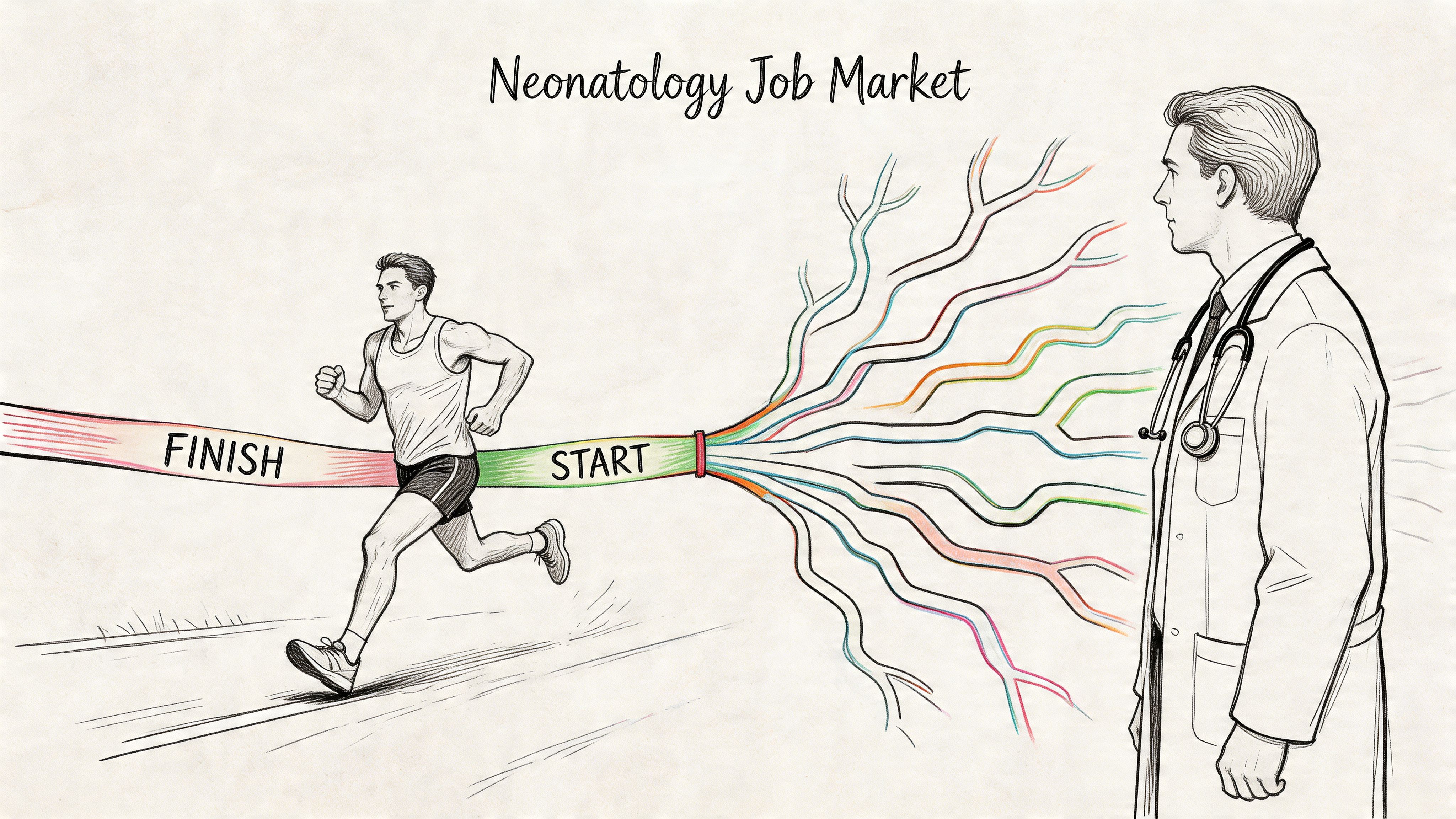
The market is more resilient than many burned-out clinicians realize. In the U.S., permanent neonatology positions averaged $347,000 annually, and salaries grew 12% over the last five years according to Zippia's neonatologist demographics and pay overview. The same source notes an average 51-hour work week, while 87% of neonatologists reported high career satisfaction and said they'd choose the field again.
That combination tells you something important. The specialty itself isn't the enemy. The wrong role is.
What the market rewards
Hospitals need dependable daytime clinicians. Groups need people who can standardize care, improve documentation, stabilize handoffs, and keep the NICU running without constant friction. If you can offer those things, you hold a strong position.
The strongest candidates don't just ask, "Who's hiring?" They ask different questions:
- What problem am I being hired to solve
- Does this role depend on me filling chronic staffing gaps
- Is the schedule sustainable if one partner resigns
- Will the group protect boundaries once I'm onboarded
Practical rule: A good neonatology job isn't only about compensation. It's about whether the contract protects your time when the unit gets busy.
What burnout-conscious candidates do differently
Burnout-friendly jobs in neonatology rarely announce themselves with that exact label. You have to read between the lines. A posting that emphasizes medical directorship support, daytime coverage, quality initiatives, newborn nursery integration, telehealth consults, or documentation oversight may be more livable than a generic "full-scope NICU coverage" role.
The primary shift is mental. Stop searching as if you're trying to remain employable. Start searching as if you're selecting a practice model that can hold up for years.
Beyond the NICU Shift Unpacking Your Career Options
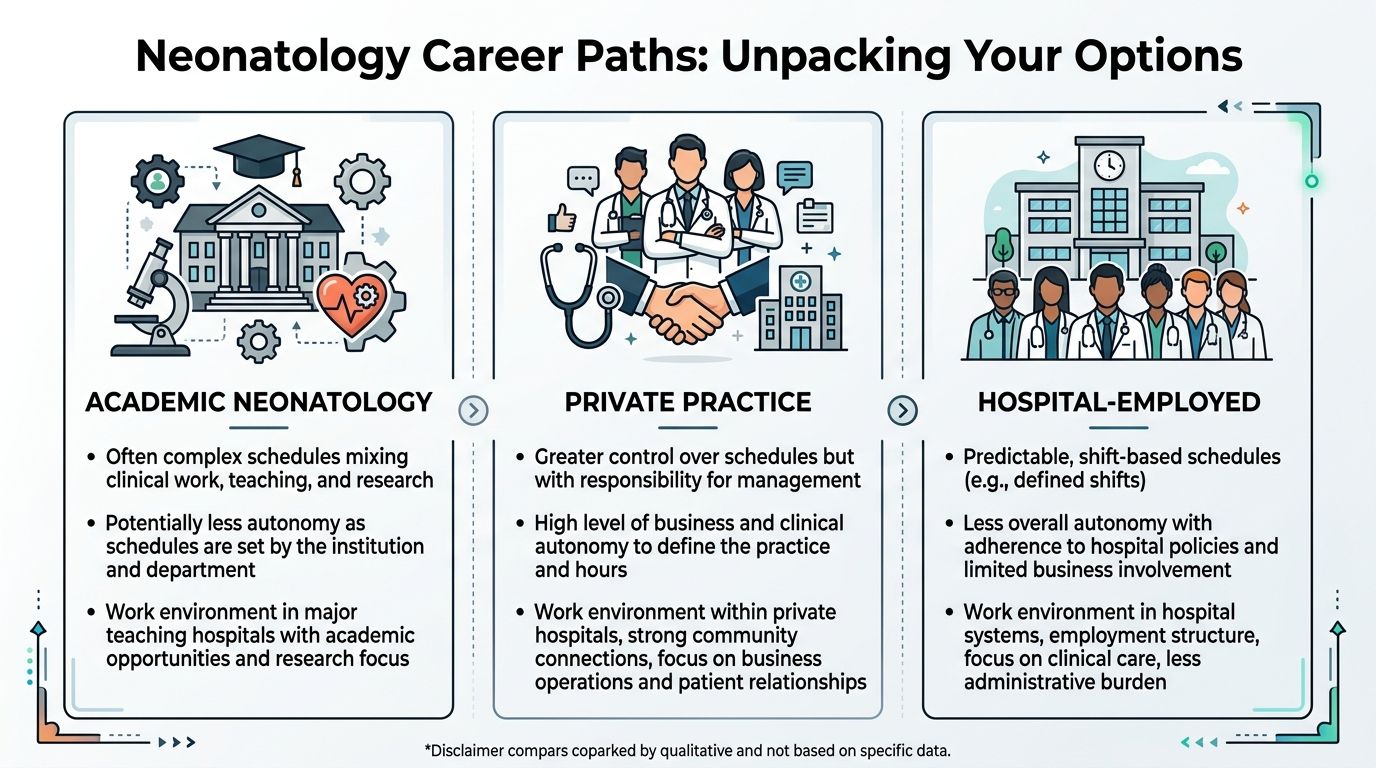
Most jobs in neonatology fall into one of three buckets. Academic, private practice, and hospital-employed roles can all be excellent. They can also all become draining if the structure doesn't match your tolerance for call, committee work, or unpredictable coverage.
How the settings differ in real life
| Setting | Usually works well for | Common friction points | Best question to ask |
|---|---|---|---|
| Academic | Clinicians who want teaching, fellows, protocols, and institutional identity | More meetings, more stakeholders, slower decisions | Who owns schedule changes and service distribution |
| Private practice | Clinicians who value autonomy and efficiency | Coverage strain when staffing thins, business pressure | What happens when a partner leaves or takes leave |
| Hospital-employed | Clinicians who want administrative infrastructure and clearer employment terms | Less control over policy, more system metrics | Which expectations are written into the contract versus handled informally |
Academic jobs often suit people who like complex systems and don't mind shared governance. They can be intellectually rich, but "protected time" isn't always protected. If the NICU gets hammered, that time may disappear into service work.
Private practice can feel cleaner operationally. Decisions can happen faster, and some groups are very good at preserving physician autonomy. The trade-off is fragility. If the group is small, one departure or one prolonged vacancy can turn a workable call model into a punishing one.
Hospital-employed roles sit in the middle. They may offer more formal HR processes, better access to benefits, and cleaner scheduling infrastructure. They can also come with leadership layers that make simple fixes surprisingly slow.
Where NNP roles fit
A modern NICU isn't staffed by physicians alone. The NNP workforce grew from 5,433 certified professionals in 2018 to 7,871 by 2024, and their average salary reached $140,290 in 2024 according to Baylor's neonatal nurse practitioner facts and stats summary. That growth changes the daily reality of the unit.
For physicians, strong NNP integration can mean better continuity, less unnecessary overnight disruption, and a more stable division of labor. For NNPs, it opens multiple career paths inside the specialty, from bedside management to consultative and administrative trajectories.
A sustainable unit usually has clear role boundaries. An unsustainable one calls it "flexibility" when it really means constant role spillover.
What usually works and what usually doesn't
Some patterns are consistent across settings:
- Works well: Defined daytime service, explicit cross-coverage rules, transparent call backup, and staffing depth.
- Often fails: Vague expectations, "shared responsibility" language without numbers in writing, and jobs built around heroics.
- Often underestimated: The emotional cost of being the default fix when transport, delivery attendance, and NICU volume all spike at once.
When you compare jobs in neonatology, don't focus only on title and pay. Focus on the operating model behind the title.
How to Search Smarter for Neonatology Jobs
A broad search creates noise. A narrow search creates options you can evaluate.
Most clinicians start with specialty title and location, then wonder why every result looks the same. A better approach is to search by lifestyle constraint first, then by role. If your real objective is weekday-only work, your search terms should reflect that from the start.
Use filters that reflect your non-negotiables
Start with the features that determine whether a job is livable:
Schedule terms first
Search phrases like no call, no weekends, weekday only, part-time, hybrid, and remote. That removes jobs that will never fit, even if the title sounds attractive.Then add setting language
Layer in NICU follow-up, newborn nursery, utilization review, telehealth, documentation, quality, or medical director depending on what kind of work you want more of.Read for hidden call
Some listings say "flexible schedule" when they mean uneven service blocks. Others say "team-based coverage" when everybody still takes nights. Read every line for who covers after hours.
A practical way to organize your search is to keep three folders. One for true target roles, one for maybes, and one for jobs that look good on paper but contain schedule red flags. That keeps you from re-reviewing the same posting after fatigue sets in.
Evaluate the listing, not just the headline
Good postings usually tell you how the work is distributed. Weak ones stay vague. If a listing doesn't clarify who takes night call, who covers weekends, or whether daytime-only roles exist within the division, assume you'll need to ask hard questions early.
Platforms built around physician job search tools can help structure that review. The WeekdayDoc physician job search guide is useful because it focuses on schedule-fit questions rather than just volume of listings.
Look for details such as:
- Coverage language that distinguishes in-house, home call, and backup call
- Team composition that signals whether APP support is mature or merely aspirational
- Role scope that separates delivery attendance, NICU service, nursery service, follow-up clinic, and administrative duties
- Flexibility wording that tells you whether flexibility helps you, or the employer
If the job ad makes work-life balance sound like a personality trait instead of a staffing model, keep reading carefully.
Search for the job after the job
Many burnout-friendly roles aren't framed as classic neonatology roles at all. They may appear under pediatric hospital medicine, utilization review, clinical documentation, quality improvement, transport leadership, or telehealth consultation. If you search only for "neonatologist," you'll miss some of the most sustainable options.
Precision beats persistence here. The point isn't to see more jobs. It's to spend your attention only on roles that could plausibly improve your life.
Tailoring Your CV for the Job You Actually Want
Most CVs in medicine read like credential archives. That's fine if you're applying to everything. It's weak if you're trying to land a selective, burnout-conscious role.
A hiring team doesn't just want proof that you've worked hard. They want proof that you'll solve the problems their unit currently has. If the role is day-focused, remote, consultative, or systems-oriented, your CV should make that easy to see in the first page.
Lead with signals that match the role
If you want a sustainable job, stop burying your most relevant work under old presentations and long publication lists. Put operational value up front.
That often means highlighting experience such as:
- Protocol development: surfactant pathways, extubation standards, transfer criteria, discharge processes
- Quality work: registry participation, documentation improvement, sepsis review, readmission review, multidisciplinary standardization
- Team leadership: supervision of NNPs, resident teaching, service line coordination, committee leadership that changed workflow
- Non-bedside skill: EMR optimization, data review, chart abstraction, telehealth workflows, utilization discussions
The logic is simple. Employers hiring for stable weekday roles often care about reliability, systems thinking, and communication as much as raw procedural intensity.
Write bullets that show judgment
A weak CV says you participated. A strong CV shows you improved clarity, consistency, or throughput without making unsupported claims.
Instead of generic lines, write with concrete function:
- Led daily multidisciplinary huddles for NICU care planning
- Standardized handoff workflow across daytime service blocks
- Reviewed documentation for neonatal quality registry submission
- Developed family-facing discharge education process with nursing partners
If you need a refresher on matching application materials to a specific posting, How to Tailor Resume to Job Description offers a useful framework that applies well even to physician CV adaptation.
Remove what distracts from your target
Many strong applicants sabotage themselves by sending the same document to an academic division chief, a hospital-employed nursery role, and a remote clinical review position. That tells the employer you want a job. It doesn't tell them you want their job.
Use a master CV for recordkeeping, then create targeted versions. The WeekdayDoc physician curriculum vitae guide is a practical reference for that kind of editing.
A tailored CV doesn't hide your background. It arranges your background so the right employer can immediately recognize you.
One more point. If you want less call and more control, don't apologize for that in your materials. Frame it professionally. You're pursuing a role where you can deliver focused, durable value over time. That's a mature career decision, not a retreat.
Secure Your Schedule Through Smart Negotiation
Negotiation starts long before the offer letter. It starts the moment you decide not to be vague about your boundaries.
In neonatology, many clinicians negotiate salary and title, then accept undefined coverage expectations that ultimately reshape the job six months later. That's backwards. If your schedule matters, the schedule has to be treated like a core contract term.

A typical Level III or IV NICU is built for continuous high-acuity coverage, often including 8 neonatologists plus broad support staff according to Neonatology.net's overview of careers and staffing. That matters because around-the-clock units don't stop needing coverage just because a recruiter says the culture is collaborative. If you want a burnout-friendly role, you need to know exactly where you sit in that coverage structure.
Questions that reveal the real job
Ask these early, and ask them plainly:
- Who takes first call, second call, and backup call
- How often does daytime staff get pulled into nights or weekends
- What happened the last time the group had a vacancy
- Which duties are fixed, and which shift based on census
- Does the unit use defined daytime-only positions
- Are there seasonal surges that change weekend expectations
- Who covers delivery attendance when the NICU is full
These questions do two things. They reveal the truth, and they signal that you're evaluating sustainability, not just prestige.
Scripts that help
You don't need aggressive language. You need clear language.
Try:
"I'm most interested in roles where I can provide consistent daytime coverage without routine participation in the overnight call cycle. Is that structure already in place here, or would it need to be built?"
Or:
"I can be flexible about scope, but I want the schedule expectations to be explicit in writing. Which parts of nights, weekends, and holiday coverage are contractual?"
And when the answer gets fuzzy:
"I want to avoid misunderstanding later. Could you walk me through the actual schedule your current physicians worked over the last few months?"
What to get in writing
Verbal reassurance is not enough. If it matters to your life, it belongs in the contract or a formal schedule appendix.
Make sure you clarify:
- Call expectations: none, backup only, rotating, or temporary
- Weekend structure: routine, rare, voluntary, or excluded
- Clinic and committee load: especially if "protected time" is part of the offer
- Cross-coverage triggers: who absorbs work when staffing changes
- Review points: when schedule terms can be revisited
Compensation still matters, of course. But for many clinicians, a slightly lower salary with a defendable weekday schedule is the better long-term deal. Sustainable work lets you stay effective, preserve personal time, and avoid making expensive career exits out of sheer exhaustion.
The Rise of Remote and Alternative Neonatology Careers
Some of the most promising jobs in neonatology now sit outside the traditional attending template. That's good news for clinicians who still want to use their NICU expertise but don't want their life organized around nights, holidays, and constant coverage volatility.
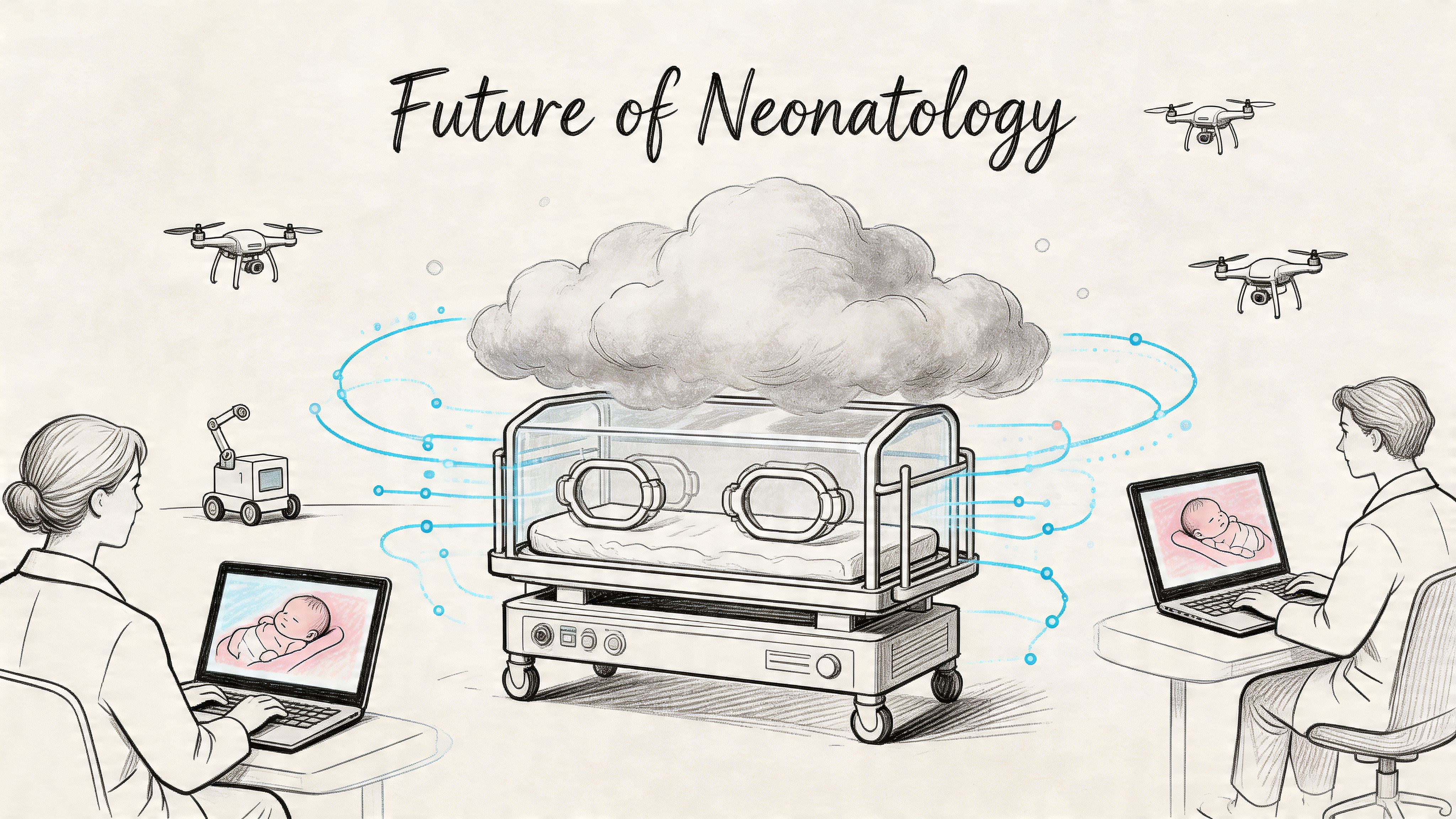
I've seen many clinicians assume their only alternatives are leaving the specialty or tolerating a bad fit. That's outdated. There are now meaningful paths in telehealth, chart review, registry abstraction, utilization work, follow-up coordination, and documentation-focused roles.
Remote data work is not a step down
One of the clearest examples is remote neonatal clinical data abstraction. These roles offer Monday through Friday, no-call schedules and salaries ranging from $71,000 to $115,000, according to Indeed's neonatal clinical data job listings overview. The work involves structured chart review for quality registries, accuracy standards above 95%, and direct contribution to better reporting and patient care processes.
That kind of role fits a specific clinician profile. You need to enjoy detail, consistency, and documentation discipline. If you need adrenaline every hour, it may feel too quiet. If you're tired of unpredictable service intensity and want focused cognitive work, it can be an excellent reset.
What these roles actually look like
A remote abstraction or documentation role usually centers on careful review of NICU charts, standardized variable capture, coding alignment, and submission to registry or internal quality systems. The daily rhythm is very different from bedside practice.
What tends to work well:
- Experienced chart readers who can find key neonatal events quickly
- Clinicians with QI instincts who understand why clean data matters
- People who like repeatable workflow and don't need constant interruption
- Applicants who can document accuracy and consistency from prior work
What tends not to work:
- Applying with a purely bedside CV that never mentions documentation, registry, or data tasks
- Assuming remote means low scrutiny when these jobs often track accuracy closely
- Ignoring tech readiness such as comfort with registry tools, spreadsheets, and structured review workflows
For clinicians exploring broader nontraditional employers, lists of top remote companies can help you think beyond hospital websites alone.
A broad search across remote healthcare jobs can also uncover adjacent physician and advanced practice roles that use similar skills even when they aren't labeled under classic neonatology titles.
Telehealth and consultative work
Some alternative careers remain more clinically direct. Telehealth consults, newborn follow-up support, utilization review, and hybrid education roles can preserve specialty identity without locking you into a full overnight burden.
This is also where your communication style matters. Employers hiring for remote or hybrid work want clinicians who write clearly, make decisions from records, and stay dependable without constant supervision.
A useful visual overview of where remote care is heading is below.
Alternative work isn't for everyone. But for the right person, it can turn a career that feels unsustainable back into one that feels chosen.
Building Your Sustainable Career in Neonatology
You don't need to abandon the field to protect your life. You need to stop accepting the assumption that only one kind of neonatology career counts.
The clinicians who build durable careers usually do three things well. They define their core priorities early, they present themselves for the role they want, and they negotiate from a place of clarity instead of guilt. That approach works for attendings, NNPs, and experienced NICU clinicians moving into adjacent roles.
Sustainable jobs in neonatology aren't accidental. They're found by reading the structure behind the posting, asking direct questions about coverage, and refusing to let vague promises substitute for written terms.
Choose the role that lets you stay good at this work for a long time.
There is still room in this specialty for ambition, strong compensation, and meaningful patient care. But ambition doesn't have to mean permanent schedule sacrifice. A career should support your clinical standards and your actual life.
If you're searching now, be selective on purpose. That's not being difficult. That's being experienced.
If you're looking for burnout-conscious clinical roles, WeekdayDoc is a physician-founded job platform where clinicians can search remote, hybrid, and in-person opportunities with clear no-call and no-weekend markers, along with salary data and schedule-focused filters.