Your Guide to Becoming a Remote Nurse Practitioner
Discover how to become a remote nurse practitioner. This guide covers job types, salary insights, licensing, and finding roles with great work-life balance.
Imagine delivering top-notch patient care without the brutal daily commute or the slow creep of clinical burnout. This isn't a far-off dream; it's the new reality for the remote nurse practitioner. The role has quickly grown from a temporary pandemic fix into a stable, highly sought-after career path, giving NPs the power to diagnose, treat, and manage patient care from anywhere with a decent internet connection.
The New Frontier of Remote Nurse Practitioner Careers
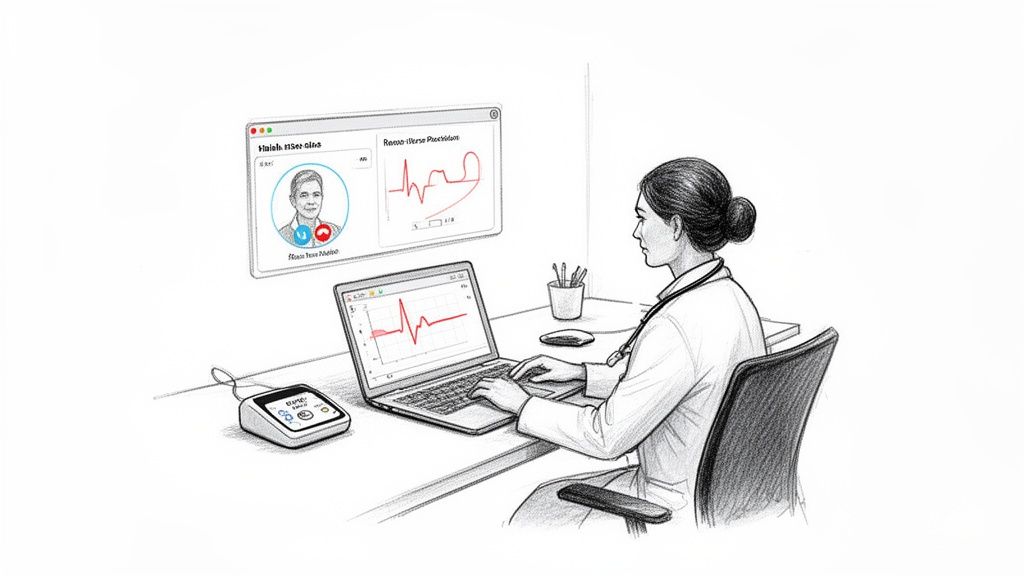 The idea of a remote nurse practitioner is no longer a niche concept. It has firmly planted itself as a mainstream pillar of modern healthcare. What started as a supplemental service is now a core component of how care is delivered, pushed forward by patients demanding convenience and clinicians fighting for a better work-life balance. Honestly, this shift is one of the biggest changes we've seen in how advanced practice nurses build their careers.
At its heart, the job is all about using technology to close the physical gap between you and your patient. Think of it less as "medicine from a distance" and more as "focused care, delivered efficiently." Instead of herding patients through a crowded clinic, you're connecting one-on-one through secure video calls, messaging apps, and remote patient monitoring (RPM) devices. These tools aren’t just for show; they provide a steady stream of health data that lets you be proactive and preventative.
To give you a clearer picture, here’s a quick breakdown of what the day-to-day responsibilities look like.
Core Responsibilities of a Remote Nurse Practitioner
This table summarizes the main duties of a remote NP and the specific technologies that make this work possible.
| Core Responsibility | Typical Activities | Enabling Technology |
|---|---|---|
| Virtual Patient Consultations | Conducting video or phone appointments for assessment, diagnosis, and treatment planning. | Secure Telehealth Platforms (e.g., Doximity, Zoom for Healthcare) |
| E-Prescribing & Management | Electronically sending prescriptions to pharmacies and managing medication refills. | E-Prescribing Software integrated into the EHR |
| Remote Patient Monitoring (RPM) | Analyzing data from devices like blood pressure cuffs, glucose meters, or ECGs. | RPM Dashboards & Connected Medical Devices |
| Patient Education | Providing guidance on managing chronic conditions, medications, and lifestyle changes. | Secure Messaging Apps, Patient Portals, Video Calls |
| Care Coordination | Collaborating with specialists, primary care physicians, and other healthcare providers. | Secure Email, EHR Messaging, Collaborative Care Platforms |
As you can see, the core clinical work remains the same—it's the delivery method that has changed, often for the better.
A Career Path Defined by Flexibility
Let's be real: one of the biggest draws of becoming a remote NP is reclaiming control over your schedule and your sanity. The daily grind of long commutes, packed clinic schedules, and endless administrative tasks is a fast track to burnout. Remote work offers a powerful way out.
The benefits go way beyond just working from home:
- Reduced Commute Stress and Costs: Wiping out the daily commute saves an incredible amount of time, money, and mental energy. You can start your day focused on patients, not traffic.
- Improved Work-Life Integration: That flexibility makes it so much easier to handle personal responsibilities, show up for your family, and find a healthier rhythm.
- Focus on Clinical Tasks: Many remote jobs are set up to cut down on administrative bloat, letting you spend more of your time on the clinical work you were trained to do.
Meeting a Growing Demand
The demand for qualified NPs is absolutely exploding. The U.S. Bureau of Labor Statistics is projecting a massive 35% increase in NP jobs between 2024 and 2034. That's a growth rate that blows the average for all other occupations out of the water. This surge is mainly fueled by the desperate need for primary and preventive care, especially in underserved areas where telehealth is a true lifeline. You can dive deeper into the latest advanced practice provider trends to see how this is shaping the entire industry.
This isn’t just a job trend; it's a structural shift in healthcare. As technology matures and patient acceptance grows, the remote nurse practitioner will become even more integral to creating accessible, efficient, and sustainable healthcare systems.
Platforms like WeekdayDoc are built to find these kinds of opportunities, helping you filter for roles that actually fit your life—like jobs without mandatory on-call shifts or weekend hours. This guide will walk you through everything you need to know to make the leap and join this new frontier.
A Day in the Life of a Virtual NP
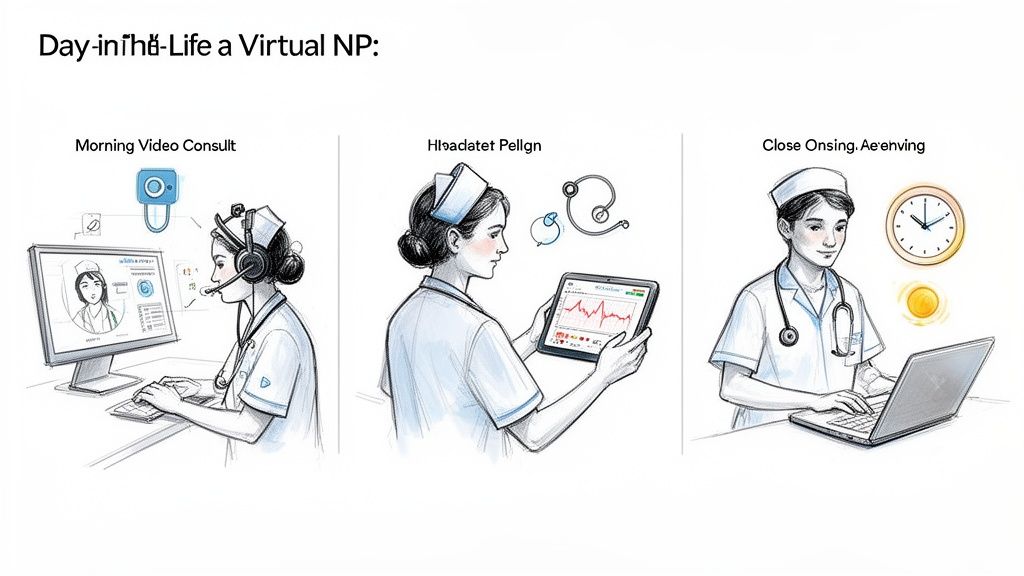
So, what’s it really like to be a remote NP? Forget the old picture of a clinician stuck in one exam room all day. This is a totally different world—one that blends technology with focused patient care and gives you a surprising amount of control over your day.
The rhythm of your workday can change a lot depending on the specific job, but some things are pretty universal.
Your day starts with a login, not a commute. After grabbing a coffee, you'll open a secure, HIPAA-compliant telehealth platform. This is your new command center. From here, you’ll see your video appointments, patient messages, and a running list of lab results and refill requests that need your attention.
The morning might be a block of synchronous video calls. These are your live, face-to-face appointments for common stuff like sinus infections, UTIs, or rashes. You’ll get really good at building rapport through a screen—developing a great "webside manner" is a real skill. It’s all about picking up on subtle cues and guiding patients through a self-exam with clear, simple instructions.
The Two Speeds of Remote Care
Not all virtual NP jobs operate at the same speed. The pace is really dictated by the type of care you're providing, and it generally falls into one of two buckets.
Urgent Care and Teletriage: This is the telehealth fast lane. You’re moving quickly from one patient to the next, solving immediate, low-acuity problems. It’s not uncommon to see 20-30 patients in a shift, making fast but accurate calls on whether they need an e-prescription, some self-care advice, or need to be seen in person.
Virtual Primary and Chronic Care: This is a marathon, not a sprint. The workflow is intentionally slower because it’s all about building relationships and managing long-term health. A big chunk of your day is asynchronous—reviewing data from remote patient monitoring devices, answering portal messages, and fine-tuning treatment plans.
Imagine you're managing a patient's hypertension. Instead of just seeing them once every few months, you log into a dashboard and see a whole week's worth of their blood pressure readings, sent directly from their cuff at home. This stream of real-time data lets you make tiny, precise tweaks to their meds before a small issue becomes a big problem.
This shift from reactive to proactive care is one of the most powerful aspects of virtual practice. You're not just treating sickness; you're actively managing wellness using a continuous stream of data, empowering both you and the patient.
Managing the Virtual Caseload
Once your block of video calls is done, you might switch gears to asynchronous work. This is the focused time for reviewing specialist notes, responding to patient messages, and catching up on charting without the usual clinic chaos and interruptions.
Because you’re in charge of your own environment, staying organized is everything. To really succeed, you have to get comfortable with productivity tools for remote workers that help you manage your patient load without missing a beat. The day usually wraps up with a final check of the EMR to make sure every note is signed and every task is cleared.
Ultimately, a day in the life of a virtual NP is about using technology to deliver focused, high-quality care. It requires sharp clinical judgment, top-notch communication skills, and a solid handle on digital tools. The trade-off? A level of freedom and control that’s almost impossible to find in a traditional clinic.
Navigating Telehealth Licensing and Legal Essentials
Working as a remote nurse practitioner gives you incredible freedom, but it also opens up a whole new world of legal complexity. When your patient is in one state and you're in another, whose rules do you follow?
Figuring out the legal side of things isn’t just a formality—it’s absolutely essential for practicing safely and ethically in a virtual setting.
Think about traditional, in-person practice. Your state license allows you to care for patients who are physically in that state. Telehealth runs on the exact same logic: the patient's physical location during the appointment determines which state's laws and licensing rules apply. If you're based in California treating a patient who is vacationing in Texas, you must hold an active, unrestricted Texas license.
This one rule is the bedrock of telehealth compliance. It shapes everything about how a remote NP can build their career.
The Nurse Licensure Compact Explained
Thankfully, managing this state-by-state puzzle has gotten much easier because of the Nurse Licensure Compact (NLC). For NPs looking to practice remotely, this multi-state agreement is a total game-changer.
It works a lot like your driver's license. Your home state issues it, but you have the privilege to drive in other states without getting a new license every time you cross the border. The NLC does the same thing for your nursing license.
If you hold a multi-state license through the NLC and live in a compact state, you can practice—both in-person and via telehealth—in any other NLC member state. This cuts down on a massive amount of paperwork and expense.
You'll want to check the official NLC map pretty regularly, as new states are always in the process of joining. For NPs in non-compact states, the process is still manual: you have to apply for and maintain separate licenses for every single state where you intend to see patients.
State-Specific Telehealth Laws
While the NLC makes licensing simpler, it doesn't create one universal set of rules for practicing telehealth. Each state still has its own regulations, and they can vary wildly. As a remote NP, it's on you to know and follow the laws of the state where your patient is located.
Here are a few key areas where you’ll see major differences:
- Establishing the Provider-Patient Relationship: Some states demand an initial in-person or video visit to officially establish a provider-patient relationship. Others are more lenient, allowing it to start with just a phone call or even secure messaging.
- Informed Consent: States have very specific language for what you must tell a patient before a telehealth visit, like the limitations of virtual care and what to do in an emergency.
- Prescribing Regulations: This is a huge one. Every state has unique rules for prescribing medications via telehealth, and things get especially tricky with controlled substances.
Remote Prescribing and Malpractice Insurance
Prescribing is central to the NP role, and doing it from a distance requires you to be meticulous. The Ryan Haight Act, a key federal law, has historically governed the online prescribing of controlled substances, usually requiring an initial in-person exam.
But things have shifted, especially with temporary flexibilities put in place during the public health emergency. Always, always verify the current federal and state-specific laws before prescribing controlled substances to a patient you’ve only seen virtually.
Finally, you absolutely must update your malpractice insurance. Your standard policy might not cover telehealth services, particularly across state lines. Call your provider and confirm that your policy:
- Explicitly covers telehealth and virtual care.
- Provides coverage in every state where you're licensed to see patients.
- Has adequate liability limits for the risks of remote practice.
Forgetting to update your insurance could leave you dangerously exposed. This is a non-negotiable step to take before you see your first remote patient.
Finding the Right Remote Nurse Practitioner Job for You
When you hear “remote nurse practitioner,” what comes to mind? For many, it’s a single, specific image, but the reality is much more diverse. The term covers a surprisingly wide range of roles, each with its own rhythm, clinical demands, and impact on your life. It's definitely not a one-size-fits-all career path.
Figuring out the key differences is the first step to finding a role that truly clicks with your skills, your personality, and the life you want to build.
Probably the biggest fork in the road is how you interact with patients: in real-time or on your own time. This is the difference between synchronous and asynchronous care, and it dramatically shapes your day-to-day.
Synchronous Care: Real-Time Patient Interaction
Synchronous care is what most people think of when they hear "telehealth." It's all about live, real-time interactions, usually over video or phone. Think of it as the digital version of a classic office visit.
Primary Care Telehealth: In these roles, you build a panel of patients and manage their long-term care. You'll handle everything from chronic conditions to acute issues through scheduled video visits. If you thrive on building relationships and continuity of care, this is your sweet spot.
Urgent Care Telehealth: This is the fast lane of remote care. You'll be treating low-acuity problems like UTIs, rashes, and colds. The pace is quick, with a higher volume of shorter, more focused appointments. It's a great fit for NPs who love rapid-fire problem-solving.
Specialty Consults: Got deep expertise in a specific area like psychiatry or dermatology? Telehealth needs you. These roles involve providing expert consultations, often collaborating with other providers to guide patient care.
Asynchronous Care: Flexibility on Your Terms
Now, let's talk about the game-changer: asynchronous care. Often called "store-and-forward," this model completely ditches the traditional appointment schedule. Instead of live calls, you review patient information—messages, photos, lab results—and respond within a set timeframe, but on your own schedule.
A perfect example is a job centered on secure patient messaging. Patients send in questions, you review the case, and you write back with a clear treatment plan. This kind of work is ideal for NPs who are strong written communicators and prefer deep, focused work without the pressure of being "on" for a live video call.
The core benefit of asynchronous work is control. It disconnects your schedule from your patients' schedules, allowing you to structure your day in a way that truly supports work-life balance.
Licensing is another huge piece of the puzzle. The states you're licensed in will directly determine your job opportunities, as this decision tree illustrates.
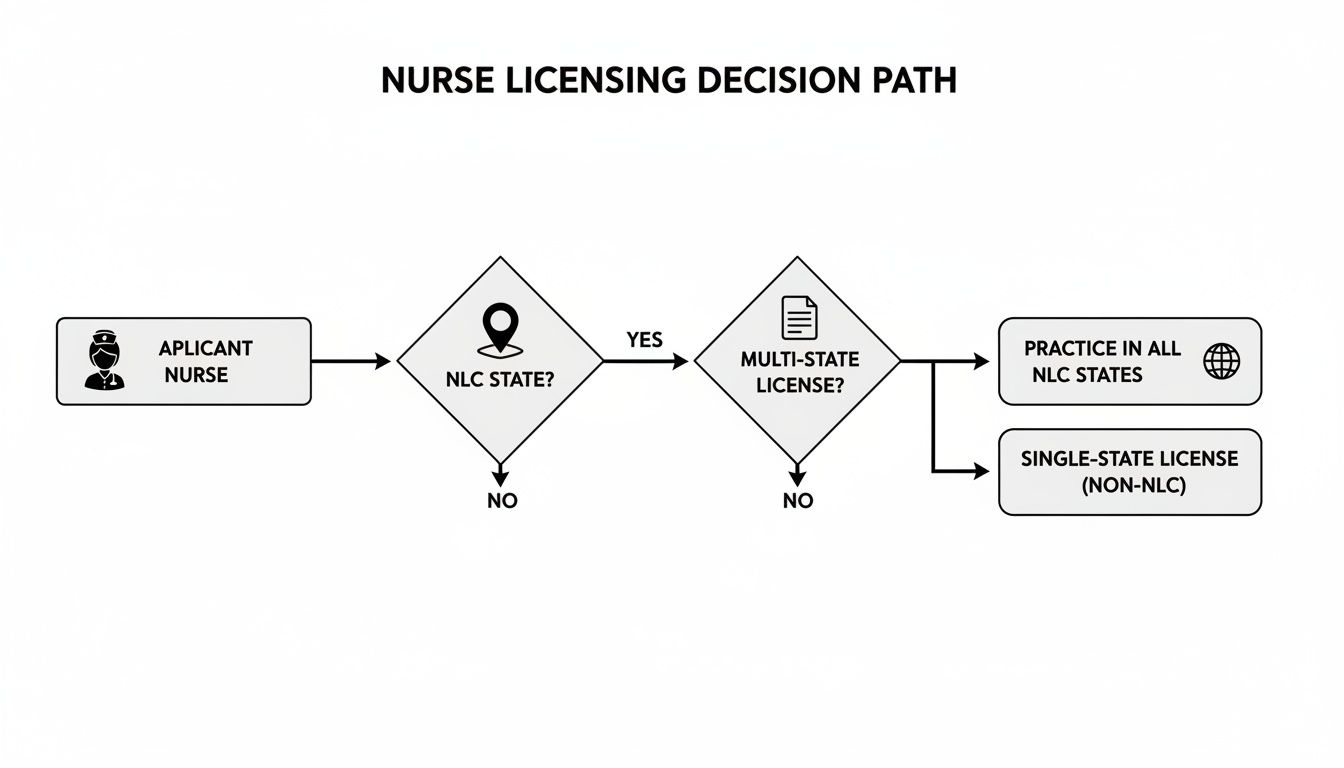
As you can see, holding a multi-state license through the Nurse Licensure Compact (NLC) blows the doors wide open on your job search, giving you access to a much larger pool of potential employers.
To help you visualize these different paths, here's a breakdown of how the workflows and schedules compare.
How Different Remote NP Job Models Compare
| Job Type | Primary Workflow | Patient Interaction Style | Best For Work-Life Balance |
|---|---|---|---|
| Primary Care Telehealth | Scheduled video appointments for chronic and acute care. | High-touch, relationship-focused, continuous. | Predictable hours but requires being "on" for appointments. |
| Urgent Care Telehealth | On-demand or short-notice video/phone consults. | Transactional, high-volume, episodic. | Can be intense during shifts; often requires evenings/weekends. |
| Asynchronous Care | Reviewing patient charts, messages, and labs. | Written, non-real-time communication. | Maximum flexibility; allows you to set your own work hours. |
| Remote Patient Monitoring | Analyzing patient-generated health data (e.g., BP, glucose). | Data-driven with periodic check-ins. | Often offers a mix of scheduled tasks and flexible data review. |
Each model offers a distinct experience. The key is to match the job's daily reality with your personal and professional needs.
Specialized and Data-Driven Roles
Beyond this basic split, other exciting remote NP roles are popping up. Remote patient monitoring (RPM) is a fantastic, data-centric field where you analyze health data streamed from patient devices like blood pressure cuffs or glucose meters. It’s a proactive way to manage chronic disease, perfect for NPs who are analytical and enjoy using data to drive clinical decisions.
And this area is growing—fast. By 2026, healthcare executives expect a 33% surge in the focus on virtual care, especially remote monitoring. The 2026 healthcare industry outlook for nurses gives a great overview of just how big these trends are becoming.
Ultimately, the best remote job is the one that fits you. By understanding these different models, you can cut through the noise and strategically look for the roles that align with your goals. Whether you crave the patient connection of virtual primary care or the incredible flexibility of asynchronous work, there are plenty of excellent remote nurse practitioner jobs out there that can help you build a career that’s both fulfilling and sustainable.
Salary Insights for Financial Independence
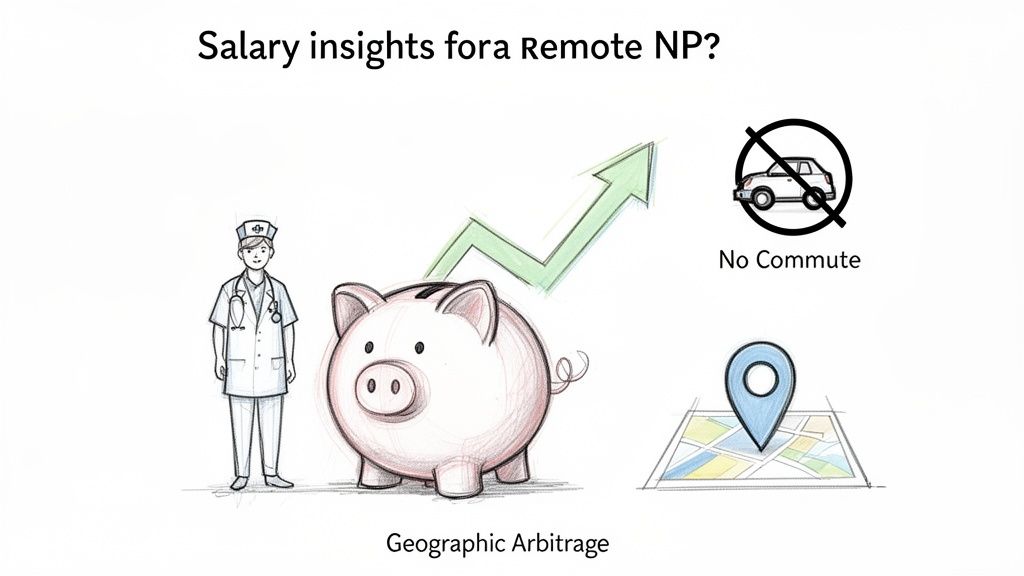
Let's get straight to the numbers. Moving into a remote nurse practitioner role is more than just a change of scenery; it's a strategic financial decision that can seriously accelerate your path to financial independence. While the salary is a huge piece of the puzzle, the real magic is how this career path can completely reshape your budget.
Nationally, the average nurse practitioner salary lands around $128,000, but that number is just a starting point. It can swing pretty wildly depending on a few key things. An NP specializing in psychiatry, for instance, will have a different pay scale than one doing primary care telehealth. Your years in the trenches and the state(s) where you're licensed also make a big difference.
What Shapes Your Remote NP Salary
To maximize your earnings, you first have to understand what drives them. Your compensation isn't some fixed number—it's a dynamic figure that reflects your specific skills and how your job is structured.
- Your Specialty: In-demand fields like psychiatric-mental health often pay more, plain and simple. There's a national shortage of providers, which puts you in a much stronger negotiating position.
- Your Experience: If you're a seasoned NP with five or more years under your belt, you can command a more competitive salary and benefits package.
- W2 vs. 1099: Are you an employee or an independent contractor? W2 roles offer a steady paycheck and benefits. 1099 gigs often come with a higher hourly rate, but you're on the hook for your own taxes, insurance, and retirement.
- Your Licenses: Holding a multi-state license through the NLC is a game-changer. It opens up a much wider pool of jobs and gives you serious leverage when it's time to talk money.
A remote career isn’t just about what you earn; it’s about what you keep. The financial benefits extend far beyond your direct deposit, creating new avenues for wealth-building that traditional roles often can't match.
Geographic Arbitrage: The Remote NP Superpower
This is where things get really interesting. Geographic arbitrage is a fancy term for a simple, powerful idea: earn a big-city salary while living somewhere with a low cost of living.
Think about it. You could be earning a salary competitive with the San Francisco market, but your mortgage and property taxes are based on rates in the Midwest. That difference can easily add up to tens of thousands of dollars in extra cash every single year. This isn't just fun money; it's fuel for your financial goals. It's what allows you to crush debt, max out your retirement accounts, and invest like you mean it.
The Hidden Financial Wins of Working from Home
Beyond the huge advantage of geographic arbitrage, working as a remote NP eliminates a ton of small, sneaky expenses that quietly drain your income in a traditional job.
Add up the savings:
- Zero Commute: You save a fortune on gas, car maintenance, and maybe even insurance. The average American spends thousands a year just driving to work and back.
- Lower Food Bills: That daily coffee run and overpriced salad for lunch? Gone. You're in control of your kitchen and your food budget.
- No Work Wardrobe: Say goodbye to buying and dry-cleaning stacks of scrubs or professional clothes.
These "invisible" savings add up fast, freeing up a significant chunk of your income to work for you. When you combine a strong salary with drastically lower living and work-related costs, you create a powerful engine for building wealth.
To get a precise look at how your own specialty and location affect your earning potential, you need to use a salary calculator for financial planning to map out your specific numbers.
How to Land Your First Remote NP Role
Making the leap from a hands-on clinic to a virtual one takes more than just good clinical skills. It's a whole new ballgame, and it requires you to present yourself in a completely different way. Landing that first remote NP job is all about proving you’re ready for the digital world—that you’re not just a great clinician, but a tech-savvy communicator, too.
Your resume isn’t just a history of your past jobs anymore. Think of it as a marketing document for the job you want. A traditional NP resume is usually packed with procedural skills and in-person patient management. For a telehealth role, you need to pivot and spotlight a different set of talents.
Your mission is to convince hiring managers you can hit the ground running in a digital environment from day one.
Tailoring Your Resume for Telehealth
To get a remote employer’s attention, your resume has to speak their language. That means taking your existing experience and reframing it to show its relevance to virtual care. Instead of just listing what you did, you need to explain how you used technology to do it.
Here’s how you can translate your skills:
- EMR Proficiency: Don't just list the EMRs you know. Try something like this: "Expertly navigated Epic and Cerner to manage patient data, coordinate with specialists, and process e-prescriptions, ensuring seamless continuity of care."
- Digital Communication: You've been communicating digitally for years. Showcase it. For example: "Utilized secure patient portals to provide clear, concise medical advice and follow-up care, achieving a 95% patient satisfaction rating for communication."
- Virtual 'Webside Manner': Even without a formal telehealth title, you have the right experience. Frame it like this: "Conducted telephone triage and follow-up calls, effectively assessing patient needs and building rapport without any in-person contact."
These subtle shifts change the entire focus, showing you’re primed for a remote setting.
Acing the Virtual Interview
That video interview? It's your audition. It’s not just about what you say; it’s about demonstrating your comfort and professionalism in the exact environment you’ll be working in.
Your setup is part of the interview. A clean, quiet background, a stable internet connection, and good lighting show that you understand the practical requirements of working from home and are taking the opportunity seriously.
Practice making a real connection through the screen. Look directly into the camera to create eye contact, use active listening cues like nodding, and stay engaged. Be ready with specific stories about how you've used technology to solve a clinical problem or improve a patient's outcome.
Finding Burnout-Friendly Remote Jobs
Let's be honest: not all remote jobs are the low-stress dream you're looking for. The key is knowing where and how to search for roles that genuinely respect your work-life balance. Use job platforms that let you filter for the things that actually matter to you. For example, on WeekdayDoc, you can instantly search for remote NP jobs with "No Weekends" or "No Call".
Don’t underestimate the power of networking. Learning how to effectively message recruiters on LinkedIn can open doors to opportunities you'd never find otherwise. When you do get to the interview stage, be upfront about what you need. It’s not just okay to ask about patient volume, on-call duties, and schedule flexibility—it's essential.
By thoughtfully preparing your resume and carefully vetting each opportunity, you can find a remote NP role that fuels your career without draining your life. And when an offer comes in, a tool to analyze your job offer and compensation can give you the clarity you need to make the right choice.
Of course. Here is the rewritten section, crafted to sound like an experienced human expert and match the provided style guide.
Your Questions About Remote NP Careers, Answered
Thinking about moving into a remote role is exciting, but it also brings up a ton of practical questions. What does the day-to-day really look like? Let’s clear up some of the most common things NPs ask when they're considering the switch to virtual care.
What Kind of Tech and Equipment Do I Actually Need?
Good news: most legitimate telehealth companies aren't going to make you buy their proprietary software. They'll provide secure access to their EMR and telehealth platform. Your responsibility is the hardware.
Think of it as setting up a professional home office:
- A reliable computer that can handle video calls without freezing (laptop or desktop is fine).
- High-speed internet that’s stable. Dropped calls are not an option.
- A decent webcam and microphone so your patients can see and hear you clearly.
- A private, quiet workspace where you can guarantee HIPAA compliance. No interruptions.
Some of the better employers offer a tech stipend to help you get set up, which is a great perk to look for.
Honestly, the most critical piece of "equipment" is your digital fluency. Getting comfortable with new EMRs, doing basic tech troubleshooting on the fly, and mastering clear communication through a screen—those are the skills that really set you up for success.
How Can I Build Rapport with Patients I Never Meet in Person?
Building that crucial patient connection through a screen is a skill, and it's one you can absolutely master. It’s often called “webside manner,” and it’s a little different from what you do in the clinic.
Instead of relying on physical presence, you lean into other cues. It’s about active listening, looking directly into the camera (not just at their picture on your screen), and using verbal affirmations to show you’re engaged. When you create a focused, unhurried space for them, patients feel heard and respected. That’s how you build the trust that’s essential for great long-term care, whether it's in person or online.
Is This a Career Dead End? What Are the Growth Opportunities?
Not at all. A remote NP role isn't a sidetrack—it's a launchpad into some of the most in-demand areas of healthcare.
Many experienced telehealth NPs move up the ladder into leadership, managing teams of virtual clinicians or shaping telehealth protocols for entire health systems. Others pivot into fascinating fields like clinical informatics, quality improvement, or digital health consulting. The skills you hone in virtual care—efficiency, clear communication, tech savvy—are incredibly valuable and transferable across the industry.
Ready to find a remote NP job that fits your life, not the other way around? WeekdayDoc is a job platform founded by physicians to help clinicians find burnout-friendly roles without mandatory nights, weekends, or on-call shifts. Start your search for a sustainable career today at https://www.weekdaydoc.com.