Calculate Your Physician Call Burden
Calculate physician call burden before accepting an offer by annualizing home and in-house call, nights, weekends, backup, interruptions, recovery, and pay.
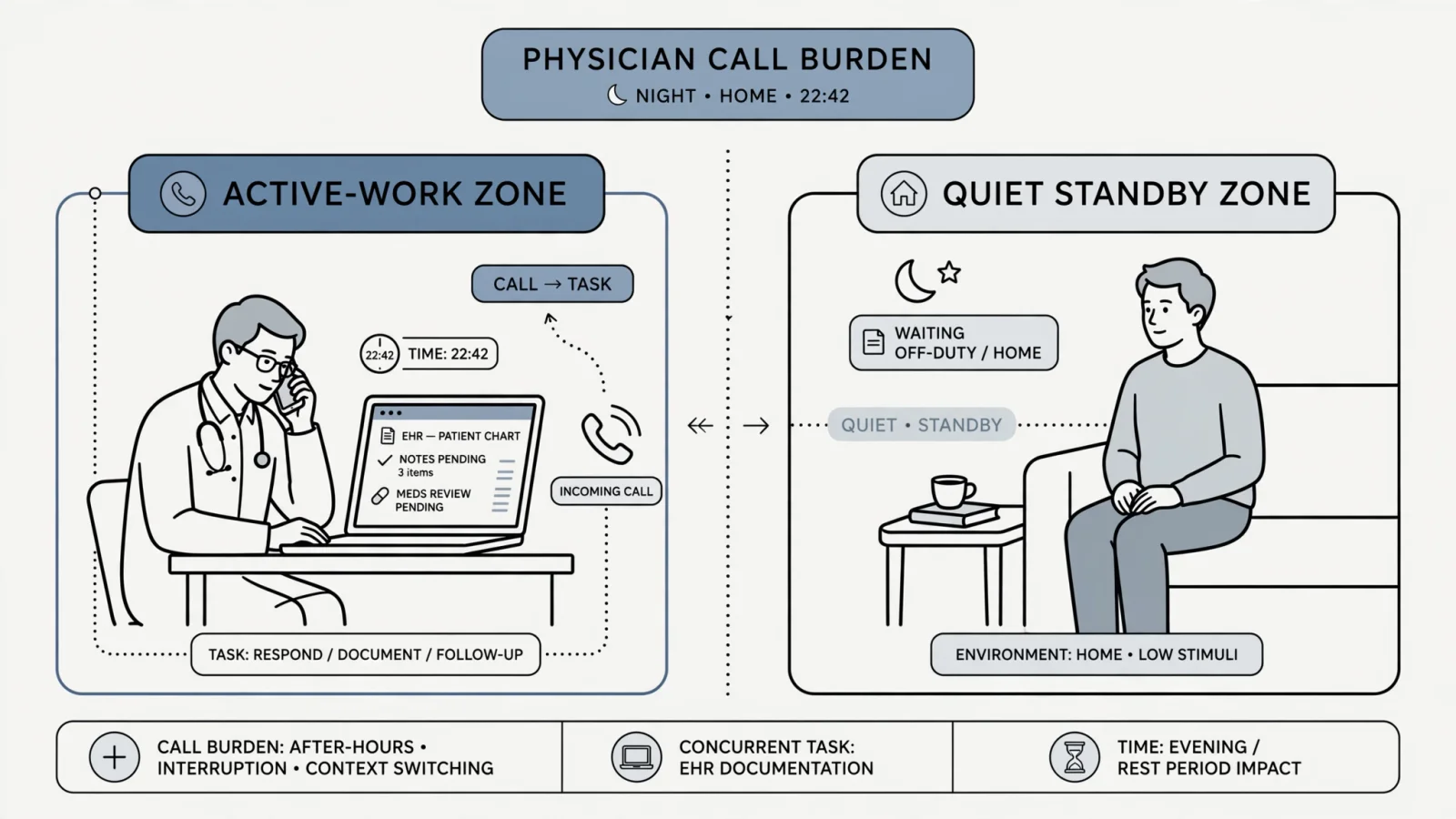
Vague call language in an employment offer hides the actual workload you agree to take on. The phrase "one-in-four call" expresses a ratio rather than a concrete schedule. To calculate your real physician call burden, convert that fraction into a hard count of annual assignments, standby hours, direct labor, sleep disruptions, and next-day schedule changes.
Comparing roles accurately requires standardizing this data. Gather the proposed contract, the compensation structure, and a sample monthly schedule from the medical director before negotiating an agreement. Identifying whether a role involves home triage, in-house shifts, unpaid backup liability, or heavy weekend requirements clarifies the actual demands. WeekdayDoc organizes this decision data by turning vague job descriptions into comparable listings with 0-to-10 work-life scores, visible call expectations, and salary context. These tools allow you to evaluate the financial and operational trade-offs of a role prior to signing.
Converting a theoretical call ratio into a practical annual workload requires a structured sequence. The process separates your restricted availability window from your active clinical labor, accounts for the fragmentation of interrupted sleep, and translates the resulting burden into an hourly value for offer comparison.
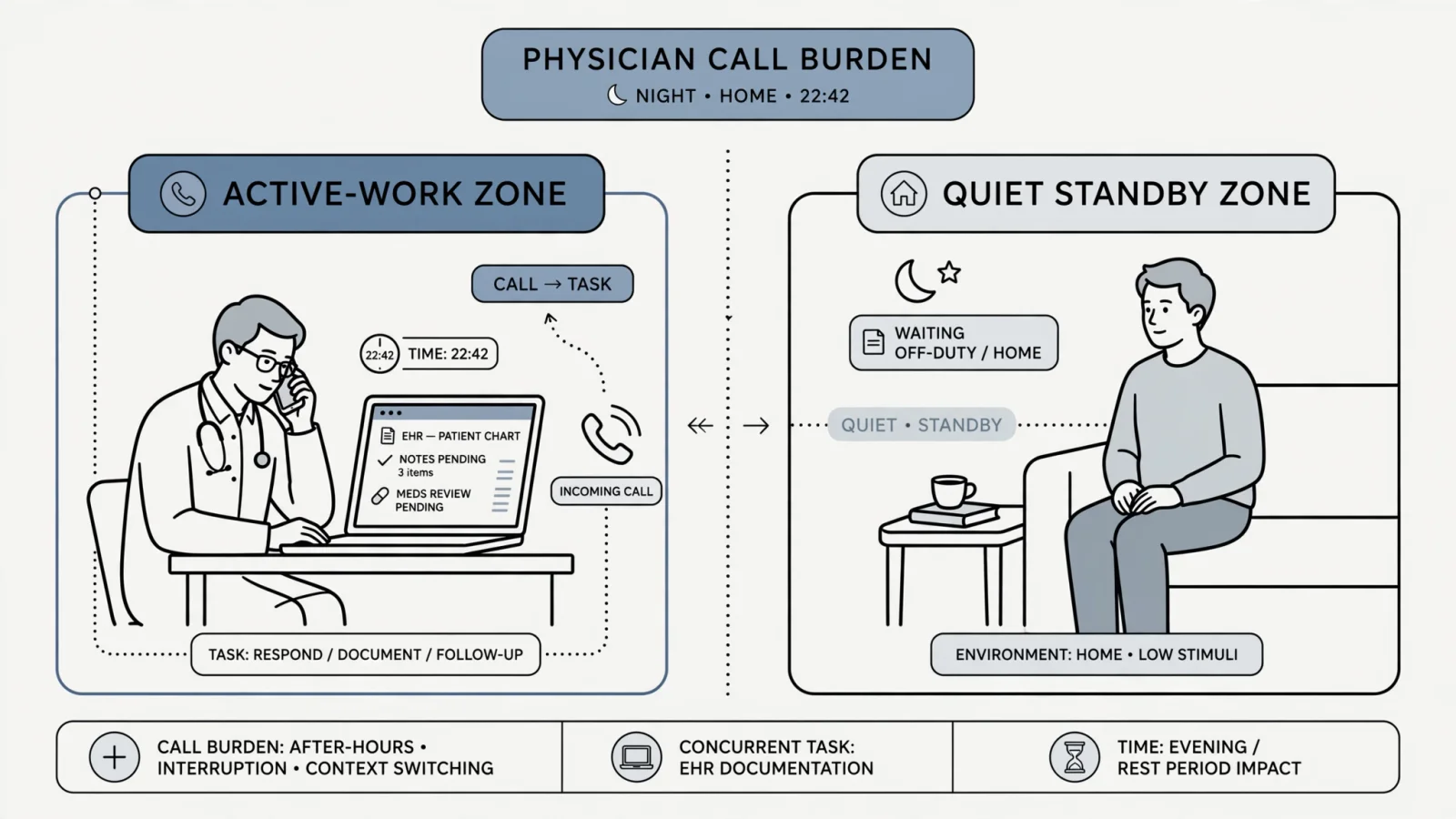
Step 1: Decode the Schedule’s Denominator
A call ratio lacks meaning without an attached unit of measurement. Covering one in four weeknights produces a completely different lifestyle footprint than working one full week every four weeks, making it important to identify the denominator before doing any math.
Start by turning the proposed ratio into an annual assignment count. A standard planning year of 52 weeks contains 260 weekdays and 52 weekends. If an offer specifies one-in-four weeknight call, divide 260 by four to yield approximately 65 weeknight assignments per year. Alternatively, if the offer includes one-in-four weekend call, dividing 52 by four results in 13 weekend blocks annually.
A schedule requiring one week of call every four weeks produces 13 full call weeks per year, meaning you cover 65 weeknights and 13 weekends simultaneously. While the ratio looks identical on paper, the distribution of your personal time changes entirely. To maintain accuracy, calculate your weeknight, weekend, holiday, and backup rotations as separate line items.
After calculating the baseline numbers, ask the employer how the denominator changes during staffing shortages. A one-in-four rotation only survives while the practice retains four active clinicians. Determine whether the contract caps your maximum required call or if you automatically absorb a one-in-three rotation when a partner leaves, takes extended medical leave, or reduces their clinical FTE.
Step 2: Calculate Standby and Direct Call Work
Call burden consists of two distinct physical states: restricted availability and active clinical labor. A 15-hour home-call window and a 15-hour in-house shift cover the exact same amount of time on the clock, yet they represent entirely different workloads. Calculating them independently clarifies the true demands of the job.
Calculate your annual standby hours first by multiplying your total assigned call periods by the number of hours in the coverage window. For a typical 5 p.m. to 8 a.m. weeknight rotation, each assignment equals 15 standby hours. These blocks represent restricted personal time where you cannot travel freely, consume alcohol, or guarantee uninterrupted sleep, so record this total separately from your worked hours.
Next, calculate your active direct labor. For home call, use a formula that captures remote work and travel by multiplying your estimated contact events by the average minutes per contact. Factor in the time you spend on documentation, orders, and physician administrative burden tied to the EHR, alongside the hours spent driving to the hospital and providing care during a call-in. Dividing the total by 60 yields your annual home-call work hours. If a phone call leads directly to a hospital activation, avoid counting the same minutes twice.
For in-house call, multiply your total shifts by the shift length, separating your total scheduled hours from your incremental call hours if the in-house shift replaces routine daytime clinic work. Counting a night shift as an incremental burden when it replaces a Tuesday clinic overstates your total annual labor.
Medical training rules also treat remote clinical work as labor. The 2025 ACGME common program requirements FAQs specify that clinical work performed from home, including taking calls and using the EHR, counts toward the 80-hour limit for residents and fellows. Time spent in the hospital after being called in also applies to this limit. While these regulations govern training programs rather than attending-physician employment, the underlying principle holds true for any contract evaluation because remote clinical labor requires measurable effort.
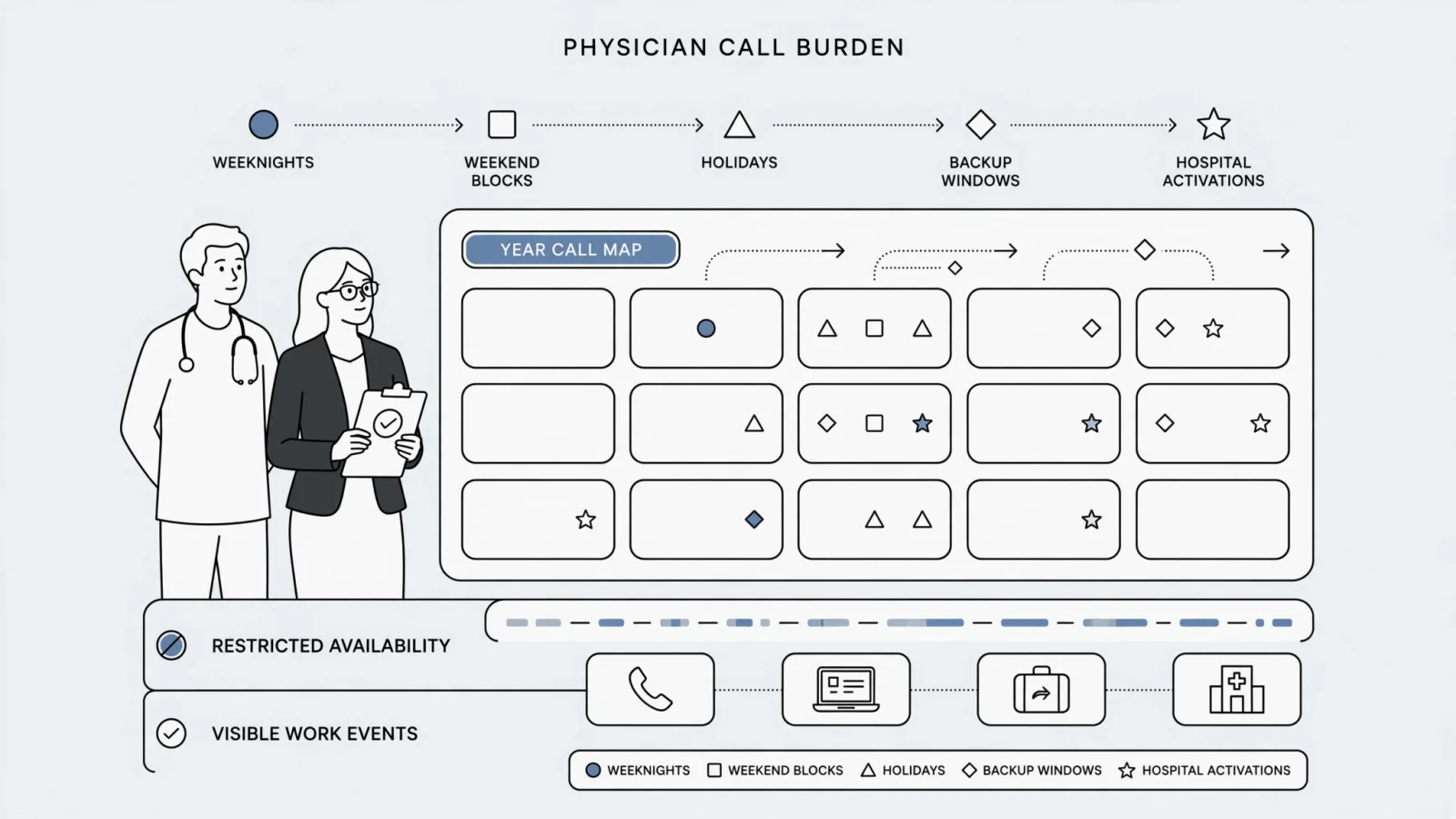
Step 3: Measure Interruptions, Backup, and Recovery
Direct minutes alone understate the physical cost of a fragmented night. A two-minute phone call at 2 a.m. might add very little to your labor calculation, but it can disrupt a 90-minute sleep cycle and alter your cognitive function for the following day.
Track your expected annual interruption events by totaling your projected phone calls, pager alerts, secure messages, EHR tasks, and transfer requests. You can estimate an attention footprint by multiplying those events by the direct contact time, the documentation time, and your typical task-resumption time. Because task-resumption time varies by specialty and individual, use a conservative range rather than a single fixed number. A prospective observational study published in BMJ Quality & Safety tracked 29 German hospital doctors during daytime shifts and found an average of 3.66 disruptions per hour, which researchers associated with a higher perceived workload. While that specific frequency describes a daytime European hospital setting rather than a U.S. attending overnight schedule, the study still illustrates why frequent task switching can add to exhaustion, even when each interruption is brief.
Backup call requires its own dedicated calculation since many physicians accept these duties assuming they will rarely face activation. Track your backup assignments, the restricted availability window, the activation probability, and the required response time. Multiplying your backup assignments by the activation probability and the average activation hours reveals your expected annual backup work. An unpaid backup role restricting you to a 30-minute geographic radius every third weekend limits your life much like primary standby call does.
Check the post-call recovery rules to determine whether the schedule protects the day after a heavily disrupted night. A call rotation requiring a full procedural schedule at 8 a.m. following three overnight activations carries a higher burnout risk than a schedule offering a protected post-call recovery day.
Step 4: Convert Call Burden Into Comparable Value
Once you map the hours, you can translate the schedule into a comparable financial metric using a hypothetical one-in-four model. Assume an offer requires one-in-four weeknight call from 5 p.m. to 8 a.m. and one-in-four weekend call in 48-hour blocks. In this scenario, you anticipate two contacts per weeknight, five contacts per weekend, 15 minutes of direct work per contact, and one three-hour hospital activation for every 10 assigned call periods.
Under a 52-week calendar, this schedule produces 65 weeknight assignments and 13 weekend blocks for a total of 78 call periods. Multiplying 65 weeknights by 15 hours yields 975 standby hours, while multiplying 13 weekends by 48 hours yields 624 standby hours. This brings your total assigned standby window to 1,599 hours of restricted personal time.
The active work calculation follows next. You face 130 weeknight contacts and 65 weekend contacts, totaling 195 events. At 15 minutes each, that equals 48.75 hours of remote clinical work. Dividing your 78 call periods by 10 produces 7.8 expected hospital activations, adding 23.4 activation hours to the total. After removing any overlapping minutes, you establish a concrete estimate of your incremental clinical labor.
These figures help evaluate physician call pay across different offers. Divide your annual call-specific stipend by your incremental call-work hours to find your pay per active call hour. To view the broader picture, divide your total annual compensation by your baseline clinical hours plus your incremental call-work hours. This calculates your overall physician pay per hour, revealing whether a high base salary compensates you fairly for the extra nights and weekends. Keep your 1,599 standby hours visible alongside these numbers, as a high hourly rate for active work does not erase the lifestyle cost of spending 1,599 hours tied to a pager.
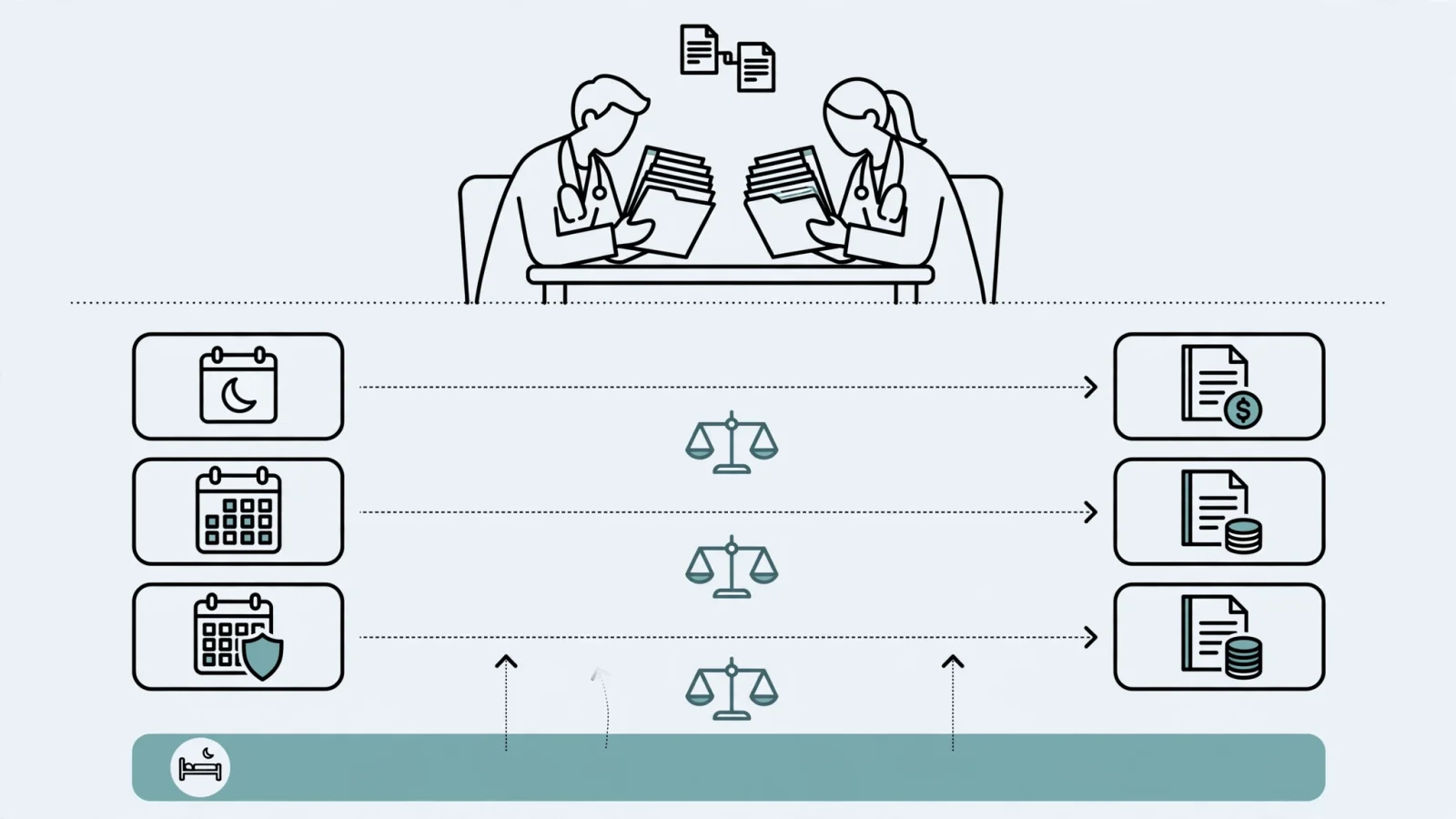
Step 5: Verify the Offer Before You Accept
The calculations you perform rely on the numbers the employer provides. Verifying those assumptions during the interview process prevents surprises after you sign an agreement. Turning your worksheet variables into a due-diligence checklist allows you to collect specific data from the medical director or practice manager.
Ask targeted questions about volume and coverage, requesting the actual number of calls, pages, and call-ins recorded during the busiest recent call period. Clarify whether the rotation includes covering a single hospital, multiple emergency departments, outpatient portal messages, or unassigned emergency patients. You can also ask how the practice handles post-call scheduling when a physician works past midnight and determine how additional emergency call is compensated when a colleague falls ill.
Verbal assurances that a call rotation stays "usually pretty light" offer no contractual protection. The AAFP guidance on physician employment contracts advises physicians to secure written terms for the maximum required call, the exact locations covered, the payment structure, shared call expectations, and coverage during absences. If the medical director promises you will never take more than one weekend a month, that cap belongs in the final written agreement.
Common calculation traps can distort your final decision. Confusing nights with full weeks applies the wrong denominator, while treating standby time as either active labor or completely free time misrepresents your availability. Assuming that home call requires less energy than an in-house shift also ignores the toll of interruptions. Evaluating the hidden geographic and lifestyle restrictions of a backup rotation prevents unwelcome surprises.
You can use the WeekdayDoc contract scanner to flag missing call parameters, non-competes, and problematic scheduling clauses in your draft agreement. This AI-powered tool accepts pasted text, PDF, or DOCX files and highlights areas requiring clarification. While securing professional legal review remains standard practice for final interpretation of complex terms, the scanner provides immediate decision support during the negotiation phase.
Evaluating a healthcare role requires mapping out the true cost of your time. By calculating your annual assignments, standby exposure, active direct labor, interruption frequency, and schedule recovery, you replace vague promises with comparable data. Compare these exact metrics, along with work-life scores and salary benchmarks, across roles on WeekdayDoc before applying.
Find roles that align with your lifestyle. Compare schedule quality, visible call expectations, burnout scores, and compensation data for your specialty on WeekdayDoc.