Dermatologist Career Outlook: 2026 Salary & Job Guide
Explore the 2026 dermatologist career outlook. Our guide covers salary, demand, and how to find burnout-friendly roles with excellent work-life balance.
You're probably looking at dermatology from one of two places right now. Either you're still in training and seeing eye-catching compensation numbers while wondering what the day-to-day cost will be, or you're already in practice and realizing that a “good lifestyle specialty” can still turn into a job that eats your evenings, clogs your inbox, and makes every clinic session feel overpacked.
That tension sits at the center of the dermatologist career outlook. The field is still attractive for good reasons. The work is varied, the procedural mix can be satisfying, and many physicians do build excellent long-term careers in it. But the headline narrative misses the question that matters most once you're close enough to sign a contract.
Can you build a dermatology career that stays good after year three, not just year one?
Beyond the Hype a Sustainable Dermatology Career
A common scene looks like this. A resident finishes clinic, opens a spreadsheet of job options, and sees what appears to be an easy decision. One offer pays more. Another is in a nicer city. A third hints at future partnership. On paper, all three look like “great dermatology jobs.”
Then the practical questions start.
How many patients per session? Who handles prior authorizations? Is there call in reality, even if the contract sounds vague? How much cosmetic work are you expected to bring in? Will you have protected charting time, or are you expected to finish your inbox at night after dinner?
That's where the dermatologist career outlook primarily starts. Not with a single growth statistic, but with whether the practice model is built for a sustainable physician life.
Why the usual lifestyle story is incomplete
Dermatology still carries the reputation of being one of medicine's more controllable specialties. Compared with many hospital-based fields, that reputation isn't baseless. Predictable clinics, fewer emergencies, and multiple practice settings do create room for a better schedule.
But a controllable specialty isn't the same as a protected one.
A dermatologist can still burn out in a polished outpatient office if the visit template is unrealistic, cosmetic expectations are relentless, or every “quick follow-up” gets squeezed into an already full day. Administrative burden hasn't skipped dermatology. It just shows up differently than it does in inpatient specialties.
Practical rule: Don't confuse a specialty's reputation with a specific job's reality.
What actually makes a dermatology career hold up
The physicians who stay satisfied long term usually get several things right early:
- They choose the practice model carefully. A high-paying role with poor boundaries often costs more than it gives.
- They define nonnegotiables before interviewing. No-call, weekday-only, cosmetic mix, support staff, and charting expectations matter as much as compensation.
- They evaluate autonomy in concrete terms. Real autonomy means control over schedule, visit length, procedure mix, and time off.
- They think in decades, not signing bonuses. A role that preserves energy often preserves career longevity too.
The useful way to read the dermatologist career outlook today is this: the market is strong enough that most qualified dermatologists have choices. The hard part isn't finding any job. It's avoiding the wrong one.
The Dermatology Job Market by the Numbers
A dermatologist reviewing offers in 2026 can usually find another option if the first contract looks wrong. That matters more than a flashy growth percentage, because career durability in this field depends less on whether jobs exist and more on whether you use a strong market to get a job you can sustain.
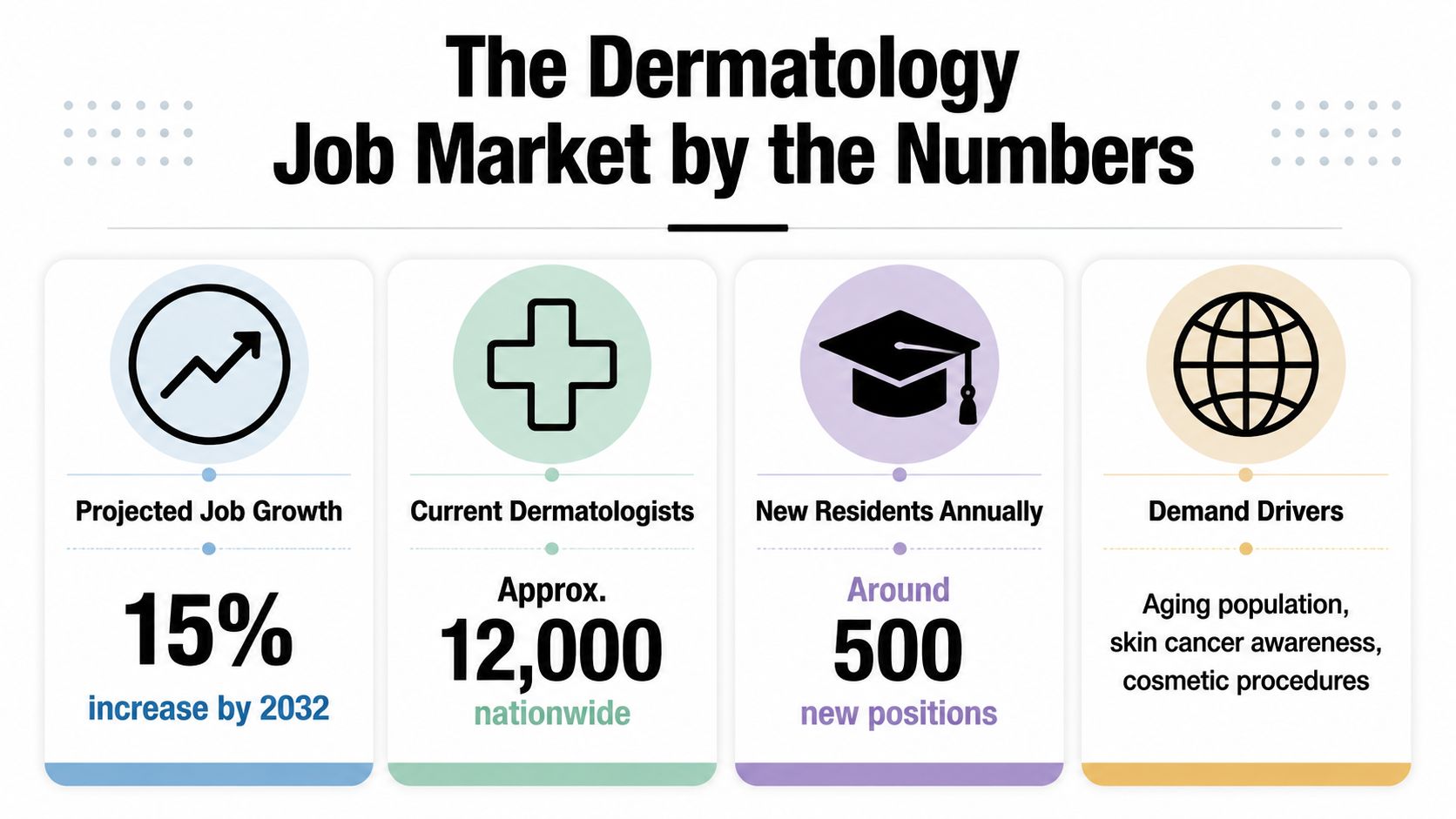
The broad labor numbers look ordinary at first glance. The Bureau of Labor Statistics projected 3% employment growth from 2021 to 2031 for physicians and surgeons, the umbrella category that includes dermatology, and PracticeLink's roundup also cites CareerExplorer data showing 11.4% growth between 2016 and 2026 plus demand tied to both new positions and retirements, according to PracticeLink's dermatologist outlook summary. General physician growth figures alone miss what drives hiring in dermatology.
Dermatology remains a constrained workforce.
Why modest growth still translates into a strong market
A peer-reviewed workforce analysis found 4.14 dermatology providers per 100,000 people in the U.S. in 2016. It also noted that even including physician assistants only pushes supply to just above the commonly cited adequacy threshold of 4 per 100,000, as reported in this dermatology workforce analysis. In practice, that is a thin margin for a specialty managing skin cancer surveillance, chronic inflammatory disease, procedural visits, and cosmetic demand that can quickly absorb clinic capacity.
That is why a market can feel tight even when the headline growth rate sounds average.
The day-to-day implication is straightforward. A clinic does not need explosive national growth to stay busy. It only takes a limited supply of trained dermatologists, steady referral patterns, and enough attrition, retirement, or geographic mismatch to keep openings active for months.
What the long view means for actual hiring
The useful read on dermatology is not that every market is equally hot. It is that many employers still have trouble filling positions with physicians who fit the practice model, pace, and scope they need. Rural access gaps, suburban expansion, physician turnover, and retirement all contribute. So does simple mismatch. Some jobs stay open because the contract is weak, staffing is thin, or productivity expectations are detached from how a dermatologist wants to practice.
That distinction matters if you are job hunting. A strong market gives you room to be selective. It does not protect you from signing into a setup that burns time, attention, and energy.
If you are reviewing current dermatology job openings on WeekdayDoc, read the numbers with that lens. The advantage in dermatology is rarely just access to employment. The true advantage is having enough demand behind you to ask harder questions about support staff, schedule design, documentation load, and how long the job will still feel workable in year five.
Decoding Dermatologist Salary and Compensation Models
A common dermatology recruiting scenario goes like this. Two offers land in the same week. One posts the higher number. Six months later, the physician in that job is charting at night, covering staffing gaps, and wondering why the “great lifestyle” specialty suddenly feels tight.
That happens because compensation in dermatology is rarely just compensation. It is a package of pace, staffing, payer mix, scheduling control, and who absorbs the friction when clinic operations are inefficient.

Why the headline number misleads
National pay data is useful for orientation, but job choice happens locally. The BLS dermatologist wage and employment data shows meaningful variation by state and metro area. In practice, that means the same specialty can produce very different financial outcomes depending on where you work and how the clinic runs.
A hospital-employed position may offer stable benefits, referral security, and a smoother ramp, while capping upside and adding more institutional rules. A private practice offer may promise higher earnings, but the question is how long it takes to reach those numbers and what daily workload sits underneath them.
The more useful reading of compensation is operational.
| Factor | What it changes |
|---|---|
| Geography | Base pay, payer mix, cosmetic demand, cost of living |
| Practice setting | Stability, upside, benefits, partnership potential |
| Compensation formula | Predictability versus productivity pressure |
| Clinical mix | Procedures, cosmetics, follow-up burden, patient expectations |
How the main compensation models play out
The structure matters as much as the salary figure on page one.
- Guaranteed salary, then incentives. Often the safest way to start. It gives income stability while you build volume. The catch is whether the conversion to incentive pay is based on realistic visit length, procedure mix, and support staffing.
- Productivity-heavy compensation. This can be excellent in a well-run clinic with strong MAs, efficient prior auth support, and sane documentation expectations. It gets ugly fast when the physician is carrying inbox work, cosmetic counseling, and unpaid admin time on top of a packed template.
- Partnership track. This can create strong long-term income and more control over practice decisions. It only works when the buy-in, timeline, governance, ancillary revenue participation, and exit terms are written clearly.
- Academic compensation. Usually lower on headline pay, sometimes better on intellectual fit. For some dermatologists, teaching, complex referral cases, and a different pressure profile make the trade worth it.
A short video can help frame how physicians think through income and career design over time.
What actually determines whether an offer is good
The standard story about dermatology is still true in part. Compared with many fields, it can offer strong income and a more controllable schedule. But plenty of dermatologists learn the hard way that a high-income job can still be exhausting if the compensation model depends on overbooking, inbox sprawl, or constant pressure to add procedures.
I advise physicians to ask plain questions. Who handles prior auths. How often are templates changed. What counts toward productivity. Are no-shows backfilled automatically. How much non-visit work falls to the doctor. A contract can look generous and still require too much invisible labor to be sustainable.
That is why salary review should sit next to financial planning. Koru's 2026 financial freedom guide is a useful reference if you want to compare income paths against savings goals and career flexibility, not just annual pay.
For specialty-specific benchmarks, current dermatologist salary data and market context is most useful when you read it beside schedule design, support structure, and the odds that the job will still feel workable in year five.
A compensation package is only as good as the work required to earn it.
Choosing Your Practice Setting and Subspecialty
Two dermatology jobs can share the same title and feel like different careers. One gives you broad control and a manageable patient mix. The other gives you a polished office, a full schedule, and no actual say over how the day runs.
That's why practice setting usually matters more than branding.

How the major settings differ in real life
The cleanest comparison is side by side.
| Setting | What tends to work | What often doesn't |
|---|---|---|
| Private practice | Autonomy, entrepreneurial upside, control over clinical style | Admin burden, staffing headaches, business risk |
| Hospital or system employment | Stable infrastructure, benefits, easier ramp | Bureaucracy, template pressure, less control |
| Academic practice | Teaching, complex cases, intellectual variety | Lower pay in many settings, institutional friction |
| Group practice | Shared overhead, collegial coverage, operational support | Less individual control than true owner-led practice |
The mistake is assuming one setting is universally superior. The right choice depends on what you want to protect.
If you care most about schedule control, some private and smaller group models may fit better. If you want predictable benefits and less business responsibility, employed roles may be the better trade. If teaching or subspecialty complexity matters, academics may be worth the lower financial ceiling.
The newer flexibility paths
The dermatologist career outlook has also become more about fit than about simple headcount. Industry discussions point to teledermatology, corporate roles, and other nontraditional models, while a 2024 AMA survey found dermatologists were among the specialists least likely to report intent to leave their current role, as discussed in this overview of dermatologist alternative career paths.
That matters because many physicians no longer want only one traditional answer to the question, “Where should I practice?”
Some want hybrid clinic schedules. Some want fewer procedure days. Some want teledermatology as a partial buffer against commuting, call, or physical clinic intensity. Others want an industry or advisory role that uses expertise without requiring full-time patient volume.
Subspecialty changes the rhythm of the job
Subspecialization doesn't just change prestige or income potential. It changes the texture of your week.
- Mohs-focused practice can bring procedural concentration, surgical flow, and a very different pace than general dermatology clinic.
- Cosmetic dermatology may increase control over scheduling in some settings, but it also raises expectation management and patient service demands.
- Pediatric dermatology changes communication style, referral patterns, and the emotional tenor of the day.
- General medical dermatology often offers variety, but variety can become fragmentation if the template is poorly designed.
The right subspecialty isn't the one that sounds impressive at a conference. It's the one whose daily workflow you can tolerate for years.
Navigating Work-Life Balance and Burnout Risk
Dermatology does offer real advantages for work-life balance. Many jobs are office-based. Schedules can be more predictable than in many acute-care fields. Physicians often have more control over their environment than colleagues in hospital-dependent specialties.
That's the upside. The stereotype goes wrong when people stop there.
O*NET describes dermatologists as having very high decision latitude, with 99% reporting “a lot of freedom,” while also showing high competition and daily time pressure in a Job Zone Five role that requires extensive preparation and years of specialized training, according to the O*NET dermatologist occupational profile. This highlights the tension of the specialty. High control and high pressure can coexist.
What burns dermatologists out in practice
Burnout in dermatology usually doesn't come from the same sources people imagine when they compare it with more acute specialties. It often comes from friction that looks manageable until it becomes daily.
A few examples show up repeatedly:
- Volume creep where a “busy but reasonable” clinic slowly becomes a conveyor belt
- Inbox spillover from pathology follow-up, prior authorizations, refill messages, and patient portal expectations
- Cosmetic pressure in practices where service, sales, and clinical judgment start to blur
- Cancer burden where serious diagnoses break up an otherwise routine clinic and add emotional weight
- Documentation after hours when no protected admin time exists
The same autonomy can protect you or exhaust you
Autonomy helps when it is real. If you control your schedule, have meaningful say over staffing, and can shape visit lengths, that freedom buffers stress. If “autonomy” only means you're personally responsible for making an overloaded system function, it does the opposite.
Here's a practical way to evaluate balance risk before taking a role.
| Green flags | Warning signs |
|---|---|
| Protected admin time | “Most physicians finish charts from home” |
| Clear patient-per-session norms | Volume expectations described vaguely |
| Dedicated support staff | Shared or rotating support with no consistency |
| Defined cosmetic mix | Pressure to grow aesthetics without infrastructure |
| Explicit no-call terms | “Minimal call” with no written detail |
What actually improves sustainability
Dermatologists who stay steady usually build guardrails early.
- Protect the template. If the visit schedule is broken, the rest of the job won't save it.
- Ask who owns the inbox. A manageable clinic can still produce miserable evenings.
- Separate prestige from fit. A sought-after group can still be wrong for your life.
- Treat recovery time as a clinical resource. Fatigue changes judgment, patience, and tenure.
Some dermatology jobs are lifestyle-friendly. Some are simply outpatient jobs with better branding.
How to Find Burnout-Friendly Dermatology Jobs
A dermatologist signs what looks like a strong offer. The salary is attractive, the office is busy, and the group promises flexibility. Three months later, clinic runs late most nights, pathology follow-up spills into dinner, and “light call” turns out to mean being available whenever the schedule breaks. That pattern is common because many physicians shop for dermatology jobs as if demand alone will protect them.
It will not.
A strong market gives you options. It does not guarantee a sustainable job. The practical question is whether you can turn that market advantage into a role with a schedule, staffing model, and compensation structure you can still live with in a few years.
Read the posting like an operator
Job listings rarely hide problems outright. They usually blur them.
A posting that leads with “high income potential” but says little about template control, staffing consistency, inbox coverage, or call should prompt closer review. “Flexible” may mean schedule autonomy. It may also mean the clinic expects you to absorb overflow. “Entrepreneurial” sometimes means room to build. It also sometimes means weak infrastructure and physician-owned cleanup.
Look for concrete details:
- Schedule design. “Weekdays only” means something. “Flexible schedule” needs explanation.
- Call terms. No call should appear plainly, not as “limited” or “shared.”
- Support staffing. Dedicated MA support and clear front-desk processes change the day.
- Clinical mix. General medical, surgical, cosmetic, and teledermatology work create very different rhythms.
- Ramp expectations. A fast path to full volume can be financially attractive and operationally punishing.
Ask questions that expose the real job
Broad culture questions get polished answers. Workflow questions get the truth.
Use the interview to pin down the daily mechanics:
- How many patients are booked in a standard half day, and who can change that template?
- Who handles prior authorizations, pathology callbacks, and prescription messages?
- Is there protected admin time on the schedule, or is charting expected after clinic?
- What does call look like in writing, including weekends, refill requests, and inbox coverage during time off?
- How long did the last dermatologist stay, and why did they leave?
- What happens when a medical assistant is out sick or a physician falls behind?
One of the most useful questions is simple: What does a normal Thursday look like here? Groups with a stable system can answer that quickly.
If nobody can describe a normal clinic day clearly, the workflow usually depends on physician catch-up.
Screen for fit before you ever apply
A good search process saves more energy than a good negotiation.
Use job filters that reflect how you want to practice. If your goal is lower burnout risk, start with roles that state the schedule boundaries up front, such as dermatology and clinical jobs tagged burnout-friendly. That does not guarantee a good job, but it cuts out many listings built on vague promises.
Dermatology still carries the “great lifestyle” reputation for a reason. Many roles are better than what colleagues in other specialties tolerate. The mistake is stopping there. The physicians who build durable careers usually get specific early, verify how the clinic runs, and treat time, staffing, and after-hours burden as seriously as compensation.
Using WeekdayDoc to Evaluate Your Next Career Move
Consider two hypothetical offers.
Offer A pays more on paper. The group has a polished website, a large footprint, and “minimal call” language that never gets pinned down. The schedule looks efficient until you notice there's no protected admin time and no clear answer on how many messages physicians handle after clinic.
Offer B starts lower. The role is clearly weekday-based, explicitly no-call, and built around a schedule you can realistically explain to a spouse or partner. There's less mystery around support staffing, charting expectations, and session flow.
The wrong way to compare those jobs is to stop at the starting salary.

A better framework for comparing offers
Use a simple screen:
| Question | Offer A | Offer B |
|---|---|---|
| Is call defined clearly? | Ambiguous | Clear |
| Is admin time protected? | Unclear | Defined |
| Can you describe a normal week? | Not really | Yes |
| Does the workflow look sustainable? | Questionable | More likely |
That doesn't make the lower-paying offer automatically better. It does force you to measure what usually determines whether you still want the job later.
How to evaluate the long game
Practical tools matter. A platform like WeekdayDoc can be useful if you want to compare more than a headline number, because it includes Burnout-Friendly Score, salary data, and FIRE projections by state on job listings. That lets you examine whether a role with slightly lower compensation may still produce a better long-term outcome if it reduces turnover risk, protects weekends, and lowers the odds that you'll need to exit early.
A sustainable dermatologist career outlook isn't just about whether the specialty remains desirable. It's about whether your specific next move gives you enough control to stay in the work without resenting it.
When two jobs are financially viable, the one that protects your energy often protects your career.
If you're comparing dermatology roles and want to filter for schedules that protect evenings, weekends, and call burden, WeekdayDoc is one practical place to start. It lets clinicians review salary context, burnout-focused job filters, and work-style details before investing time in the wrong interview cycle.