Remote Pharmacist Jobs Your Guide to a Flexible Career
Explore remote pharmacist jobs and discover the path to a flexible, high-paying career with better work-life balance. Find roles that fit your life.
If you're a pharmacist feeling the squeeze of a traditional retail or hospital setting, the idea of a remote job probably sounds like a breath of fresh air. It is. A remote pharmacist role allows you to use your clinical and administrative expertise from a home office, shifting your focus from dispensing pills to tasks like medication therapy management, clinical reviews, and in-depth patient counseling.
These aren't just administrative positions; they are a powerful escape route from the burnout plaguing the profession, offering a shot at genuine work-life balance and a schedule you can actually plan your life around.
The New Era of Pharmacy and Your Place in It
Feeling the strain of clinical burnout? You’re definitely not alone. The entire pharmacy profession is going through a massive shake-up, thanks to telehealth and the growing need for specialized virtual care. Think about how banking has changed—we went from standing in line for a teller to managing everything on our phones. Pharmacy is on the exact same path, opening up incredible new opportunities for professionals who want a sustainable career.
This isn’t just a feeling; the job market data backs it up. The real growth isn’t in traditional retail anymore. Instead, hospitals, outpatient centers, and home healthcare are projected to add over 8,400 new pharmacist roles. In fact, hospitals alone are expected to account for 60% of this non-retail growth, signaling a clear industry shift toward more specialized, often remote-friendly, positions.
The Rise of Virtual Clinical Services
The heart of this change is simple: a pharmacist's clinical brain is no longer tied to a physical pharmacy counter. Technology now makes it possible for highly skilled pharmacists to deliver essential care from anywhere, paving the way for roles that value your cognitive skills above all else.
This shift comes with some major perks:
- A Real Work-Life Balance: Many remote jobs stick to standard business hours. That means no more mandatory nights, weekends, or holidays eating into your personal time.
- Less Burnout: When you can focus on meaningful clinical work and patient conversations without the constant pressure of a retail queue, your job satisfaction can skyrocket.
- More Career Flexibility: Remote work opens the door to opportunities with companies all over the country. You're no longer limited by what’s within driving distance.
As healthcare embraces more flexible models, even adjacent roles like virtual medical receptionist services are streamlining patient care from a distance. This same principle is fueling the explosion of remote pharmacist jobs. This is more than a fleeting trend—it's a fundamental change in how we deliver pharmaceutical care.
To get a broader perspective on this movement, take a look at our guides on telehealth jobs and see how other clinical professions are making the leap.
Exploring Your Options in the Remote Pharmacy Landscape
Thinking about remote pharmacist jobs is like realizing the traditional career map has a whole uncharted territory. It's not just one path—it's a diverse landscape of roles where your clinical brain is valued more than your physical location. Let's peel back the job titles and see what a "day in the life" actually looks like in these gigs.
Each one offers a completely different way to impact patient care, shifting your work from a busy pharmacy counter to a focused, virtual setting.
Medication Therapy Management (MTM) The Health Coach
Imagine being a dedicated health coach for patients juggling complex medication regimens. That’s the heart of a remote MTM pharmacist. Forget the rushed interactions at the pickup window; here, you conduct deep-dive consultations by phone or video. Your entire mission is to help patients master their medication list, spot potential side effects, and tackle problems like non-adherence or duplicate therapies.
A typical day might look like this:
- Conducting comprehensive medication reviews with three or four patients, then building a personalized action plan for each one.
- Calling a physician's office to suggest an adjustment based on your findings, maybe recommending a more affordable alternative.
- Documenting every single interaction with meticulous detail in the patient’s electronic health record to keep the whole care team in the loop.
This role is a fantastic fit for anyone who genuinely loves patient education and untangling tricky clinical puzzles. You’re building real relationships and empowering people to take control of their health—all from your home office.
Clinical Prior Authorization The Gatekeeper
Think of this job as being a highly specialized gatekeeper for advanced medications. Pharmacists in prior authorization usually work for insurance companies or pharmacy benefit managers (PBMs), reviewing requests for high-cost or specialty drugs. Your role is to make sure these meds are prescribed appropriately, safely, and in line with both clinical guidelines and the patient's insurance plan.
You aren't just stamping "approved" or "denied" on forms. You're diving deep into complex cases, applying your clinical knowledge to justify a new biologic for rheumatoid arthritis or calling a prescriber’s office to understand why a non-formulary drug is absolutely necessary. It's a critical-thinking role that directly affects patient access to life-changing treatments while also managing healthcare costs.
Drug Information The Medical Detective
For the pharmacist who loves nothing more than a good research rabbit hole, the drug information specialist role is a dream come true. You become the go-to expert for other healthcare providers who have questions that a quick Google search just can't answer. You might work for a hospital system, a pharma company, or a medical information center, essentially acting as a 'medical detective.'
A physician might call you with a tough case: a patient with multiple comorbidities is experiencing a potential rare drug interaction. Your job is to hit the books—combing through clinical trials, case studies, and medical literature to give them an evidence-based, actionable answer.
This job is less about face-to-face patient time and more about supporting the high-stakes clinical decisions of your peers. It demands sharp analytical skills and a real passion for staying on top of the latest pharmaceutical knowledge. Each of these remote pharmacist jobs lets you use your degree in a totally new way, helping you build a career that fits your strengths and your life.
What Can You Earn as a Remote Pharmacist?
Switching to a remote pharmacy job isn't just about changing your scenery; it's a major career and financial move. The great news? You don't have to sacrifice your income to leave the physical pharmacy behind. In fact, many remote roles offer highly competitive salaries, especially if you have specialized skills.
Recent data shows the average U.S. salary for a remote pharmacist is $126,701 per year. That breaks down to about $10,558 a month or $61 an hour. Top-tier earners are pulling in as much as $149,000, with the 75th percentile reaching a solid $140,000. These aren't small numbers—they prove that the virtual pharmacy world has serious earning potential. You can dig deeper into pharmacist salary trends to see how things shake out in different locations.
You'll quickly find that "remote pharmacist" isn't a one-size-fits-all job title. The field is broken down into several key areas.
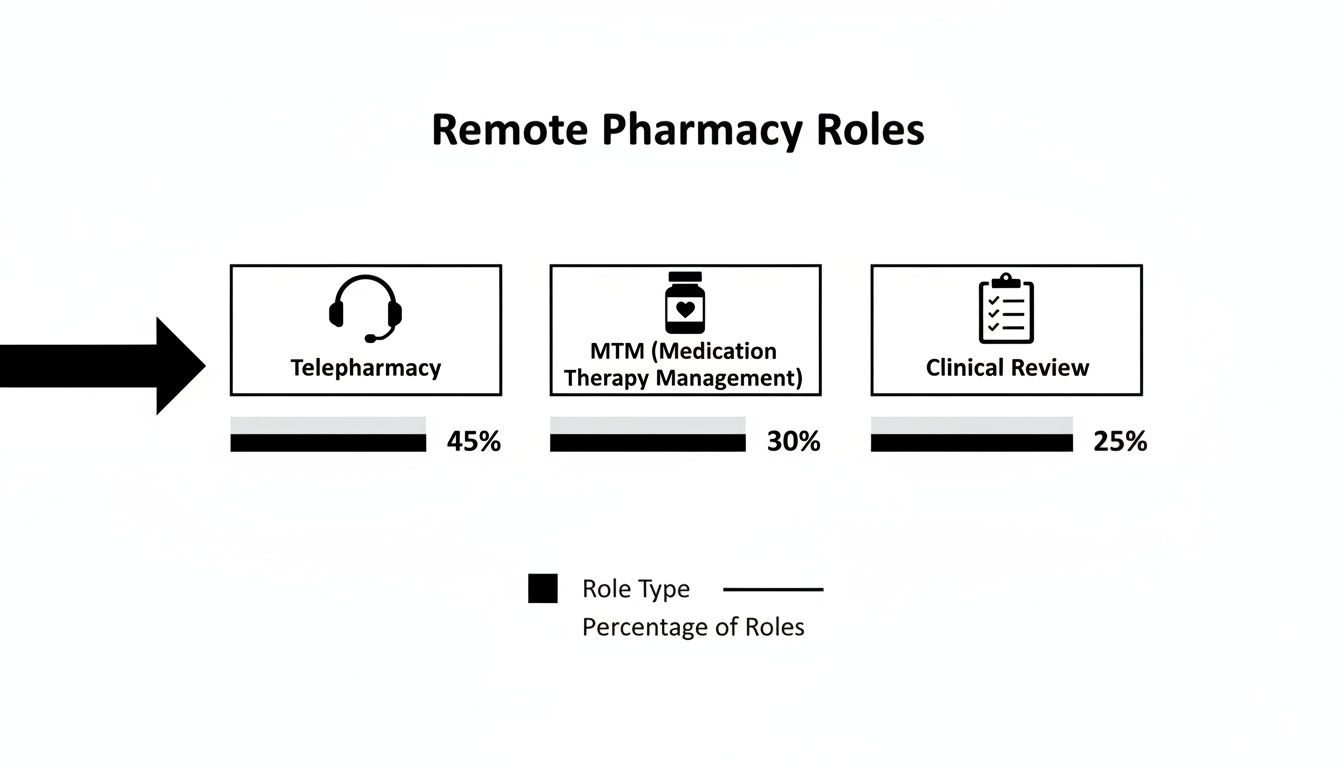
As you can see, the work can range from direct patient care via telepharmacy to behind-the-scenes clinical reviews. Your specific role will have a huge impact on your day-to-day responsibilities and, of course, your salary.
Let's look at how the numbers typically break down across different specialties.
Remote Pharmacist Salary Ranges by Role and Experience
This table offers a snapshot of what you can expect to earn based on your role and experience level, giving you a baseline for what to look for in job listings.
| Job Title/Specialty | Entry-Level Salary Range | Experienced/Specialist Salary Range |
|---|---|---|
| Telepharmacy / Remote Order Entry | $110,000 – $125,000 | $125,000 – $140,000+ |
| Medication Therapy Management (MTM) | $115,000 – $130,000 | $130,000 – $150,000+ |
| Clinical Review Pharmacist (PBM/Insurance) | $120,000 – $135,000 | $135,000 – $155,000+ |
| Drug Information / Medical Safety | $125,000 – $140,000 | $140,000 – $160,000+ |
| Specialty Pharmacy (Remote) | $125,000 – $145,000 | $145,000 – $170,000+ |
These ranges show that specialization really pays off. A pharmacist with board certifications and deep experience in a high-demand area like oncology or managed care can command a top-tier salary well above the national average.
How to Boost Your Remote Salary
So, what separates a good salary from a great one? A few key things. Earning board certifications like BCPS (Pharmacotherapy) or BCACP (Ambulatory Care) instantly makes you a more attractive candidate for higher-paying clinical roles. Experience is another obvious one. If you’ve spent years navigating complex fields like managed care or specialty medications, you're in a much stronger negotiating position.
But the single biggest lever you can pull is multi-state licensure.
Holding active licenses in multiple states opens you up to nationwide opportunities with large PBMs and telehealth companies. It instantly multiplies your job options and lets you compete for roles based in high-paying regions, no matter where you physically live.
It's about expanding your professional footprint. A pharmacist licensed only in a low-cost state is stuck competing for local or state-specific jobs. But add a license for California or New York, and suddenly you're eligible for positions that pay according to those markets' higher salary scales.
Connecting Your Salary to Your Life Goals
Knowing the numbers is one thing. Actually connecting them to your life goals is where the real power lies. A six-figure salary can feel abstract until you see how it directly impacts your ability to save for the future, invest, or even pursue financial independence and retire early (FIRE).
The same salary can have a wildly different impact depending on where you live and what your financial goals are. That's why it's so important to move beyond the job description and crunch the numbers for yourself.
Using a tool that connects your potential income to your long-term goals is a game-changer. Our Salary and FIRE calculator was built for clinicians to do exactly that. It helps you see how a specific salary offer translates into real progress, turning your job search from a simple hunt for a paycheck into a strategic move for your financial future.
What It Takes to Land a Great Remote Pharmacy Job
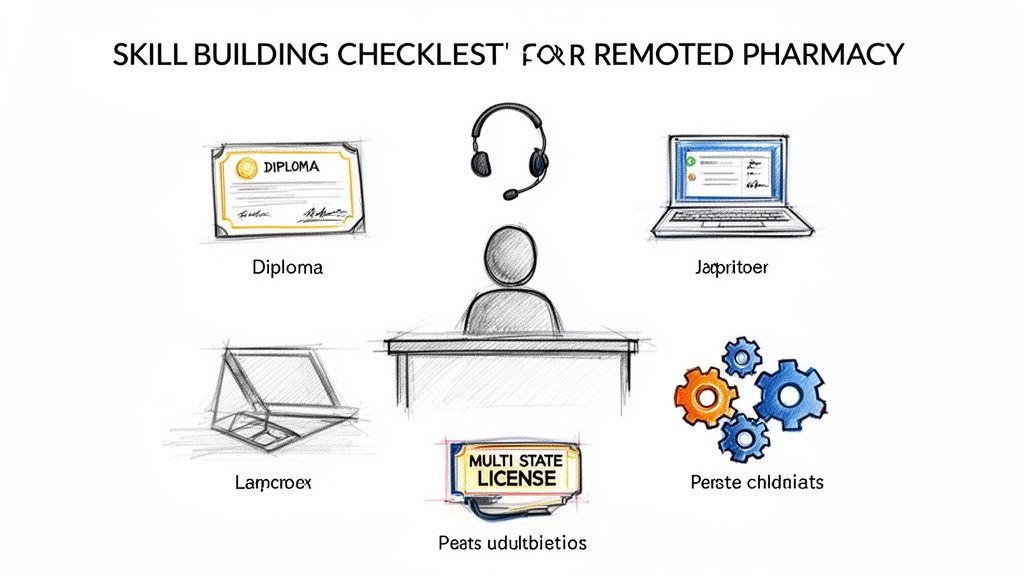
Making the jump to a remote role takes more than just your clinical chops. Your Pharm.D. and state license are the absolute baseline, but the best remote pharmacist jobs look for a specific blend of credentials, tech-savviness, and key personality traits.
Think of it this way: your degree gets you in the door, but these other skills are what let you thrive once you're inside.
The first big hurdle for many is licensure. Having a license in your home state is a must, but if you want to open up a world of opportunity, you need to think bigger. Pharmacists who pursue multi-state licensing are playing a different game. It’s a golden ticket that makes you an instant contender for roles with national telehealth companies, major insurers, and PBMs serving patients across the country.
Mastering the Soft Skills of Working from Home
Beyond the paperwork, succeeding as a remote pharmacist means you are mission control for your own workday. The freedom of working from home is a massive perk, but it demands a level of self-discipline that a traditional pharmacy setting just doesn't. With no manager watching over your shoulder, your ability to manage your time and stay on task is everything.
You'll also need to level up your communication. You’re explaining complex medication regimens and building patient trust, but you’re doing it through a screen or over the phone.
This isn't just about being clear; it's about projecting empathy and confidence without the help of in-person body language. Your ability to connect virtually becomes one of your most valuable assets.
This is especially critical for building rapport in MTM consults and keeping everything running smoothly with a remote healthcare team.
Building Your Technical and Clinical Edge
You don't need to be an IT guru, but you absolutely have to be comfortable with technology. That means confidently navigating Electronic Health Records (EHRs), various pharmacy software, and secure communication platforms like Slack or Microsoft Teams. Employers expect you to handle your digital workflow without a lot of hand-holding.
To really stand out from the pack, consider beefing up your clinical credentials. While not always a dealbreaker, specialty certifications can give you a serious competitive advantage, especially for the higher-paying, more specialized roles.
- Board Certified Pharmacotherapy Specialist (BCPS): This one screams clinical expertise. It’s highly valued for any role that involves complex patient cases and deep therapeutic knowledge.
- Board Certified Ambulatory Care Pharmacist (BCACP): If you're eyeing MTM or other outpatient-focused remote jobs, this certification is tailor-made for you. It shows you know your stuff when it comes to managing chronic diseases.
- Certified Geriatric Pharmacist (CGP): With more and more seniors receiving care at home, this certification is becoming incredibly relevant for telepharmacy roles focused on the elderly population.
By strategically combining multi-state licensure with sharp communication skills and a solid tech foundation, you position yourself as a top-tier candidate in a very competitive market.
How to Find and Land a Burnout-Friendly Role
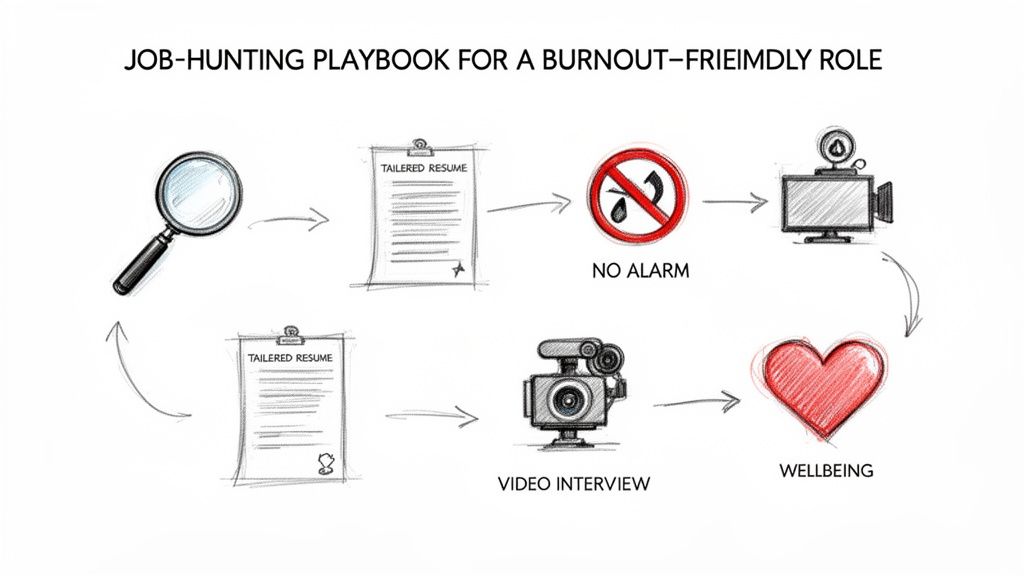
Finding the right remote pharmacist job isn't just about browsing listings; it's a strategic mission to reclaim your well-being. This means ditching the generic job boards and adopting a targeted approach to find roles that genuinely protect your work-life balance.
Look for platforms designed for clinicians, where you can filter for what really matters—like positions that explicitly state "no on-call duties" or "no weekends." These are the first green flags you're looking for, signaling an employer who actually respects your personal time.
If you're ready to make the jump, having a solid framework is essential. For a great starting point, check out your ultimate guide on how to find remote work.
Decoding Job Listings for Wellness
Let's be honest: not all remote roles are created equal. A job description might promise flexibility, but the reality on the ground can be a world apart. To find a truly burnout-friendly position, you have to learn to read between the lines and use smarter tools.
WeekdayDoc cuts through the noise with our proprietary Burnout-Friendly Score for every listing. This score isn't just a gimmick; it analyzes key factors like scheduling demands and on-call expectations to give you an at-a-glance feel for a role's real impact on your life. If you're not sure where you stand right now, our burnout calculator for clinicians can give you a personalized baseline.
Remote pharmacist jobs are a clear antidote to the grind of traditional retail and long commutes. With median salaries around $137,480 and specialist roles climbing toward $200,000, these positions offer a powerful blend of flexibility and financial stability.
The demand is only growing, especially in telehealth and digital care. You’ll find hundreds of openings at any given time, from part-time weekend work to full-time clinical analysis roles.
Acing Your Remote Interview
Once you’ve pinpointed a few promising opportunities, the final hurdle is the virtual interview. This is your moment to prove you have the self-discipline and communication chops to thrive outside of a traditional office.
Here's a simple playbook to make a great impression:
- Set the Stage: Find a quiet, well-lit space. Make sure your background is professional and clutter-free. Always test your camera and microphone beforehand to avoid any last-minute technical headaches.
- Highlight Remote-Ready Skills: Don't just give generic answers. Emphasize your self-motivation, time management, and comfort with digital tools like EHRs or whatever communication platforms they use.
- Project Confidence: Look at the camera, not just the screen—it creates the feeling of direct eye contact. Speak clearly and show them you can build rapport virtually, just like you would with a patient in person.
By combining a targeted search with a polished virtual presence, you can turn your application into an offer for a role that supports your career and your well-being.
Building a Long-Term Career in Remote Pharmacy
Landing that first remote pharmacist job feels like a huge win, and it is. But it’s really just the starting line. The real objective is to build a career that’s not just remote, but also sustainable and fulfilling for the long haul.
This is about shifting your mindset from merely escaping a bad situation to proactively designing a professional life that actually fits your personal one. Think of it like this: your first remote job is like renting a great apartment. Building a long-term career is like designing and building your own custom home. It requires a blueprint, continuous learning, and an eye for future growth—not just a paycheck.
The Future of Remote Pharmacy
Telepharmacy isn't standing still, and neither should your career. To stay relevant and build something lasting, you have to keep your skills sharp and your network active.
Embrace Specialization: Don’t just be a generalist. Pursuing advanced certifications in high-demand areas like geriatrics or pharmacotherapy makes you a much more valuable (and sought-after) candidate.
Develop Leadership Skills: Look for chances to mentor junior pharmacists or take the lead on projects, even from a distance. These experiences are what get you noticed for senior-level roles down the road.
Stay Tech-Savvy: Get comfortable with the latest EHR systems, telehealth platforms, and data analytics tools. Your fluency with technology is a massive differentiator in the remote space.
The most successful remote pharmacists don't just react to changes in the field—they get ahead of them. When you treat your career as a dynamic, evolving path instead of a static job title, you can create a professional life that offers both stability and the flexibility you need for years to come.
Frequently Asked Questions About Remote Pharmacist Jobs
Making the leap to a remote pharmacy role is a big step, and it's natural to have a few questions. Let's tackle some of the most common ones I hear from pharmacists considering the switch.
Do I Need Special Certifications to Work Remotely?
Your Pharm.D. and a valid state license are your ticket to the game, but specific certifications are what get you the best seats in the house. Think of them as a powerful signal to employers that you have deep clinical expertise. Board certifications like BCPS (Pharmacotherapy) or BCACP (Ambulatory Care) are especially valuable and can make you a standout candidate.
Beyond clinical credentials, the single biggest advantage you can give yourself is multi-state licensure. This is a huge deal. It instantly expands your job pool to include national health systems and telehealth companies, which means more opportunities and, frankly, better leverage for negotiating your salary.
What Is the Biggest Challenge of Working from Home?
Hands down, the toughest part for most remote pharmacists is drawing a hard line between your work life and your personal life. When your office is just a few steps from your living room, the workday can easily start to bleed into your evenings and weekends. There's no commute to act as a natural buffer.
Successful remote pharmacists are masters of routine. They establish a dedicated workspace and maintain strict office hours to protect their work-life balance and prevent burnout.
Another real challenge is professional isolation. You have to be intentional about fighting it. That means making an effort to connect with your team through virtual channels and staying active in online professional communities. It’s on you to maintain that sense of connection that used to happen naturally in the breakroom.
Are Part-Time Remote Pharmacist Jobs Common?
Yes, absolutely. The flexibility that comes with remote work has opened up a thriving market for part-time pharmacist positions. These roles are a fantastic fit for all sorts of situations:
- Pharmacists wanting to add a supplemental income stream.
- Seasoned professionals looking to ease into retirement without stopping cold turkey.
- Anyone trying to strike a healthier balance between career and family.
You’ll see plenty of part-time openings in areas like MTM, contract-based clinical reviews, and after-hours order verification for hospitals. It’s a great way to build a work schedule that actually fits your life, not the other way around.
Finding a role that truly respects your time is the key to a sustainable career. On WeekdayDoc, every job listing is curated to be burnout-friendly, with clear markers for "No Call" and "No Weekends" so you can find a position that fits your life. Explore burnout-friendly remote pharmacist jobs on WeekdayDoc.