Hand Surgeon Salary: A 2026 Compensation and Career Guide
Explore 2026 hand surgeon salary benchmarks, from $790K medians to $1.2M top earners. Learn how practice type, call, and location drive your real take-home pay.

The 2026 median hand surgeon compensation is $790,000. That looks simple until you see the spread, because the same title runs from roughly $240,000 in academic settings to $945,000 in private practice.
A hand surgeon salary is one of the clearest examples of why specialty pay can't be judged from a single national figure. The headline number is real, but it's only a midpoint inside a market shaped by ownership model, wRVU production, call burden, and geography.
What Hand Surgeons Earn in 2026
The cleanest current benchmark puts hand surgery median total compensation at $790,000, based on 11 physician-reported submissions with an interquartile range of $650,000 to $835,000 and an average of $775,909 (SalaryDr hand surgery benchmark data). That matters because the median and the average are close, which suggests the market is not being pulled only by a few extreme outliers, even though the top end still reaches $1,200,000 annually in that same dataset.
The experience ladder reveals the real story
SalaryDr's 2026 hand orthopedic surgeon page shows a steep progression over time, with entry-level compensation around $633,000 and physicians with more than 10 years of experience typically at $895,000, a 41% increase across the career arc (SalaryDr hand surgery benchmark data). That is not a marginal gain. It separates a high-income starting point from a much higher long-run pay tier, especially once case volume, referral flow, and call coverage become more valuable to the group.
| Hand Surgeon Pay by Experience Level (2026) | Compensation |
|---|---|
| Entry-level | $633,000 |
| More than 10 years of experience | $895,000 |
Practical rule: do not compare your offer to the top of the market unless you are also comparing your call, case mix, collections, and setting.
The phrase hand surgeon salary gets misused because it is often treated like a single national wage. A more accurate reading is that hand surgery sits inside a wide compensation band shaped by ownership model, productivity expectations, and how much trauma or coverage work the job really carries. If you want the broader physician context, the WeekdayDoc overview of physicians and surgeons compensation is a useful baseline, but it does not replace specialty-specific contract math.
The distribution matters more than the midpoint. A hand surgeon working in a trauma-heavy, coverage-driven practice can earn very differently from a colleague whose income is built mostly on elective cases and clinic volume, even if the title is identical. That is why the headline number is only a starting point, not a contract answer.
The takeaway is straightforward. If you only remember one number, remember $790,000. If you make a career decision from that number alone, you will probably miss the structure that determines what lands in your account.
How Hand Surgery Compares to Broader Physician and Orthopedic Pay
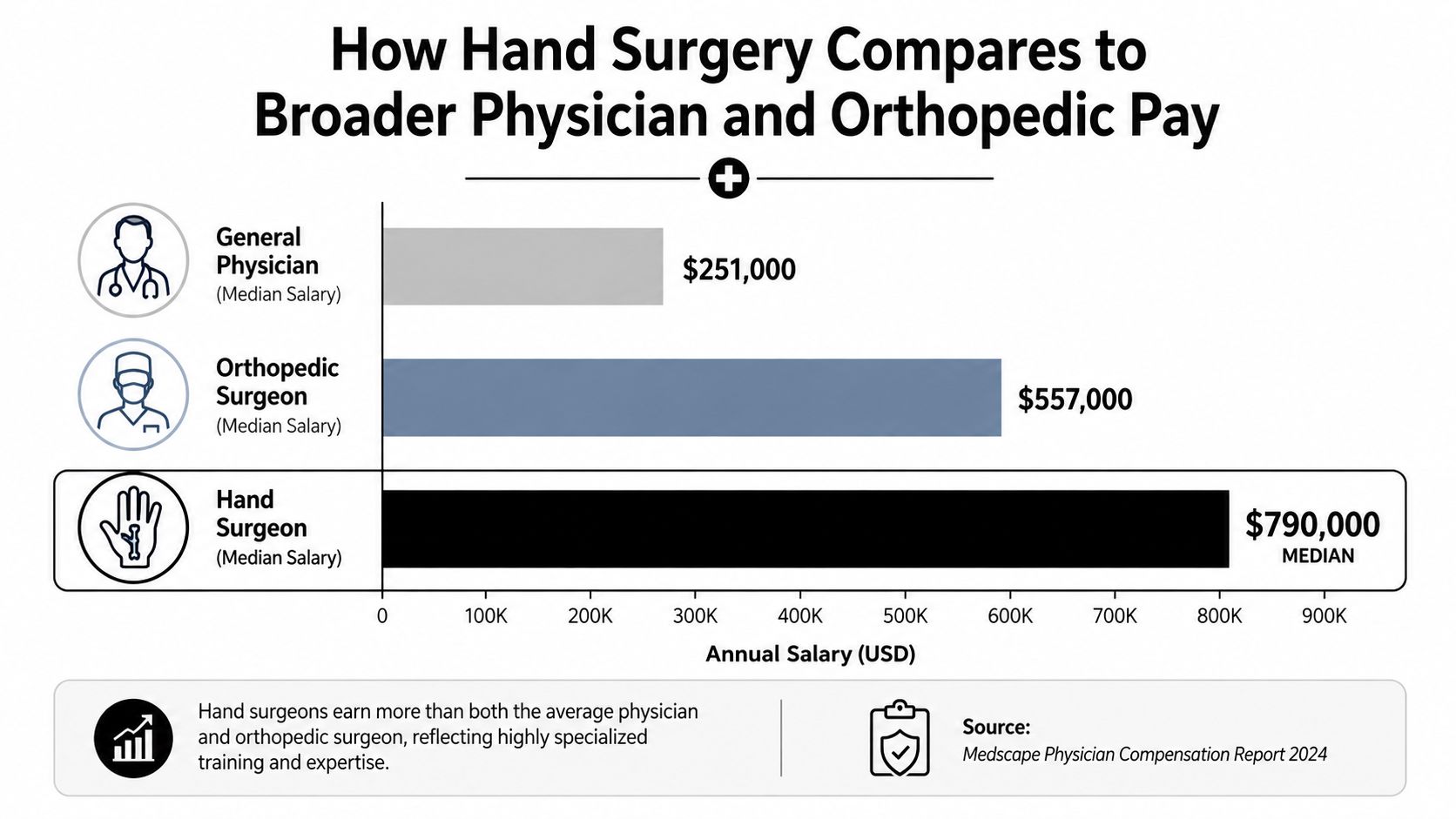
A $790,000 hand surgery median sits well above broader physician and orthopedic benchmarks. A 2026 summary of major orthopedic pay sources placed orthopedic compensation in the $611,000 to $686,000 range, including $611,000 from Medscape's 2025 data year and $679,517 from Doximity's 2024 data year (Becker's orthopedic pay comparison in 2025). On that basis, hand surgery's median is higher by roughly $104,000 to $179,000.
Why generic physician data misleads
The U.S. Bureau of Labor Statistics lists physicians and surgeons at a median wage of at least $239,200 per year or $115 per hour (BLS Physicians and Surgeons). That figure is useful as a broad reference point, but it is too blunt for contract review in a subspecialty like hand surgery. A generic physician-and-surgeon benchmark hides the economics of operative intensity, trauma coverage, and procedure-heavy reimbursement.
The gap widens further if you compare hand surgery with average orthopedic surgery pay. Medscape-based reporting put orthopedic and orthopedic surgery at $543,000 on average in 2025, still far below the 2026 hand-surgery median (Becker's orthopedic pay comparison in 2025). Hand surgery operates on different economics than general orthopedics, with compensation tied more closely to access, urgency, and operative demand.
Bottom line: if a job posting cites only broad physician averages, it is not giving you a hand-surgery-grade comparison.
You can sanity-check broader physician benchmarks against specialty pages on the WeekdayDoc physicians and surgeons market page, but the comparison still needs to stay at the specialty level. That is the point where headline pay starts to make sense, and where a contract review should also account for healthcare career options beyond hospitals.
Why Practice Model Matters More Than Subspecialty Title
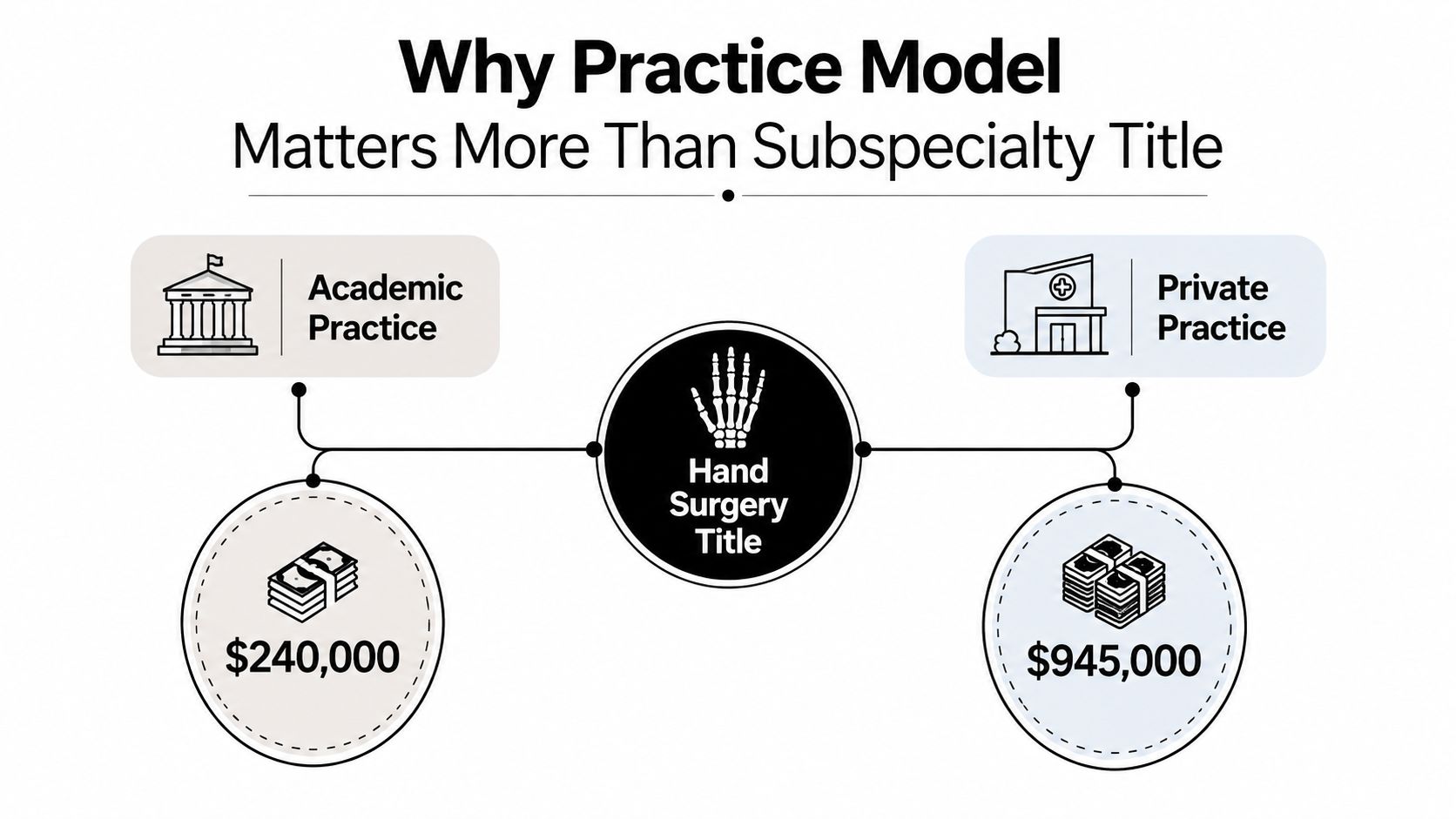
The same hand-surgery title can mean radically different economics depending on where you practice. SalaryDr's 2026 data shows $945,000 in private practice, $691,667 in hospital-employed roles, and just $240,000 in academic practice (SalaryDr hand surgery practice model data). That spread is large enough that two surgeons with similar case mixes can be living in entirely different compensation worlds.
What those numbers usually include
Academic compensation often emphasizes a base salary, sometimes with modest supplements, while private-practice figures can reflect collections after overhead and hospital-employed packages usually blend base, productivity, and quality components. That's why a clean-looking number on a recruiter call can be misleading if you don't know what's inside it. The title is the same, the money is not.
A useful way to think about it is this, compensation of what, exactly? If the answer is unclear, you're not comparing offers yet. You're comparing labels.
The gap also shows up in how physicians evaluate non-hospital careers. If you're weighing roles that trade prestige for flexibility, healthcare career options beyond hospitals can help frame the broader decision without assuming the hospital is the default endpoint. That kind of perspective matters, because the highest gross offer is not always the strongest long-term fit.
Ask this before anything else: is the quoted number base pay, total compensation, collections, or a blended estimate with call and bonus included?
The practical point is simple. A hand surgeon salary only means something when you know whether you're looking at academic pay, employed pay, or private-practice economics. Without that context, the number is too blunt to guide a real decision.
The Productivity Math Behind Hand Surgeon Paychecks
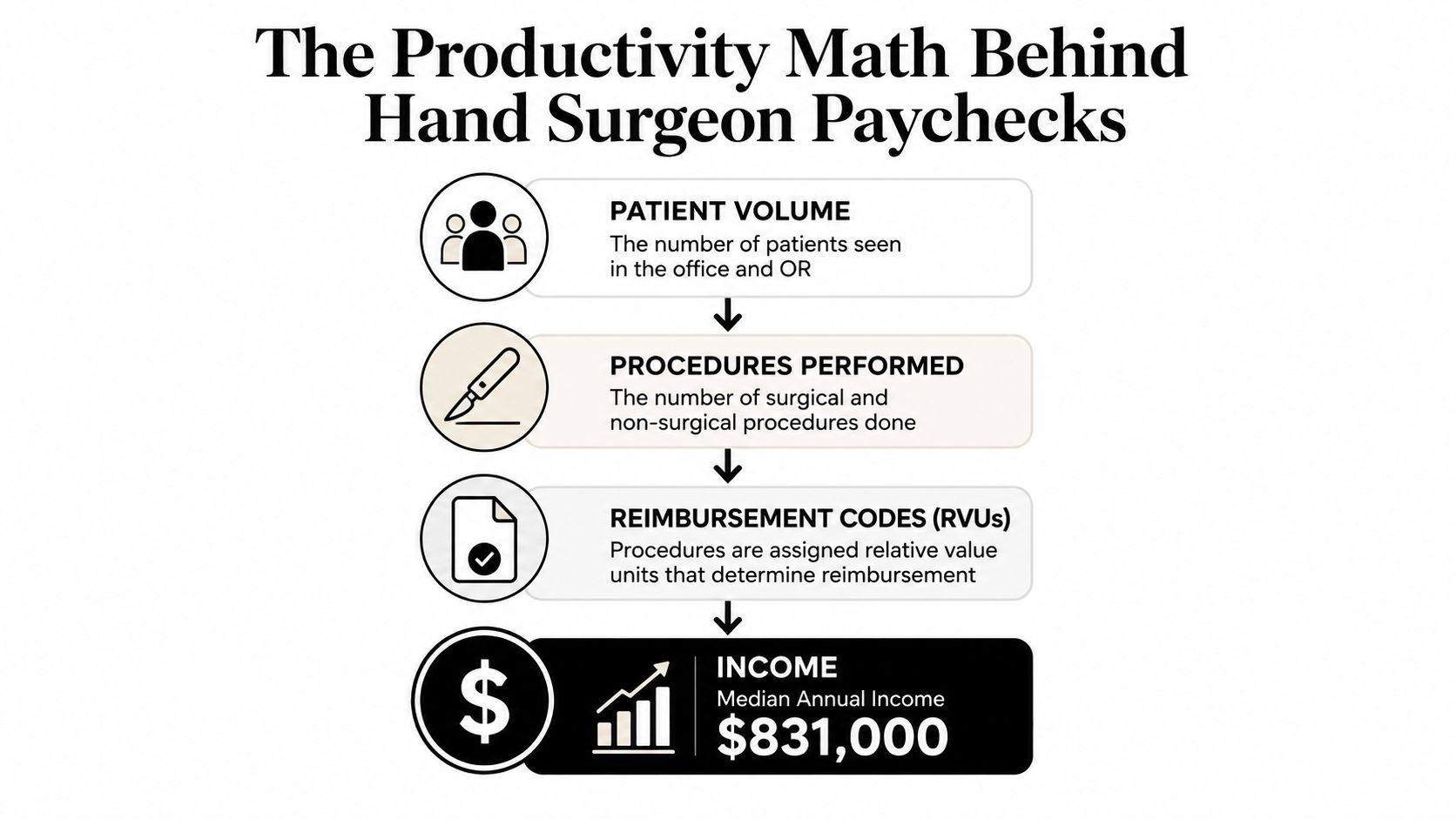
FastRvu's orthopedic income guide gives the clearest look at how hand surgery gets paid in practice. It reports median hand-surgery compensation of $831K, median wRVUs of 7,800, and $106.54 per wRVU, along with a relatively low call burden compared with other orthopedic subspecialties (FastRvu orthopedic income guide). That combination shows a specialty that pays well because its compensation model rewards throughput, not just credentials.
What the wRVU numbers imply
At 7,800 median wRVUs and $106.54 per wRVU, the benchmark points to a contract structure where productivity drives a large share of pay. If your agreement pays above that conversion factor, the deal is richer than the median benchmark on a per-unit basis. If it pays below that level, the salary line may look strong while the productivity rate is weaker than it first appears.
Call changes the picture again. Trauma-call coverage is often paid separately at $1,000 to $2,500 per 24-hour shift, and annual call income can reach $60,000 to $240,000 depending on frequency and volume. In practical terms, two surgeons can have the same base salary and still finish the year with very different total earnings if one carries a heavier trauma load. The gap is not theoretical, it comes from how much paid call sits on top of clinical production.
A useful way to compare offers is to break the moving parts apart.
| Compensation Lever | What to Check |
|---|---|
| wRVU conversion | Dollars paid per wRVU |
| Annual volume | Whether the case load is realistic for your setting |
| Call stipend | Whether trauma call is paid separately |
| Call frequency | How many 24-hour shifts you're expected to cover |
If you want to test your own contract math, the WeekdayDoc RVU calculator lets you see how a conversion factor and call stipend change the final number. That matters because a glossy salary line does not show how much production, call, and volume sit underneath it.
For hand surgeons, productivity math is not a finance exercise. It separates a fair offer from one that only looks rich until the call calendar and wRVU target show up.
State-by-State and Setting Variation in Real Job Postings
AMN Healthcare's permanent hand-surgery data makes the dispersion obvious. The average annual salary was $695,000 over the past year, but permanent roles ranged from $430,000 to $1.0 million (AMN Healthcare permanent hand surgery jobs). That range is wide enough to swallow most national averages whole. The average is real, but it's not the offer you'll get in every market.
Geography changes the contract
A 2025 Oxford study on specialist hand-surgeon distribution found state-level disparities and noted that lower-per-capita-income states may be particularly underserved, which can affect emergency hand-trauma access (Oxford specialist hand-surgeon distribution study). That's the structural reason some markets pay more. They're not buying prestige, they're buying coverage.
Compensation signals in underserved and non-metro markets reinforce that point. Hand surgery has been cited around $750,000 to $1 million+ in rural or underserved areas, and around $720,000 to $900,000 in the Midwest non-metro market. Those figures aren't a national universal, but they do show how access gaps can pull pay upward when communities need reliable coverage.
A quick market checklist helps separate a strong offer from a stretched one:
- Check the setting first. Rural, non-metro, and underserved jobs often ask for more coverage, not just more clinic time.
- Look for call density. If trauma coverage is heavy, the salary should reflect it.
- Compare the posted range to the average. A wide spread usually means negotiability, but it can also signal uneven case volume.
- Use a market page. Review the role against WeekdayDoc's market pulse and the salary calculator pro before you take the first number seriously.
The broader lesson is that location is not just a lifestyle variable. It's an income variable. For hand surgeons, the hardest-to-cover markets often pay more precisely because coverage is the scarce asset.
Net Take-Home, FIRE Timelines, and Lifestyle-Adjusted Pay
Gross salary isn't the number that decides freedom. Net take-home does, and so does how much of that net you can save without burning out. A $790,000 hand surgeon salary sounds huge, but after taxes, benefits, and living costs, the question becomes how quickly you can turn income into investable surplus.
FIRE math starts after tax, not before
WeekdayDoc's Salary & FIRE Calculator logic is built around that exact point. If a clinician saves 30% of net income, the timeline to a $2.5 million to $3.5 million portfolio depends less on the top-line salary than on the amount left after taxes and lifestyle costs. The higher the call burden, weekend work, and commuting burden, the less valuable the gross figure can feel in real life.
That's why a $945,000 private-practice offer isn't automatically better than a lower hospital-employed package. If the private role carries heavy call and weekend coverage, the burnout cost can erase some of the financial advantage. A lower offer with cleaner boundaries can produce a better effective hourly life, which is the number that matters when your goal is long-term sustainability.
Practical rule: compare offers on net savings capacity, not just annual pay.
If you want a framework for personal finance alongside career planning, how to manage your finances well is a useful reminder that strong income still needs a system behind it. In clinical careers, money management isn't optional because compensation can swing sharply with work structure, taxes, and call load.
The lifestyle-adjusted view also changes how you think about a hand surgeon salary. The best offer isn't always the one with the highest gross number. It's the one that gets you to your financial goal without making the work unsustainable before you get there.
Negotiating the Offer and Stress-Testing the Contract
A hand-surgery offer lives or dies on five levers, base salary, wRVU conversion factor, call stipend, signing bonus, and tail coverage. If a recruiter only quotes one number, the contract still isn't fully priced. The easiest way to get trapped is to treat the first line as the whole deal.
What to pressure-test before you sign
Start with the conversion factor. If the group says productivity pay is tied to wRVUs, compare that rate with the specialty math already discussed. Then ask whether call is separately compensated and whether trauma coverage comes with a fixed stipend or a vague “as needed” promise.
- Base salary: confirm whether it's guaranteed, how long it lasts, and what drops it.
- wRVU conversion: check the dollar rate, not just the threshold.
- Call stipend: verify the amount and the schedule it covers.
- Signing bonus: ask about repayment triggers and timing.
- Tail coverage: make sure you know who pays it if you leave.
A contract scanner can help flag restrictive covenants, call obligations, and non-compete language before you're locked in. The WeekdayDoc physician salary negotiation guide is a useful reference point for that review, especially when the headline compensation looks strong but the work design is rough. If you're comparing offers across markets, it's also worth reviewing a specialty-specific source like the salary guide for PMs in Singapore just to see how differently other professions have to unpack pay bands and contract structure.
The negotiation rule is simple. Don't ask whether the salary is high. Ask whether the pay, call, and productivity terms match the workload. That's how you separate a real hand surgeon salary from a number that only looks good on paper.
If you're comparing hand-surgery offers right now, use WeekdayDoc to look at pay, Burnout-Friendly Score, and FIRE projections side by side before you sign. Visit WeekdayDoc to review curated clinician roles and pressure-test the compensation structure against the life you want.