
Physician Leadership Without an MBA
Learn how clinicians can enter leadership through operational results, committees, finance, mentorship, and targeted roles—without relying on an MBA.

An MBA is not a universal prerequisite for physician leadership. The path into roles such as medical director, quality leader, service-line chief, or clinical operations director depends on the employer and the specific position. Clinicians build a credible leadership path by demonstrating measurable operational improvement, taking responsibility for committees and governance, learning practical healthcare finance, leading people before receiving a formal title, and choosing roles with clear authority.
The American Academy of Family Physicians career-options guidance describes fellowships, courses, and education as ways to customize and develop skills, identifies policy and operations as a nonclinical and administrative path, and points to business skills such as revenue-cycle management and managing people, along with practice-management CME covering payment, business, and team care.
You can start exploring these options by comparing leadership opportunities directly. WeekdayDoc allows you to evaluate medical director, quality, clinical operations, telehealth, hybrid, and part-time roles using visible salary context, work-life or burnout scores, call expectations, schedule flexibility, and administrative burden. These scores act as decision aids to help you compare the operational reality of different positions before you apply.

Choose the Leadership Role You Actually Want
Physician leadership encompasses different jobs depending on the organization, which means each destination requires a different evidence portfolio. A quality role prioritizes improvement methods and performance data. A service-line position involves staffing, access, capacity, and budget responsibility, and a CMO role demands deep experience with medical staff affairs, personnel management, governance, and enterprise strategy.
Target roles include:
- Assistant or associate medical director
- Clinic or site medical director
- Quality and patient-safety leader
- Utilization or clinical-documentation leader
- Service-line medical director
- Department chair or vice chair
- Chief medical officer
- Clinical informatics leader
- Telehealth operations leader
- Payer medical director
- Medical-affairs roles
To clarify your path, pull two real job descriptions for positions you want. Read past the boilerplate language and sort their actual requirements into categories: clinical credibility, operations, quality and safety, finance, people management, governance, regulatory work, education, and formal credentials.
Sorting the requirements turns physician leadership without an MBA into a practical goal rather than a vague question, helping you identify the exact capabilities missing from your target role.
Build Leadership Evidence Before You Have the Title
Operational results serve as the strongest proof of your readiness because hiring committees want to see how you define a problem, establish a baseline, and identify stakeholders. They expect you to explain your personal contribution to a solution, choose a tracking metric, report the outcome, and plan for sustainability.
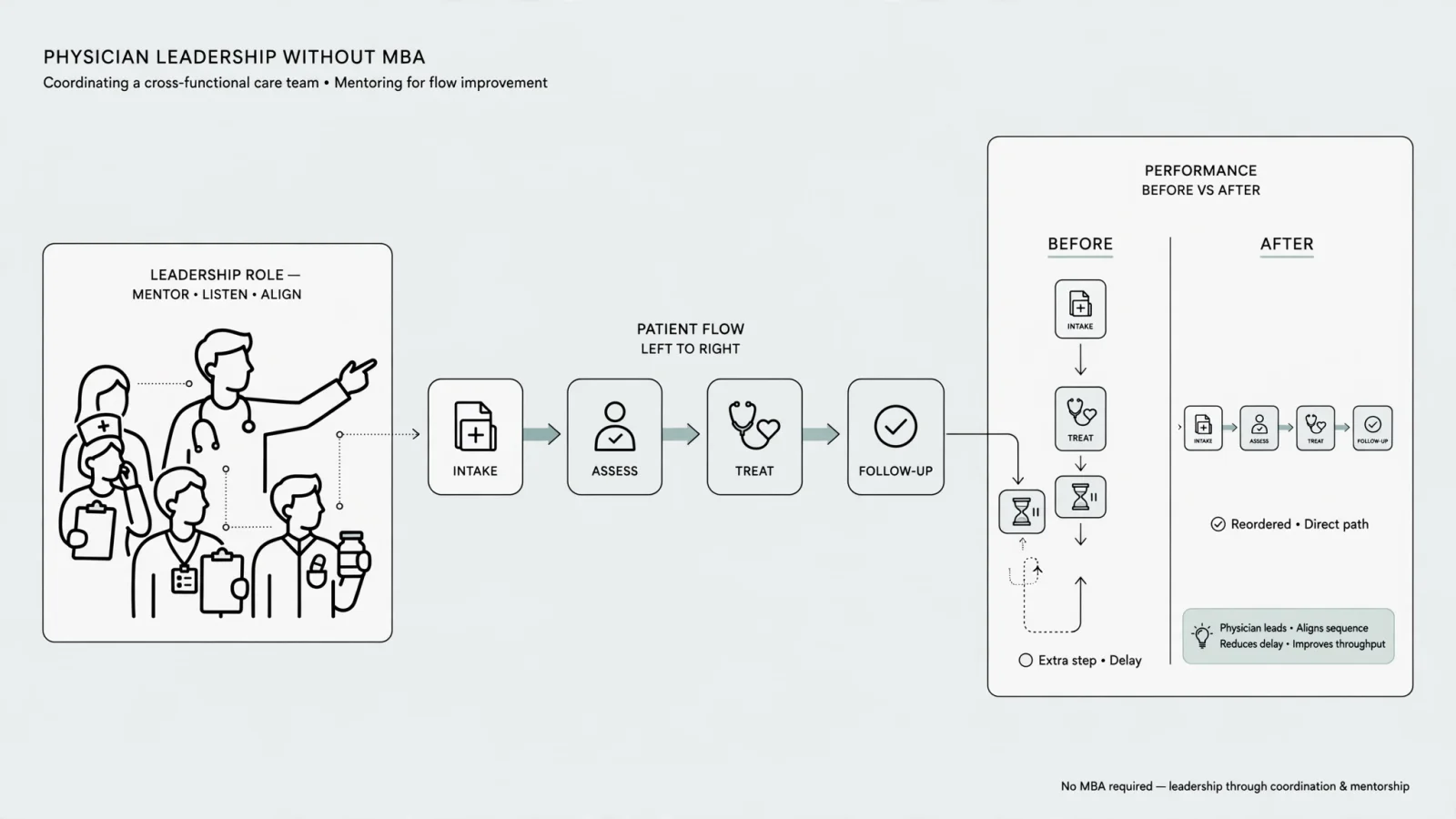
An inpatient hospitalist targeting a quality or operations role builds evidence by taking responsibility for a discharge-delay project rather than merely serving on a committee. The clinician maps the current process, identifies bottlenecks with nursing and pharmacy, establishes a baseline, tests a revised workflow, reports the outcome to the quality committee, and documents which changes lasted.
A primary-care physician aiming to become a clinic medical director could lead an access project that involves adjusting scheduling templates, opening same-week appointments, tracking clinician capacity, and improving patient communication. The resulting portfolio shows how the physician balanced access goals with workload, staffing, and clinician sustainability.
The Accreditation Council for Graduate Medical Education Assessment Guidebook provides a useful framework by connecting systems-based practice with patient safety, quality improvement, performance data, multisource feedback, and the assessment of individual contributions to a result.
Choose Committee Work With Real Ownership
Committee attendance is weak evidence without a defined deliverable, data access, decision rights, protected time, executive sponsorship, and recognition in performance discussions. Before accepting a seat, ask what decision you will own.
Align your committee choices with your target direction:
| Target Leadership Direction | Useful Committee or Assignment |
|---|---|
| Quality, Safety, or CMO | Quality, patient safety, peer review, infection prevention |
| Medical Staff Governance | Medical executive committee, credentialing, privileging, bylaws |
| Clinical Operations | Access, throughput, staffing, scheduling, patient flow |
| Payer or Utilization Work | Utilization management, case management, documentation, denials |
| Informatics or Digital Health | EHR governance, clinical informatics, telehealth operations |
The American Association for Physician Leadership guidance on becoming a CMO identifies peer review, medical staff affairs, department leadership, quality committees, process improvement, assigned accountability, and expected outcomes as valuable preparation for senior roles.
Practice People Leadership Early
Clinical excellence does not automatically show that someone can manage a team. Hiring managers distinguish being respected clinically from demonstrating readiness to lead people.
Start building evidence by mentoring early-career colleagues, redesigning clinician onboarding, or facilitating interdisciplinary meetings. These activities allow you to coach teams through workflow changes and manage conflict constructively. They also prepare you to give difficult feedback and support struggling colleagues through established performance processes.
Learn Finance and Document Your Leadership
Financial literacy remains a highly practical skill. You do not need to master an entire business curriculum to manage a department effectively.
Focus on the numbers your target role uses, including department budgets, budget variance, staffing costs, capacity, payer mix, and reimbursement models. Operations leaders also need to understand revenue-cycle performance, denials, contribution margin, and the cost per visit or episode. Grasping physician compensation, wRVU models, quality incentives, return on investment, and opportunity cost rounds out this practical knowledge base.
Research in the Physician Leadership Journal examined 51 articles alongside AAPL competency data and identified finance as the least-frequently researched domain, with financial management, resource allocation, economics, and payment models among its gaps. The review calls for comprehensive business education to address these gaps, and the AAPL micro-credentials page lists Business Decision Making and Financial Decision Making while describing its credentials as a flexible way to gain topic-specific skills with no long commitment.
Create a Leadership Evidence Portfolio
Document your work in a one-page portfolio summary for each meaningful project by outlining the problem, the baseline data, and the patient or business impact. Include the stakeholders involved, your specific responsibilities, the actions taken, and the tracked metrics. Then record the result, sustainability plan, leadership lessons learned, and any feedback.
This longitudinal portfolio supports promotion conversations, internal nominations, compensation negotiations, and interviews while helping you decide whether a formal degree is necessary to prove your capability.
Find Mentors and Sponsors
A mentor helps you understand leadership work, whereas a sponsor creates access to meaningful assignments.
Seek leaders whose actual responsibilities resemble your target role, keeping in mind that a hospital CMO, outpatient medical director, telehealth operations leader, and payer medical director will offer very different advice. Ask your connections which roles make the best first steps, what evidence makes candidates credible, which committees expose you to the right stakeholders, and what finance concepts require immediate attention.
Evaluate Leadership Jobs for Scope and Sustainability
Leadership does not automatically mean lower stress or better work-life balance because a role may reduce direct patient volume while adding meetings, inbox work, travel, personnel issues, performance accountability, or after-hours availability. Evaluating the reality of the schedule before accepting an offer prevents unexpected burnout.
During interviews, ask whether protected administrative time replaces clinical sessions or sits on top of them, and check whether nights, weekends, holidays, travel, or after-hours availability are expected. You also need to clarify decision rights, budget control, direct reports, analyst support, and executive sponsorship so you know what happens when clinical and financial priorities conflict.
Evaluate the compensation arrangement, whether it includes a stipend, salary, bonus, reduced clinical load, or a combination of these factors. Reviewing the effects on RVU production, clinical incentives, success metrics, repayment clauses, and clawbacks helps ensure your administrative time is guaranteed in writing. Taking a pay cut for work-life balance only works if the new administrative burden does not consume the time you gained.
Use WeekdayDoc Before You Apply or Sign
WeekdayDoc solves the comparison problem by making leadership-oriented listings easier to evaluate, allowing you to view salary context, market percentiles, and dollar-per-RVU benchmarks. The platform also provides schedule flexibility metrics, call expectations, and work-life or burnout scores for each position.
When you have an offer, WeekdayDoc provides negotiation scripts and an AI contract scanner that accepts PDF, DOCX, TXT, or pasted text. The software flags issues such as non-competes, tail coverage, and payback clauses for your review, helping you spot restrictive provisions early even though it does not replace individualized legal advice.

Decide Whether an MBA Is Worth the Investment
Framing the MBA as a strategic choice rather than a status test helps you recognize that a formal graduate degree adds value under specific conditions.
An MBA or comparable degree makes sense when you target enterprise strategy, C-suite ambitions, or a major move into nonclinical business leadership. Clinicians exploring physician consulting jobs, payer roles, health-tech, private equity, or corporate positions often benefit from structured training in accounting, strategy, operations, and organizational behavior. Furthermore, a degree provides a formal professional network and satisfies requirements for roles that explicitly demand the credential.
Because targeted learning often suffices as a first step, a full MBA remains unnecessary for local medical director roles, clinicians managing defined operational projects, or professionals closing specific gaps like budgeting. If a role offers direct responsibility through a committee or service line, building a track record on the job offers more immediate value. Delaying a degree can also help you avoid an expensive mistake if you are still testing whether management work is desirable.
Build a decision framework by reviewing your target job descriptions and separating required, preferred, and helpful credentials. Once you identify your missing capabilities, compare the value of a degree against coursework, mentorship, and direct responsibility. Calculating tuition, lost clinical income, time investments, and effects on your clinical practice helps you judge whether a program creates access, capability, or both.
Follow a Practical Path Into Physician Leadership
Moving into management requires deliberate steps, starting with choosing a target role and identifying your missing competencies. From there, take ownership of one operational problem, join a committee aligned with that role, and learn the finance behind your project. Mentoring others and documenting the results in a portfolio prepares you to pursue a formal role with protected time, clear authority, and defined success measures.
Common Questions About the Path
Can a physician become a medical director without an MBA? Requirements vary by employer, but many organizations promote physicians based on experience. The AAFP describes clinical operations, quality, budgets, personnel, communication, and mentoring as highly relevant to medical director work, positioning an MBA as one of several helpful preparation options.
What experience matters most for physician leadership? Organizations look for clinical credibility paired with measurable operational or quality results, people leadership, committee experience, financial fluency, and the ability to work across clinical and administrative groups.
Which committee should a physician join first? Choose the committee that matches your desired leadership role and offers a real deliverable. Quality, patient safety, peer review, medical staff governance, access, utilization, and informatics committees provide strong platforms when they include data access and decision rights.
How can physicians learn finance without graduate school? Physicians can work directly with finance or operations leaders, review budgets and dashboards, build business cases for projects, and take targeted coursework in healthcare finance, practice management, or business decision-making.
Do leadership roles improve work-life balance? Leadership roles do not inherently improve work-life balance. Some roles reduce clinical shifts and provide more predictable hours, while others add personnel responsibility, travel, or after-hours availability. Evaluate the actual schedule, protected time, autonomy, and administrative burden rather than relying on the title.
A Note for APPs and Other Clinicians
Nurse practitioners, physician assistants, CRNAs, nurses, pharmacists, psychologists, and therapists can use the same evidence-building approach. Although organizational structures and scope-of-practice rules vary by region, the practical capabilities remain the same.
The American Hospital Association principles for successful APP leadership models support a framework involving quality, financial, workforce, compensation, operational, and committee responsibilities. A clinician exploring a career change from nursing into management will need to demonstrate quality improvement, finance, and workforce planning exactly as a physician would.
Forgoing an MBA means acquiring the specific business, operational, and people-leadership capabilities the role requires rather than avoiding business education entirely. You choose formal education when it solves a targeted knowledge gap.
Explore medical director, quality, clinical operations, telehealth, hybrid, and alternative-career roles on WeekdayDoc. Compare salary context, work-life scores, call expectations, schedule flexibility, and administrative burden, then use our contract scanner to review your offer before you sign.