
A Modern Guide to Physician Job Requirements
Navigate today's physician job requirements with our guide. Learn about credentials, licensing, and contracts to build a sustainable medical career.
That stereotypical image of the overworked physician—constantly on call, buried in charts—isn't just a cliché. For too many, it's a direct path to professional burnout. The first step toward building a sustainable, fulfilling career is to really understand the full landscape of today’s physician job requirements. This guide is your roadmap to finding a practice that works for you, not against you.
Rethinking Today's Physician Job Requirements

The traditional demands placed on doctors just aren't sustainable anymore. After a decade or more of grueling training, many clinicians walk straight into roles defined by punishing hours, unpredictable call duties, and mandatory weekend shifts. It's a perfect storm for burnout, and it's a well-documented crisis that’s crushing career longevity and hurting patient care.
Something has to give, and thankfully, it is. A new generation of physicians is refusing to accept the old terms. They’re scrutinizing job requirements more closely than ever, actively seeking out roles that offer genuine flexibility without sacrificing professional fulfillment.
The High Cost of Outdated Expectations
For decades, the healthcare industry has run on a model that equates a doctor's dedication with their constant availability. This has fueled staggering burnout rates and is pushing us toward a massive workforce shortage. The numbers don't lie: physician burnout is a pervasive problem, and demanding schedules are a primary cause.
At the same time, we're facing a "silver tsunami" in medicine. The Association of American Medical Colleges (AAMC) reports that 20% of physicians are 65 or older, and another 22% are between 55 and 64. This means a huge portion of our most experienced doctors are nearing retirement, creating an urgent need to fill those gaps.
This pressure cooker environment forces the remaining physicians to cover more ground, which just accelerates the burnout cycle. It’s no surprise that projections show the U.S. could face a shortage of up to 86,000 physicians by 2036. You can explore the detailed projections about this growing physician shortage on aamc.org.
The core issue is crystal clear: when job requirements demand everything from a physician, both the doctor and the healthcare system pay a steep price. Redefining these expectations isn't a luxury—it's absolutely essential for the future of medicine.
A New Approach to Medical Careers
The good news? The industry is finally starting to get the message. Forward-thinking employers and modern job platforms now recognize that "burnout-proof" roles aren't just a nice perk; they're a business necessity for retention and quality care.
The focus is shifting toward positions that offer what clinicians are actually asking for:
- Defined Hours: Roles that respect a standard workday, without the unspoken expectation of being available 24/7.
- No On-Call Duties: Opportunities that allow physicians to truly disconnect and recharge when their shift ends.
- Protected Weekends: Jobs that safeguard personal time for family, hobbies, and much-needed rest.
This guide will walk you through every component of these modern physician job requirements. Our goal is to empower you to find a role that supports both your professional ambitions and your personal well-being.
Building Your Core Medical Credentials
Think of your medical career like a skyscraper. Before you can even think about the penthouse suite—like landing that perfect weekday-friendly or telehealth role—you have to pour an incredibly deep and strong foundation. These are your core medical credentials, the non-negotiable achievements that prove your expertise and earn you the right to care for patients.
This isn't a quick process. It's an endurance marathon that starts long before you ever write your first prescription. Getting to the starting line as a fully qualified physician takes a minimum of 11 years: four years of undergrad, four years of medical school, and at least three to seven years grinding through residency. Add a fellowship for a subspecialty, and you’re looking at even more time.
These tough standards, which have been getting stricter since the landmark Flexner Report of 1910 reshaped U.S. medical education, are a double-edged sword. While they ensure high-quality care, they also contribute to a serious workforce crunch, with a projected shortage of 139,940 physicians by 2036. You can dive into the data behind this projected physician shortage on hhs.gov.
Before we get into the nitty-gritty of licensing and contracting, let's walk through the four key pillars that make up this foundation.
1. The Educational Blueprint: Undergrad and Medical School
It all begins with a four-year undergraduate degree. While a lot of aspiring doctors major in biology or chemistry, you don't have to. What’s non-negotiable is crushing the prerequisite science courses—organic chemistry, physics, and advanced biology—that prime you for the Medical College Admission Test (MCAT). A killer GPA and a strong MCAT score are your ticket to the next level.
Once you’re in, medical school is another four-year journey to earn your Doctor of Medicine (MD) or Doctor of Osteopathic Medicine (DO). The first two years are a firehose of information, cramming everything from anatomy to pharmacology into your brain. The last two years are where the rubber meets the road: clinical rotations. You'll cycle through different specialties like internal medicine, pediatrics, and surgery, finally applying all that textbook knowledge to real patients.
2. Forging Expertise: Residency and Fellowship
Graduating from medical school makes you a doctor, but it doesn't mean you can practice on your own. Not yet. The next mandatory step is residency—a period of intense, supervised training in your chosen specialty that lasts anywhere from three to seven years. It's a demanding, high-stakes apprenticeship where you take on more and more responsibility for patient care, all under the watchful eye of senior physicians. This is where you truly become a competent, confident practitioner.
For those who want to dive even deeper into a niche field like cardiology or pediatric surgery, there's fellowship. This adds another one to three years of highly specialized training after you’ve already completed residency.
Think of it this way: residency teaches you how to fly a commercial airliner with a captain guiding you. A fellowship is like getting certified to fly a supersonic jet—it requires a whole other level of mastery.
3. The Final Seal: Board Certification
The capstone of your training is board certification. After finishing residency, you have to pass a grueling, specialty-specific exam given by a member board of the American Board of Medical Specialties (ABMS) or the American Osteopathic Association (AOA).
Passing this exam is the gold standard. It’s the ultimate signal to patients, hospitals, and insurance companies that you have met the absolute highest standards of knowledge and skill in your field. While it's not always a legal requirement to get a license, it’s a practical necessity. Good luck finding a hospital or insurance plan that will credential you without it.
This whole decade-plus journey is the absolute baseline for any physician job you’ll ever apply for.
To put it all into perspective, here's a high-level look at the typical path.
Physician Credentialing Pathway at a Glance
This table maps out the major milestones and timelines involved in becoming a fully licensed, board-certified physician in the United States. It's a long road, but each stage is a critical building block for a successful career.
| Credentialing Stage | Typical Duration | Key Outcome |
|---|---|---|
| Undergraduate Degree | 4 years | Bachelor's degree with pre-med coursework completed; ready for MCAT. |
| Medical School | 4 years | MD or DO degree earned; qualified to enter residency training. |
| Residency Training | 3–7 years | Specialty-specific clinical training completed; eligible for state licensure. |
| Board Certification | Initial Exam + MOC | Passed specialty board exam; recognized as an expert in the field. |
| State Medical Licensure | Ongoing | Legal authorization to practice medicine in a specific state. |
As you can see, the path is structured and rigorous, designed to produce highly competent clinicians. Once this foundational work is done, you're finally ready to tackle the administrative hurdles of licensing and credentialing.
Mastering State Licensing and Administrative Tasks
Once you’ve put in the years to build your medical credentials, you hit a completely different kind of challenge. This part isn’t about clinical knowledge; it’s about navigating a maze of administrative hurdles. Think of it like the final walkthrough before a new building can open—every single piece of paperwork has to be perfect.
These administrative steps, from state licensing to insurance credentialing, are essential physician job requirements that can feel painfully slow. But getting a handle on this process is the only way you get the legal authority to actually practice medicine and, just as importantly, get paid for your work.
Your State Medical License: The Key to Practice
The single most critical document you’ll secure is your state medical license. This isn’t a one-and-done national credential. You need a separate license for every single state where you plan to see patients, whether that’s in a brick-and-mortar clinic or through a telehealth platform.
Each state’s medical board plays by its own rulebook, with unique applications, fees, and timelines that can stretch from a few weeks to several months.
The number one reason for delays? Incomplete or inaccurate information. You have to treat your application like a patient’s chart—meticulously detailed and completely error-free. Even a tiny discrepancy in your work history or a forgotten malpractice claim can bring the entire process to a dead stop.
This infographic shows just how long the road is to even get to the licensing stage.
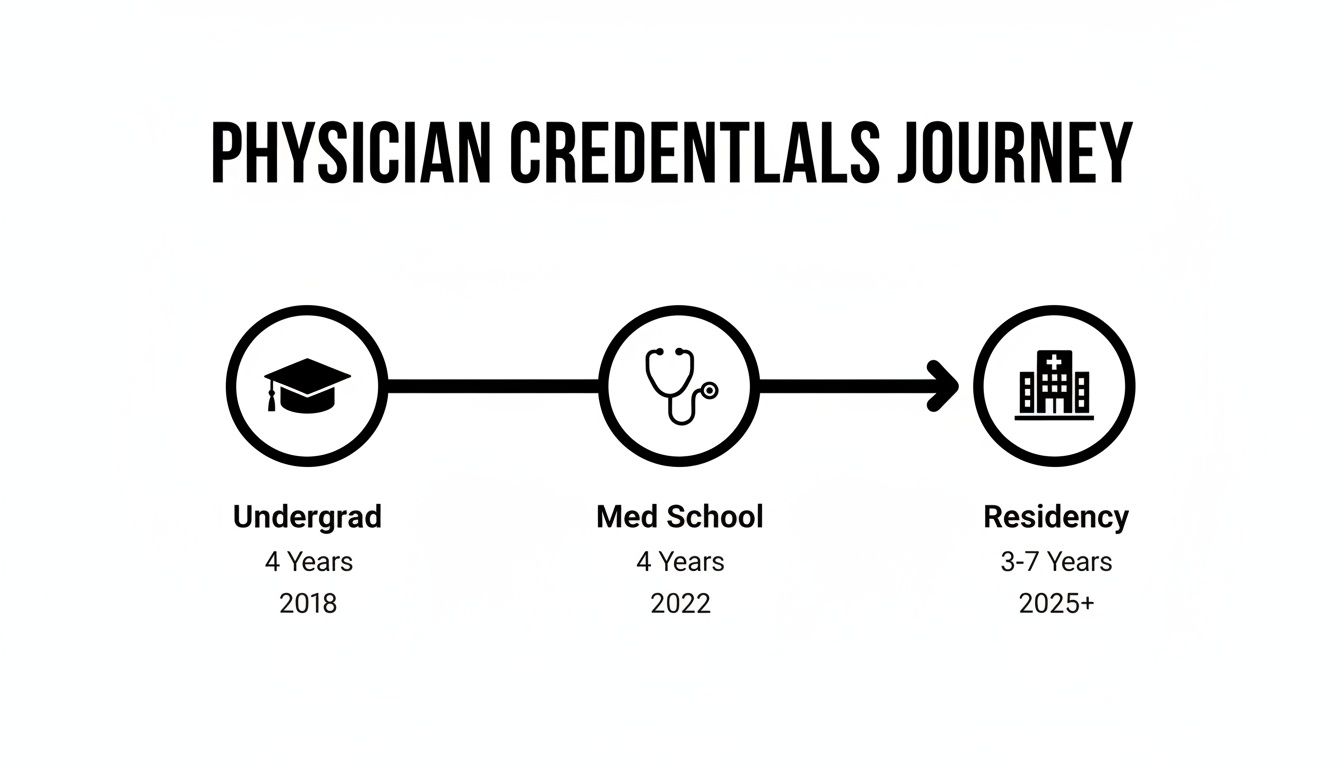
As you can see, becoming license-eligible is a multi-year marathon. Each step is designed to build on the last, ensuring you meet an incredibly high standard of care before you ever apply for that first state license.
The Rise of the IMLC
If you’re interested in practicing across multiple states, especially in telehealth, the traditional state-by-state licensing grind can be a huge barrier. Applying for multiple licenses one by one is both a massive time sink and a serious hit to your wallet.
This is where the Interstate Medical Licensure Compact (IMLC) has been a total game-changer. The IMLC is an agreement between participating states to fast-track the licensing process for qualified physicians. If you already hold a full, unrestricted license in an IMLC member state, you can get expedited licensure in other compact states.
The IMLC isn’t a single national license, but it works like a "fast pass" for getting licensed in other states. It slashes the redundant paperwork and can shrink the timeline from months down to just a few weeks, making multi-state and telehealth roles a whole lot more realistic.
Essential Administrative Credentials
Beyond your state license, a few other key administrative credentials are required before you can start seeing patients. Each one serves a specific, non-negotiable purpose in the healthcare system.
- DEA Registration: If you're going to prescribe controlled substances, you need a registration from the Drug Enforcement Administration (DEA). This is a federal requirement, but you'll usually need a separate DEA registration for each state where you prescribe.
- NPI Number: Your National Provider Identifier (NPI) is your unique 10-digit ID number. It's basically the healthcare equivalent of a Social Security number for your professional life. You'll need it for billing, submitting insurance claims, and working with electronic health records.
- Insurance Credentialing: This is the process of getting "in-network" with insurance companies—think Medicare, Medicaid, and private payers like Blue Cross or UnitedHealthcare. They verify your education, training, license, and competency. Without it, insurers won't pay for your services, creating a massive problem for both you and your employer.
Your Document Checklist and Realistic Timelines
All told, the entire administrative process can take anywhere from three to six months. It's absolutely critical to start early and get organized. Don't wait until you have a job offer in hand to start pulling your documents together.
Here’s a checklist of the core documents you'll need for almost any licensing or credentialing application:
- Curriculum Vitae (CV): Make sure it's current, with no unexplained gaps in your work history.
- Medical School Diploma: A crisp, clear copy.
- Residency and Fellowship Certificates: Proof of completion for all of your postgraduate training.
- Board Certification Certificate: Verification of your specialty board status.
- USMLE or COMLEX Transcripts: Your complete exam history.
- State License Copies: Copies of every medical license you currently hold or have held in the past.
- Government-Issued ID: A clear copy of your driver’s license or passport.
By getting ahead of these administrative requirements, you can turn what often feels like a series of roadblocks into a smooth, predictable part of starting your next role.
Understanding Unique Telehealth Job Requirements

The explosion of virtual care has created a fantastic new career path for physicians, but jumping in requires more than just a good webcam. The physician job requirements for telehealth have their own distinct flavor, blending our core medical expertise with a new comfort level in technology and digital communication.
Think of it this way: your medical degree and board certification are your license to drive. But telehealth is a completely different kind of vehicle. To handle it well, you have to learn a new set of controls and rules of the road. That means getting a handle on multi-state licensing, becoming tech-savvy, and developing a solid "webside manner."
Navigating the Licensing Labyrinth
One of the first, and biggest, hurdles in telehealth is licensing. It’s pretty simple: a physician must be licensed in the state where the patient is physically located during the visit. For a doctor who wants to see patients across the country, this used to be a nightmare of paperwork, fees, and waiting—applying for dozens of individual state licenses.
This is where knowing about the Interstate Medical Licensure Compact (IMLC) is a game-changer. The IMLC is an agreement between member states that dramatically streamlines the process for eligible physicians to get full, unrestricted licenses. It's the key that unlocks a practice that isn't boxed in by state lines.
The core principle of telehealth licensing is simple and absolute: the patient's location dictates the license you need. Trying to get around this is considered practicing medicine without a license, which brings serious legal and professional consequences.
Mastering the Tech and Perfecting Webside Manner
Beyond the paperwork, telehealth demands a unique skill set. You have to be as comfortable navigating digital tools as you are using a stethoscope. This isn’t just about knowing how to use video conferencing software; it's about fluently operating the specific Electronic Medical Record (EMR) or telehealth platform your employer uses.
But the most subtle—and most critical—skill is what we call webside manner. It’s the digital version of bedside manner: the art of building rapport, showing empathy, and communicating clearly through a screen.
This comes down to mastering a few key techniques:
- Active Listening Cues: Since you can't rely on physical presence, you have to be more deliberate. Use verbal affirmations like "I see" or "go on," and nod to show you're engaged.
- Camera Presence: This feels unnatural at first, but looking directly into the camera lens simulates eye contact. It’s a small thing that does wonders for building trust.
- Clear and Concise Communication: Speaking plainly and avoiding medical jargon is even more vital when you can't use a whiteboard or pamphlet to explain things.
A Sustainable Career Path
While telehealth has its unique demands, it also comes with major rewards. For many of us, these roles are a powerful antidote to burnout. The flexibility to work from home, combined with more predictable hours and no commute, creates a work-life balance that’s hard to find in traditional practice.
For any clinician feeling the squeeze of a typical in-person role, exploring virtual care can be a lifesaver. You can learn more about finding a good fit by checking out the different types of telehealth jobs on WeekdayDoc, where the opportunities are specifically curated for a sustainable career. It's a way to keep practicing high-quality medicine while taking back your personal time and well-being.
How to Analyze Job Postings and Contracts
Landing a great physician role is about more than just having the right credentials. You have to learn how to read between the lines of job descriptions and, most importantly, the employment contract.
A glossy job posting can easily hide a culture of burnout. Think of it like a brochure for a house—it shows you the beautiful kitchen and staged living room but conveniently leaves out the leaky roof in the attic. Your job is to be the inspector, looking for the subtle language that reveals the reality of the role.
This skill is more critical than ever. The demand for flexible work is soaring, with locum tenens roles surging 20% yearly to fill the gaps from retiring physicians and widespread burnout. With a projected U.S. physician shortage of up to 124,000 by 2034, employers are scrambling for clinicians. This gives you significant leverage, but only if you know how to use it by dissecting the fine print.
Decoding the Language of Job Postings
When you're scanning job listings, pay close attention to the exact words they use to describe the work. Vague or overly demanding language should set off alarm bells.
A truly burnout-friendly role will use clear, transparent language. You might see phrases like "collaborative team environment" or "predictable weekday schedule." These are good signs, suggesting a workplace that values structure and support.
On the other hand, be skeptical of vague phrases that often hide unsustainable demands.
- "Flexible schedule" can be a code word for being on call 24/7.
- "Fast-paced environment" often means chronically understaffed and overworked.
- "Shared call duties" is meaningless without knowing the frequency. Is it 1 in 10 or 1 in 3?
A truly supportive employer is transparent. If a job posting leaves you with more questions than answers about your schedule, patient load, or call duties, that’s a major red flag.
Scrutinizing the Employment Contract
Once you have an offer, the employment contract becomes the single most important document you’ll review. This isn't just paperwork; it’s a legally binding agreement that will shape your professional life for years. Getting this part right is crucial, and that starts with understanding modern employment agreements.
Don't rush this. Seriously. It’s always smart to have an attorney who specializes in physician contracts review the document, but you need to understand the key clauses yourself.
Key Contract Terms to Analyze:
- Compensation and Bonuses: Is your salary crystal clear? Are bonuses based on achievable metrics like quality of care, or are they tied strictly to productivity? The latter can be a recipe for overwork.
- Duties and Schedule: The contract must spell out your responsibilities, work hours, and on-call obligations. Any ambiguity here is an open door for scope creep and burnout.
- Non-Compete Clauses: These clauses can prevent you from practicing in a specific area for a set time after you leave. An overly restrictive non-compete can hamstring your future career options. Be very careful here.
- Malpractice "Tail" Coverage: This is huge. Tail insurance covers you for claims made after you’ve left a job for things that happened while you were employed. The contract needs to state clearly who pays for it—you or the employer.
- CME and Benefits: Look for a defined Continuing Medical Education (CME) stipend. The contract should also detail health insurance, retirement plans, and vacation time without any fuzzy language.
By carefully dissecting both the job posting and the final contract, you’re not just finding a job—you’re making a strategic career move. This diligence ensures you land a role that fits your goals and protects your long-term well-being. For a deeper look at comparing offers, check out our guide on how to use a physician contract offer analyzer.
NPs, PAs, and Psychologists: A Look at Job Requirements
While physicians are central to healthcare, patient care is a team sport. A huge number of weekday-friendly roles are filled by other highly skilled clinicians like Nurse Practitioners (NPs), Physician Assistants (PAs), and Clinical Psychologists.
If you're exploring these career paths, it's crucial to understand that while the end goal is similar—great patient care—the journey to get there looks quite different for each role. Each has its own advanced degree, national certification, and state licensing hurdles to clear.
Different Roads to Practice: Education and Certification
Let’s break down the distinct training pipelines for these essential roles.
Nurse Practitioners (NPs) start their careers as Registered Nurses (RNs). From there, they earn an advanced degree, either a Master of Science in Nursing (MSN) or a Doctor of Nursing Practice (DNP). Their national certification comes from organizations like the American Academy of Nurse Practitioners (AANP), and it's always tied to a specific patient group, like family practice, pediatrics, or mental health.
Physician Assistants (PAs) go through a master's program built on a generalist medical school model. After graduating, the big test is the Physician Assistant National Certifying Exam (PANCE). Passing it earns them the all-important PA-C credential, which is required for state licensure.
Psychologists take the academic route to a doctoral degree, earning either a PhD or a PsyD. This long road involves thousands of supervised clinical hours and culminates in passing the national Examination for Professional Practice in Psychology (EPPP).
The key difference here is the training philosophy. The PA curriculum is designed to create a medical generalist who can adapt to any specialty. In contrast, NP training is rooted in a nursing model and is specialized from day one, focusing on a specific patient population.
To give you a clearer picture, here’s a quick summary of the requirements for each of these advanced clinical roles.
Credential Overview for Advanced Clinicians
| Clinician Role | Primary Degree | Key Licensing Body | Practice Authority Note |
|---|---|---|---|
| Nurse Practitioner | MSN or DNP | AANP or ANCC | Varies by state (Full, Reduced, or Restricted) |
| Physician Assistant | Master's Degree | NCCPA (for PA-C) | Works collaboratively with a physician |
| Clinical Psychologist | PhD or PsyD | State Licensing Boards | Focus on mental/behavioral health; limited Rx |
As you can see, the letters after their names represent years of very different, highly specialized training.
Understanding Your Scope of Practice
Perhaps the most critical difference between these roles is the scope of practice—what the law allows them to do. This isn't a national standard; it changes dramatically from state to state.
For NPs, this is called "practice authority." Right now, 27 states grant NPs Full Practice Authority, which means they can diagnose, treat, and prescribe medication without a physician's direct oversight. In other states, their practice is reduced or restricted, requiring a formal collaborative agreement with a doctor. This single factor can completely shape an NP's job search and career options.
PAs, on the other hand, almost always practice as part of a physician-led team. The exact nature of that "collaboration" is defined by state law, but the team-based model is the standard.
Psychologists have a scope that's tightly focused on mental and behavioral health. While most cannot prescribe medication, a handful of states now allow specially trained psychologists to do so.
Getting into the weeds of these differences is essential. For clinicians drawn to mental healthcare, for example, it's worth exploring how these credentials play out in the job market. Taking a look at specific psychologist jobs and their requirements can offer a real-world view of how training and licensure connect to day-to-day practice.
Your Top Questions, Answered
After years of medical training, you'd think the hard part was over. But navigating the job market brings a whole new set of questions that never came up in residency.
Think of this section as your quick-and-dirty guide to the real-world logistics of finding a new role. We’ll cut through the noise and give you straight answers.
How Long Does It Really Take to Get a New State License?
This is the million-dollar question, and the honest answer is frustrating: it depends.
You should plan on it taking three to four months from the day you submit your application to having that license in hand. That's the average. But if you have a complex background or the state board is swamped, it can easily stretch to six months or more. Don't get caught off guard.
There is one major shortcut, though. If you're eligible for the Interstate Medical Licensure Compact (IMLC), the process can be radically faster. Using the IMLC can shrink that timeline down to just a few weeks. It's an absolute game-changer for anyone looking at multi-state telehealth or locums work.
Hospital Employment vs. Private Practice: What’s the Real Difference?
Choosing between a big hospital system and a smaller private practice is one of the most significant forks in the road for your career. They offer fundamentally different ways to practice medicine, each with its own perks and headaches.
Hospital Employment: This is the stability route. You get a predictable salary, good benefits (health, retirement, the works), and you don't have to worry about the business side of things. The trade-off? Less autonomy. You'll work within their system, use their EMR, and follow their rules.
Private Practice: This is the autonomy route. You get more control over your schedule, how you care for patients, and your clinical philosophy. There's also a clear path to partnership and higher earning potential. The catch is that you're also a business owner, responsible for everything from staffing and billing to keeping the lights on.
At the end of the day, it's about what you value most. Do you want the security of a large, built-in system, or do you crave the independence and entrepreneurial challenge of private practice?
Are Non-Compete Clauses Still a Thing?
Absolutely. Non-competes are still incredibly common in physician contracts, even though they're facing more legal challenges than ever before. A non-compete is a clause that stops you from practicing within a certain geographic radius for a set amount of time after you leave a job.
How enforceable they are varies wildly from state to state. Some states have banned them for physicians altogether. Others will only uphold them if the terms are considered "reasonable"—a vague standard at best. Always, always have an attorney review this section of your contract. A restrictive non-compete can hamstring your career options down the line.
Finding a role that fits your life means getting clear on these practical details. At WeekdayDoc, we specialize in curating jobs that prioritize a healthy work-life balance, with the transparency you need to make an informed decision. Explore roles with no call and no weekends today at https://www.weekdaydoc.com.