Work Life Balance for Doctors Practical Strategies for Wellness
Unlock practical strategies for work life balance for doctors with real case studies on burnout prevention, smart scheduling, and sustainable wellness planning.

Finding harmony between your career and personal life can feel out of reach when you’re wearing a white coat. Three elements really make the difference: honest burnout checks, clear personal boundaries, and smart use of real-time data. I still think about Dr Smith’s early days—working 80-hour weeks, barely sleeping, and ready to quit medicine altogether. This playbook will walk you through measuring your burnout baseline, negotiating shifts that respect your life, and building a durable plan for wellness and financial freedom.
Why Work Life Balance For Doctors Matters
Over the last decade, what physicians value most on the job has shifted dramatically. In 2018, 63% of doctors fresh out of residency named work–life balance as their top concern. Fast forward to 2022 and that number jumps to 85%—an absolute gain of 22 percentage points and roughly a 35% relative increase from four years earlier. Read the full research about early-career physicians’ top priorities.
Here’s how the emphasis on work–life balance has shifted over four years:
Physician Priorities Comparison
A side-by-side look at the leading concern for new doctors in 2018 vs 2022.
| Priority | 2018 | 2022 |
|---|---|---|
| Work–Life Balance | 63% | 85% |
The data underscores a clear shift toward prioritizing balanced schedules.

Key Components
• Assess Burnout Risk by logging sleep patterns, mood shifts, and workload changes
• Set Clear Boundaries around on-call shifts, charting days, and personal commitments
• Use Data Tools like WeekdayDoc’s Burnout Score and the FIRE calculator to back up your requests
Impact On Patients
A schedule that respects your downtime isn’t just about you. It translates to fewer errors, higher patient satisfaction, and more meaningful interactions.
Healthy doctors provide better care
By tempering exhaustion, you show up fully present for every consult.
You might also be interested in our clinician mental health resources on WeekdayDoc Wellness.
Dr Smith turned her personal trendline into a six-week block off and now enjoys two months a year completely free of weekend calls.
You’ll find concrete examples in each chapter. Dr Nguyen’s self-audit secured her lighter weekend rotations. Dr Patel convinced her department to pilot a no-weekend schedule.
• Craft data-backed proposals for smarter shifts
• Hunt for roles that match your lifestyle goals
• Model long-term savings and early-retirement scenarios
Next Steps
Work through this guide in order and revisit WeekdayDoc’s calculators whenever you need fresh insights.
In the next section, you’ll learn how to quantify your burnout risk and pinpoint specialty-specific stressors with simple self-inventories.
Ready to reclaim your time? Start by tracking each day in 15-minute segments—note stress levels, sleep, and on-call duties. Dr Smith’s first audit took ten minutes daily and unlocked the data she needed to demand real change.
Understanding Burnout Baseline And Specialty Risks
Before you overhaul your schedule, you need to know exactly where your stress starts. A simple daily log can shed light on sleep gaps, fatigue peaks and mood swings you might otherwise miss.
Pick a trusted survey—either the Maslach Burnout Inventory or WeekdayDoc’s self-audit—and track for two weeks. Pair the numeric results with notes on call nights and high-pressure moments.
• Record hours worked and sleep quality each night
• Rate your daily stress on a 1–10 scale
• Jot down mood changes around your busiest shifts
In just a fortnight, you’ll begin to see real patterns in your energy. Those hard numbers turn abstract complaints into persuasive data when you ask for call adjustments.
Dr. Nguyen started with a basic spreadsheet and wound up with lighter weekend duty. You can follow her lead using our Burnout Index: WeekdayDoc Burnout Index tool.
Mapping Specialty Trends
Not all clinician roles carry the same burnout risk. Primary care burnout jumped from 46.2% in 2018 to 57.6% in 2022, while telemedicine providers tend to report far lower levels than onsite colleagues. Dive deeper in this JAMA Network analysis.

That chart makes one thing clear: nontelework roles tend to experience sharper burnout spikes.
Burnout Rates By Specialty And Work Model
To put your own numbers in context, here’s how burnout shifted across different roles and settings from 2018 to 2022:
| Specialty Or Model | Burnout 2018 | Burnout 2022 |
|---|---|---|
| Primary Care | 46.2% | 57.6% |
| ICU | 52.0% | 60.3% |
| Telemedicine | 38.5% | 42.1% |
| Nontelework ER | 48.7% | 58.9% |
This snapshot confirms remote clinicians often fare better—and highlights where you may need to focus your efforts.
Building Your Personal Baseline
Dr. Nguyen’s nightly routine took less than ten minutes:
• Log hours worked
• Give sleep a rating (1–5)
• Assign a stress score (1–10)
By month three, her downward trend in well-being was impossible to ignore. That graph became her key talking point when proposing a reduced weekend load. You can mirror this process in under five minutes a day—just note if mood dips after every second overnight shift.
Turning Numbers Into Negotiations
Once you’ve gathered solid data, prepare for a conversation with your department leadership. Lead with average stress scores—imagine an 8 after three night shifts versus a 5 on days off—and frame a pilot swap or partial call relief.
• Show how patient coverage remains seamless with proposed shift trades
• Highlight fewer sick days after call reductions
• Contrast your scores against department norms
Data-driven proposals carry weight. Precise metrics always outshine anecdotal requests.
Next Steps For Evidence-Based Proposals
Aim to collect at least six weeks of logs before your meeting. Bring simple visuals—trendlines or bar charts—and a concise one-page summary. Tie your request directly to patient safety benchmarks and operational goals. Well-documented cases move through approval faster and with less resistance.
Quantify your baseline. Negotiate from evidence. Thrive in your role.
Start tracking today. Share anonymized peer trends to underscore broader needs. Then set up follow-up metrics to demonstrate ongoing gains in wellness and performance. Stay motivated.
Setting Personal and Professional Boundaries
When work spills over into evenings and weekends, your mind never truly clocks out. Deciding not to chart after dinner may seem small, but it creates the breathing room you need.
Drawing a clear line between hospital corridors and home hallways frees up mental bandwidth for the people and passions you value most.
Everyone’s life looks different, so your blueprint must be flexible. Dr. Lee, for example, protects weeknights for family and reserves Monday mornings strictly for paperwork.
Build Your Priority Pyramid
First, capture every daily commitment and sort it into three zones:
- Critical: Patient rounds, urgent consults
- Important: Charting, case reviews
- Optional: CME reading, professional newsletters
Color-code or label each task—this visual cue makes it obvious when nonclinical work creeps into personal time. Dr. Lee shaded Monday–Friday evenings in red on her digital calendar. That simple ten-minute exercise became a powerful barrier against creeping obligations.
Communicate Non Negotiables
It feels awkward at first to push back, but clear limits foster respect and curb burnout. Frame refusals around patient safety or team efficiency to keep things objective.
Try a brief email template when extra charting lands in your inbox:
- Subject: Monday Paperwork Block
- Hi Dr. Carter, I’m reserving Monday mornings for essential documentation and will deliver charts by Tuesday.
- Thanks for understanding and supporting our workflow.
With that template on hand, you’ll decline ad-hoc requests without the usual guilt or second-guessing.
This AMA study found a 0.04 T-score increase in social isolation for each extra work hour per week. Women, unmarried physicians, and those early in their careers showed the highest rise. And 92% of millennial doctors rank work–life balance as their top career priority. Read the full research Learn more about physician social isolation findings.
Enforce Time Blocks
Time blocking is your best defense against surprise tasks:
- Use repeating calendar events to carve out nonclinical focus time.
- Assign a unique color or emoji to personal slots so they stand out.
- Share read-only access with a coworker to reinforce your availability.
When someone asks for your blocked slot, offer an alternative window. This shows you’re collaborative without sacrificing your plan.
Respecting time blocks reduces conflict and preserves mental bandwidth.
Handle Pushback Confidently
Late invites and urgent emails are inevitable. A short, practiced response keeps frustration at bay and reinforces your boundaries:
- “I appreciate the need for coverage, but I have a reserved slot from 2–4 pm for documentation.”
- “Can we shift the consult to 4–6 pm so I can honor that commitment?”
These scripts steer conversations back to shared goals instead of resentment.
Sketch Your Boundary Schema
Bring everything together in a simple chart or table. At a glance, you’ll see where your nonnegotiables live.
| Priority Level | Example Activity | Time Block |
|---|---|---|
| High | Patient Rounds | 7–9 am Mon–Fri |
| Medium | Charting | 2–4 pm Daily |
| Low | CME Reading | 1 hr Sunday |
Keep this schema pinned in your inbox and workspace. When fatigue creeps in, it’s your quick reminder of what deserves your energy.
A solid boundary schema is your roadmap to balance and resilience.
Boundaries aren’t set in stone. Review and adjust quarterly. Start today by mapping one week of commitments, then block one personal and one professional priority. You’ll be amazed at how a small shift reshapes your workload.
Celebrate the wins—big and small—and defend them fiercely.
Own it.
Negotiating Schedules For Better Work Life Integration
Your schedule sets the tone for your wellbeing. When Dr. Patel tracked six months of stress scores alongside her overnight calls, she uncovered a powerful insight: protected weekends drove down her fatigue. Armed with that data, she pitched a plan to secure every third weekend off—and won approval.
Here’s what she assembled before the meeting:
- Assessment summary with burnout scores and on-call nights
- Sample email scripts that highlight patient-safety gains
- Pilot proposals complete with timelines and measurable goals
- Follow-up strategies plus documentation tips
Framing Flexibility As Patient Care Win
Showing flexibility as a patient-care benefit changes the conversation. Dr. Patel’s no-weekend pilot delivered a 30% drop in fatigue-related chart errors. That statistic opened doors.
She teamed up with a colleague to rotate weekend duties and designed a tight handover protocol. The payoff was immediate: fewer late-night cross-coverage calls and seamless patient transitions.
| Proposal Element | Benefit | Metric |
|---|---|---|
| Weekend Swap | Reduced fatigue | 30% error reduction |
| Shift Rotation Pilot | Balanced workload | 1:1 swap ratio |
| Coverage Handover Plan | Continuous patient monitoring | Zero missed consults |
A well-structured pilot demonstrates both physician and patient benefits.
Crafting Battle-Tested Email Messages
A concise, focused email is your foot in the door. Start with context, attach your burnout summary, then outline:
- Why you’re requesting schedule changes
- Key findings from your logs (improved performance)
- Proposed pilot duration (e.g., 3 months)
- Metrics you’ll track (error rates, staff satisfaction)
For example:
“Following my six-month wellness audit, I noted a 25% improvement in weekday alertness when weekends were protected. I’d like to trial rotating every third weekend off starting next quarter.”
Proposing Incremental Pilots Effectively
Big shifts can feel risky—so start small. Try:
- A six-week trial of protected weekends
- A midpoint review to share early findings
- An option to extend or tweak based on feedback
This shows you’re responsive and framing the ask as data-driven, not entitled.
Small changes can build momentum and trust with administrators.
Follow-Up And Documentation Best Practices
Once you have approval, keep everyone in the loop. Send a weekly update via a shared doc or email thread that tracks:
- Date of schedule changes
- Performance data (patient wait times, error rates)
- Feedback from colleagues and patients
A simple table makes it easy:
| Week | Fatigue Score | Errors Logged | Notes |
|---|---|---|---|
| 1 | 4/10 | 2 | Smooth handover |
| 2 | 3/10 | 1 | Positive nurse feedback |
Solid documentation cements your credibility and keeps the plan on track.
Real-World Schedule Negotiation Example
In her meeting with the chief, Dr. Patel led with her personal stress scores alongside improved patient satisfaction trends. Coverage concerns? She had a draft swap calendar and shift adjustments ready.
- Shared a one-page visual trendline
- Provided a draft weekend-swap calendar
- Cited 15% reduction in sick days over the pilot
That clear, metrics-driven approach won approval—no extra hires needed. Now it’s your turn: gather your data, frame it around patient welfare, and make your case today.
Finding Burnout-Friendly Roles And Work Arrangements
If you’re a clinician staring at a mountain of on-call pages and packed shifts, it’s easy to feel stuck. Shifting into a role that dims the after-hours noise can recharge your energy and protect your sanity.
We’ll dive into real listings—remote telemedicine, hybrid setups, no-call roles, and weekend-free positions. Comparing salary bands, call frequency, and expected off-hours work reveals your stress footprint. Pair that with a custom match score to see which options align with your boundaries and life goals.
Below is a flowchart that illustrates how to gather your data, craft a pilot request, and launch a trial schedule.
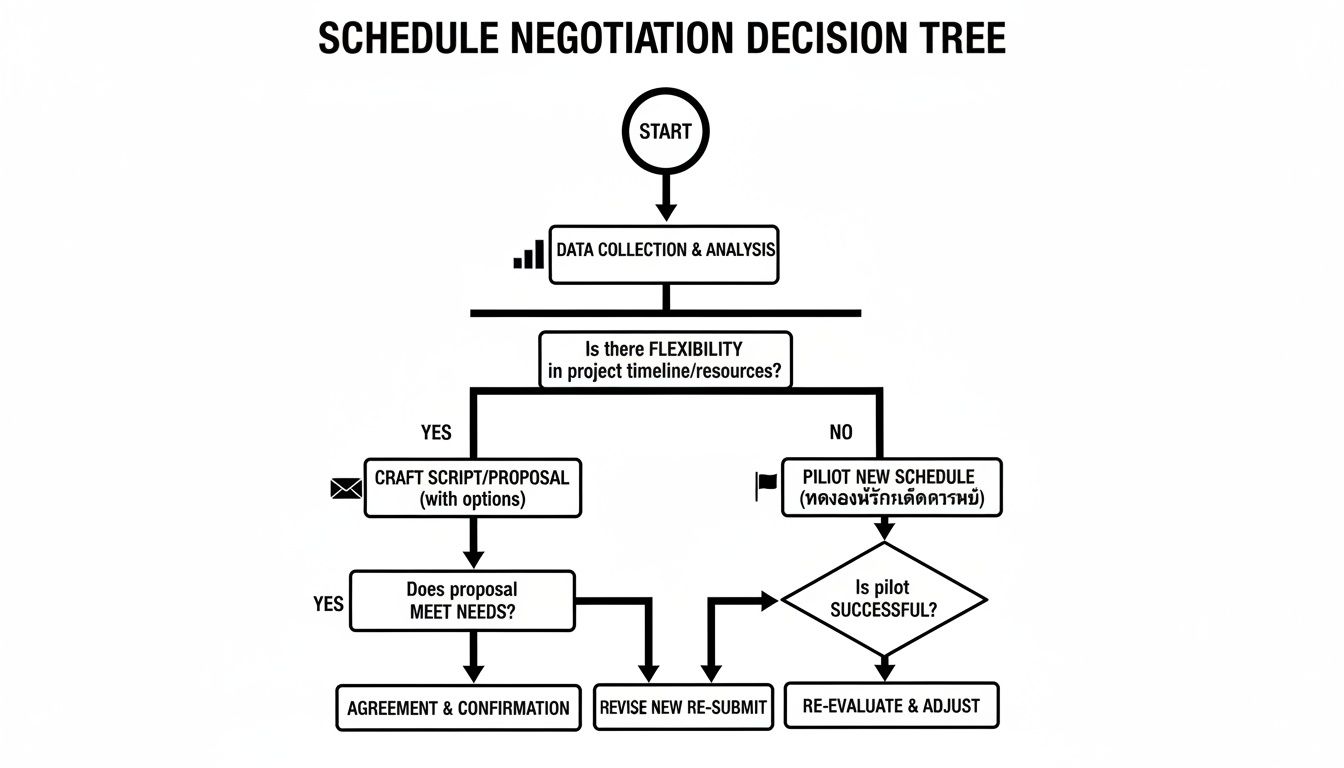
This chart walks you through three essential steps: gathering stress metrics, scripting your request, and testing a new schedule.
Comparison Of Popular Work Arrangements
Weighing the benefits and trade-offs of each setup helps you narrow in on what truly matters.
Comparison of Work Arrangements
| Arrangement | Pros | Cons |
|---|---|---|
| Remote Telemedicine | Complete location flexibility and no call | Limited face-to-face patient interaction |
| Hybrid Clinic/Telehealth | Blend of in-person balance and remote days | Requires commute on scheduled office days |
| No-Call Clinical Role | Zero overnight or weekend calls | May offer lower procedural income |
| Weekend-Free Position | Full weekend recovery and family time | Requires fixed weekday hours without swaps |
Use this overview to spot the fits and eliminate what won’t work.
Scoring Roles Against Your Boundaries
Giving every job a score removes the guesswork. Here’s how to turn your priorities into a clear ranking system:
- List your non-negotiables (e.g., weekend calls, overnight shifts, charting hours).
- Assign each factor a weight from 0 to 5 based on importance.
- Plug in the WeekdayDoc Burnout Score and multiply by your weights.
- Sum the results for a total fit score you can share with partners or mentors.
A transparent scoring system takes the emotion out of career moves and aligns roles with your wellbeing goals
When Dr. Hughes applied this method moving from ICU shifts to a 100% telehealth role, her fit score jumped by 50%. She also saw a 60% drop in after-hours pages and a 40% boost in sleep quality after three months.
On WeekdayDoc, refine your search with filters for no weekends, no call, or fully remote roles:
- Filter for a Burnout-Friendly Score above 80 to focus on low-stress options.
- Narrow salary bands according to your Salary & FIRE Calculator results.
- Preview call schedules and on-call frequency to avoid surprises.
Many physicians underestimate the hidden toll of weekend charting and night-call alerts. Setting these filters early lets you bypass listings that will drain your energy.
Real-Life Role Shifts
Dr. Martinez traded a high-stakes hospitalist gig for a no-call outpatient clinic. She gave up 10% of her procedural bonus but gained six full weekends each quarter.
Her stress logs went down by 45%, and weekends are now for family hikes and retreats. Use these stories as scripts when talking to hiring managers—real numbers and real relief resonate.
Using WeekdayDoc Tools For Wellness And Financial Planning
Medicine is too complex to navigate on gut feeling alone. When Dr. Gomez faced mounting stress, she turned to WeekdayDoc’s suite of calculators to chart both her burnout risk and financial future at once.
She started by running our Burnout Score tool, narrowing 120 openings down to just 18 low-stress gigs. Then she plugged in different salary figures into the Salary & FIRE Calculator to see when she could realistically retire. Below, I’ll walk you through the exact steps she took.
Before diving in, you may want to fine-tune your own boundaries with the interactive Work Life Balance Calculator guide. It’s a perfect warm-up for setting realistic goals.
Below is a screenshot of the WeekdayDoc Tools dashboard where you can access the Burnout Score and Salary & FIRE calculators.

On this screen you’ll see filters for remote work, no-call contracts, and weekend-free schedules alongside burnout scores and salary ranges. These details make it simple to zero in on roles that actually support your wellness plan.
Running Burnout Score To Identify Low-Stress Roles
I know the drill: long shifts, night calls, endless charting. WeekdayDoc turns those pain points into a Burnout Score out of 100. Lower is always better.
Dr. Gomez entered her:
- Typical weekly shifts
- Call frequency
- Average charting hours
Then she tweaked the weight on nights and weekends, filtered out anything requiring weekend coverage, and watched her list shrink from 120 to 18 fits under a 45 burnout threshold.
Here’s how to run and refine your score:
- Enter weekly schedule and rotation details
- Adjust weights for night calls and charting
- Exclude weekends and overnight obligations
- Export results to share with colleagues
Once you’ve identified the low-stress roles you want, it’s time to switch gears to finances.
Projecting Income And Early Retirement Scenarios
Aligning your career choice with your financial milestones is where the magic happens. The Salary & FIRE Calculator models how fast you can reach independence using your salary, savings rate, and spending assumptions.
Take Dr. Gomez’s numbers as an example:
| Annual Income | Estimated Retirement Age |
|---|---|
| $180,000 | 60 |
| $200,000 | 57 |
| $220,000 | 55 |
To map your own path, just:
- Enter state tax rate and deductions
- Log current retirement balances and monthly contributions
- Set your target retirement age or year
- Review the charts and adjust until it feels right
This approach ensures a role with a lower stress load still checks off your long-term financial goals.
Creating Your Personalized Wellness And Financial Roadmap
Your final roadmap brings stress metrics and money targets into one view. Pick your three non-negotiables—say, no weekends, at least two remote days, max six hours charting—and make them your filters.
Follow these four simple steps:
- Overlay burnout-friendly roles under your threshold
- Match salary ranges with your FIRE timeline
- Prioritize jobs that satisfy both wellness and income needs
- Schedule quarterly check-ins to update scores and plans
Dr. Gomez landed her ideal position by combining a 43 burnout score with her 55 FIRE goal, choosing a 100% remote, no-weekend opening.
Visualize your roadmap as a table or Gantt chart and keep it front and center—pin it on your office wall or set it as a background on your computer.
A data-driven roadmap unites career moves with personal wellbeing.
Next Steps To Keep Momentum
Momentum comes from consistency. Set calendar reminders every quarter to re-run both calculators. That way, you’ll capture raises, schedule changes, or shifting priorities.
Connect with other clinicians in our community to trade tips and celebrate wins. Peer feedback often sparks fresh ideas for boundary tweaks and savings hacks.
In your quarterly reviews, try to:
- Document what went well and what needs tweaking
- Test new filters as your goals evolve
- Reward yourself for milestones—whether it’s a lower burnout score or hitting a savings target
Remember, this roadmap is alive. Keep updating it, and you’ll transform the idea of work–life balance from a dream into your daily reality.
Frequently Asked Questions
Clinicians juggling hectic schedules often look for practical ways to reclaim balance. This FAQ dives into quick assessments, flexible scheduling strategies, compensation trade-offs, and methods to keep progress on track.
What Quick Assessments Help Gauge Burnout Risk
Before you negotiate or adjust your routine, know where you stand. A two-week self-audit combined with a validated tool paints the clearest picture.
Use inventories like the Maslach Burnout Inventory or WeekdayDoc Burnout Score to establish your baseline. Then track:
- Daily stress on a 1–10 scale
- Number of on-call nights and charting hours
- Sleep quality and mood shifts each day
Review those trends weekly to pinpoint your peak fatigue periods. You’ll spot patterns and know exactly when your risk climbs.
How Can I Propose Flexible Hours To Administration
Data trumps anecdotes every time. When you’re ready to ask for a shift in hours, lead with your numbers.
Start by summarizing your stress log alongside a clear coverage plan for patients. Then:
- Highlight benefits: fewer errors and improved staff morale
- Suggest a pilot period—say, four weeks—to demonstrate impact
- Share a sample schedule that balances your needs with the department’s
Data-driven proposals outshine anecdotal appeals
This approach shows you’ve thought it through—and that you’re invested in a win-win solution.
What Trade-Offs Exist Between Compensation And Balance
Remote or no-call positions can mean fewer procedural fees, but the personal time you reclaim often outweighs the lost revenue. To decide:
- Compare net income versus hours saved each week
- Estimate wellness gains over the next year
- Factor in career trajectory: will reduced burnout boost longevity?
Putting hard numbers side by side clarifies whether a slightly lower salary is worth less stress and more free evenings.
How Do I Sustain Improvements Long-Term
Small changes stick when they’re woven into your routine. Treat your work–life plan like any other project.
- Set quarterly reminders to revisit boundaries and workload
- Track your burnout score alongside a peer or mentor
- Update financial projections after promotions or schedule tweaks
By linking your wellness data to your big-picture goals, you’ll stay accountable—and celebrate each win.
Each of these tactics builds toward a sustainable, doctor-friendly rhythm. Lean on real data, test small tweaks, gather feedback, and refine your plan as you go.
Ready to find burnout-friendly roles that respect your time? Explore WeekdayDoc for curated, no-call, no-weekend job listings and data-driven tools at WeekdayDoc