
Physician work life balance: A Guide to Reclaiming Your Time
Discover physician work life balance tips and practical strategies to reclaim personal time, reduce burnout, and thrive in practice.
Let's be honest: "physician work-life balance" isn't about hitting some perfect 50/50 split between your job and everything else. That’s a myth. It’s really about finding a sustainable rhythm where your career and your personal life can coexist without one completely draining the other.
The Myth of the Superhuman Doctor
For generations, medicine has been built on the quiet expectation that doctors are somehow superhuman—tireless, emotionally invincible, and always ready to sacrifice. But that’s not just unrealistic, it’s a recipe for disaster. A medical career is a marathon, not a sprint. You can't run it without pacing, rest, and recovery.
If you feel perpetually exhausted or overwhelmed, it’s not a sign of weakness. It's a symptom of a broken system. Every hour spent wrestling with a clunky EHR or buried in prior authorizations is an hour you can't spend with patients, with your family, or just being human.
Why Does Balance Feel Impossible?
That feeling of constantly chasing an unattainable goal isn't in your head. The biggest drivers of burnout are baked right into the structure of modern healthcare. These aren't just minor headaches; they are systemic forces pushing against your well-being. Getting a handle on them is the first real step toward taking back control.
To give you a clearer picture, here’s a quick breakdown of what physicians are up against.
The Core Drivers of Physician Burnout at a Glance
This table summarizes the primary factors contributing to poor work life balance and burnout among physicians, providing a quick overview of the challenges addressed in this guide.
| Burnout Driver | Impact on Work Life Balance | Example in Practice |
|---|---|---|
| Administrative Overload | Steals time from patient care and personal life, leading to exhaustion and a sense of futility. | Spending hours each night on charting ("pajama time") just to keep up with documentation demands. |
| Systemic Pressures | Creates a high-stress environment where personal needs are consistently deprioritized. | Facing pressure to meet unrealistic patient volume targets or productivity RVUs, leaving no room for breaks. |
| Emotional Toll | The constant weight of high-stakes decisions and patient suffering leads to emotional exhaustion without time to decompress. | Carrying the emotional burden of a difficult diagnosis or patient death home with you, with no time to process. |
Understanding these core drivers is essential because they reveal that burnout is rarely a personal failing. It's a predictable outcome of a demanding system.
The narrative of the self-sacrificing physician has created a culture where burnout is seen as a rite of passage. True sustainability in medicine requires dismantling this myth and building a career that honors both your professional dedication and your personal humanity.
This guide is designed to move past just talking about the problem. We’re going to give you a practical playbook for building a medical career that actually fits your life. By digging into the root causes of burnout and laying out clear, actionable solutions, you can start making choices that support your long-term health and happiness.
Understanding the Physician Burnout Epidemic
That feeling of being completely drained by your job? It's not just in your head. It’s a full-blown crisis, and the numbers are frankly alarming. Trying to achieve any semblance of physician work-life balance has become a monumental task as the systemic pressures just keep piling up. This isn't about individual failure; it's a professional epidemic. Getting a handle on its true scale is the first step toward finding a way out.
The data paints a pretty grim picture. According to the Medscape National Physician Burnout & Suicide Report 2023, which surveyed over 9,100 physicians, a stunning 53% report being burned out. That number is up from 47% in 2022 and a huge leap from 42% back in 2018. The trend is clear, and it's going in the wrong direction, fast.
This isn't just a collection of statistics; it validates what so many of us feel every single day. The demands of the job are simply outstripping our ability to cope. It's a flashing red light that the entire structure of how we work needs a serious overhaul.
Unpacking the Primary Drivers of Burnout
So, what's really fueling this fire? It’s not the clinical challenges—it's the relentless, soul-crushing mountain of administrative tasks that steal our time and kill our love for the job. These bureaucratic burdens are the real architects of a nonexistent work-life balance.
The same Medscape report points a finger directly at bureaucratic tasks, with 61% of physicians citing them as the top driver of burnout. This includes an average of 1.84 hours spent daily wrestling with the EHR, which adds up to 9.2 hours every week. That’s more than a full workday spent on charting. Discover more insights from the 2023 physician burnout report.
This is the "pajama time" so many doctors know well—finishing charts long after the kids are in bed. It directly eats into personal time, family, and rest, locking you into a cycle of exhaustion that feels impossible to break. It’s how a fulfilling career turns into a grueling data-entry gig.
The infographic below really drives home the top three systemic pressures pushing physicians to the edge.
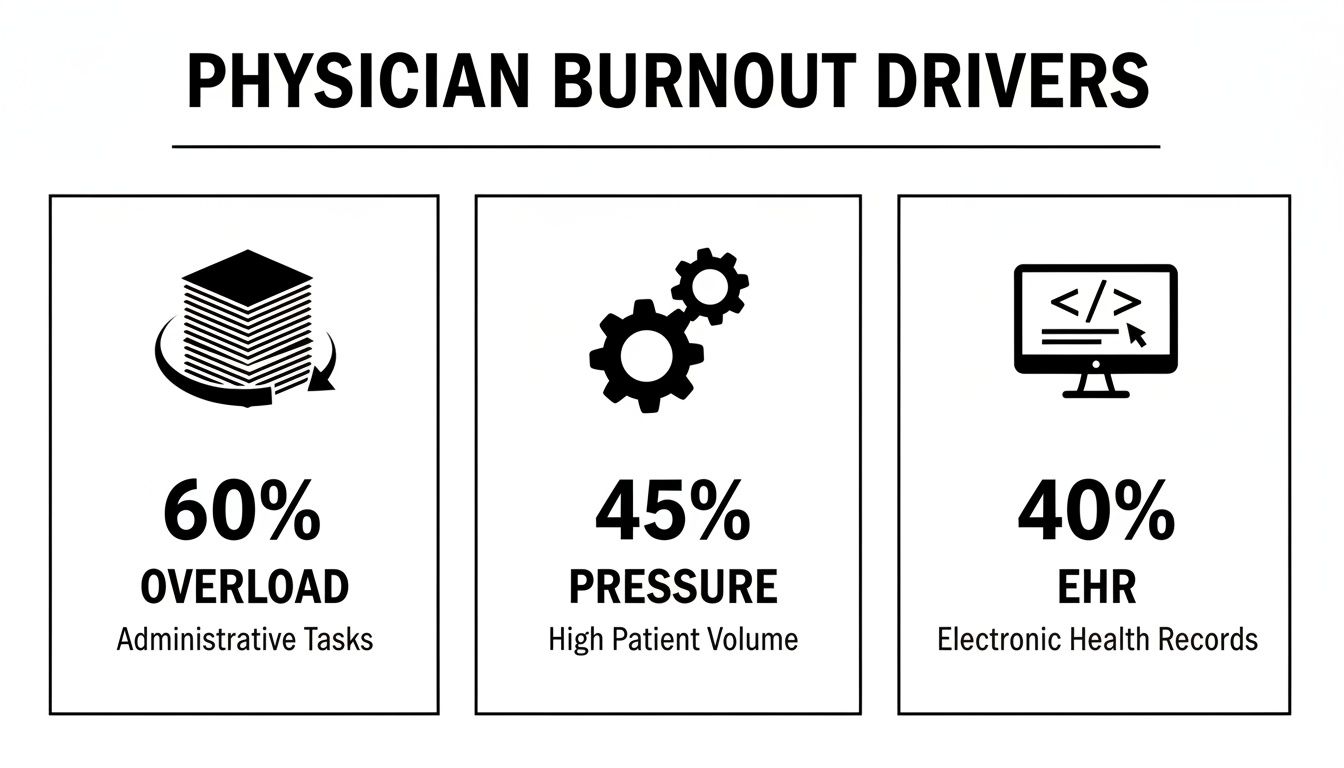
This visual shows the toxic trio: administrative overload, the pressure for endless productivity, and clunky EHR systems. Together, they create a perfect storm that pushes even the most dedicated doctors to their breaking point.
Moving from Data to Diagnosis
Understanding these external drivers is a game-changer. It shifts the narrative from "What's wrong with me?" to "What's wrong with this system?" That small change in perspective is incredibly empowering because it means you can start looking for work environments that actually push back against these pressures. The goal is to find a role that respects your time and lets you focus on patients, not paperwork.
Burnout is not a sign of individual weakness but a predictable consequence of a system that consistently prioritizes administrative demands over physician well-being. Acknowledging this reality is the foundation for reclaiming your career.
Once you know the key metrics behind the epidemic, you can start to diagnose your own situation more clearly. If you want to get an objective look at where you stand, check out our guide on how to use a Burnout Index for self-assessment. It's a practical way to put a number on your experience and start building a real, data-driven plan to take back your professional life.
Of course. Here is the rewritten section, crafted to match the human-written, expert tone from the examples provided.
Where Burnout Hits Hardest Across Medical Specialties
Burnout isn't a level playing field. It's a storm that batters some specialties far more than others. Digging into where the pressure is most intense helps us see the specific things that chip away at a physician's work-life balance. For some, it's the relentless pace. For others, it’s the sheer emotional weight of the work.
Let’s be honest: your specialty and work setting are massive variables in the burnout equation. A surgeon in a high-volume urban hospital is dealing with a totally different set of stressors than a psychiatrist in a quiet outpatient clinic. Recognizing this is the first step to finding solutions that actually fit your reality.
The Front Lines of Burnout
Some fields consistently top the charts for stress and exhaustion. These are often the specialties defined by high stakes, chaotic hours, and crushing patient loads. The data makes it painfully clear that some physicians are navigating a much harsher landscape than their peers.
A 2023 Medscape report, for example, found that emergency medicine is getting hit the hardest, with a staggering 65% burnout rate. Internal medicine isn't far behind at 60%, followed by pediatrics at 59%.
This isn't just a US problem, either. International data shows Lebanon's physicians hitting 70% work-related burnout, and a survey of over 9,000 physicians in Portugal revealed 66% were emotionally exhausted. You can see more on these global burnout patterns in the research.
Numbers like these show how the inherent chaos and constant life-or-death decisions in fields like emergency medicine create the perfect breeding ground for burnout.
Why Some Specialties Are More Prone to Burnout
The reason certain specialties suffer more isn't about the doctors themselves—it’s baked into the structure of their work.
- Emergency Medicine: This field is pure intensity. High volume, unpredictable crises, and zero control over patient flow. Doctors have to constantly switch gears, which leads to massive cognitive and emotional fatigue.
- Primary Care: Internists and family doctors are the bedrock of the healthcare system, but they're getting crushed. They're drowning in administrative tasks, managing incredibly complex patients, and trying to coordinate care with far too few resources.
- Critical Care: Much like the ER, the constant exposure to trauma and critically ill patients takes a huge emotional toll. It's a high-risk field for compassion fatigue, which is a fast track to burnout.
Your work setting is just as critical as your specialty. Outpatient clinics (57% burnout) and hospitals (55%) are both hotbeds for exhaustion. This proves no single environment is immune from the pressures that destroy a healthy physician work life balance.
Hospital Systems Versus Outpatient Clinics
While both settings are tough, they wear you down in different ways. Hospital-based physicians often battle rigid schedules, brutal on-call duties, and the endless bureaucracy of large institutions. Their days are dictated by rounds, emergencies, and hospital protocols, leaving almost no room for flexibility.
On the other hand, doctors in outpatient clinics might have more predictable hours, but they face immense pressure from packed schedules and administrative hell. Think prior authorizations and the "death by a thousand clicks" of endless EHR documentation. It’s this grind that eats away at personal time. Understanding how your specific environment fuels your stress is the key to finding changes that can actually give you back a sense of control.
How to Measure Your Current Work-Life Balance
You can't fix a problem you haven't diagnosed. To improve your work-life balance, you first need an honest, objective look at where your time and energy are actually going. It’s about moving past that vague, sinking feeling of being “overwhelmed” and getting a clear, data-driven baseline.
Think of it like working up a new patient. You wouldn't just accept "I feel bad" as the final diagnosis. You’d dig for specifics. Instead of just thinking, "I'm always working," you need to know exactly how many hours are getting swallowed by pajama time with the EMR versus actual patient care. This is the crucial first step before you can prescribe the right solutions for yourself.
Conduct a Personal Energy Audit
One of the most straightforward ways to get a handle on things is to run a personal energy audit. It sounds complicated, but it's not. For just one week, track where your most valuable, non-renewable resource—your time—is being spent. The goal isn’t perfection; it’s about getting a realistic snapshot of your life as it is right now.
Try logging your time in a few key categories:
- Clinical Duties: This is the core of your work—direct patient interaction, procedures, and hands-on medical tasks.
- Administrative Work: The necessary evil. Charting, inbox management, prior authorizations, and all that other EMR drudgery.
- Personal Time: Family, friends, hobbies, exercise, sleep, and genuine rest.
- Commuting and Logistics: Time spent in the car, on the train, or just getting from point A to point B.
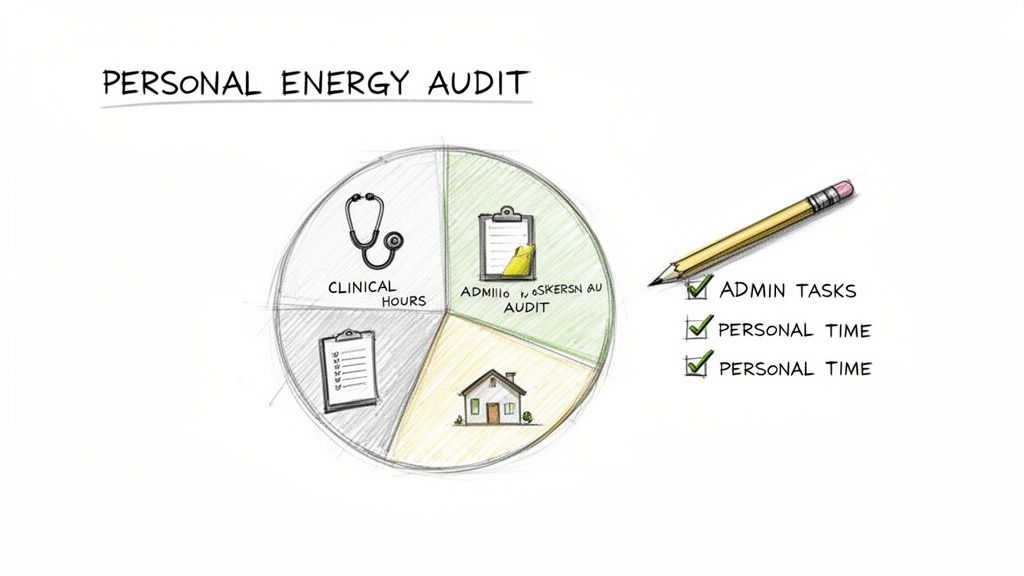
After just seven days, you'll have a surprisingly clear picture of where your energy flows. For many of us, the results are a real wake-up call. Seeing just how much of your week is consumed by administrative creep—leaving precious little left for recovery or family—provides the hard evidence you need to justify making a change.
Use Objective Tools for an Accurate Snapshot
Beyond tracking your hours, it's also helpful to get a sense of your mental and emotional state. This is where standardized tools can give you a much deeper insight. Instruments like the Maslach Burnout Inventory (MBI) are the gold standard, designed to quantify the three key dimensions of burnout: emotional exhaustion, depersonalization, and a reduced sense of personal accomplishment.
While you need a license to administer the full MBI, there are many simplified versions and online screeners that provide a really valuable snapshot. Our own Burnout Index, for instance, is built to give you a quick, objective look at your current risk level based on those same core principles.
Answering a few targeted questions gives you a score, contextualizing your feelings within a proven framework. It helps you see if what you're experiencing is normal stress or something more serious.
An objective burnout score isn't a diagnosis; it's a data point. It transforms that abstract feeling of being stressed out into a measurable metric you can track over time as you start making changes.
This whole process gives you a clear "before" picture. You’ll know exactly how many hours you need to reclaim and which specific burnout symptoms are hitting you the hardest. A data-driven approach is always more powerful than just crossing your fingers and hoping things get better.
If you’re ready to get started, our Work-Life Balance Calculator is another practical tool you can use for a quick self-assessment.
Strategic Career Moves for Better Work Life Balance
Feeling stuck is a classic symptom of burnout. But the good news is, you have far more agency over your career path than you might think. Finding a sustainable work life balance isn't about landing some magical, stress-free job. It's about making deliberate, strategic moves that align your work with the life you actually want to live.
This means shifting your mindset from just enduring the daily grind to actively architecting a career that serves you. These aren't steps backward; they are calculated pivots toward long-term professional fulfillment and personal well-being.
Reclaiming Control Through Smart Negotiations
Before you even think about a major job change, look at what you can adjust right where you are. Sometimes, small, negotiated changes can make a huge difference in your day-to-day life. The key is to ask for what you need with a clear, professional justification.
Consider negotiating for:
- Protected Administrative Time: Get it formally blocked off in your schedule. This isn't just about catching up; it's about ending the dreaded "pajama time" charting and actually leaving work at work.
- A Four-Day Work Week: Compressing your clinical hours can give you a full extra day for life, errands, and much-needed rest. It can be a game-changer for your sense of balance.
- Modified Call Schedules: If call is a huge source of stress, explore your options. Can you reduce the frequency? Share responsibilities with partners? Or get compensation that truly reflects the disruption?
One other move to consider is bringing on a dedicated healthcare virtual assistant to offload administrative tasks and streamline patient communication, freeing up more of your valuable time.
Exploring Alternative Career Models
If small tweaks aren't cutting it, it might be time to think bigger. The traditional, full-time clinical role is no longer the only path. Alternative models are gaining traction for one simple reason: they offer the flexibility and autonomy that so many physicians are craving.
A recent national survey series revealed that 45.2% of doctors reported at least one burnout symptom in 2023. While this is an improvement from the pandemic peak, it underscores that nearly half the workforce is still struggling.
This data screams for more sustainable ways to practice medicine. Fortunately, several models are proving effective at combating burnout and restoring a healthier physician work life balance.
The Rise of Telehealth and Part-Time Roles
The shift toward remote work has been a bright spot for many clinicians. The latest national burnout survey found that physicians working remotely most of the time report significantly lower burnout rates than their on-site colleagues. Stanford research from late 2023 confirms this trend, though it warns that burnout rates remain worryingly high overall.
Transitioning to a telehealth role can completely eliminate your commute, reduce exposure to workplace stress, and offer schedule flexibility that's hard to beat. It lets you focus on patient care without the constant logistical and administrative crush of a busy clinic.
Similarly, moving to a part-time schedule is one of the most powerful moves you can make to reclaim your life. Working fewer hours provides the mental and physical space you need to recover, pursue hobbies, and be present for your family. For a deeper dive, check out our guide on finding fulfilling part-time physician jobs.
Another impactful option is locum tenens. This model offers ultimate control over your schedule, allowing you to work intensely for a set period and then take extended time off. It’s a fantastic way to travel, try out different practice settings, and break free from the relentless grind of a permanent job, all while keeping your income strong.
Let's break down how these models stack up against a traditional role.
Comparing Career Models for Better Work Life Balance
The table below offers a quick look at how traditional roles compare to these alternative models, highlighting key differences in schedule, autonomy, and the potential to build a better life.
| Career Model | Typical Schedule | Autonomy Level | Work Life Balance Potential |
|---|---|---|---|
| Traditional Full-Time | Rigid, often with nights/weekends/call | Low to Moderate | Low to Moderate |
| Telehealth | Highly flexible, often self-scheduled | High | High |
| Part-Time Clinical | Fixed but reduced hours, predictable | Moderate | High |
| Locum Tenens | Contract-based, work in blocks with time off | Very High | Very High |
By consciously choosing roles with features like "No Call" or "No Weekends"—whether in a permanent position or through locums—you start designing a career that supports your life, not one that consumes it.
Building Financial Freedom to Burnout Proof Your Career
True work-life balance isn't really about schedules—it's about having choices. When your career decisions are dictated by financial pressure instead of personal and professional fulfillment, you lose the power to protect your own well-being.
This is where smart financial planning stops being about spreadsheets and becomes a powerful act of career self-defense.
Getting your finances in order gives you the ultimate leverage. It's the freedom to leave a toxic job, the confidence to negotiate for better hours, or the flexibility to go part-time without panicking. Simply put, financial health is the key that unlocks real professional autonomy and makes your career burnout-proof.

Embracing Financial Independence as a Physician
Financial Independence (FI) is the point where your investments generate enough passive income to cover your living expenses forever. It doesn't always mean retiring in your 40s to a beach somewhere. For most physicians, it’s about reaching "work-optional" status.
This puts you in an incredibly powerful position. You can practice medicine because you want to, not because you have to.
Getting there isn't magic. It comes down to a clear plan built on three core pillars:
- Attack Your Debt: High-interest debt, especially from massive student loans, is an anchor holding you back. Making a plan to tackle it is the critical first step.
- Maximize Savings & Investments: This means consistently saving a significant chunk of your income and putting it to work in the market, especially in tax-advantaged accounts.
- Create a Sustainable Spending Plan: This isn't about depriving yourself. It's about making sure your money is actually funding the life you want to live.
For a lot of physicians, the journey starts with figuring out how to manage student loans effectively. Getting a handle on that debt is often the single most impactful move you can make.
Charting Your Path to Financial Freedom
Building a financial plan is a lot like creating a treatment protocol for a patient. You need a clear diagnosis of where you are, a specific goal, and measurable steps to track your progress. The objective is to build a nest egg that acts as a secure buffer, giving you the confidence to make career moves that prioritize your own health.
Think of financial independence not as an escape from medicine, but as a way to design a version of your medical career that you can actually love for the long haul. It's having the financial runway to take a sabbatical, cut back to three days a week, or pivot to a less intense specialty.
Tools can make this process feel much less abstract. A FIRE (Financial Independence, Retire Early) calculator, for instance, can give you a clear picture of your timeline based on your income, savings rate, and investment goals.
Seeing how different savings rates can drastically change your timeline to FI makes the goal feel real and attainable. By plugging in your own numbers, you can visualize how small tweaks can shave years off your journey, bringing that career freedom much closer to reality. This data-driven approach turns a vague dream into an achievable, step-by-step plan.
Your Questions About Physician Work Life Balance, Answered
Juggling a demanding medical career with a life outside of it brings up some tough questions. Here are some straight, practical answers to the concerns we hear most often from physicians trying to reclaim their balance.
Is It Realistic to Find a Physician Job Without Call or Weekends?
Absolutely. If you had asked me this ten years ago, I would have said it was a long shot. But things have changed.
Employers are finally waking up to the high cost of physician turnover and are starting to prioritize well-being to attract and keep good doctors. That means roles with real boundaries are becoming much more common. Outpatient clinics, telehealth companies, and a growing number of non-clinical jobs are now designed without on-call duties, weekend rounds, or overnight shifts. The trick is knowing how to filter for them in your job search. As more physicians demand sustainable careers, your options will only continue to grow.
How Can I Even Think About Financial Independence While Drowning in Student Loan Debt?
It’s a huge hurdle, but it’s not impossible. You just need a solid plan. Think of it as a two-front battle: you need to aggressively attack your debt while simultaneously building your assets. This strategy gives you the financial cushion to make career choices based on what you want to do, not what you have to do.
First, get your loan strategy sorted out. That might mean pursuing Public Service Loan Forgiveness (PSLF), refinancing to a lower rate, or just throwing every extra dollar at your principal. At the very same time, max out your contributions to tax-advantaged retirement accounts like a 401(k) or 403(b). By fighting the debt and building wealth in parallel, you create the runway you need for a long, sustainable career.
Financial independence isn’t about retiring at 40. It’s about having the power to practice medicine on your own terms. It’s the freedom to walk away from a toxic job and find one that actually fits your life.
Does a Telehealth Job Actually Improve Your Work-Life Balance?
For many physicians, it's a total game-changer. The research backs this up, too—burnout rates are consistently lower for doctors who work remotely. The benefits are real and often immediate.
Just think about the time you get back by cutting out your commute. That alone can add hours back to your week. On top of that, you get more flexibility in your schedule and far more control over your work environment, which makes integrating your work and personal life so much easier. The key to making it work is finding a role with clear, firm boundaries so your home life doesn't just become an extension of the virtual clinic. When you find the right fit, telehealth can be an incredible path to a more balanced and fulfilling career.
Ready to find a role that respects your time? At WeekdayDoc, we specialize in burnout-friendly jobs that are explicitly free of call, weekend, and overnight shifts, helping you build a medical career that fits your life. Start your search for a better work life balance today.