7 Part Time No Weekends Jobs for Clinicians
Explore 7 part time no weekends jobs for U.S. clinicians, with employer examples, schedule filters, pay guidance, and application tips.
In 2024, 35.9% of part-time workers worked on an average weekend day, compared with 28.8% of full-time workers, so part-time status alone doesn't guarantee weekends off. The strongest part time no weekends jobs are roles where you control availability or complete asynchronous work, not roles that merely advertise flexibility.
A clinician can open a listing labeled “flexible,” accept a reduced schedule, and still discover that patient demand, team coverage, holiday rotations, or a partner program requires weekend availability. That distinction matters for U.S. physicians, NPs, PAs, psychologists, and pharmacists comparing sustainable work with compensation, credentialing, and long-term career implications.
This roundup evaluates seven pathways by schedule control, administrative ownership, income variability, and verification risk. The screening standard is practical: weekday-only availability must be explicit or realistically controllable, while compensation, employment classification, coverage expectations, licensure, and permanence still require confirmation in writing.
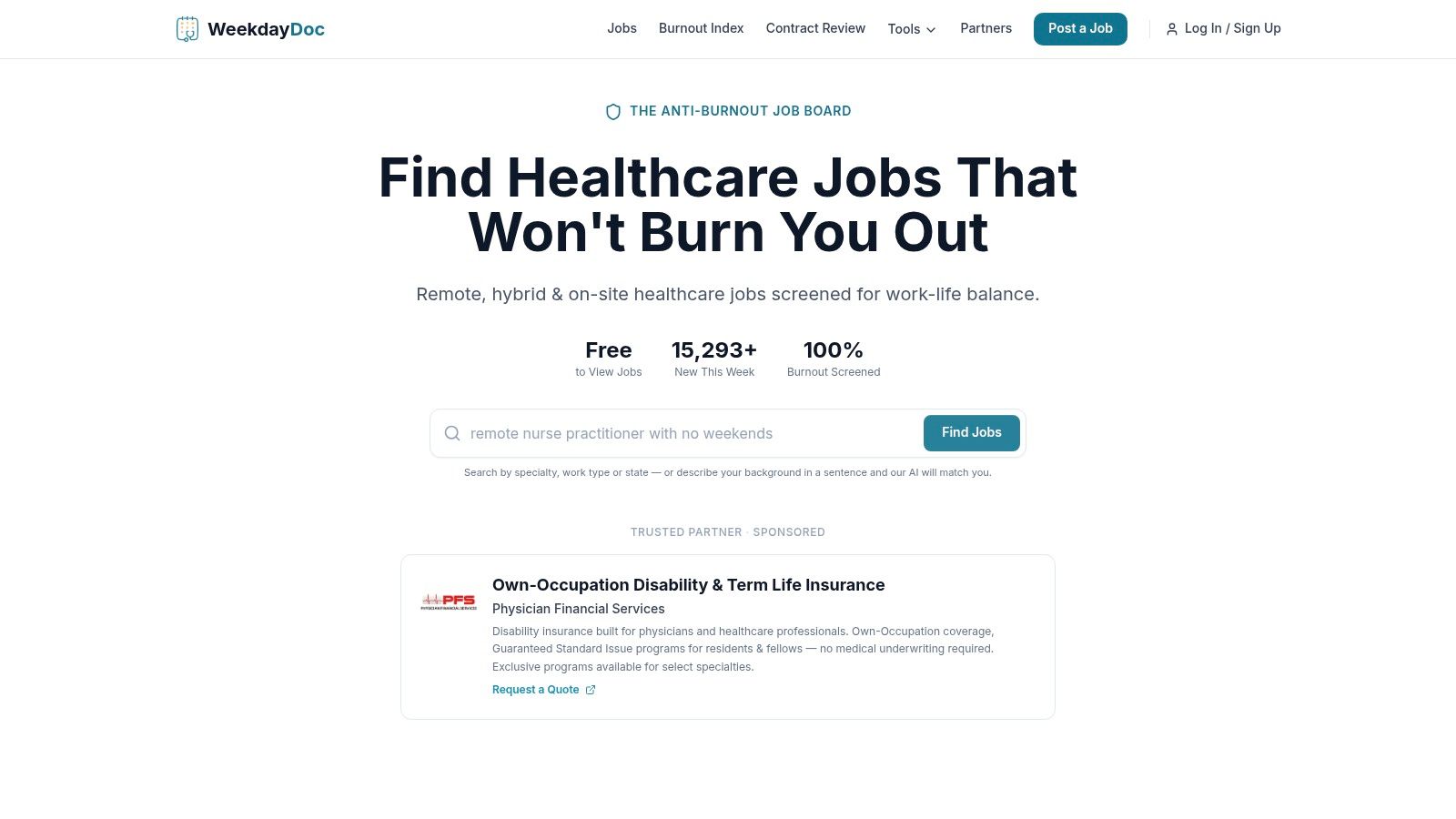
WeekdayDoc is useful at the search stage because its listings use No Call and No Weekends markers, salary context where available, a Burnout-Friendly Score, and financial-planning tools. Browse part-time remote clinician jobs, compare broader salary context through WeekdayDoc's market pages, and use the Salary & FIRE Calculator to test whether fewer clinical hours remain financially workable. Its guide to remote physician jobs also helps separate location flexibility from actual schedule control.
1. WeekdayDoc
WeekdayDoc is most useful when no weekends is a hard boundary rather than a preference. The physician-founded platform focuses on burnout-conscious careers and curates remote, hybrid, and in-person roles with explicit signals for avoiding call, weekend, and overnight work. That gives clinicians a clearer screening layer than a general job board, where “part-time” may describe total hours without specifying which days those hours include.
Its filters cover role, specialty, and work style for MDs, DOs, NPs, PAs, RNs, and psychologists. The dedicated part-time remote jobs page is relevant to clinicians combining weekday work with caregiving, recovery, academic responsibilities, or another clinical position.
Why the platform is useful
Listings may include a proprietary Burnout-Friendly Score, salary information where available, and state-level FIRE projections. Together, these features address schedule quality and financial feasibility, two factors that job boards often leave in separate searches. The platform also offers AI-assisted matching, contract and negotiation guides, and a Burnout Index. Clinician access is free with passwordless sign-in.
The main value is screening, not final verification. A “No Weekends” label can reduce search time, but it does not establish who controls coverage, whether the arrangement is permanent, or how administrative work is assigned.
Practical rule: Treat a “No Weekends” marker as a high-value search signal, then verify the same boundary with the hiring manager and in the agreement.
Where it falls short
Salary data is not available for every listing, and advertised compensation may sit below relevant market context. Results also vary by specialty and location. A platform centered on burnout-conscious roles may produce fewer options for clinicians willing to accept nights or weekends in exchange for higher volume or broader clinical scope.
Administrative responsibility still requires scrutiny. Applicants should ask who handles scheduling, patient messages, prior authorizations, documentation support, and coverage when demand changes. They should also confirm employment classification, credentialing requirements, malpractice coverage, and whether weekday-only availability is written into the contract.
Public employer pages describe access to burnout-conscious candidates, but employer pricing and posting details are not displayed publicly. For clinicians, that makes the individual listing and agreement more important than assuming every role receives identical screening.
Best fit: Clinicians seeking a structured weekday-only search while comparing schedule control, compensation, burnout, and FIRE considerations in one workflow.
Website: WeekdayDoc
2. SteadyMD
SteadyMD suits clinicians who want remote care with a schedule they can shape, though weekday availability still depends on the program and its coverage needs. Its clinician opportunities include MDs, DOs, NPs, PAs, and therapists working across urgent care, primary care, and behavioral health. Flexible hours and remote workflows may make part-time daytime work easier to arrange than a fixed clinic template.
The practical test is schedule control. Selecting available hours does not necessarily mean controlling patient volume or coverage expectations. An urgent-care program may require coverage when demand rises, while behavioral-health work may follow a different onboarding and scheduling process. Ask whether you can decline weekend blocks without losing access to assignments.
SteadyMD describes operational support, training, and a clinician community serving a multi-state workforce. Those resources can reduce the work of building telehealth workflows, but they do not settle the terms of an individual role. Verify state licensing, credentialing, malpractice coverage, employment classification, and whether the position is employee or contractor work.
Income also requires clarification. Confirm whether compensation is hourly, per encounter, or tied to another production model, and ask how cancellations, low-demand periods, and changing partner needs affect pay. Administrative support may cover some workflows, while clinicians may still carry documentation or patient-message responsibilities.
What to verify before accepting
Ask whether the role is permanently part time or whether participation may expand toward full time. Confirm whether submitted availability is binding, whether partner programs can change scheduling rules, and how much notice is provided before coverage needs change. The remote physician career guide can help compare this pathway with other remote options, but the written offer defines the obligation.
Best fit: Clinicians seeking a remote clinical program with operational support and weekday scheduling, provided volume, pay, administrative duties, and weekend exclusions are documented.
Website: SteadyMD clinician opportunities
3. Wheel
Wheel's appeal is its assignment-level flexibility. The telehealth network works with MDs, DOs, NPs, PAs, behavioral-health clinicians, RNs, and registered dietitian nutritionists across partner programs. Rather than tying every clinician to one conventional clinic schedule, it presents care models and assignments that can be matched to a provider's availability.
That structure can support a weekday-only calendar, especially for a clinician who wants part-time work without taking ownership of a full telehealth operation. Wheel also centralizes elements such as credentialing, training, protocols, and virtual-care tools. The administrative benefit is real, but it comes with a trade-off: your workload and income may depend on the needs of individual partners.
The schedule is controlled, but not guaranteed
A clinician can choose availability while still depending on partner demand for case volume. Those are separate forms of control. You may control when you are willing to work, but not how many assignments appear during those hours.
Pay also differs across engagements. Before treating the role as a dependable income stream, ask whether compensation is hourly, per encounter, per case, or tied to another production model. Confirm when payment occurs, whether cancellations are compensated, and whether inactive periods affect your status with the platform.
“Weekday availability” is strongest when the platform records it as a formal constraint, not when a recruiter says the schedule is usually flexible.
Wheel's breadth can be useful for clinicians with multiple licenses or interests spanning medical and behavioral care. It can also make the credentialing process more efficient than approaching each partner independently, although state-specific requirements still belong on the clinician's verification list.
Best fit: Clinicians who value scheduling autonomy and centralized operational support, and who can tolerate variable partner demand.
Website: Wheel clinician network
4. Hims & Hers
Hims & Hers offers a different form of weekday flexibility. Clinicians work in asynchronous and synchronous telehealth across service lines that include dermatology, sexual health, and weight management. The provider careers information emphasizes part-time opportunities and self-set schedules, allowing a clinician to limit availability to weekdays if the operational requirements permit it.
Asynchronous care can reduce the need to sit in a continuously staffed live clinic. That doesn't mean the work is frictionless. Providers still need to review histories, apply protocols, document decisions, manage follow-up expectations, and understand how the platform handles escalation.
The patient-access contradiction
A direct-to-consumer platform may give patients access around the clock while allowing individual clinicians to choose their own working windows. Those facts can coexist, but the service line may still have coverage expectations outside your selected hours. Ask whether “24/7 access” describes the patient experience, the broader clinical operation, or your personal availability obligation.
Protocol-driven care can improve consistency and reduce avoidable administrative variation. It may also constrain clinicians who want broad subspecialty discretion or a highly individualized treatment model. Review escalation rules, prescribing authority, quality review, and the circumstances under which the platform can change workflows.
The financial question is equally important. A flexible part-time schedule isn't meaningful if unpaid review, messaging, or documentation expands beyond the time used to calculate compensation. Request a realistic description of expected case handling and determine whether the pay model recognizes asynchronous work.
Best fit: Clinicians who prefer telehealth, can work within standardized pathways, and want to restrict self-set hours to weekdays.
Website: Hims & Hers provider careers
5. Ro
Ro is relevant for clinicians looking for an explicitly labeled part-time virtual physician role, including both salaried and 1099 openings. Its model combines telehealth with laboratory and pharmacy operations, so the clinical work sits inside a broader care-delivery system rather than an independent video-visit practice.
That integration can simplify the patient journey and give clinicians a defined operational environment. It can also mean that clinical decisions follow service-line protocols, documentation standards, and team processes. The more integrated the platform, the more important it becomes to understand who owns follow-up, refill questions, lab coordination, and escalations.
Compare classification before comparing pay
A salaried part-time role and a 1099 engagement can both advertise remote flexibility, but they don't create the same financial or administrative experience. Ask about benefits eligibility, taxes, malpractice coverage, paid administrative time, equipment, and the practical effect of maintaining licenses across states. Don't compare a contractor headline rate directly with an employee salary without accounting for those differences.
Weekday-only work may be possible when clinical availability aligns with team coverage. That phrase deserves close scrutiny. If the team requires coverage during specific windows, your schedule may be constrained even when the job is described as flexible.
Ro's provider postings can open and close frequently, so candidates should verify that the role remains active and that the responsibilities in the interview match the current posting. Also ask whether the organization can change service lines, protocols, or minimum availability after onboarding.
Best fit: Physicians who want a clearly designated virtual role and are prepared to evaluate employment classification, team coverage, and protocol intensity.
Website: Ro careers
6. RubiconMD
RubiconMD is the clearest fit for a specialist who wants asynchronous, weekday-only clinical work without live visits. Its eConsult platform connects primary-care teams with specialists who answer clinical questions when they have availability. The work is consultative rather than longitudinal, which changes both the schedule and the professional trade-off.
Cases are described as taking around 10 minutes each, a figure presented in the platform's specialist materials. The short-case format can make it easier to work in defined weekday blocks, but it shouldn't be treated as a guaranteed hourly equivalent. If consult volume varies, the clinician's available time may not translate into predictable income.
The administrative trade-off
Compared with clinic-based care, asynchronous eConsulting can reduce room turnover, live scheduling, and some patient-facing overhead. It still requires careful record review, clear recommendations, appropriate limitations, and attention to the boundaries of specialist responsibility. Ask who handles patient communication, whether the requesting clinician remains responsible for implementation, and how urgent cases are screened.
The role also changes the kind of professional satisfaction available. Specialists who want longitudinal relationships won't find them here. A clinician who enjoys focused diagnostic reasoning and concise recommendations may find the format more sustainable than adding another recurring clinic session.
Credentialing and licensure remain central. Confirm which states are included, whether the platform requires active privileges or payer enrollment, how malpractice applies to recommendations, and whether the arrangement is an independent contractor relationship.
Best fit: Specialists seeking strict control over weekday work, limited live-care obligations, and consultative practice rather than ongoing patient panels.
Website: RubiconMD specialist network
7. Grow Therapy
Grow Therapy suits licensed therapists and prescribers who want to build a weekday-only independent practice schedule while outsourcing much of the administrative workload. Providers work as independent contractors, set their availability, and retain clinical autonomy. Grow handles credentialing, billing, claims management, and provides telehealth and electronic health record infrastructure.
That arrangement gives the clinician direct control over both schedule and panel size. It also shifts economic risk away from a conventional employer and toward the provider. Revenue depends on reimbursement, insurance mix, completed visits, cancellations, documentation time, and the platform's revenue share.
Autonomy does not equal predictable income
Grow advertises free credentialing with major insurers, billing support, weekly direct deposit, and reimbursement protections. Candidates should still confirm the exact net reimbursement by payer and state, the timing of payment adjustments, and the treatment of denied or rescheduled claims. A platform can remove administrative tasks without guaranteeing a specific patient volume.
The 1099 structure also requires a broader comparison than rate per session. Include unpaid documentation, taxes, professional liability coverage, license renewals, continuing education, technology, and nonclinical business time. If the platform controls billing and claims, ask how quickly you can access records and what happens to patients if you leave.
For mental-health clinicians weighing caseload design, WeekdayDoc's telehealth mental-health jobs guide offers a useful comparison point. Clinicians focused on perinatal mental health support may also need to assess whether the platform's referral mix matches their preferred population.
Best fit: Therapists and prescribers who want weekday control, clinical independence, and administrative support, and who can manage variable contractor economics.
Website: Grow Therapy provider opportunities

7-Part-Time, No-Weekend Job Comparison
| Product | Implementation Complexity | Resource Requirements | Expected Outcomes | Ideal Use Cases | Key Advantages |
|---|---|---|---|---|---|
| WeekdayDoc | Low, web-based search; passwordless access | Low time investment; free for clinicians | High alignment with no‑call/no‑weekend roles; large, up‑to‑date inventory | Clinicians prioritizing burnout‑avoidance and long‑term financial planning | Proprietary Burnout‑Friendly Score; Salary & FIRE tools; 100K+ listings |
| SteadyMD | Moderate, company hiring process and onboarding | Requires licensure, remote setup, employer employment | Flexible weekday schedules possible; growing nationwide clinician base | Clinicians seeking employed telehealth (urgent care, primary, behavioral) with schedule control | True schedule control; diverse program mix; clinical ops support |
| Wheel | Moderate, single contract + partner onboarding | Centralized credentialing; remote tech; variable partner demand | High scheduling autonomy; access to multiple partner roles | Clinicians wanting part‑time across specialties with centralized admin | Single contract to many partners; credentialing/training support |
| Hims & Hers | Low–Moderate, join DTC telehealth teams | Protocol‑driven platform; remote tech; national patient base | Flexible self‑set hours possible; steady patient flow if scheduled | Clinicians in dermatology, sexual health, weight management wanting DTC work | Large DTC brand; operational/quality systems; consistent patient volume |
| Ro | Moderate, role‑specific hiring (salaried or 1099) | Remote setup; coordination with team coverage for schedules | Labeled part‑time roles available; integrated care platform supports workflows | Physicians seeking explicitly posted part‑time virtual physician roles | Clearly labeled part‑time openings; vertically integrated services (labs/pharmacy) |
| RubiconMD | Low, sign up for asynchronous consults | Minimal time per case (~10 min); specialist expertise | Maximum schedule autonomy; quick, on‑demand consult income | Specialists preferring async consult work without live visits or weekends | No live visits; low admin; work entirely on your schedule |
| Grow Therapy | Low, 1099 contracting with platform onboarding | Requires licensure and telehealth setup; platform handles credentialing/billing | Controlled weekday‑only caseload; predictable admin support and payments | Therapists/prescribers wanting independent part‑time panels with admin handled | Platform handles credentialing/billing; precise availability; weekly pay |
Turn a No-Weekend Preference Into a Contract Check
The labor-market data explains why the wording matters. In 2024, 80% of employed people worked on an average weekday, compared with 30% on an average weekend day, according to the Bureau of Labor Statistics. “No weekends” is therefore a meaningful scheduling distinction, not a minor lifestyle preference.
Part-time work also isn't automatically weekday work. The same BLS release reports that 54.8% of part-time workers worked on an average weekday in 2024, while 35.9% worked on an average weekend day. A separate BLS historical comparison shows that weekend exposure has been a structural feature of part-time work over time. The conclusion is practical: screen for the schedule you need, not the employment label you expect to provide it.
Healthcare deserves extra caution. BLS analysis reports that 35% of healthcare practitioners and technical workers worked on an average weekend day, compared with 31% of workers in nonhealthcare occupations, and weekend-working healthcare professionals averaged 6.5 hours per weekend day when they worked. Review the BLS healthcare occupation data alongside the job description, particularly if the employer describes weekend work as occasional, shared, or “as needed.”
Use this verification sequence before accepting any of the roles above:
- Exact weekday hours: Get the permitted days and time windows in writing.
- Availability control: Ask whether you set availability or whether a manager, partner, or coverage grid can override it.
- Part-time permanence: Confirm whether reduced hours are permanent, seasonal, probationary, or subject to conversion.
- Employment classification: Distinguish employee, salaried part-time, and 1099 terms before comparing compensation.
- Pay model: Identify salary, hourly pay, per-visit, per-case, productivity, revenue share, and payment timing.
- Volume assumptions: Ask what patient, case, or consult volume the compensation model assumes.
- Call and holidays: Look for after-hours messages, holiday coverage, backup obligations, and escalation language.
- Credentialing duties: Clarify who pays for licenses, payer enrollment, privileging, background checks, and renewals.
- Termination terms: Review notice requirements, patient transition duties, restrictive language, and access to records.
Academic clinicians should be especially precise. The AAMC physician workforce methods define active physicians as licensed doctors working more than 20 hours per week, while the AAMC faculty report found no standard definition of part-time faculty. That report notes that 45% of institutions define part time as less than 100% FTE, while 37% define it as 50% to 90% FTE. Your institution's definition may affect benefits, promotion, clinical expectations, and eligibility for internal roles.
Finally, compare gross compensation with administrative time and benefits, not just the headline rate. Save searches using WeekdayDoc's No Weekends and No Call filters, review salary and market context on /market-pulse, use the /rvu-calculator or /salary-calculator-pro when the compensation model calls for it, and run the agreement through the /tools/contract-scanner. A sustainable schedule is strongest when the listing, the manager, and the written agreement all describe the same weekday boundary.
WeekdayDoc helps clinicians find burnout-friendly remote, hybrid, and in-person roles with clear No Call and No Weekends markers, salary context, and planning tools. Visit WeekdayDoc to search part-time clinician jobs by schedule control, then verify that the weekday boundary survives the interview and contract review.