Traveling Therapy Jobs: Your Guide to Sustainable Careers
Explore traveling therapy jobs for PTs, OTs & SLPs. Our 2026 guide covers pay, taxes, licensure & finding burnout-friendly roles with no call or weekends.

You finish a full day of patient care, then stay late to clear documentation. Your phone lights up with another staffing request, a family text you haven’t answered, and tomorrow’s schedule already looks overbooked. If you’re a PT, OT, or SLP, that kind of fatigue isn’t dramatic. It’s routine.
A lot of clinicians start looking at traveling therapy jobs when they hit that wall. Not because they suddenly want an airport lifestyle, but because they want more control. They want a way to stop accepting every bad schedule, every unrealistic productivity target, and every “we just need you to help out on weekends for now” promise that somehow becomes permanent.
Travel therapy can give you that advantage. Used well, it’s not an escape hatch. It’s a career design tool.
Rethinking Your Career with Travel Therapy
The colleague I worry about most isn’t the one who complains loudly. It’s the one who says, “I’m fine,” while charting through lunch and dreading Monday by Sunday morning. That clinician usually isn’t lazy, fragile, or uncommitted. They’re overextended, under-supported, and stuck in a role that keeps asking for more.
That’s where traveling therapy jobs can change the conversation. A short-term assignment lets you test a setting, a city, a team, and a schedule without signing away the next several years of your life. It gives you a defined end date. Burned-out clinicians need that more than they realize.

The market is strong enough to make that move realistic. The Fusion MedStaff therapy market overview notes that the U.S. Bureau of Labor Statistics projects PT jobs to grow 18 percent, OT jobs 16 percent, and SLP jobs 25 percent from 2019 to 2029, and that experienced travel therapists typically see weekly net pay from $1,900 to $2,200, with some roles reaching $3,000.
Why this matters to a burned-out clinician
Those numbers matter, but the bigger point is control.
A permanent job often traps you in one culture, one manager, one flawed staffing model. Travel work gives you repeated decision points. After each contract, you can ask:
- Did this setting fit me: outpatient, SNF, school, hospital, or home health?
- Did this team support clinicians well: or did they just cycle through travelers?
- Did the schedule protect my life: or did the “flexibility” only benefit the employer?
Practical rule: Don’t treat travel therapy as a rescue fantasy. Treat it as a series of controlled experiments that help you build a career you can actually tolerate long term.
Travel isn’t only about adventure
The social media version of travel therapy is all sunsets, scrubs, and scenic hikes. Real travel work is less glamorous and more useful. It can help you rebuild your finances, learn what kind of caseload you want, and stop tying your identity to one employer’s dysfunction.
That’s the mindset shift. You’re not running away. You’re getting strategic.
How Traveling Therapy Jobs Actually Work
Travel therapists fill a staffing gap for a defined period. A clinic, school, hospital, SNF, or home health team needs coverage fast. An agency recruits and submits candidates, the facility chooses who it wants, and the therapist comes in to keep patient care running during turnover, leave, seasonal volume, or a hard-to-fill vacancy.
That sounds simple. The day-to-day mechanics are not.
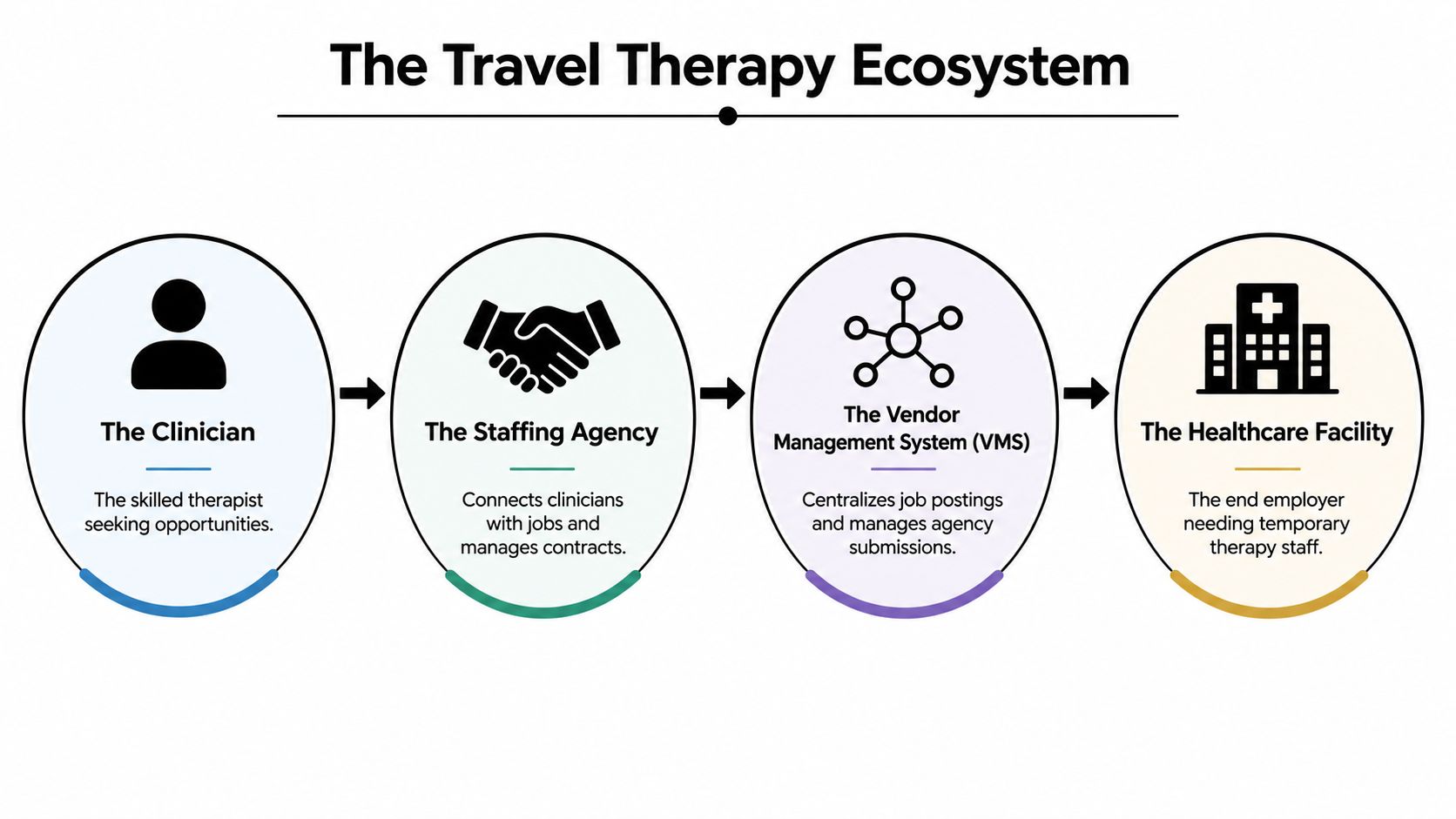
The four players in the system
Travel therapy works like a labor chain. Once you understand who controls what, contracts make a lot more sense.
You, the clinician
You are the skill set the facility is buying for a short window. That means more than a license. It means walking into a new building, picking up the workflow quickly, managing a live caseload, and staying clinically sound without weeks of training.
The staffing agency
The agency recruits you, presents openings, submits your profile, handles much of the paperwork, and negotiates pay and contract terms. A strong recruiter can save you time. A weak recruiter can waste a month and still not tell you whether the role includes weekends.
The VMS or MSP layer
Many facilities use a vendor management system or managed service provider to control submissions. That middle layer often slows communication and limits how much detail you get early. It also explains why five recruiters can contact you about what looks like the same job.
The healthcare facility
The facility is the part that matters most once you start. It sets productivity, scheduling, orientation, documentation expectations, and coverage rules. If you care about burnout prevention, the crucial negotiation pertains to these elements.
What an assignment usually looks like
A travel assignment is usually a short contract built around an immediate operational need. The common term is 13 weeks, but the number matters less than the reason the job exists. Some contracts cover a maternity leave. Some patch over chronic turnover. Some are trial balloons while a department decides whether it can recruit permanent staff.
Settings vary, but the work pattern changes with the environment:
- Outpatient clinics: faster pace, direct scheduling pressure, and less patience for a slow ramp-up
- Skilled nursing facilities: heavy documentation, shifting census, and productivity pressure that needs close review before signing
- Hospitals: more onboarding steps, broader medical complexity, and greater dependence on interdisciplinary flow
- Schools: more predictable calendars, but organization varies a lot by district
- Home health: more autonomy, but territory size, point-of-care charting, and drive-time expectations can make the role sustainable or miserable
The smarter question is not just what setting the job is in. Ask how the department runs, who covers gaps, and what happens when staffing gets thin.
Where the system creates burnout
New travelers often expect the hard part to be patient care. More often, the friction comes from operations.
Every assignment brings a new EMR, new badge access rules, new competencies, and a different rehab manager. One site closes notes by end of day. Another tolerates a lag but expects higher productivity. One team protects lunch and treats travelers like clinicians. Another treats the traveler as the default person for every late eval, weekend need, or coverage hole.
This is why schedule questions matter so much. Burned-out therapists do well in travel when they stop treating weekends and call coverage as minor details. Those terms shape recovery time, family life, and whether a contract is merely busy or proves draining.
How control is distributed
A lot of clinicians give the recruiter too much authority in their head. Recruiters matter, but they do not control the building.
Use this rule:
- The recruiter can present and negotiate
- The facility can define schedule and workflow
- You can accept, decline, extend, or walk away before signing
That last point is the career-saving one. Travel work gives repeated chances to choose better conditions, but only if you ask direct questions early.
Ask about:
- Weekend rotation
- On-call expectations
- Productivity targets
- Average daily caseload
- Who covers evals, admits, and same-day add-ons
- How much orientation a traveler gets
- Why the previous traveler left, if there was one
If a recruiter cannot get those answers, treat that as information.
What experienced travelers do differently
The clinicians who last in travel usually treat each contract like a business decision, not a rescue plan. They keep licenses, compliance records, references, and onboarding documents organized. They save their own workflow tools. They read the cancellation terms. They ask for the schedule in writing.
They also get specific about burnout limits. If your goal is career sustainability, say so plainly. Ask for weekday-only roles. Ask whether weekends are optional, rotating, or built into the base expectation. Ask who takes call. A surprising number of bad assignments can be filtered out before submission if you stop sounding flexible about conditions that wear you down.
Travel work can give you more room to breathe, but only when you understand who holds the pressure points and you negotiate from there.
The Pros and Cons of the Travel Therapist Lifestyle
Travel therapy is one of the few ways to change your job without changing your profession. That’s the appeal. You keep using your clinical training, but you stop accepting the idea that one employer gets unlimited access to your time and energy.
Still, a lot of clinicians idealize the lifestyle and get blindsided by the day-to-day reality. The right question isn’t “Is travel therapy good?” The right question is “Which trade-offs can I live with?”
What travel does well
Traveling therapy jobs can create breathing room that permanent jobs often don’t. The contract has an endpoint, which means bad situations aren’t forever. You can also use assignments to test settings before committing long term.
The upside often looks like this:
- Greater influence: you can decline future contracts that don’t fit
- Broader clinical range: you learn how different teams handle similar problems
- Planned time off: breaks between contracts are easier to design intentionally
- Faster clarity: you figure out quickly what environment drains you and what environment doesn’t
For some clinicians, travel also rebuilds confidence. A therapist who feels boxed in at one dysfunctional workplace may perform very well in a different system.
What travel does poorly
Travel work also strips away a lot of comfort. You may lose the predictability of familiar coworkers, a known EMR, and routines that took years to build. If you need stable mentorship, deep team relationships, or highly structured onboarding, travel can feel lonely and exposed.
The hard parts usually hit in less glamorous ways:
- You’re repeatedly “the new person”
- Credentialing never seems fully over
- Facility promises may sound better before arrival than after
- Clinical isolation can be real, especially in thinly staffed departments
Some clinicians aren’t burned out from patient care. They’re burned out from constant uncertainty. Travel can improve that, or amplify it, depending on how you choose assignments.
Weighing the Travel Therapy Lifestyle
| Pros | Cons |
|---|---|
| Defined contract end dates create a built-in exit strategy | Frequent transitions can feel destabilizing |
| Exposure to multiple settings sharpens adaptability | Every assignment comes with new onboarding and paperwork |
| Easier to reject bad-fit environments after a contract ends | Recruiter descriptions don’t always match facility reality |
| Time between contracts can be used for rest or relocation | Gaps between assignments require planning |
| You can shape your career around preferred settings and locations | Housing, licensure, and logistics add mental load |
| New environments can restore motivation | Support and mentorship may be inconsistent |
A useful self-check
Travel therapy tends to work best for clinicians who can answer yes to most of these:
- Can you tolerate ambiguity: not every detail will be perfect before you start
- Can you build rapport quickly: patients and teams will judge fit fast
- Can you work without extensive orientation: many buildings need productivity early
- Can you separate inconvenience from danger: some assignments are merely messy, others are unacceptable
If that list makes you feel relieved, travel may suit you.
If it makes you tired just reading it, that’s useful information too.
The real goal isn’t movement
The smartest travelers I’ve known weren’t chasing novelty. They were using mobility to protect themselves from staying too long in the wrong place. That’s a very different posture from “I just want adventure.”
Adventure fades. Structure matters. So do weekends, call expectations, patient load, and manager behavior.
That’s why the lifestyle question has to be grounded in your actual nervous system, not your Instagram feed.
Decoding Pay Packages Housing and Taxes
A contract can advertise a strong weekly number and still leave you with a worse real-life setup. I have seen clinicians take the higher pay, then realize the taxable base was thin, the housing option was inflexible, and the schedule came with weekend coverage they did not factor into the decision.
That is how people stay burned out while telling themselves they got a better deal.

Understanding your compensation
Travel pay is usually a mix of taxable hourly wages and non-taxed stipends for housing, meals, and incidentals if you qualify. Recruiters often present the weekly take-home first. That is useful, but it is not enough.
Ask for the full breakdown in writing:
- Taxable rate
- Housing stipend
- Meals and incidentals stipend
- Any bonuses
- Travel reimbursement
- Guaranteed hours
- Holiday, weekend, or call expectations tied to the rate
That last point matters more than many clinicians realize. A job paying a bit less for five clean weekday shifts can be the better financial move if it protects your recovery time and keeps you from relying on overtime to make the package feel worth it.
Tax rules can make or break the deal
The biggest mistake I see is casual thinking about the tax home.
If you are receiving tax-free stipends, your living situation needs to meet IRS rules for a legitimate home base. If it does not, those stipends may not stay tax free. That can turn an attractive contract into an expensive problem later.
Do not let a recruiter, Facebook group, or coworker make that call for you. Use a tax professional who understands travel healthcare work. The small cost of good advice is usually cheaper than cleaning up a preventable tax issue.
Housing affects burnout more than people expect
Housing is not just a line item. It shapes sleep, commute time, privacy, and whether the assignment feels tolerable by week six.
Agency housing can reduce setup work. That can be a relief during a heavy season of life. The trade-off is control. You may get a longer commute, a less convenient neighborhood, or housing that looks fine on paper but wears on you in practice.
Taking the stipend gives you more choice. It also gives you more work. You have to screen listings, read lease terms, confirm parking, ask about noise, and make sure the place is safe and realistic for your contract length.
A few options tend to come up repeatedly:
- Agency-arranged housing: lower planning burden, less flexibility
- Stipend and self-booking: more control, more responsibility
- Shared housing: lower cost if schedules, cleanliness, and boundaries match
- Corporate housing: furnished and simple, often a good middle ground
If you want a starting point for furnished short-term rentals, guides on safe corporate housing for nurses can still be useful for therapists who want temporary housing with fewer surprises.
Ask one practical question early. “Can I switch from agency housing to stipend, or the other way around, before signing?” Sometimes the answer is yes. Sometimes it is not.
Similar jobs can produce very different take-home value
Two contracts in the same city and setting can look nearly identical at first glance and still pay differently. Part of that comes from how the job moved through the staffing chain before it reached you. More layers can mean less room in the package.
That is why it helps to compare the same assignment through more than one recruiter when possible. It also helps to compare more than pay. One agency may have cleaner cancellation terms or better benefits timing, which matters if you are using travel work to build a sustainable routine rather than chasing the highest number every 13 weeks.
Review the offer like a clinician, not a shopper
The best contract is the one that holds up under real life. Weekly pay matters. So do the parts that determine whether the assignment drains you.
I would review these items every time:
- Exact pay breakdown: taxable pay, stipends, reimbursements, and any vague wording
- Guaranteed hours: what happens if visits drop or census falls
- Schedule details: weekends, call, rotating shifts, late stays, holiday coverage
- Cancellation terms: how quickly the facility or agency can end the contract
- Benefits timing: when insurance starts and what happens between assignments
- Housing control: who signs, who can change placement details, who pays if plans shift
For clinicians trying to avoid another overbuilt schedule, the schedule line deserves the same scrutiny as the pay line. If you want weekday-only work, say that early and get it written into the offer whenever possible. Verbal reassurance does not protect your Saturdays.
A structured checklist helps. This guide on how to evaluate job offers is useful for comparing compensation, schedule terms, and risk in one place.
A quick explainer can help if you’re new to the language around travel pay packages:
What experienced travelers learn
The strongest travelers stop focusing on the flashiest advertised rate. They start protecting predictability.
A clean weekday schedule, solid guaranteed hours, workable housing, and a contract with fewer surprises will often do more for your finances and your nervous system than a bigger number attached to call, weekends, or unstable terms. That is the version of travel therapy that tends to last.
How to Find and Evaluate Travel Therapy Assignments
Finding a solid assignment is less about scrolling endlessly and more about filtering aggressively. Good travelers don’t apply blindly. They build a process.
That process starts before you ever talk to a recruiter.
Start with licenses and geographic strategy
If you want flexibility, licensure has to be handled early. Delays here can cost you a start date or push you toward a weaker assignment because it’s the only one available when your paperwork clears.
After that, look at where demand is concentrated. The Travel Therapy Mentor January 2026 market update states that California, Washington, and Massachusetts lead in travel job volume as of January 2026. It also notes that outpatient orthopedic clinics are the highest-demand setting for PTs with the strongest base salaries, and that school-based settings are often the most accessible path for new SLPs because of supervision requirements.
That tells you something important. Search strategy should match your discipline and stage of career.
Don’t shop for agencies. Shop for recruiter behavior.
A recruiter doesn’t need to be charming. They need to be accurate, responsive, and willing to answer hard questions without getting slippery.
Good signs include:
- They send the pay breakdown in writing
- They answer questions directly instead of redirecting
- They admit when they don’t know something
- They don’t pressure you to sign before the details are clear
Bad signs are easier to miss because they’re often framed as urgency.
Watch for this:
- “This will close in an hour, just trust me”
- Vague answers about productivity or weekend coverage
- No clarity on who supervises the rehab team
- A contract summary that doesn’t match the verbal pitch
If a recruiter gets impatient when you ask basic contract questions, imagine how helpful they’ll be when something goes wrong after you arrive.
Questions that reveal the real job
The interview with the facility matters as much as the agency conversation. It reveals whether the assignment is merely busy or completely unsustainable.
Ask things like:
How many patients are expected per day
You want specifics, not “it depends.”
What are the productivity expectations
A number isn’t enough by itself. Ask how it’s tracked and how rigidly it’s enforced.
Who else is on the rehab team
A solo therapist setup feels very different from a staffed department with a lead therapist.
What does orientation include
“We’ll get you up to speed” is not an answer.
Are weekends required, rotated, or optional
Don’t leave this implied.
Is there call
If yes, how often, and is it written into the contract?
Use tools that help you read contracts faster
A lot of assignment quality comes down to what’s buried in the actual paperwork. That includes cancellation language, float expectations, schedule wording, and guaranteed hours. If you want help catching red flags faster, a tool like the WeekdayDoc contract scanner can help review job details more systematically.
Match the assignment to your actual goal
Not every travel job should serve the same purpose. One assignment may be about rebuilding savings. Another may be about getting out of weekends for a few months. Another may be about testing whether schools, outpatient, or home health fit you better.
That’s why I’d separate assignments into three buckets:
| Assignment goal | What to prioritize |
|---|---|
| Recovery from burnout | Schedule, no-call expectations, team support, manageable ramp-up |
| Skill building | Caseload variety, mentorship access, setting exposure |
| Financial focus | Clean pay package, housing flexibility, stable guaranteed hours |
The clinicians who do best in traveling therapy jobs are usually the ones who know which bucket they’re in before they start applying.
Securing a Burnout-Friendly Role with WeekdayDoc
Most travel job boards sell the same dream. High pay. New city. Adventure. Fast start. That’s fine as far as it goes, but it leaves out the details that determine whether you’ll still like your life two weeks into the assignment.
That gap matters because schedule structure drives burnout more than most recruiters acknowledge.
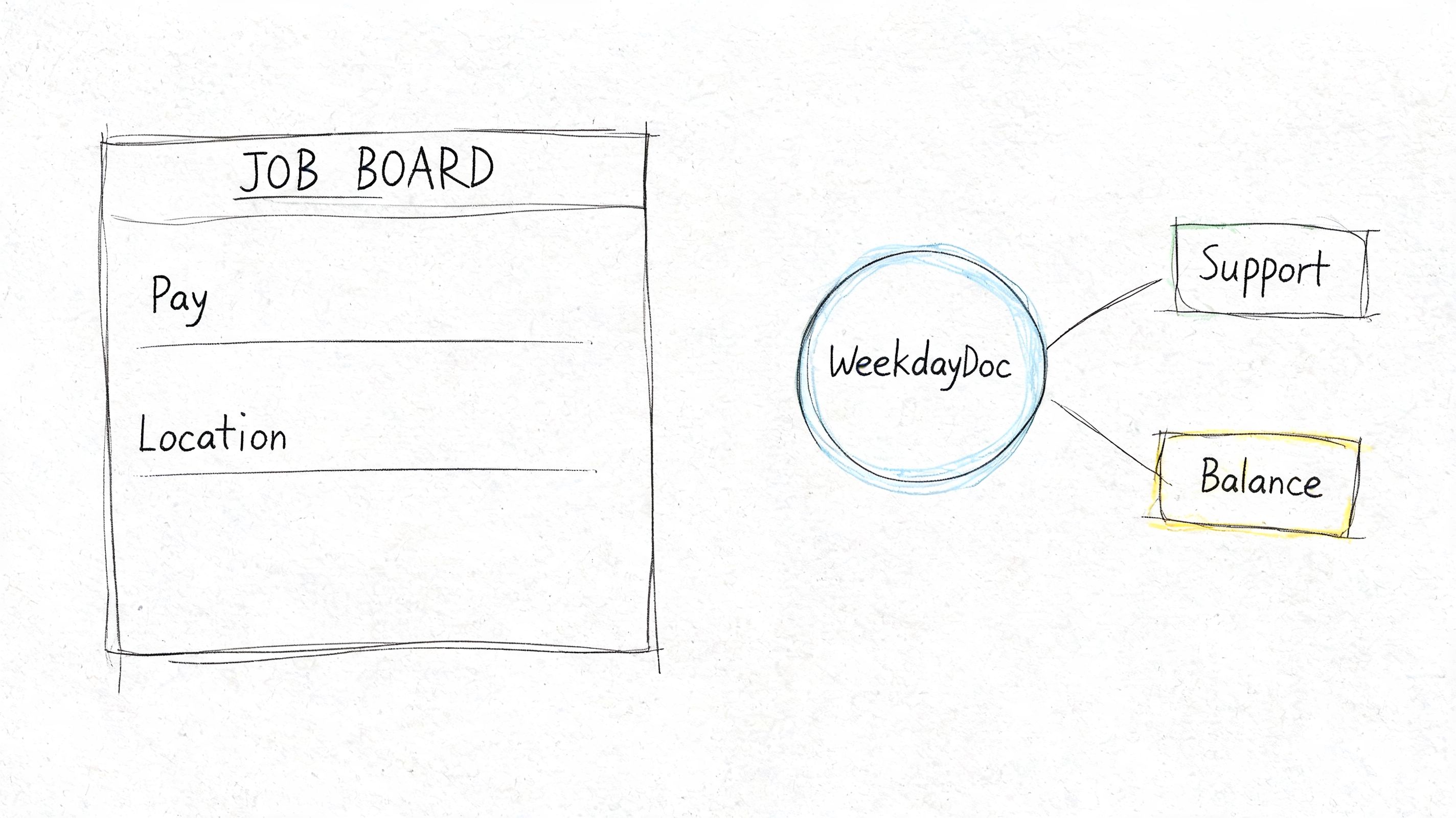
The Vivian travel therapy market page highlights a problem many clinicians already feel. Major travel platforms such as Soliant, Aya Healthcare, and Vivian emphasize pay and location, but don’t provide a standard way to filter for work-life-balance terms like “No Call” or “Weekday Only.” For a therapist trying to build a sustainable career, that omission is huge.
Negotiate the part that actually affects your life
If you only negotiate compensation, you’re leaving the hardest part untouched.
For burnout-conscious clinicians, the key contract terms are often:
- No mandatory call
- No required weekends
- Guaranteed hours
- Realistic productivity
- Clarity on start and end times
- No surprise floating to unrelated settings
A lot of therapists feel awkward asking for these because they assume it makes them look difficult. It doesn’t. It makes you clear.
Try language like this:
I’m interested in the role, but I’m only considering assignments with weekday-only scheduling and no mandatory call. If the facility can support that, send me the updated terms in writing.
That one sentence does a lot. It narrows the field fast. It also tells the recruiter you’re not evaluating the job on pay alone.
What usually fails in these negotiations
Clinicians often lose their advantage by asking broad lifestyle questions instead of contract questions.
Less useful:
- “Is the schedule pretty balanced?”
- “Would you say the team cares about work-life balance?”
More useful:
- “How many weekends are required in a contract cycle?”
- “Is call mandatory, rotated, or absent?”
- “Are hours guaranteed in writing?”
- “What productivity standard is used for this role?”
The first set invites marketing language. The second set forces specifics.
Use a platform that surfaces those terms
A tool built around burnout-related filters is more useful than a generic board. WeekdayDoc’s burnout-friendly job listings are designed around work-life details such as call, weekends, and schedule structure, rather than only specialty and location. For clinicians screening traveling therapy jobs with sustainability in mind, that’s a more practical starting point than sorting by compensation alone.
The better long-term play
A sustainable travel career usually doesn’t come from finding one perfect assignment. It comes from getting better at rejecting bad-fit terms early.
That means:
- Refusing vague schedule language
- Asking about weekends before the interview ends
- Requiring written confirmation for no-call terms
- Walking away when “flexibility” means employer-only flexibility
Burnout-proof isn’t a label. It’s a set of boundaries backed by contract language.
If you want travel therapy to help your career instead of draining it in a new zip code, this is the part to get serious about.
Your Travel Therapy Questions Answered
Can you travel with a partner, kids, or pets
Yes, but the housing question gets more important. A studio that works for one clinician may be miserable for two adults, a child, or a dog with separation anxiety. Before accepting the assignment, confirm pet rules, commute reality, laundry access, parking, and whether the space is livable for your household.
For couples, the primary challenge is schedule alignment. If one person works weekends or variable shifts, the housing setup needs to support recovery, not just sleep.
What happens if you need to cancel a contract early
It depends on the contract language and the situation. Read the cancellation terms before signing, not after there’s a problem. You need to know what notice is required, whether housing gets affected, and how your agency handles early exits.
From a career standpoint, one early cancellation usually isn’t fatal if you communicate clearly and have a legitimate reason. Repeated abrupt exits are different. They make recruiters and facilities nervous because travelers are hired to reduce disruption, not create more of it.
How much experience should you have before starting
Enough to work with limited orientation and make safe decisions under pressure. That threshold differs by discipline, setting, and personality. Some clinicians are ready early because they adapt quickly and ask good questions. Others benefit from more time in one environment before taking on constant transitions.
If you still need frequent reassurance on routine workflow, travel may feel harder than it needs to.
Are traveling therapy jobs good for burnout recovery
They can be, but only when the assignment is chosen strategically. A new city won’t fix an old problem if the contract still includes poor support, weekends you didn’t want, or a productivity model that burns you out in a different building.
The recovery version of travel therapy usually looks less glamorous than people expect. It’s often a simpler assignment, a cleaner schedule, and a setting that doesn’t follow you home every night.
What should you keep organized before your first assignment
Keep your licenses, certifications, vaccination records, references, onboarding documents, and contract copies in one place you can access quickly. Travel becomes much easier when you stop rebuilding your admin life from scratch every few months.
A calm traveler usually isn’t dealing with less complexity. They’re just better organized.
If you’re screening roles with schedule boundaries in mind, WeekdayDoc is a practical place to start. You can review burnout-conscious listings, compare work-life details like no-call and no-weekend terms, and use the platform’s tools to think through whether a role supports both your income goals and your actual life.