Your Guide to Becoming a Locum Tenens Provider
Explore a career as a locum tenens provider. This guide covers the benefits, financial realities, and how to find flexible roles that prevent burnout.

A locum tenens provider is a physician or advanced practice clinician who steps in to fill temporary staffing gaps at hospitals, clinics, and other healthcare facilities. Think of it as being a highly skilled, on-demand specialist for patient care.
What Is a Locum Tenens Provider?

The term locum tenens literally means "to hold a place" in Latin. Instead of being a permanent employee tied to one facility, you travel to different locations for assignments that can last anywhere from a few days to over a year.
This model is a powerful solution for both sides of the healthcare equation. For facilities, it’s a lifeline that ensures continuity of care during staff shortages, seasonal demand spikes, or while they recruit for permanent roles.
A Growing Trend in Modern Medicine
For clinicians, locum tenens work represents a massive shift toward greater autonomy and career control. It's an increasingly popular path for physicians, nurse practitioners (NPs), physician assistants (PAs), and psychologists who are looking for an alternative to the rigid structures of a traditional medical career.
This demand for flexibility has fueled incredible growth. The global locum tenens market is exploding, projected to grow from USD 9.50 billion in 2024 to a staggering USD 19.74 billion by 2034. This boom is driven by an aging population and rising rates of chronic disease, creating a constant need for skilled clinicians.
To give you a clearer picture, here’s a quick comparison of what it means to be a locum tenens provider versus a permanent one.
Locum Tenens Provider At a Glance
| Aspect | Locum Tenens Provider | Permanent Provider |
|---|---|---|
| Employment Status | Independent Contractor (1099) | Employee (W-2) |
| Commitment | Short-term assignments (days to months) | Long-term, indefinite employment |
| Schedule | You choose when and where to work | Fixed schedule set by the employer |
| Compensation | Typically a higher hourly rate | Salaried position with benefits |
| Benefits & Insurance | You manage your own (health, retirement) | Employer-sponsored benefits package |
| Practice Setting | Varies by assignment (urban, rural, etc.) | One primary location and facility |
This table highlights the core trade-offs. While you gain immense flexibility as a locum, you also take on responsibilities typically handled by an employer.
Why Clinicians Choose This Path
The reasons for going locum are as diverse as the clinicians themselves, but a common thread is the search for a healthier relationship with medicine. For many, it's a practical escape route from the administrative overload and frustrating hospital politics that lead to burnout.
By taking the reins of their own schedule, providers can finally design a career that fits their life, not the other way around.
This career path is more than just temporary work; it's a strategic choice for clinicians aiming to balance professional fulfillment with personal well-being. It empowers you to practice medicine on your own terms.
Here are some of the key motivators we hear about most often:
- Greater Schedule Control: You decide when you work and when you don’t. This makes it far easier to take that extended vacation, pursue a side project, or just be more present for your family.
- Higher Earning Potential: Locum assignments often pay a higher hourly or daily rate to compensate for the lack of traditional benefits like paid time off and retirement plans.
- Exploring Different Settings: You can "test drive" all kinds of practice environments—from a small rural clinic to a major urban trauma center—before deciding where you want to put down roots.
- Avoiding Burnout: The ability to intentionally choose assignments with no call, no nights, and no weekends is a huge draw for clinicians seeking a sustainable, long-term career in medicine.
If you're looking for more ways to build a career that truly works for you, check out our collection of clinician guides.
The Real Pros and Cons of Locum Tenens Work

So, is the locum life right for you? It's a question that requires a hard, honest look at the trade-offs. This career path offers an incredible degree of freedom and earning potential, but it's fundamentally different from a traditional, salaried job.
Let's get past the shiny brochure promises and dig into what it’s really like—the good, the bad, and the paperwork. Knowing both sides of the coin is the only way to decide if this path aligns with your career goals and, more importantly, your well-being.
The Clear Advantages of Locum Tenens
For most clinicians, the biggest draw is the sheer control you gain over your life and career. As an independent contractor, you're essentially the CEO of your own one-person medical practice. That opens up a whole new world.
Here are some of the most compelling benefits:
- Significant Earning Potential: Locum assignments almost always pay a higher hourly or daily rate than comparable salaried roles. This premium is designed to compensate for the lack of employer-paid benefits and reward you for your expertise and adaptability.
- Ultimate Schedule Flexibility: You own your calendar. Want to take a six-week trip to Italy? Go for it. Need to block off every Friday for personal projects? You can. This is about designing a work life that fits you, not the other way around.
- Career Exploration: Think of it as "test-driving" a job. Locum tenens work lets you experience different practice settings—from a fast-paced urban hospital to a small rural clinic—and explore new cities before you even think about putting down roots.
- Sidestepping Hospital Politics: As a temporary provider, you're blessedly insulated from most of the administrative red tape, endless committee meetings, and internal drama that can drain the life out of you in a permanent role. Your job is to show up and care for patients. Period.
This kind of autonomy is resonating deeply with clinicians. In 2024, the demand for locum providers skyrocketed, filling a record 16.4% of physician searches and 8.1% of advanced practice provider (APP) searches in the U.S. There are now roughly 52,000 physicians taking locum assignments each year, and many report higher morale simply because they've escaped rigid, unforgiving schedules. You can read the full research on locum tenens trends to see how the industry is shifting.
Weighing Your Options: Locum Tenens vs. Permanent Roles
The decision often comes down to what you value most at this stage in your career: stability and predictability, or autonomy and flexibility? There's no right answer, but this table breaks down the core differences.
| Factor | Locum Tenens Provider | Permanent Provider |
|---|---|---|
| Schedule | You set your own hours, block off vacation time, and choose when to work. | Fixed schedule (e.g., M-F, 9-5) with a set number of PTO days. |
| Income | Higher hourly/daily rate, but income can be variable between assignments. | Stable, predictable annual salary with regular paychecks. |
| Benefits | You are responsible for your own health insurance, retirement (e.g., SEP IRA), and disability. | Employer-sponsored benefits package (health, dental, vision, 401(k) match). |
| Taxes | You're an independent contractor (1099), responsible for quarterly estimated taxes and self-employment tax. | W-2 employee with taxes automatically withheld from each paycheck. |
| Administrative Work | You manage your own licensing, credentialing, and malpractice insurance (though agencies help). | The employer's administrative staff handles most of this for you. |
| Career Path | Gain diverse experience across many settings, but no built-in path for advancement (e.g., Medical Director). | Clear path for promotions, leadership roles, and tenure within one organization. |
| Workplace Culture | You remain outside of long-term team dynamics and hospital politics. | You are an integrated part of a team and participate in workplace culture. |
| Job Security | Security comes from your skills and the availability of assignments. You can be let go with short notice. | More traditional job security with employment contracts and severance policies. |
Ultimately, choosing between locum and permanent work is about aligning your career with your lifestyle priorities. Each path offers a different set of rewards and responsibilities.
The Practical Challenges to Consider
While the freedom is fantastic, being a successful locum tenens provider means you have to get comfortable wearing a few different hats. You're no longer just a clinician; you're also a business owner.
These responsibilities aren't deal-breakers, but you absolutely have to plan for them.
Being a successful locum provider means embracing an entrepreneurial mindset. You are not just a clinician; you are a business owner responsible for your own benefits, licensing, and professional continuity.
You’ll need to be prepared to tackle these realities head-on:
- Managing Inconsistent Work: Gaps between assignments happen. A good staffing agency will work to minimize downtime, but it's on you to have a financial buffer to stay comfortable during those periods.
- Administrative Legwork: Maintaining licenses in multiple states is a beast. It means a ton of paperwork and keeping track of different renewal deadlines. (Thankfully, there are services that can help manage this).
- Handling Your Own Benefits: You're in charge of finding and funding your own health insurance, disability coverage, and retirement plan. It takes some research, but the upside is you get to pick plans that are a perfect match for your needs.
- Constant Adaptation: Every assignment is a new adventure. That means a new EMR system to learn, a new set of colleagues to work with, and a totally different clinic workflow. This job requires you to be a quick study and highly adaptable.
The choice to go locum is a personal one. It's a direct trade-off: you swap the stability and built-in structure of a permanent job for the freedom and accountability that comes with being your own boss. By weighing these pros and cons honestly, you can figure out if this dynamic career is the right fit for you.
Understanding Your Pay, Contracts, and Finances
When you go locum tenens, you’re not just a clinician anymore—you’re the CEO of your own medical practice. The clinical work is familiar, but the business side of things is a whole new world. Getting a firm grip on how you’re paid, what your contract actually says, and how to manage your money as an independent contractor isn't just a good idea; it's essential for success.
This financial freedom is a huge part of the appeal. You trade a fixed salary for direct control over your income. But with that control comes the responsibility to manage it well. Let's break down the key pieces you need to nail down.
Decoding Your Compensation
Locum pay structures can feel a little more complex than a standard salary because they’re built for flexibility. Your rate can swing pretty dramatically based on your specialty, where the assignment is, and just how badly they need someone.
You’ll typically see a few common pay models:
- Hourly Rate: The most straightforward model. You get paid a set amount for every hour you're on the clock. This is super common for clinic work or anything shift-based.
- Daily Guarantee: A lot of gigs offer a guaranteed daily rate, usually for an 8 or 10-hour day. This gives you a predictable income floor, which is nice if patient volume is slow.
- Overtime and Call Pay: Your contract absolutely needs to spell out how you’re paid for hours beyond your normal shift or for taking call. This is usually at a premium rate and can seriously boost your total earnings.
But when you're looking at an offer, don't just fixate on the base rate. Think about the total value. The agency might be covering your housing, travel, rental car, and malpractice insurance. Those are massive expenses you'd otherwise pay yourself, making them a huge part of your real compensation. To see the full financial picture when comparing different gigs, a dedicated tool can be a lifesaver. For a detailed breakdown, check out the WeekdayDoc Offer Analyzer.
Navigating the World of 1099 Contracting
As a locum provider, you are almost always a 1099 independent contractor, not a W-2 employee. This is the single most important financial distinction to understand, and it has massive implications for your taxes and retirement planning.
Basically, you’re a business of one, and the hospital is your client. This means no taxes are withheld from your paychecks. You get the full, gross amount, and you're on the hook for paying your own income and self-employment taxes (that’s Social Security and Medicare) directly to the IRS.
The shift from a W-2 employee to a 1099 contractor is the biggest financial adjustment for new locum tenens providers. Getting ahead of your taxes isn't optional—it's critical for your financial health.
To handle this, you need to make quarterly estimated tax payments to the IRS and your state. If you don't, you can get hit with some nasty underpayment penalties at tax time. A good rule of thumb is to stash 25-40% of every paycheck into a separate savings account just for taxes.
Building Your Financial Future
While you lose the typical employer-sponsored 401(k), you gain access to even more powerful retirement accounts built for self-employed people. These often come with much higher contribution limits, letting you seriously fast-track your retirement savings.
Your main options are:
- SEP IRA (Simplified Employee Pension): This lets you contribute up to 25% of your net adjusted self-employment income, with a hefty maximum of $69,000 for 2024. They're incredibly simple to open and manage.
- Solo 401(k): This is for self-employed folks with no employees (a spouse is okay). It lets you contribute as both the "employee" and the "employer," which can lead to even higher total contributions than a SEP IRA, especially at lower income levels.
To make the most of your new financial setup, it's wise to learn some key tax-saving strategies for freelancers and small business owners. These can help maximize what you keep and what you save.
Reading the Fine Print in Your Contract
Your locum tenens contract is your shield. It's the legally binding document that lays out all the expectations—for you and for the facility. Never, ever sign one without reading every single word.
Zero in on these critical clauses:
- Guaranteed Hours: Does the contract promise a minimum number of hours per week or month? This is your protection against getting your hours slashed if the patient census suddenly drops.
- Cancellation Clause: This is a big one. It needs to specify how much notice the facility has to give you if they cancel the assignment (e.g., 30 days). And if they cancel with less notice, the contract should have a penalty payment to you.
- Scope of Duties: Make sure your clinical responsibilities are spelled out clearly. This prevents "scope creep"—when you're suddenly asked to do things you never agreed to.
- Tail Coverage: Your contract should clearly state who pays for malpractice "tail" insurance. This is what covers you for any claims filed after you've already left the assignment.
Mastering these financial and contractual details is what allows you to not only protect yourself but also to step up and confidently negotiate the pay and terms you truly deserve.
Managing Licensing, Credentialing, and Malpractice
Let's be honest: the administrative side of locum tenens work can feel like its own full-time job. Between state licenses, hospital credentialing, and malpractice insurance, the paperwork can be a real grind.
But here’s the thing—mastering this process is what separates a smooth, successful locum career from one that’s constantly bogged down in delays. Think of it as the foundational work you have to do before you can enjoy the flexibility and freedom. A good staffing agency will be your best friend here, acting as a kind of administrative concierge.
Streamlining Your Medical Licensing
As a locum tenens provider, holding multiple state medical licenses is your golden ticket. It’s what lets you jump on the best assignments anywhere in the country. But applying for licenses one by one is a notoriously slow, painful, and repetitive process. We’re talking months of paperwork for each state.
This is where the Interstate Medical Licensure Compact (IMLC) is an absolute game-changer for eligible physicians. The IMLC is an agreement between participating states to fast-track the licensing process for doctors who already have a full, unrestricted license in a member state.
Instead of drowning in unique applications, you submit one streamlined application through the IMLC. This allows you to get separate licenses from multiple states in a fraction of the time—often in weeks instead of months. It’s a must-have for maintaining geographic flexibility.
The Credentialing Process Demystified
Once you say "yes" to an assignment, the credentialing clock starts ticking. This is the hospital's deep-dive background check on you. They verify every part of your professional life: education, training, licenses, work history—you name it. It's all about ensuring you meet their standards for patient safety.
Don't underestimate how long this takes. The credentialing process can easily stretch out to 60 to 90 days. It involves a mountain of paperwork and back-and-forth communication with the facility’s medical staff office. Again, this is where a great agency earns its keep by managing the whole submission process for you.
Credentialing is non-negotiable and takes time. Start the second you accept an assignment and stay in close contact with your agency. The last thing you want is a paperwork delay pushing back your start date.
Understanding Malpractice Insurance
Malpractice coverage is an absolute must, and any reputable locum agency will provide it. But not all policies are created equal. You have to understand the difference between "claims-made" and "occurrence" policies. It’s critical.
- Occurrence Policies: This is the gold standard. It covers any incident that occurred while you were on the assignment, no matter when the claim is eventually filed. It provides true peace of mind.
- Claims-Made Policies: This type only covers claims that are filed while the policy is still active. If a claim pops up after your assignment ends, you’re not covered—unless you have an extension.
That essential extension is called tail coverage. If your agency uses a claims-made policy, it is non-negotiable that they also pay for your tail coverage. This protects you from claims that might surface years after you've left. Always, always get this confirmed in writing in your contract.
And when you’re handling professional documents and communications in this digital world, it’s just as important to use tools that protect patient privacy, like HIPAA compliant online services.
The flowchart below shows how these financial and administrative steps all fit together.
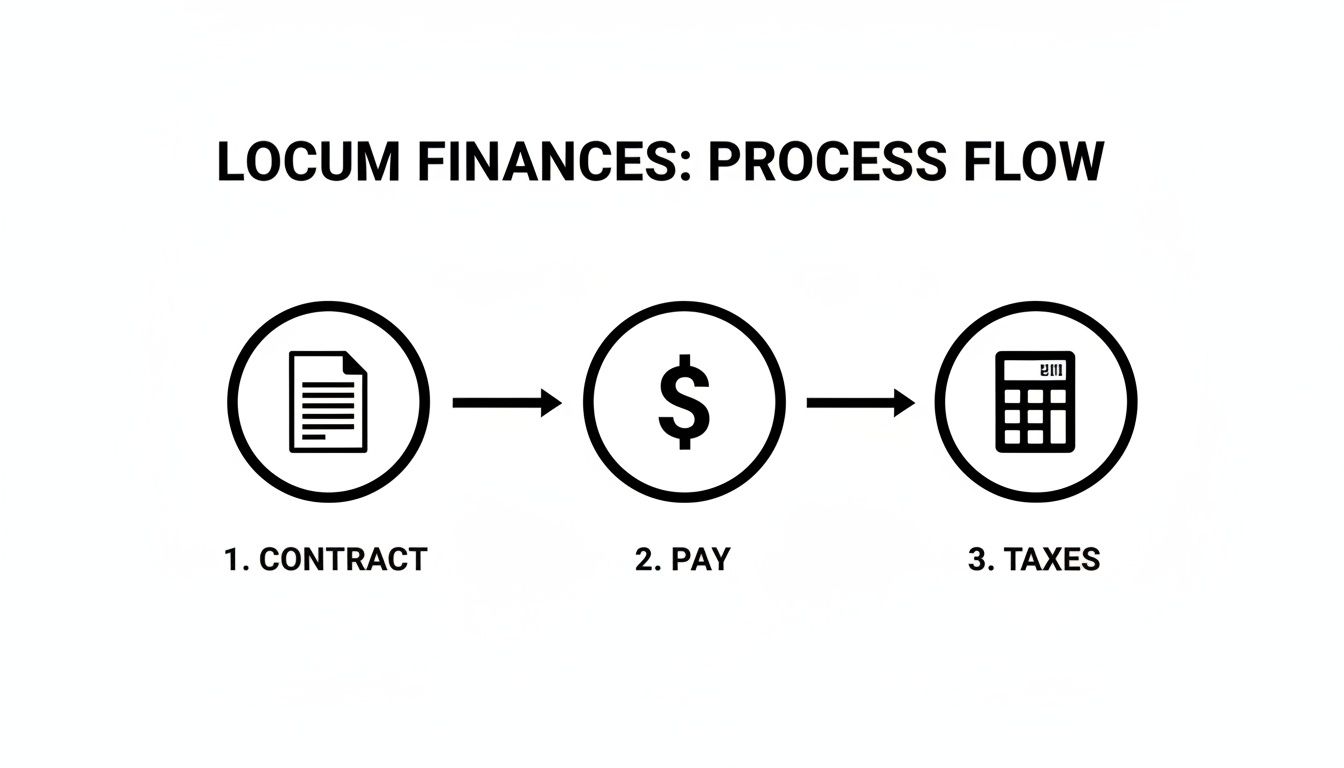
From signing the contract to managing your taxes as an independent contractor, each administrative step is connected to your overall financial health.
Finding Locum Tenens Roles That Prevent Burnout

For a growing number of clinicians, pursuing locum tenens work isn't just another career move. It's an act of self-preservation.
The promise of taking back control over your life is a huge draw, but let's be honest: not all locum assignments are created equal. To find roles that actively protect you from burnout, you need a game plan.
It all starts by getting crystal clear on what "burnout-friendly" actually means to you. It's not some generic industry buzzword; it's your personal work-life equation.
Define Your Non-Negotiables
Before you even glance at a job board, stop and make a list. Write down your absolute must-haves and your hard-and-fast deal-breakers. This list is your new best friend—it’s the filter that will save you from chasing down roles that are a terrible fit for your well-being.
What might go on this list? Everyone's is different, but here are some common boundaries:
- Schedule Boundaries: A strict no-call and no-weekends policy is non-negotiable for many clinicians who are serious about reclaiming their personal time.
- Manageable Patient Load: Maybe you need to set a cap on the number of patients you see per day. This ensures you can deliver quality care without feeling like you're on a treadmill.
- The Right Clinical Setting: Do you prefer the predictable rhythm of an outpatient clinic over the high-stakes environment of an inpatient unit? Be specific.
- Work Style Flexibility: Is the ability to work remotely via telemedicine a must-have? A hybrid schedule? This can dramatically cut down on commute time and daily stress.
Once you have these criteria defined, you’re no longer just passively scrolling. You’re on a targeted mission.
Using Technology to Filter for Well-Being
Okay, you know what you want. Now, how do you find it?
Most traditional job boards are cluttered and make it nearly impossible to filter for the nuanced things that actually matter for work-life balance. This is where specialized platforms built for clinicians like you come in.
A truly burnout-friendly role is one that respects your boundaries before you even have to state them. The right platform will surface these opportunities for you, eliminating the noise and guesswork from your search.
Imagine a job search where your well-being is the first filter, not an afterthought. That's the entire idea behind WeekdayDoc. We didn't just build another job board; we built a tool to help you find roles that fit your life.
This means giving you features designed to protect your time and energy from the get-go:
- Clear "No Weekends" and "No Call" Tags: You can see instantly which jobs respect your personal time without having to read the fine print.
- Proprietary Burnout-Friendly Score: We rate every single listing on factors that contribute to a sustainable career, giving you a quick, at-a-glance assessment of how a role might impact your well-being.
- Financial Independence Projections: We help you connect the dots between your career choices and your long-term life goals by including FIRE (Financial Independence, Retire Early) projections.
This level of curation changes everything. The search for a locum tenens provider position transforms into a proactive step toward a healthier, more sustainable career. Whether you’re looking for a full-time locum gig or exploring different part-time physician jobs, having the right filters makes all the difference.
It's time to stop settling for roles that leave you drained. Start exploring curated, burnout-friendly listings on WeekdayDoc and discover what it feels like to practice medicine on your own terms.
Frequently Asked Questions About Locum Tenens
Even after you've weighed the pros and cons, diving into the world of locum tenens can still feel like it comes with a lot of unanswered questions. What about health insurance? Can I do this right out of residency? What if my gig gets canceled?
Let's tackle the most common questions we hear from clinicians head-on. Think of this as the practical, no-nonsense guide to sorting out those final details before you pack your bags for that first assignment.
How Do I Handle Health Insurance and Retirement?
This is a big one. As a 1099 independent contractor, you're the CEO of You, Inc.—and that means you're in charge of your own benefits. It's a shift from the W-2 world, for sure, but it also gives you total control.
For health insurance, you have a few solid options:
- ACA Marketplace: Check out the plans on the federal or your state’s health insurance marketplace.
- Private Brokers: An insurance broker can be a huge help, sorting through plans from different carriers to find one that fits your life.
- Professional Organizations: Don't forget to check with your medical associations. They often offer group plans with competitive rates for members.
When it comes to retirement, this is where being self-employed really shines. You get access to powerful retirement accounts that often let you save far more than a typical 401(k). The two heavy hitters are the SEP IRA and the Solo 401(k). Just remember to build the cost of these benefits into the rate you're asking for.
Can I Work Locum Tenens Right After Residency?
Absolutely. In fact, many new physicians jump into locum tenens right after finishing residency, and for good reason. It’s a fantastic way to "test drive" different practice settings—think academic vs. private, or a bustling city hospital vs. a quiet rural clinic—before you sign on the dotted line for a permanent job.
It’s also an incredibly effective way to make a serious dent in your student loans, thanks to the higher earning potential. While some facilities might look for a few years of post-residency experience, plenty of agencies specialize in placing new grads in roles that are a perfect match.
"Starting with locums out of residency was the best decision I made. It let me 'test drive' different parts of the country and types of medicine, all while making a significant dent in my loans before I ever signed a long-term contract."
That early exploration gives you a perspective that can shape your entire career, helping you figure out what you really want before you commit.
What Happens If My Assignment Is Canceled?
It's a valid worry, and it’s exactly why your contract is so important. This is where the cancellation clause comes in.
A good contract will spell out a minimum notice period the facility has to give you—usually 30 days. If they cancel with less notice than that, the clause should trigger a penalty payment to you. This might be a few days' or even a few weeks' pay, giving you a financial buffer. Always, always review this part of the contract with your agency before you agree to anything.
How Do Locum Tenens Agencies Make Money?
Pulling back the curtain on how agencies get paid is key to feeling empowered when you negotiate. The simple answer is: they don't charge you. Their money comes directly from the healthcare facility.
Here's how it breaks down:
- The agency agrees on a "bill rate" with the hospital, say $200 per hour.
- They then agree on a "pay rate" with you, the clinician, maybe $150 per hour.
- That $50 difference is the agency's gross margin.
That margin has to cover a lot of ground—recruiter salaries, credentialing paperwork, your malpractice insurance, and their own profit. Knowing this helps you see that your rate isn't set in stone; it's one piece of a bigger financial puzzle, and there's almost always room to talk.
Ready to find locum tenens roles that align with your life, not the other way around? At WeekdayDoc, we curate burnout-friendly jobs with clear work-life boundaries. Explore listings with "No Call" and "No Weekends" tags, proprietary Burnout-Friendly Scores, and FIRE projections to build a career on your terms. Find your next great opportunity at https://www.weekdaydoc.com.