Your Guide to Finding Fulfilling Remote Psychiatry Jobs
Discover how to find remote psychiatry jobs that offer flexibility, prevent burnout, and align with your career goals. Your complete telepsychiatry guide.
Remote psychiatry is more than just a job—it's a fundamental shift in how we deliver mental healthcare. For clinicians, it opens up unprecedented flexibility, better work-life balance, and a level of autonomy that’s hard to find in a traditional clinic.
This isn't about escaping the office. It's about moving psychiatric practice beyond the physical walls of a building, using technology to meet the soaring demand for mental health services while giving you the power to design a more sustainable career. Think of it as a strategic move toward gaining real control over your schedule and your financial future.
The Rise of Telepsychiatry and What It Means for Your Career
The entire landscape of mental healthcare is being reshaped, driven by what patients need and what clinicians want. What used to be a niche option is now a mainstream career path. Remote psychiatry jobs have gone from being the exception to a widely accepted—and often preferred—standard of care.
Make no mistake, this isn't just a fleeting trend. It's a durable transformation in how psychiatric services are delivered and accessed across the country.
This shift finally gives clinicians a chance to reclaim their professional lives. It offers a tangible escape from the rigid structures that so often lead to burnout—grueling commutes, inflexible hours, and the endless administrative burdens that pull you away from patient care. Instead, you can build a work environment that actually aligns with your personal and financial goals.
Why Is This Happening Now?
A few key factors are fueling this massive growth. Patients are increasingly looking for the convenience and privacy of receiving care from home, which tears down old barriers like travel time and stigma.
For clinicians, the pull is just as strong. The demand for mental health support has exploded. The COVID-19 pandemic alone triggered a global surge in anxiety and depression cases by roughly 25% back in 2020. This created a massive, immediate need for more accessible care. As a result, the telepsychiatry market is now projected to quadruple by 2032, a growth rate that outpaces most other medical fields.
You can dig deeper into how telehealth is impacting the psychiatry job search.
The real benefit here is choice. You get the power to decide not just where you work, but how you work. It’s about prioritizing high-quality patient care while building a life that feels genuinely balanced and fulfilling.
It’s About More Than Just a Shorter Commute
The advantages of going remote extend far beyond skipping rush-hour traffic. Let's look at the strategic career opportunities this opens up. This table breaks down some of the key benefits for clinicians.
Key Benefits of Remote Psychiatry Jobs
| Benefit Category | Description for Clinicians |
|---|---|
| Greater Autonomy | Set your own hours, manage your patient load more effectively, and focus purely on clinical work without the distraction of office politics. |
| Financial Advantages | Lower your overhead costs (no commute, less spent on professional attire) and open up new income streams with multi-state licensing. |
| Career Longevity | Create a truly sustainable work-life balance that helps you prevent burnout and practice medicine on your own terms for the long haul. |
These benefits aren't just perks; they're foundational elements for building a healthier, more sustainable career in medicine.
Understanding the different types of telepsychiatry roles is the critical first step to making these advantages work for you. This new model provides the tools to build a professional life that supports your well-being, rather than one that compromises it.
Mastering Multi-State Licensing and Credentialing
The real magic of remote psychiatry is the freedom to see patients anywhere. But that flexibility comes with a catch: you have to be legally able to practice across state lines. Let’s be honest, navigating the maze of multi-state licensing can feel like a full-time job in itself, but a smart approach makes it completely manageable.
This is where you need to know about the Interstate Medical Licensure Compact (IMLC). For physicians (MD/DO), this is a game-changer. It takes the agonizingly slow process of getting licensed in a new state and shrinks it from months down to just a few weeks.
Instead of drowning in dozens of separate, redundant applications, you submit one main application to the IMLC. It streamlines all the background and qualification checks, allowing other compact states to issue your license much faster.
Strategically Choosing Your State Licenses
Before you dive headfirst into the IMLC, take a step back and think strategically. Which licenses will actually give you the best return on your time and money?
- Follow the Demand: Look for states with well-known shortages of mental health providers. This is where you’ll find a steady stream of patients actively looking for telehealth care.
- Play the Time Zones: Holding licenses on both the East and West Coasts can be a huge advantage. It gives you the flexibility to design a schedule that works for your life, not the other way around.
- Run the Numbers: Every state has its own application fees and CME requirements. Weigh those costs against the potential income and job opportunities in that state.
You’ll also want to get familiar with the concept of credentialing-by-proxy. This is an arrangement where one healthcare facility agrees to accept the credentialing decisions of another approved organization. For you, it means you can sidestep a mountain of repetitive paperwork when you start working with multiple telehealth platforms or hospital systems.
This whole process is driven by one simple fact: patient demand is what fuels the growth of remote careers and allows us to design a better life.
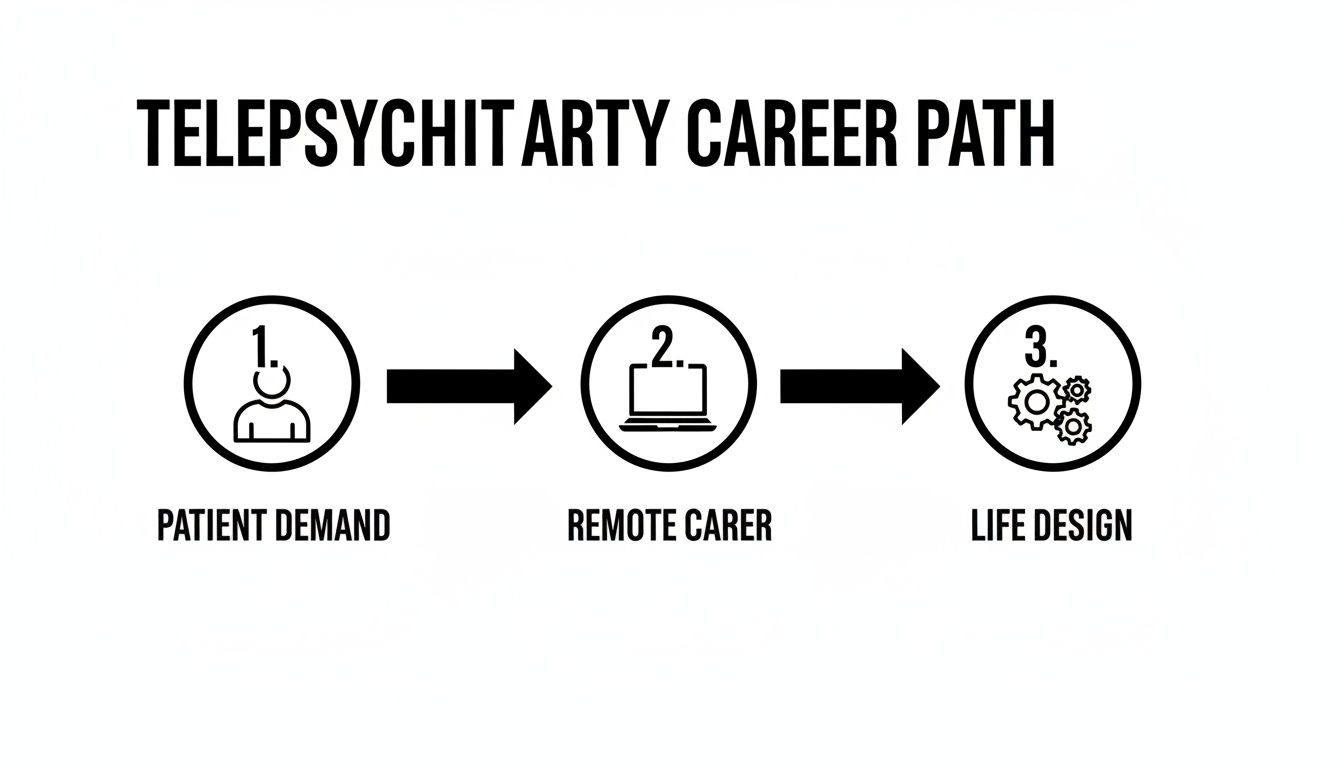
The demand for quality mental healthcare is what gives us the leverage to build careers that actually fit our lives.
My best advice? Get organized from day one. Create a dedicated digital folder for all your critical documents: license copies, DEA certificates, board certifications, your CV. Then, use a simple spreadsheet to track renewal dates, fees, and any state-specific CME requirements.
This simple system will save you from last-minute panic and make sure you’re always in good standing, no matter where you practice. Getting a handle on the administrative side of telehealth is the bedrock of a successful and sustainable multi-state practice.
And if you're looking to see what's out there, our comprehensive guide covers a wide range of flexible telehealth jobs available right now.
How to Stand Out in a Virtual Job Market
Landing a great remote psychiatry job isn't just about having a solid CV. In this virtual world, employers are looking for more than clinical skill—they need to know you can thrive independently in a tech-first role. Your application has to immediately signal that you’re not just a great psychiatrist, but a great telepsychiatrist.
This means your CV needs more than a quick update. It needs a strategic overhaul.
Crafting a Remote-Ready CV
Don't bury your telehealth experience on the second page. Pull it right to the top under a dedicated heading like "Telehealth Competencies" or "Digital Health Skills."
Vague descriptions like "Experienced with EMRs" are basically invisible to recruiters. You need to show them the impact of your digital skills with hard numbers.
Here’s how you can reframe those generic points:
- EMR Proficiency: Efficiently managed a daily caseload of 15-20 patients using Epic and AdvancedMD, maintaining 98% charting compliance.
- Virtual Patient Engagement: Conducted over 1,200 secure video consultations via Doximity and proprietary platforms, consistently earning high patient satisfaction scores.
- Digital Communication: Expertly used secure messaging portals for patient follow-ups, cutting down on phone tag and improving care coordination.
These specifics prove you understand remote workflows and can operate effectively without someone looking over your shoulder. You’re showing you’re a self-starter who can handle the tech.
The goal is to paint a clear picture for the hiring manager: you are already functioning as a successful remote clinician. You're not someone who needs extensive hand-holding to adapt to a virtual environment.
Mastering the Virtual Interview
Your CV got you the interview. Now you have to build a genuine connection through a screen, which is tougher than it sounds. The non-verbal cues we rely on in person are muted, so you have to be much more intentional.
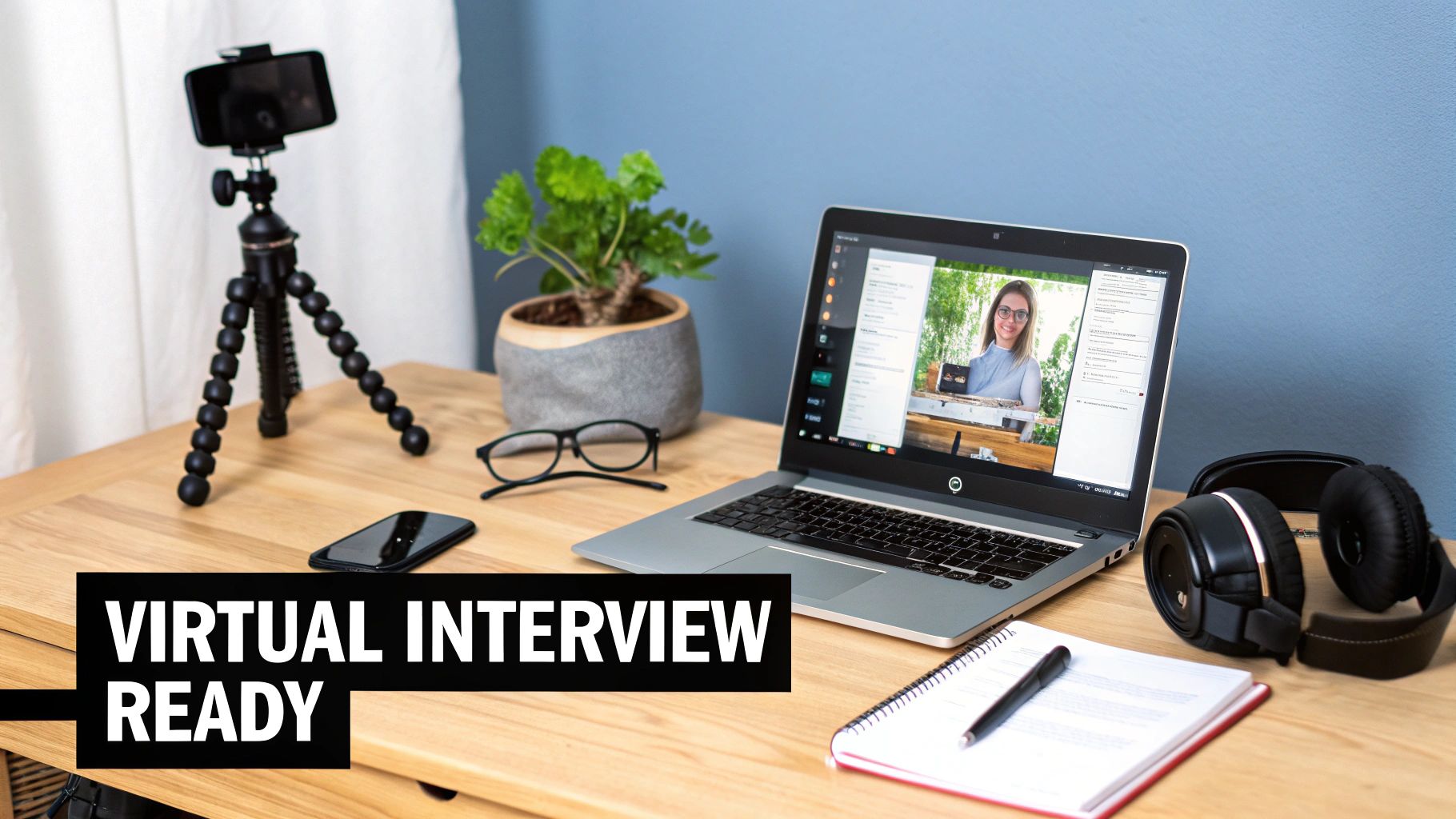
First, your setup matters. A lot. Find a space with a professional, clutter-free background and good lighting. Pro tip: light coming from in front of you is always the most flattering. Test your tech—camera, microphone, internet—well before the call starts. A frozen screen or crackly audio screams "unprepared."
During the interview itself, your answers need to underscore your autonomy. When they ask a question, try to weave in examples of how you’ve independently managed tough cases, solved logistical problems, or taken the lead on a project. This directly answers the big unspoken question every remote employer has: Can this person really be trusted to work effectively alone?
And one last simple but powerful trick: look at the camera lens, not just the person's face on the screen. It feels a little weird at first, but it creates the illusion of direct eye contact and makes a surprisingly big difference in building rapport.
Finding Remote Roles That Prevent Burnout
Let's be honest: not every remote psychiatry job is the key to a better work-life balance. Some virtual roles are just the same old high-stress, high-volume clinic environment, but with a different background on Zoom. If you want to build a truly sustainable career, you have to learn to look past the job description and spot the roles genuinely designed to prevent burnout.
The trick is to proactively screen for "green flags"—those clear markers of a supportive work environment. It starts by filtering your job search for positions that explicitly state "No Call" or "No Weekends." These aren't just perks; they are fundamental boundaries that protect your personal time. Think of them as non-negotiable elements in your search.

Decoding Job Descriptions for Sustainability
When you're scanning job listings, certain phrases can reveal a lot about the company's culture before you even apply. Beyond the obvious "no call" policies, you're looking for evidence of a manageable workload and strong support systems.
Here's what to keep an eye on:
- Realistic Patient Loads: Vague descriptions of patient volume are a red flag. Look for roles that specify a reasonable number of daily encounters or give clear expectations for new patient evaluations versus follow-ups.
- Robust Administrative Support: Does the listing mention dedicated schedulers, billing specialists, or IT support? Strong administrative backup means you spend more time on clinical care and less on logistical headaches.
- Clinician Autonomy: Phrases like "flexible scheduling" or "control over your template" suggest an employer trusts you to manage your time effectively, which is absolutely crucial for preventing overwhelm.
A job post that says, "Manage a panel of patients with dedicated MA and scheduling support," is far more promising than one that vaguely states, "Handle a diverse caseload in a fast-paced environment." For more opportunities that prioritize balance, you can find a curated selection of part-time physician jobs that often come with these burnout-friendly features.
Asking the Right Questions in Your Interview
Your interview is your chance to verify everything the job description promises. This is where you dig deeper into the organization's true culture.
The most insightful questions are those that reveal how an organization handles pressure. Instead of asking if they support work-life balance, ask them to describe how they support a clinician who is feeling overwhelmed or behind on their work.
This approach forces a concrete example of their policies in action, not just a canned response.
Remember, you have leverage here. The demand for mental health professionals is booming. The U.S. Bureau of Labor Statistics forecasts a 9% increase in employment for support roles from 2022 to 2032, and while overall telemedicine use has settled, virtual mental health services remain strong at 40%.
This gives you a significant advantage to choose a role that truly fits your life. By focusing your search on these burnout-proof markers, you can find a remote position that isn't just a job, but a long-term, fulfilling career.
Negotiating Your Salary with Confidence
You’ve done the hard work of finding a great remote psychiatry role. Now comes the final, crucial step: negotiating a compensation package that actually reflects your expertise and helps you build the life you want.
Walking into that conversation armed with solid data is the single best thing you can do for your financial future. It shifts the entire dynamic from "what I want" to "what the market dictates."
Forget about vague national averages. The real leverage comes from understanding regional salary benchmarks, especially in high-demand or underserved states where your skills are at a premium. This is where you can truly maximize your earning potential.
Using Data to Build Your Case
Your entire negotiation strategy should rest on a foundation of hard numbers. Before you even think about hopping on a call, you need to have a crystal-clear picture of the market you'll be serving—even if you're logging in from a completely different state.
This goes way beyond a quick salary search. Dig into metrics like location quotients, which are powerful indicators of regional demand. A high quotient means there's a greater concentration of jobs for your specialty in that area compared to the national average. That’s your leverage.
The most powerful position in any negotiation is being able to say, "Based on the market data for this state, including average compensation and the high demand for telepsychiatry, a salary of X is appropriate." This shifts the conversation from personal desire to objective fact.
For instance, remote psychiatry jobs are completely changing the financial game for clinicians in certain states. In high-demand areas, it's not uncommon to see locum tenens rates hit $200-250 per hour. A psychiatrist licensed in Texas can command an average of $389,000 annually, backed by a location quotient of 1.35 that signals intense demand.
Louisiana is another strong market for remote work, with average salaries around $318,770 and a 1.25 quotient highlighting significant opportunity. You can find more details on psychiatrist compensation benchmarks across the US to start building your own data-backed case.
Top States for Remote Psychiatry Compensation (Sample Data)
Here’s a snapshot of states that often offer competitive average salaries and show high demand for psychiatrists, making them particularly attractive for remote work. This kind of data is exactly what you should bring to the table.
| State | Average Annual Salary | Location Quotient (Demand Indicator) |
|---|---|---|
| Texas | $389,000 | 1.35 |
| California | $339,220 | 1.10 |
| Louisiana | $318,770 | 1.25 |
| Florida | $305,500 | 1.05 |
| Indiana | $301,440 | 1.41 |
Note: Data is illustrative and can vary based on experience, specific role, and employer. Always verify current market rates.
Having these figures on hand demonstrates that your request isn't arbitrary—it's based on objective market reality.
Tying Salary to Your Long-Term Goals
Your target salary isn't just an arbitrary number. It’s a tool. It's the key to paying off student loans, saving for a down payment, or fast-tracking your journey to financial independence (FI).
Frame your salary discussion with your bigger picture in mind. Here’s how:
- Think Total Compensation: Look beyond the base salary. A slightly lower base might be a great trade-off if it comes with an excellent 401(k) match, a hefty CME stipend, or fantastic health benefits that cut down your personal expenses.
- Acknowledge Cost of Living: If you live in a HCOL area, it’s completely reasonable to mention that your compensation needs to reflect that reality, regardless of where your patients are located.
- Discuss Future Growth: This isn't just about day one. Ask about the potential for bonuses, performance-based raises, or profit-sharing. This signals you're looking for a long-term partnership, not just a paycheck.
When you ground your negotiation in solid data and connect it to a thoughtful financial strategy, you change the entire conversation. You're no longer just asking for more money. You're presenting a logical, well-researched business case for why your skills are worth a certain number—and that’s a position any employer will respect.
Answering Your Top Questions About Telepsychiatry Jobs
Making the leap to telehealth brings up a lot of practical, real-world questions. Even when you’re sold on the benefits, the day-to-day details of practicing medicine from a home office can feel a little fuzzy.
Let’s clear that up. Here are the most common concerns I hear from psychiatrists exploring remote work, with straightforward answers to help you move forward.
What Technology Do I Actually Need?
Getting your tech right is non-negotiable, but don't worry—you don’t need a server farm in your guest room. A few key pieces of gear are all it takes to provide secure, professional care.
Most employers will give you access to their telehealth platform and EMR. Your job is to make sure your personal setup can run everything without a hitch.
Here’s the essential checklist:
- A rock-solid, high-speed internet connection. This is your lifeline. A laggy video or a dropped call can completely derail a session.
- A modern computer with a quality webcam and microphone. Clear audio and video are how you build rapport and catch those crucial non-verbal cues.
- A private, HIPAA-compliant workspace. You absolutely must have a dedicated space where you can guarantee patient confidentiality without interruptions.
Being comfortable with digital tools—and having the ability to troubleshoot minor glitches yourself—is a huge plus.
Your virtual office is the modern equivalent of a physical exam room. It has to be professional, private, and functional. A solid tech setup signals to employers that you're prepared for the autonomy of a remote role.
How Does Malpractice Insurance Work Across State Lines?
Practicing across multiple states is a major perk of telepsychiatry, but it adds a layer of complexity to malpractice coverage. Your policy has to explicitly cover you in every single state where you hold a license and see patients. A standard policy often won't cut it.
Many major carriers now offer specific telehealth policies that can be endorsed for multi-state practice. When you talk to your provider, you need to be crystal clear about every state you plan to practice in. This isn’t the place for ambiguity.
The good news? Many of the bigger telehealth companies bake comprehensive malpractice coverage right into their employment packages. This is a massive benefit, so make sure you get the details during your contract negotiation.
Can I Really Build a Strong Therapeutic Alliance Online?
This is probably the most common clinical question I get, and the answer is a firm "yes." The medium might be different, but the fundamentals of empathy, active listening, and building trust are exactly the same. A huge body of research—and tons of real-world clinical experience—confirms that telepsychiatry is just as effective as in-person care for a wide range of conditions.
The key is adapting your communication style for the screen. That means making eye contact with the camera (not just the screen), using clear verbal and non-verbal signals to show you're engaged, and being intentional about creating a warm, welcoming virtual space. For many patients, being in the comfort of their own home actually helps them open up more quickly.
Are Most Remote Jobs W2 or 1099?
You’ll find a pretty even split of both W2 and 1099 (independent contractor) jobs in the remote psychiatry market. Which one is better really comes down to your personal career and financial goals.
- W2 Employment: You’ll typically find these with large health systems and established telehealth companies. They offer stability and benefits—think health insurance, paid time off, and a 401(k).
- 1099 Contractor: This route gives you maximum flexibility with your schedule and patient load. The trade-off is that you’re on the hook for your own taxes, insurance, and benefits.
It's critical to understand the financial and legal differences here before you sign on the dotted line.
At WeekdayDoc, we specialize in connecting clinicians with burnout-friendly roles that respect your time and expertise. Explore our curated listings for remote psychiatry jobs that come with "No Call" and "No Weekends" policies, complete with salary data to support your career goals. Find your next sustainable role at https://www.weekdaydoc.com.