How to Avoid Burnout: how to avoid burnout with practical, actionable steps
Learn how to avoid burnout with practical steps like boundary setting, clearer roles, and sustainable work habits.

If you’re a clinician reading this, you’re probably exhausted. And you know that generic advice to "practice self-care" feels like a slap in the face. It completely misses the point.
To really tackle burnout, we have to look past the simplistic fixes and get real about the systemic pressures that make a career in healthcare so incredibly punishing. The way forward isn't about blaming yourself; it's about reclaiming your sanity with immediate tactics, reshaping your current role, and, if needed, finding a new one that actually supports your long-term well-being.
Moving Beyond Burnout in Healthcare

This guide is for every clinician who feels that crushing weight of exhaustion. It's for anyone who recognizes that burnout is an industry-wide failure, not a personal one. Feeling overworked, undervalued, and stretched to your absolute limit is a shared experience, and the data backs it up.
System-level problems like chronic understaffing are a huge part of the story. A recent industry analysis, for instance, projected a staggering shortfall of around 100,000 healthcare workers by 2028. That directly translates to longer hours and impossible patient loads for those of us left standing.
In that same report, 49% of clinicians said their organizations didn't have enough staff to safely meet patient needs. You aren't imagining it. The system is broken.
Burnout is not a sign of weakness; it's a sign you've been trying to do too much, for too long, in a system that demands more than it gives back. Acknowledging this is the first step toward meaningful change.
A New Approach to Clinician Wellness
Instead of putting the entire burden of "resilience" on your shoulders, this guide offers a realistic, multi-pronged strategy. We're going to focus on actionable steps that get to the root causes of burnout, giving you the tools to take back some control.
Our approach centers on three critical areas:
- Immediate Relief: Practical, on-the-ground tactics you can use today to create some much-needed breathing room.
- Workplace Advocacy: Smart ways to negotiate changes in your current job to make it more sustainable for the long haul.
- Strategic Career Moves: Real guidance on finding a new role that genuinely aligns with your health and well-being.
Before we dive deep into the long-term strategies, let's look at some immediate actions you can take. These are small but powerful ways to start pushing back against the tide of exhaustion right now.
Immediate Burnout Relief Strategies You Can Use Today
| Strategy Type | Actionable Tip | Why It Works |
|---|---|---|
| Micro-Breaks | Step away from your desk for 5 minutes between patient encounters. Don't check your phone. Just breathe or look out a window. | It interrupts the stress cycle, allowing your nervous system a brief moment to reset and preventing cognitive overload. |
| Boundary Setting | Decline one non-essential task this week. A committee, an extra shift, a "quick" favor—just say no. | It reinforces that your time is finite and valuable, giving you back a small but crucial piece of control. |
| Mindful Transition | Create a "commute ritual." Listen to a specific podcast or album to mentally separate your workday from your home life. | This creates a psychological buffer, helping you leave work stress at work and be more present at home. |
| Task Delegation | Identify one administrative task you can delegate or streamline. Can a medical assistant handle prior authorizations? Can you create a template for notes? | Reducing administrative burden is one of the most effective ways to combat a major driver of burnout—the "pajama time" EHR work. |
These quick wins aren't a cure-all, but they are a start. They help create the mental space needed to tackle the bigger, more systemic changes ahead.
By focusing on these pillars, you can build a career that isn't just professionally rewarding but also personally sustainable. And for more support on your journey, check out our other comprehensive wellness guides designed specifically for healthcare professionals.
Reclaiming Your Time and Energy Today

When you're deep in the trenches of burnout, thinking about a five-year plan feels completely out of reach. What you need are immediate, practical first-aid tactics to create some breathing room. Right now. This is about taking back control with small, deliberate actions that don't need a committee's approval but can make a real dent in your daily stress.
The goal here is simple: stop the bleeding. By setting tangible boundaries and finding moments for "micro-rest," you can start to claw back small pockets of your time and mental energy. These little wins build momentum and help you feel like you're in the driver's seat again.
Setting Firm Professional Boundaries
One of the fastest routes to burnout is having no boundaries at all. That constant "yes"—to extra shifts, after-hours patient messages, and endless administrative tasks—is a thief. It steals your personal time and plants the seeds of resentment. Learning to say "no," gracefully but firmly, isn't just a good idea; it's a survival skill.
This isn't about being unhelpful. It's about being sustainable. You can't pour from an empty cup, and protecting your time is a professional necessity, not a personal failing.
So, where do you start? Pick just one area where you know you're overextending yourself. Is it answering non-urgent portal messages at 9 PM? Agreeing to cover for a colleague when you're already running on fumes? Just pick one and draw a line in the sand.
Actionable Scripts You Can Use:
- To a colleague asking for a shift swap: "Thanks for asking, but I can't take that on. I have to protect my downtime this week to make sure I’m at my best for my own shifts."
- To an administrator adding you to another committee: "I appreciate the offer. Given my current workload, I can't give that committee the focus it deserves right now."
- For after-hours work requests: "I can definitely address this first thing during my scheduled admin time tomorrow morning."
Notice these responses are polite, professional, and clear. No long excuses needed. You're simply stating your capacity.
A boundary isn't a wall you build to keep people out. It's a line you draw to protect your own well-being. It tells the world that your time and energy are finite resources you have to manage.
Before you can fix the problem, you need to know how big it is. A tool can help you get a clear-eyed view of where you stand. Our physician burnout calculator can give you real insight into your current stress levels, which often highlights just how critical these small changes are.
Weaving Micro-Rest Into Your Hectic Day
Taking a long break during a packed clinic day? Laughable, I know. The key isn't finding some magical hour you don't have. It's about strategically embedding tiny moments of rest into the day you do have. Think of them as "oasis moments"—brief, intentional pauses that hit the reset button on your stress response.
These little breaks stop stress from snowballing. A two-minute pause can literally reset your nervous system, sharpen your focus for the next patient, and prevent that soul-crushing exhaustion that builds by the end of the day.
Examples of Effective Micro-Breaks:
- The Two-Minute Mindfulness: Between patients, just close your eyes. Plant your feet on the floor and take three slow, deep breaths. That's it. Focus only on the feeling of your breath. It can slow your heart rate and clear your head in less time than it takes to log into the EMR.
- Declare a Tech-Free Lunch: Your lunch break is sacred ground. Step away from your desk. Put your phone on silent and out of sight for at least 15 minutes. Actually tasting your food without the constant ping of emails allows your brain a genuine chance to switch off.
- The Transition Ritual: Before you walk into the next exam room, pause at the door. Take one deep breath and consciously "leave" the last encounter behind. This creates a mental buffer, helping you be fully present with your next patient.
- A Moment of Nature: Got a window? Take 60 seconds to just look out of it. Focus on a tree, the clouds—anything that isn't clinical. This practice is called "soft fascination," and it's proven to restore your brain's ability to focus.
These aren't luxuries; they're essential tools for managing the intense cognitive and emotional load of our work. By reclaiming these small moments, you start building a more sustainable way to practice medicine and bank the energy you'll need to tackle the bigger systemic issues.
Redesigning Your Work Environment for Sustainability
Micro-breaks and individual coping tactics can give you some much-needed breathing room, but they’re band-aids on a systemic wound. Lasting change means looking beyond yourself and addressing the system head-on. It's about advocating for real adjustments to your work environment, transforming it from a source of constant drain into a foundation for a sustainable career.
This can feel like a monumental task, especially when you’re already running on empty. But framing this as a strategic negotiation—not a desperate plea—completely changes the dynamic. You aren't just asking for a personal favor; you're proposing a smarter way of working that benefits the entire organization.
How to Start the Conversation with Leadership
Before you walk into your manager's office, you need a plan. Simply stating, "I'm burned out," is unlikely to get you very far. The key is to build a compelling case that frames your requested changes as a win-win.
Think of yourself as a consultant hired to improve team efficiency and retention. Your goal is to present a well-reasoned, data-backed business case.
Before you even think about scheduling that meeting, do your homework:
- Get Specific: What one or two changes would make the biggest difference? A predictable four-day week? A hybrid schedule with two telehealth days? A lower on-call burden? Know exactly what you’re asking for.
- Gather Your Data: Track your hours for two solid weeks. Don’t forget to include the "pajama time" you spend catching up on EMRs from home. Document every instance where short staffing or broken workflows led to patient care delays.
- Speak Their Language: Frame your proposal around the metrics your leadership actually cares about. This usually means patient satisfaction scores, staff turnover rates, medical errors, and the staggering cost of recruitment.
For example, instead of saying, "I can't keep working this many shifts," try this approach: "I've analyzed our scheduling and believe a compressed four-day work week could cut our overtime costs by 15% and improve continuity of care, which we know directly impacts patient satisfaction." Suddenly, you're not a complainer; you're a proactive problem-solver.
Building the Business Case for a Better Schedule
Many of us feel trapped by our schedules. The good news is that flexible work is no longer a fringe concept; it has a proven track record of slashing burnout rates. The trick is showing leadership how these models serve the bottom line while protecting their most valuable asset: their clinicians.
The data on remote work in healthcare is particularly powerful. Study after study has shown that more access to telework is tied to significantly lower burnout. One national study of the Veterans Health Administration found clinicians who teleworked most of the time reported far lower burnout levels than their colleagues who didn't have that option. You can dig into the full study on telework's impact on clinician burnout to see the numbers for yourself.
This isn't just a perk. It's a strategic workforce tool. When organizations allow certain roles to be done remotely, they actively reduce burnout risk and boost retention.
When you advocate for a better schedule, you aren't just fighting for yourself. You are championing a model of work that keeps experienced, high-quality clinicians in the profession longer. That's a direct benefit to patients, colleagues, and the healthcare system as a whole.
How to Present Your Proposal for Maximum Impact
Once you’ve got your data and a clear "ask," it’s time to make your pitch. Treat this like a formal proposal, not a casual chat by the coffee machine.
Here's a simple, structured way to frame the conversation:
- Start with a Shared Goal: Kick things off by affirming your commitment. "I'm dedicated to this team's success and wanted to discuss an idea to improve our long-term sustainability and patient outcomes."
- Present the Problem (with Data): Briefly outline the issue using objective facts. "Our current scheduling model is contributing to high turnover, which costs the organization an estimated X dollars for every clinician who leaves. It's also hurting our team's ability to see patients in a timely manner."
- Offer Your Concrete Solution: State your proposal clearly and confidently. "I propose we pilot a four-day work week for our department. This would involve reallocating clinical hours without reducing patient access."
- Highlight the Win-Win: Connect your solution back to the organization's priorities. "This wouldn't just improve clinician well-being—it could be a powerful recruitment tool, reduce our reliance on expensive locums coverage, and ultimately make patient care safer."
- Suggest a Trial Run: Make it easy for them to say yes by proposing a low-risk experiment. "Could we try this for a three-month trial period and track specific metrics like staff satisfaction, patient wait times, and overtime hours?"
This structured, evidence-based approach shifts the conversation from a personal request to a strategic business proposal. It shows you’re a forward-thinking problem-solver, making it much more likely leadership will see the value in what you're saying. Redesigning your work environment is one of the most powerful steps you can take toward ending burnout for good.
How to Find a Genuinely Burnout-Friendly Job
So, you've tried advocating for change at your current job, but you’ve hit a brick wall. What now? The single most powerful thing you can do for your well-being is to find an environment that was built to support you from the ground up.
This isn’t about giving up. It’s a strategic shift—moving from trying to fix a broken system to finding one that actually works. A genuinely burnout-friendly job isn't defined by vague promises of "work-life balance" in the description. It's defined by its structure.
We're talking about tangible, contractual protections like no mandatory on-call shifts, guaranteed weekends off, and a patient load that’s realistic. These aren’t perks; they're the foundational elements of a sustainable career in medicine.
Cut Through the Noise With Smart Filters
Let's be honest, scrolling through endless job listings is exhausting. They all start to blur together. The key is to stop wading through jobs that will never work and start with a curated list from day one.
This is where targeted search tools designed for clinicians, like WeekdayDoc, become invaluable. Instead of getting overwhelmed, you can filter for the specific factors that are non-negotiable for preventing burnout.
Here are the most effective filters to apply right away:
- No Call / No Weekends: This is the game-changer. It’s the fastest way to reclaim your personal life, instantly removing jobs that demand your evenings and weekends.
- Remote/Telehealth: If the daily grind of commuting and a chaotic clinic environment is the source of your drain, filtering for remote jobs can completely change your quality of life.
- Part-Time or Flexible Hours: Sometimes the problem isn't the work itself, but the sheer volume of it. Our guide on part-time physician jobs dives deep into how reducing your hours can be a direct path to recovery.
When you're at a crossroads with burnout, you really have two paths: try to redesign your current role or find a new one.
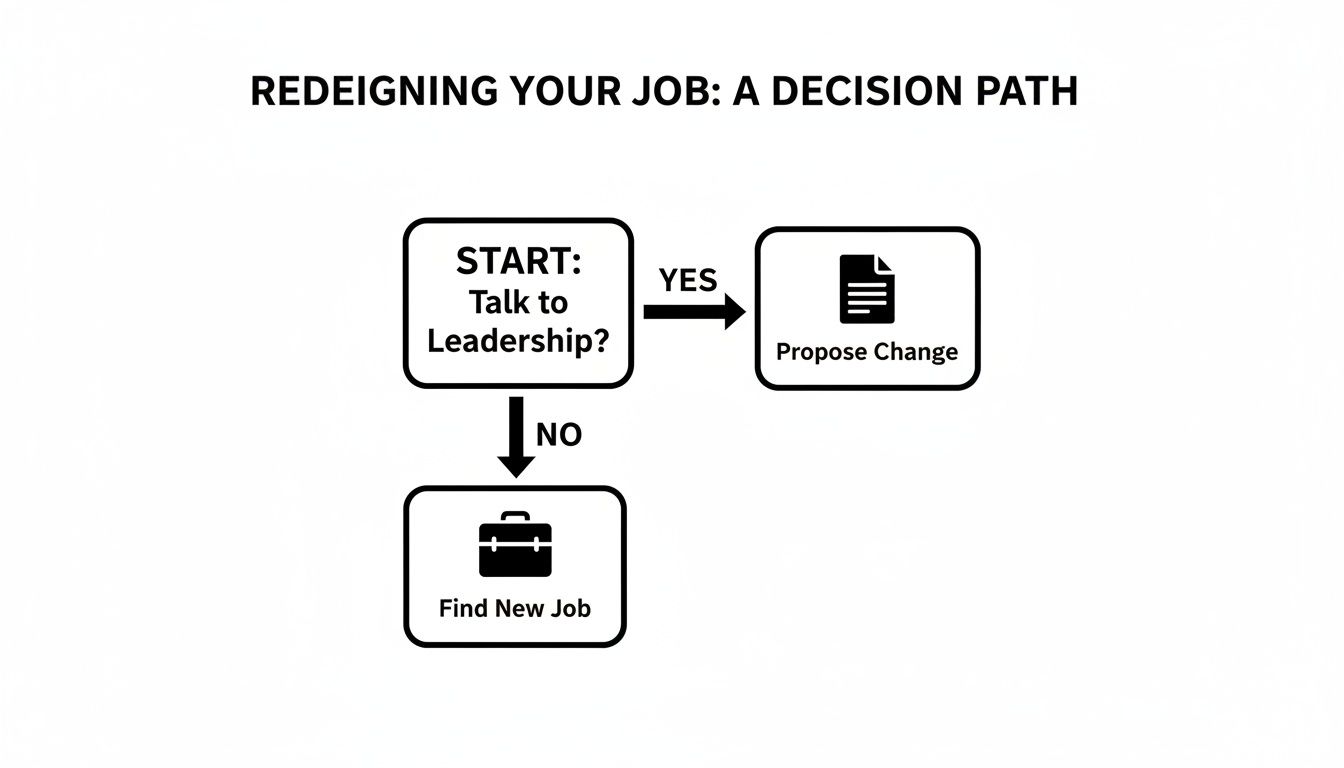
If advocating for yourself internally isn't working or simply isn't an option, a strategic job search becomes your primary action plan.
Vet Potential Employers Like a Pro
Once you've shortlisted a few promising roles, the interview becomes your investigative tool. This is where you dig past the polished job description and find out what the day-to-day reality actually is.
Don't be afraid to ask direct, pointed questions. A truly supportive employer will respect them. A toxic one will get defensive or give you vague, corporate-speak answers.
The interview is a two-way street. You aren't just there to impress them; you are a highly skilled professional evaluating if an organization is even worthy of your expertise.
Use this checklist during your job search and interview process to look beyond the job description and identify key indicators of a sustainable work environment.
How to Evaluate a Job's Burnout-Friendliness
| Factor to Assess | Green Flags (Look For These) | Red Flags (Avoid These) |
|---|---|---|
| Workload & Staffing | Clear patient-to-clinician ratios. A solid plan for when someone calls out sick. Protected admin time. | Vague answers about patient volume. "We all just chip in" for sick calls. No mention of administrative support. |
| After-Hours Expectations | Contractual "no call" means no calls, period. Clear boundaries for patient messages and lab results. | "No required call, but..." or expectations of checking patient portal/EHR from home. |
| Team Culture & Turnover | Low clinician turnover. Open discussion about well-being initiatives that go beyond a pizza party. | High turnover in the last year. Defensive or evasive answers about why people leave. |
| Leadership Style | Leaders who actively listen and have concrete examples of supporting their team during stressful times. | Management that blames individuals for systemic issues. Focus on productivity metrics over clinician well-being. |
This isn't just about feeling better; it's about addressing a well-documented crisis. Primary care physicians, for instance, consistently report the highest burnout rates, hitting 57.6% in 2022. And a 2025 survey found that 65% of nurses felt immense stress, with short staffing as the main culprit.
These numbers prove why job features like no-call contracts and weekday-only schedules aren't luxuries—they are essential interventions, especially for the highest-risk specialties.
Finding a job that is actively designed to prevent burnout is the most effective long-term strategy for your career and your health. By being deliberate in your search and bold in your questions, you can find a role that lets you thrive again.
Building Financial Resilience for Career Freedom

Financial pressure is an invisible chain. It’s what keeps so many of us tethered to toxic jobs long after we know we need to leave. When you’re staring down a mountain of student loans, a mortgage, and family bills, walking away from a steady—if soul-crushing—paycheck can feel impossible.
That’s exactly why building financial resilience isn't just a "nice-to-have." It’s one of the most powerful, concrete strategies you can deploy to protect yourself from burnout over the long haul.
This isn’t about getting rich. It’s about creating freedom. When you have a solid financial cushion, you gain the ultimate form of leverage in your career: the power to say no. The power to walk away. It allows you to make your next move based on your well-being, not just your bank account.
Demystifying Financial Independence for Clinicians
The whole "Financial Independence, Retire Early" (FIRE) movement might sound a bit extreme for a busy clinician, but the core principles are incredibly useful. At its heart, FIRE is just about getting to a point where your assets generate enough income to cover your living expenses. Work becomes a choice, not a cage.
For a clinician on the verge of burnout, this doesn't mean you have to hang up your stethoscope at 40. It means building up "walk away money"—a fund that gives you the breathing room to quit that damaging job, take a much-needed sabbatical, or switch to part-time without panicking about bills.
Financial independence isn't about not working. It’s about having the power to choose work that aligns with your values and protects your health, giving you control over your own career path.
This kind of financial agency is the perfect antidote to feeling helpless and trapped. And it all starts with a clear, intentional plan.
Creating Your Freedom Fund
The first, most practical step is to establish what I call a "Freedom Fund." This isn't your standard emergency fund for a leaky roof. This is a separate, dedicated account earmarked for one thing: your career freedom.
The goal is to save enough to cover your essential living expenses for at least six months to a year. That’s your runway. It’s the time you need to find a healthier role without the pressure of desperation forcing you into another bad situation.
The key to making this work is automation. Treat the contribution to your Freedom Fund like a non-negotiable bill. Set up an automatic transfer from every paycheck, even if it’s just a few hundred dollars. You'll be amazed how quickly it grows, building a powerful psychological and financial buffer. Think of it as paying your future self for peace of mind.
Practical Steps to Accelerate Your Financial Resilience
Beyond just saving, a few smart financial moves can seriously speed up your journey to career freedom. The idea is to optimize your money so more of it can go toward your Freedom Fund and long-term investments.
- Tackle Your Student Loans: High-interest debt is an anchor. Dig into all your options. Could you refinance to a lower interest rate? Do you qualify for Public Service Loan Forgiveness (PSLF)? Even a small reduction in your monthly payment frees up significant cash.
- Automate Your Investments: Don't let your demanding schedule sabotage your wealth-building. Set up automatic investments into low-cost index funds or target-date funds. Consistent, automated investing harnesses the power of compounding without you having to think about it.
- Track Your Progress: You can't improve what you don't measure. A simple spreadsheet or an app that tracks your net worth and savings rate can be incredibly motivating. Seeing those numbers climb is a powerful reminder of your goal, especially on the tough days.
These financial strategies aren't just about spreadsheets and numbers. They are practical, empowering tools that help you build a life where you are firmly in the driver’s seat of your own career.
Your Questions About Clinician Burnout, Answered
Even with a solid plan, navigating burnout brings up a lot of questions. It's easy to feel uncertain or wonder if you're making the right moves. We get it.
This section tackles the most common concerns we hear from clinicians. Think of it as a quick reference to give you clarity and confidence as you start taking back control of your career and well-being.
How Can I Tell the Difference Between Stress and Actual Burnout?
This is a crucial distinction. The way you solve for stress is completely different from how you recover from burnout.
Stress is a state of over-engagement. You feel a constant sense of urgency, your emotions are running high, and you might catch yourself thinking, "If I can just push through this next week, things will be okay." It’s that feeling of desperately trying to keep all the plates spinning.
Burnout, on the other hand, is a state of total disengagement. That urgency is replaced by a sense of helplessness and deep emotional exhaustion. The classic signs are cynicism, a growing detachment from your patients and your work, and a nagging feeling that nothing you do really matters anymore.
If you feel emotionally drained, detached, and find that your best efforts no longer feel like they make a difference, you're likely dealing with burnout, not just stress. Burnout strips away your sense of agency and accomplishment, leaving you feeling empty.
It’s the difference between being overwhelmed by your to-do list (stress) and feeling like the to-do list is utterly pointless (burnout).
What Is the First Step if I Cannot Afford to Quit My Job?
When leaving isn't an option right now, the single most powerful first step is to reclaim a small piece of your autonomy. Start by setting one firm, non-negotiable boundary around your personal time. This is a direct counter-attack against the feeling of helplessness that feeds burnout.
Pick something manageable but meaningful. The goal here is to create a small, protected space that you—and only you—control.
A Few Small but Powerful First Steps:
- Protect your evenings: "I will not check work email or answer patient portal messages after 7 PM. Period."
- Reclaim your lunch break: "I will take my full lunch break away from my desk and clinical areas, with my phone on silent."
- Guard your days off: "I will say no to any request to come in on my day off, no matter how small the task."
Holding firm on just one of these boundaries sends a powerful message to yourself and your colleagues: your time is valuable, and your well-being is not up for debate. This small act of control is often the first domino to fall on the path to regaining your sense of agency.
How Can I Advocate for Myself if My Manager Is Not Supportive?
When you’re dealing with an unsupportive manager, you have to change your approach. Forget framing your needs around personal well-being—it likely won’t work. Instead, you need to build a business case that benefits the organization.
This shifts the conversation from a personal plea to a discussion about operational efficiency and risk management. Your manager cares about metrics like patient safety, staff retention, and the bottom line. Speak their language.
For instance, instead of saying, "I'm overwhelmed and need less call," try this:
"I've been reviewing the data on clinician turnover and medical errors, and both are strongly linked to excessive on-call schedules. I propose we pilot a revised schedule for our team to improve our retention numbers and enhance patient safety."
This reframes you as a proactive problem-solver, not just an employee with a complaint. You’re offering a solution tied directly to institutional goals, which is much harder to ignore.
Is Taking a Telehealth or Part-Time Role a Step Back in My Career?
Absolutely not. Shifting to telehealth, part-time, or a "no-call" role is a strategic pivot toward career longevity. The old-school mindset that equates brutal hours with professional dedication is exactly what created the burnout crisis in the first place.
In today's healthcare environment, the most valuable clinicians are the ones who can provide excellent care sustainably, for the long haul.
These roles aren't a retreat; they're a smarter way to practice medicine. They allow you to preserve your hard-won skills, maintain your license, and protect your mental health. This makes you a more effective, present, and engaged practitioner for years to come. Redefining success on your own terms is the ultimate career advancement.
Finding a role that respects your need for balance isn't a compromise—it's a requirement for a sustainable career. At WeekdayDoc, we specialize in finding burnout-friendly jobs that protect your time and well-being. Explore opportunities with no call, no weekends, and clear work-life boundaries today at https://www.weekdaydoc.com.