Healthcare Burnout Statistics: A Clear Look at the Crisis
Explore healthcare burnout statistics shaping today's medical field, with insights on physicians, nurses, and practical steps to reduce burnout.
The statistics on healthcare burnout paint a grim picture. We're not just talking about a few bad days; we're witnessing a full-blown crisis where some reports show that nearly half of all U.S. health workers are grappling with frequent symptoms of burnout.
This isn't just a personal struggle. It’s a systemic rot that threatens patient safety, drives talented clinicians out of medicine, and destabilizes the entire healthcare workforce.
The Current State Of Healthcare Burnout
Healthcare is in the middle of a crisis defined by staggering burnout rates—numbers that dwarf those in most other demanding fields. The data reveals a workforce stretched past its breaking point. Emotional exhaustion, cynicism, and feeling like you’re no longer effective have become the norm for far too many. This isn't just a hangover from the pandemic; it’s a chronic illness fueled by years of systemic pressure.
The scale of the problem is just massive. For every two doctors, nurses, or PAs you see, it’s likely one of them is struggling with significant burnout. That kind of ratio shows a deep imbalance between what the job demands and the resources clinicians have to cope. The consequences are real, affecting everything from staff turnover to the quality of every single patient interaction.
A Data-Driven Snapshot
To really get a handle on this, you have to look at the hard numbers. These statistics aren't just figures on a spreadsheet; they represent millions of dedicated professionals who are now second-guessing their life's work. The data gives us the context we need to understand why so many clinicians are either leaving the field entirely or cutting back their hours just to survive.
This infographic sums it up pretty clearly, showing the overall burnout percentage and the troubling ratio of stressed-out clinicians to those who feel supported.
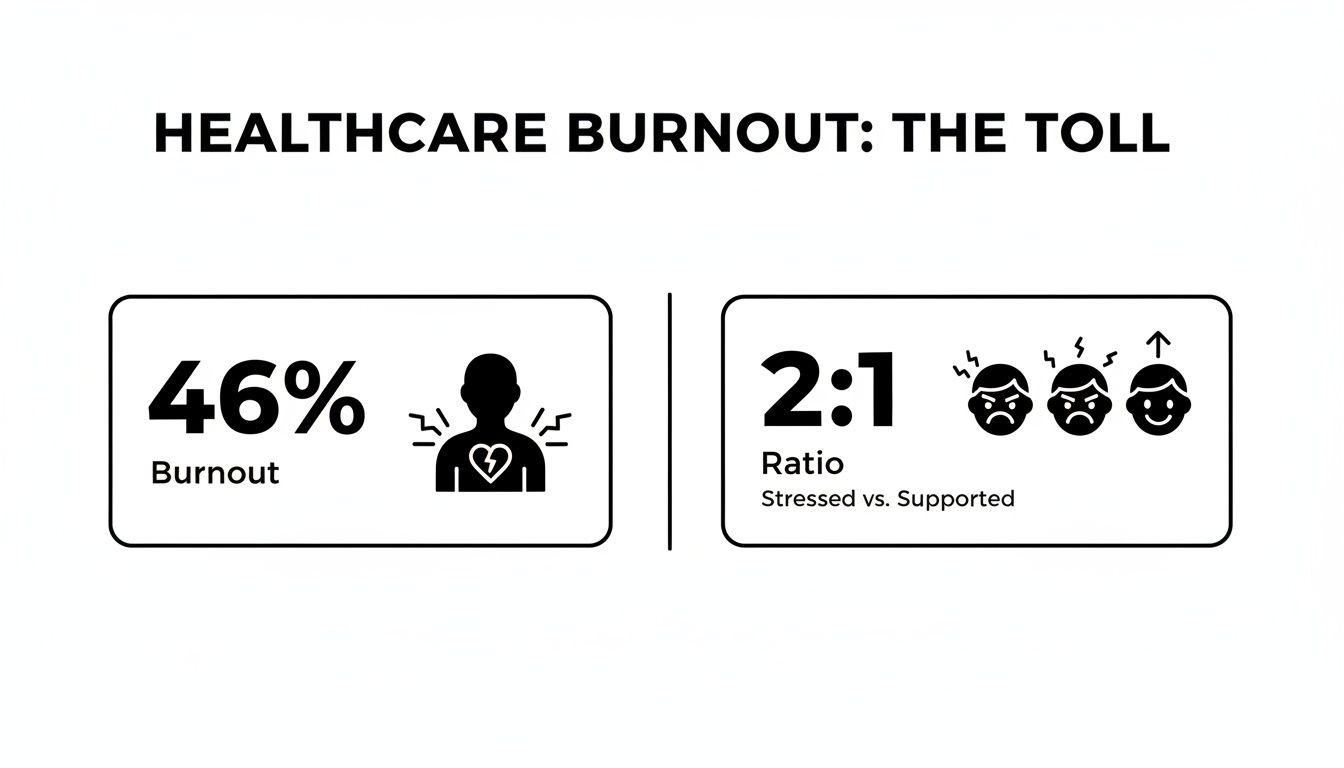
What jumps out is that nearly half the workforce is affected. This isn't a problem for a few; it’s a majority issue.
Healthcare Burnout Key Statistics At A Glance
To set the stage for a deeper dive, let's break down some of the most critical numbers. These figures show just how widespread and costly this crisis has become.
| Metric | Statistic | Source Highlight |
|---|---|---|
| Overall Burnout Rate | 46% of health workers felt burned out often or very often. | Centers for Disease Control and Prevention |
| Intent to Leave | ~25% of RNs plan to leave nursing within the next five years. | American Association of Colleges of Nursing |
| Physician Turnover Cost | Up to $1 million+ per physician lost to burnout. | American Medical Association |
| Comparison to General Workforce | Healthcare workers report higher burnout than most other industries. | Various Industry Surveys |
This data confirms that burnout isn't just an emotional toll—it carries a massive financial and operational price tag that health systems simply can't afford to ignore. That high intent-to-leave rate, in particular, should be a five-alarm fire, signaling a workforce shortage that could cripple care delivery if we don't act now.
Decoding Physician Burnout By The Numbers
Burnout hits every corner of healthcare, but physicians are weathering a particularly brutal storm. When you dig into the numbers, you find an epidemic of exhaustion, cynicism, and a feeling of just not being effective anymore. This isn't just about doctors feeling tired; it has massive downstream effects on the entire medical system.
These statistics aren't just abstract percentages. They tell the story of a profession in deep distress—a story about losing the very connection to the mission that pulled so many of us into medicine in the first place. This emotional drain is real, it’s driving good doctors out of the profession, and it's shaking the very foundation of our healthcare infrastructure.
Alarming Post-Pandemic Trends
If physician burnout was a smoldering fire before 2020, the COVID-19 pandemic was gasoline. The sheer volume of patients, constant staffing crises, and the immense emotional toll created a perfect storm that pushed physicians to their absolute limit.
U.S. physician burnout rates shot through the roof, peaking at a staggering 62.8% in 2021. That means nearly two out of every three doctors reported at least one symptom of burnout. Just one year prior, that number was 38.2%—a massive leap that shows just how intense the pressure became.
While the rate has thankfully dropped to 48.2% in 2023, it’s still stubbornly high and well above pre-pandemic levels. This signals a "new normal" where the systemic issues driving burnout—like ridiculous administrative burdens and EHR headaches—are more baked into the system than ever. Feel free to explore the full timeline of these doctor burnout rate fluctuations and see what they mean for the future of medicine.
Burnout By Medical Specialty
Not all physicians experience burnout equally. The data shows a clear and painful pattern: front-line, high-acuity specialties are consistently at the top of the burnout charts. These are the fields where the pressure simply never lets up.
Emergency medicine physicians almost always lead the pack, with some studies showing burnout rates as high as 60%. It’s a specialty defined by life-or-death decisions, chaotic schedules, and an endless stream of high-stress situations.
The data reveals a consistent hierarchy of burnout risk. Specialties like emergency medicine, family medicine, and internal medicine are the epicenters, often because they absorb the most systemic pressure with the fewest resources.
Other specialties hit particularly hard include:
- Family Medicine: These doctors are drowning in administrative work while serving as the first line of defense for patients with complex needs. The emotional labor is immense.
- Internal Medicine: Much like their family medicine colleagues, internists are tasked with managing chronic diseases and coordinating complicated care, leading to heavy cognitive and administrative loads.
- Pediatrics: While incredibly rewarding, the field also brings high emotional stress and the same administrative battles that plague other specialties, contributing to significant burnout.
These numbers make it clear that the nature of the work, compounded by a broken system, puts certain specialists at a much greater risk.
The Gender Disparity in Physician Burnout
One of the most critical and often ignored findings in the healthcare burnout statistics is the glaring gender gap. Female physicians consistently report higher rates of burnout than their male colleagues, and that gap has only gotten wider.
Recent data is stark: 63% of female physicians are experiencing burnout, compared to 46% of men. This isn't a fluke; it's the direct result of unique, layered pressures.
Female physicians often carry a heavier load of domestic and family responsibilities. On top of that, they frequently face gender bias and microaggressions in the workplace. They also have to walk the tightrope of the "double bind"—being expected to be authoritative leaders while also being nurturing caregivers. It's an exhausting balancing act that directly fuels higher rates of emotional exhaustion.
The Overlooked Crisis In Nursing And APP Burnout
Physician burnout tends to steal the headlines, but the crisis runs just as deep for nurses and Advanced Practice Providers (APPs). In some ways, it's even worse. These clinicians—including Nurse Practitioners (NPs) and Physician Assistants (PAs)—are the absolute backbone of patient care, yet the burnout statistics for their roles are just staggering.
They're caught in a perfect storm of intense patient-facing duties and systemic pressures that leave them feeling completely drained and unsupported. This is more than just feeling tired after a long shift; it's a state of profound emotional exhaustion where the passion for medicine is systematically ground down by impossible working conditions. When the people providing the vast majority of hands-on care are running on empty, the entire healthcare system begins to buckle.
Crushing Workloads And Chronic Short Staffing
If you ask nurses or APPs what's driving their burnout, the answer is relentless and painfully simple: there just aren’t enough of them. Chronic short staffing isn't a temporary hiccup; it has become the daily reality in hospitals and clinics everywhere. This creates a vicious cycle where unsafe patient loads lead to burnout, which pushes more clinicians to leave, making the staffing crisis even worse.
For nurses, this means constantly juggling the needs of far too many patients without adequate support. The consequences are dire. One study uncovered a shocking link: for every extra patient added to a nurse’s average workload, a patient's risk of dying within 30 days of admission shot up by 16%. That isn't just a professional strain; it's a heavy moral and ethical burden that contributes directly to emotional exhaustion.
APPs are right there with them. As they step up to manage more complex cases and fill gaps left by the physician shortage, their administrative tasks multiply. They're often expected to see a huge volume of patients while also wrestling with charting, billing, and endless paperwork, leaving little time for the meaningful patient interactions that prevent depersonalization and burnout.
The core issue is a fundamental mismatch between demand and capacity. Nurses and APPs are consistently asked to do more with less, turning what should be a sustainable career into a daily battle against impossible odds.
A Stark Look At The Numbers
Recent data paints a grim picture. The 2025 'Beyond the Bedside' survey found that a staggering 65% of nurses reported high levels of stress and burnout. This widespread exhaustion is directly tied to a growing disillusionment with the profession itself. You can dive into the details in the full nursing survey from Cross Country Healthcare and Florida Atlantic University.
Perhaps the most telling statistic of all is that only 60% of these nurses said they would choose the profession again. That’s a devastating indictment of a system that is failing its most essential workers. When asked why, the reasons were consistent and all too familiar:
- Chronic short staffing
- Inadequate pay and compensation
- A lack of support from leadership
- Verbal and physical abuse from patients
The pressure is even getting to those just starting out. The same survey revealed that 67% of student nurses are already anxious about their future workloads, casting a long shadow over the next generation of caregivers.
The Erosion Of Support And Respect
Beyond the crushing workloads, a profound sense of being undervalued is fueling this crisis. Many nurses and APPs report feeling like they’re treated as disposable cogs in a machine rather than as skilled, invaluable professionals. This lack of administrative support shows up in a few critical ways.
For one, their concerns about unsafe staffing levels or the need for better resources often fall on deaf ears. They're simply expected to "make it work," even when conditions put both themselves and their patients at risk. Having their professional judgment dismissed like this leads to a deep sense of powerlessness and cynicism—key ingredients of burnout.
On top of that, inadequate compensation fails to reflect the intensity and importance of their work. When long hours and immense personal sacrifice are met with stagnant wages, it sends a clear message: your contribution isn't truly valued. This financial strain, combined with the emotional toll of the job, makes it harder and harder to justify staying in a profession that takes so much and gives back so little in return. This quiet erosion of respect is a powerful force driving talented clinicians away from the bedside.
Global Burnout Trends And The Rise Of Telehealth
The burnout crisis we're seeing in healthcare isn't just a U.S. problem. It's a global phenomenon. Walk the corridors of a hospital in London, Toronto, or Sydney, and you'll hear the same stories of emotional exhaustion, cynicism, and overwhelming administrative burdens. Healthcare systems everywhere are straining under the weight of the same core issues: too much paperwork and not enough staff.
This isn't just a feeling; it's a documented reality. The World Health Organization (WHO) has been sounding the alarm for years, projecting a massive global shortfall of healthcare workers that could hit millions by 2030. That future is already here, creating unsustainable workloads for the clinicians left holding the system together.
Telehealth As A Powerful Countermeasure
Amid this worldwide challenge, one solution has gained serious momentum: telehealth. The ability to deliver care from anywhere has become a vital tool for pushing back against some of the biggest drivers of burnout. By separating patient care from a physical clinic, telehealth hits directly at pain points like long commutes, the chaos of a busy hospital floor, and rigid, unforgiving schedules.
It's really about giving clinicians back some control over their lives. Think about a physician conducting patient consults from a quiet home office, without the constant interruptions and overhead pages. That simple change doesn't just improve focus—it helps build a sustainable work-life balance, which is one of the strongest defenses against emotional exhaustion.
The rise of telehealth isn't just a tech trend; it's a structural shift. It represents a new model for healthcare that puts both patient access and clinician well-being on equal footing, directly fighting the systemic pressures that cause burnout.
Comparing On-Site And Remote Burnout Rates
The numbers tell a clear story. While burnout remains stubbornly high across healthcare—impacting nearly half of all workers and blowing past rates in other industries—remote work offers a significant buffer. According to CDC data, 46% of health workers reported feeling burned out often in 2022, a huge jump from 32% in 2018. Although things have cooled off slightly since that peak, we're nowhere near pre-pandemic levels.
But here’s the key difference: telework provides a clear escape route. For mostly remote workers, burnout rates hovered between 26.2% (2018) and 37.7% (2022). That's consistently and significantly lower than their on-site colleagues. You can discover more insights about burnout across different work models.
This gap proves a fundamental point: the environment matters. Clinicians who switch to telehealth consistently report a few key benefits that explain these lower burnout numbers:
- Greater Autonomy: They gain more control over their schedules and patient loads.
- Reduced "Pajama Time": They spend far less time catching up on charts and administrative work after hours.
- Elimination of Commute Stress: Getting back hours every single week is a game-changer for quality of life.
Mental Health Professionals Paving The Way
Mental health professionals were among the first to see the potential here. Psychologists and psychiatrists were early adopters of telehealth, proving its power not just for reaching patients but for creating sustainable careers for themselves. Since their work is often conversation-based and doesn't always require a physical exam, it was a natural fit for a remote model.
In doing so, they created a blueprint for other specialties to follow. They showed that you can build a fulfilling, long-term career outside of the high-pressure, burnout-prone traditional clinic. As more and more clinicians look for an off-ramp from exhaustion, exploring well-vetted telehealth jobs has become a go-to strategy for reclaiming both professional satisfaction and personal time.
Calculating The True Cost Of Clinician Burnout
Those alarming healthcare burnout statistics aren't just abstract figures for a research paper. They represent a massive, often hidden, expense that hits a healthcare organization’s bottom line—hard. Burnout is far from a "soft" problem with soft costs. It's an operational crisis with tangible, measurable financial consequences that ripple through every part of the system, from HR to the patient bedside.
When a clinician burns out and walks away, the empty desk is just the beginning. The real costs start piling up immediately, triggering a chain reaction of expenses that can be genuinely staggering. Ignoring this isn't just a failure to support your team; it's a huge financial blind spot that weakens the entire organization.
The Staggering Price Of Turnover
Clinician turnover is the most direct and punishing cost of burnout. You can’t just swap one physician for another. Replacing them is an incredibly expensive and drawn-out process that involves a lot more than a recruiter’s fee.
The financial bleed starts with separation costs and the high price of locums or temporary staff to plug the gap. Then you have recruitment expenses for advertising and interviews, followed by onboarding and training for a new hire who won't be operating at full capacity for months.
The total cost to replace a single physician can easily range from $500,000 to over $1 million. This isn't just salary—it factors in lost revenue during the vacancy, recruiting fees, and the critical ramp-up time for a new doctor to build a full patient panel.
This isn't a one-and-done problem. With nearly a quarter of nurses planning to leave their jobs in the next five years, these replacement costs become a recurring, multimillion-dollar line item for hospitals. It's a constant financial drain that pulls resources directly away from patient care and new initiatives.
Patient Safety And The Cost Of Medical Errors
Beyond the immediate financial hit from turnover, burnout has a dangerous and profound effect on patient safety. An exhausted, cynical, and emotionally drained clinician is simply more likely to make a mistake. The data draws a clear, undeniable line connecting high burnout rates to an increase in medical errors.
These errors come with their own devastating costs.
The table below breaks down the tangible financial and operational costs associated with healthcare worker burnout.
The Hidden Costs Of Clinician Burnout
| Impact Area | Associated Cost / Consequence | Statistical Evidence |
|---|---|---|
| Medical Errors | Increased litigation, malpractice claims, longer hospital stays. | Burned-out physicians have a 2x higher risk of being involved in patient safety incidents. |
| Patient Satisfaction | Lower HCAHPS scores, negative online reviews, damaged reputation. | Patient satisfaction is 2.2x lower when cared for by burned-out clinicians. |
| Operational Inefficiency | Reduced productivity, higher absenteeism, and lower team morale. | High burnout correlates with 3.1x higher turnover intention, creating constant vacancies. |
| Reputational Damage | Difficulty attracting top talent, loss of patient trust. | Poor safety records and low satisfaction scores deter both patients and potential hires. |
This creates a dangerous feedback loop where poor outcomes further demoralize the remaining staff, deepening the burnout crisis and driving even more errors. The system becomes less safe and more expensive for everyone.
Understanding Your Organization's Financial Risk
Every medical group and hospital is sitting on a unique financial liability from burnout. The total cost depends on your specific turnover rates, the local recruitment market, and which specialties are hit the hardest. The first real step toward a solution is to stop guessing and start measuring the scale of the problem within your own walls.
To do that, you need a clear-eyed analysis of turnover data, lost billable hours, and recruitment spending. For a clear picture of what this might look like for your organization, you can get a personalized estimate with our clinician burnout cost calculator.
When you translate abstract healthcare burnout statistics into a concrete dollar figure, the business case for investing in clinician well-being becomes impossible to ignore.
Practical Strategies To Combat Healthcare Burnout
Knowing the numbers behind the burnout crisis is one thing. Doing something about it is another. The statistics are grim, but they don't have to be our reality. For both clinicians on the front lines and the organizations they work for, there are concrete, practical steps that can turn the tide and create environments where caregivers can actually thrive.
The goal isn't just to "manage" burnout—it's to tear out its roots. That means empowering individual clinicians to reclaim their careers while also holding hospitals and clinics accountable for building healthier systems. It’s about creating a new normal where clinician well-being is treated as a core metric of success, not an afterthought.
A Roadmap For Individual Clinicians
If you're a healthcare professional feeling crushed by exhaustion, the first step is realizing the traditional, grueling career path isn't your only option. You have more power than you think. Proactively seeking out different ways of working is the single best way to realign your job with your life, steering clear of the high-volume, high-intensity roles that are notorious burnout factories.
Here's how to start taking back control:
- Spot the Early Warning Signs: Pay attention to that creeping sense of cynicism, the bone-deep emotional exhaustion, or the feeling that your work no longer matters. These aren't personal failings; they're signals that your environment is toxic.
- Explore Career Autonomy: Start actively looking for roles that give you more say over your schedule and patient load. Think locum tenens, direct primary care, or even specialized consulting gigs.
- Prioritize Work-Life Boundaries: Make your personal time non-negotiable. Finding a job that explicitly protects your time off isn't a luxury—it's essential for a sustainable career.
Burnout is rarely a personal failing; it is most often a systemic one. The most effective individual strategy is to find a system that is built to support you, not break you.
For many, this search leads to opportunities intentionally designed to be burnout-friendly. Exploring options like part-time physician jobs can be a powerful first step toward a career that doesn't demand you sacrifice yourself for it.
Proven Strategies For Employers
Healthcare organizations have a clear moral and financial reason to fix this. Creating a healthier work environment is the single most effective lever for boosting retention, improving patient safety, and protecting the bottom line. It's an investment that pays for itself, not a cost.
Proven strategies that actually work include:
- Slash the Administrative Burden: Use medical scribes, AI documentation tools, and better EHR interfaces to give clinicians their time back. Let them focus on patients, not paperwork.
- Implement Truly Flexible Scheduling: Offer real options beyond the rigid 9-to-5. This includes telehealth, compressed workweeks, and predictable shifts that allow for a life outside of medicine.
- Foster a Culture of Genuine Support: Build robust peer support programs and train leaders to spot burnout and step in with empathy, not judgment. Psychological safety—where clinicians feel safe enough to speak up—is everything.
Common Questions About Healthcare Burnout
After diving into the burnout statistics, a few key questions always seem to surface. Getting straight answers helps put the numbers into perspective for clinicians and healthcare leaders alike.
What Is The Difference Between Stress And Burnout?
It’s easy to use the words interchangeably, but stress and burnout are fundamentally different animals. Stress is a state of over-engagement—think urgency, pressure, and hyperactivity. You’re still in the fight.
Burnout, on the other hand, is defined by disengagement. It's marked by emotional exhaustion, a cynical detachment from your work, and a nagging sense of ineffectiveness.
While stress can be a temporary problem you can power through, burnout is a chronic condition that eats away at your professional identity. When nearly half of all clinicians report burnout symptoms, it's clear we're dealing with a systemic crisis, not just a bunch of stressed-out individuals. The solution isn't another wellness app; it's fixing the broken work environment.
Which Medical Specialties Report The Highest Burnout Rates?
The data is painfully consistent: specialties on the front lines of care get hit the hardest. These are the roles defined by relentless patient volumes, crushing administrative tasks, and unpredictable, high-stakes decisions.
- Emergency Medicine: It’s no surprise that EM consistently tops the charts, with burnout rates often soaring past 60%. The environment is chaotic by nature.
- Primary Care & Internal Medicine: These clinicians often feel buried under a mountain of paperwork while carrying the long-term emotional weight of their patient relationships.
These fields are the epicenters of the burnout crisis, leaving the physicians who work in them particularly vulnerable.
How Does Telehealth Help Reduce Clinician Burnout?
Telehealth isn't just a new technology; for many, it's a lifeline. It directly counters some of the biggest burnout drivers by offering schedule flexibility, cutting out the commute, and giving clinicians more control over their work environment.
The numbers back this up. Healthcare professionals with access to remote work report significantly lower burnout rates, with figures ranging from 26.2% to 37.7% compared to their peers working entirely on-site.
This shift gives clinicians a chance to reclaim their time and energy, creating the kind of work-life balance that's essential for a sustainable and satisfying career.
Finding a role designed for sustainability is key. WeekdayDoc curates burnout-friendly jobs that protect your time, with every listing showing a Burnout-Friendly Score and "No Call, No Weekends" markers. Start your search at https://www.weekdaydoc.com.